
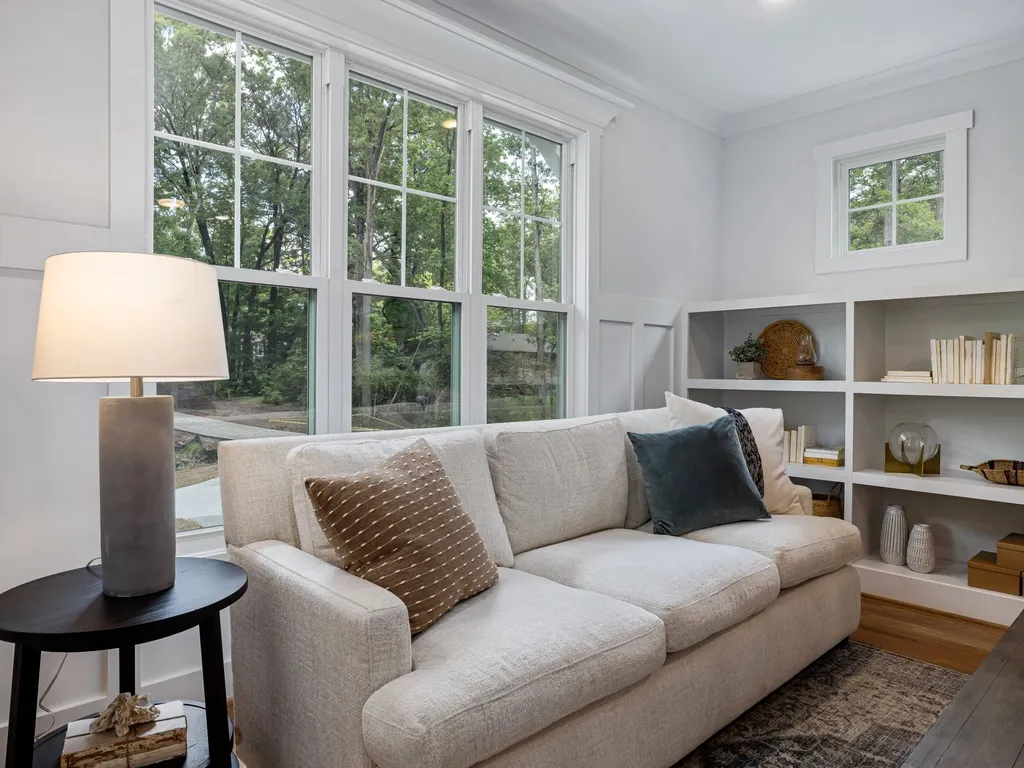
Some rooms ask you to choose a side. Traditional offers comfort, manners and furniture with a memory — but it can tip into formal and fussy. Contemporary offers clean lines and breathing space — but it can feel cold, and a little too pleased with its own restraint. Transitional style exists because most people, standing in their own living room, want neither extreme: they want the welcome of the first and the ease of the second, in the same chair.
Quick answer: The best transitional interior style ideas keep the classic bones — balanced layouts, rolled-arm shapes and rich wood — and calm them with plain fabrics, lighter tones and one quiet pattern. Keep two metals, one deep colour note and mostly clear surfaces, and the room feels settled, not staged.
That is the idea behind the ten moves that follow. Keep the classic bones — the moulding, the balanced layout, the shapes your body already trusts — and strip away everything that makes those bones feel heavy. Fewer carvings, lighter wood, quieter pattern, calmer colour. Work through them in order and the room that emerges is the hardest kind to date: not old, not new, just settled.
In this guide: Transitional Style at a Glance · Start With the Bones: Millwork, Simplified · Furniture: Classic Shapes on a Diet · A Neutral Palette With Real Depth · Let Texture Do the Decorating · Curves and Clean Lines in Balance · Wood Tones: Lighter, and Deliberately Mixed · Metals and Glass: Two Finishes, Kept Quiet · Windows: Plain Panels, Hung High and Wide · Art and Accessories: Fewer, Bigger, Better · The Transitional Bedroom · Frequently Asked Questions About Transitional Interior Style · Conclusion
Transitional Style at a Glance
| Element | The classic half | The modern half |
|---|---|---|
| Millwork | Panel moulding, a real fireplace | Flat profiles, one paint colour |
| Furniture | Wingbacks, rolled arms, camelbacks | Slimmer frames, plain upholstery |
| Colour | Warm, layered neutrals | Fewer of them, quieter contrast |
| Pattern | A place in every room | One subdued geometric, or none |
| Texture | Silk, velvet, polished wood | Bouclé, linen, jute, rattan |
| Wood | Cherry, walnut, mahogany | Lighter tones, deliberately mixed |
| Metal & glass | Brass with presence | Brushed finishes, glass for lightness |
| Windows | Full-length drapery panels | Plain linen, no swags or tiebacks |
| Art & decor | Collected, personal pieces | Fewer of them, larger in scale |
| Bedroom | Upholstered headboard, layered bed | Streamlined shapes, calm palette |
1. Start With the Bones: Millwork, Simplified
 Transitional starts with architecture, not furniture. Panel moulding, a proper fireplace surround, skirting and architraves with real depth — these are the classic bones, and they do more for a room than any single chair. Living Spaces’ guide to transitional style calls it the sweet spot between traditional and contemporary, and the millwork is where that balance gets set: keep the moulding, but simplify its profile.
The adjustment is in the detailing. Flat or single-step panels instead of raised and bevelled ones, a mantel that is a clean block of marble rather than a carved surround, and everything — moulding, walls, ceiling — painted one warm white so the architecture reads as texture, not decoration. In our guide to the types of interior design styles, transitional sits deliberately between traditional and contemporary, and the walls are where you see that negotiation first.
2. Furniture: Classic Shapes on a Diet
 The furniture shapes are the ones you already know — wingbacks, rolled arms, camelbacks, club chairs — sent through a slimming filter. The arms are lower and narrower, the legs are visible instead of skirted, and the upholstery is plain: linen, cotton, a tight-weave wool. Nothing tufted to excess, nothing fringed, nothing that needs a pattern to prove its worth.
The rule is one silhouette per room with a story: a wingback earns its place if it is the reading chair, a camelback if it is the sofa. Everything else stays quiet — a track-arm sofa in plain oatmeal, a bench instead of a second sofa, a pair of simple side chairs. The room reads as classic because the shapes are; it reads as modern because nothing is shouting.
3. A Neutral Palette With Real Depth
 Colour is where transitional earns its reputation for calm. Warm white on the walls, greige or taupe on the big pieces, and one deep accent — forest green, navy, charcoal — used sparingly enough to register as a decision. The depth comes from layering tones of the same family, not from adding more colours: three shades of warm neutral in one room will look richer than a rainbow.
Two disciplines keep it from going flat. First, every neutral must carry warmth — a grey with a brown undertone, a white with a cream base — because cool greys are what make transitional rooms feel like waiting rooms. Second, the accent colour appears in at least three places, so it reads as a thread: the chair, one cushion, the art. Our traditional interior style ideas use deeper colour more freely; here the rule is one note, repeated, then silence.
4. Let Texture Do the Decorating
 When pattern steps back and colour goes quiet, something has to supply the interest — and in transitional rooms it is texture. Bouclé, linen, jute, rattan and smooth pale wood: the contrast between soft and hard, rough and smooth, is what keeps a neutral room from looking flat. A single pattern would argue with the calm; a dozen textures enrich it.
Use the contrast deliberately. Rough against smooth — a nubby throw on a leather chair, a woven basket next to a glass table — and matte against a little shine, the way brushed brass catches light beside flat linen. The rule of thumb: if two surfaces feel the same, one of them is unnecessary. Our layered bedding ideas work the same way in the bedroom, where texture does the job pattern usually claims.
5. Curves and Clean Lines in Balance
 Transitional rooms run on a quiet geometry lesson: every straight line earns a curve somewhere near it. The room is full of rectangles — sofas, tables, built-ins, windows — so the curves do the softening: a camelback sofa, a round coffee table, an arched mirror, a floor lamp that bends over the reading chair.
The balance is the discipline. Too much curve and the room turns soft and formless; too much straight line and it turns into an office. One curved piece per zone is enough — the sofa’s back, the mirror over the mantel, the lamp in the corner — and each curve should answer a straight line nearby. The result is the style’s signature: structured, but never stiff.
6. Wood Tones: Lighter, and Deliberately Mixed
 Traditional wood runs dark and matched — the cherry suite, the mahogany set. Transitional wood runs lighter and deliberately mixed: a pale oak table with walnut chairs, a walnut sideboard against whitewashed oak floors. The mix is the point; a room where every wood matches is a showroom, not a home.
The discipline is two tones, not five. Pick a light wood and a dark one, then let everything else — the floor, the picture frames, the tray on the coffee table — fall into one of those two camps. The Houzz article on transitional style notes that this mix of finishes is the easiest signal that a room is transitional rather than traditional, and it works because it looks collected rather than purchased as a set.
7. Metals and Glass: Two Finishes, Kept Quiet
 Metal is transitional’s jewellery: present, necessary, and kept quiet. Brushed brass on the lamps, matte black on the hardware, a little glass for lightness. Two finishes per room is the rule, three at most, and each one should repeat — the lamp base matches the mirror frame, the drawer pulls match the curtain rod.
Glass does the quiet work of keeping the room light. A glass-topped coffee table, a clear vase, a mirror that bounces the window across the room: these keep a neutral palette from feeling heavy, especially in rooms without much sun. The Houzz piece on transitional style makes the same point about mixing wood and metal finishes to signal the blend, and the mirror is the cheapest way to double your light.
8. Windows: Plain Panels, Hung High and Wide
 Window treatments are where traditional style shows its age fastest: swags, jabots, valances, tasselled tiebacks. Transitional keeps the one part worth keeping — full-length drapery panels, which give a room height and softness — and deletes the rest. The panels are plain linen, unlined or lightly lined, hanging from a rod mounted as high and as wide as the room allows.
The height and width matter more than the fabric. A rod 10 to 15 cm above the frame and 15 to 20 cm wider than it on each side makes the window look bigger and the ceiling taller — and it keeps the panels clear of the glass when they are open. If you want pattern, this is where to use it: one quiet geometric or a soft stripe, never both, and never anything that shouts. Our modern organic style ideas lean even lighter on window treatments; transitional keeps the panels because the classic bones need them.
9. Art and Accessories: Fewer, Bigger, Better
 Transitional decorating is an editing exercise. The classic impulse is to fill the mantel, the shelves, the sideboard; the transitional impulse is to choose three things and give them room. One large framed abstract in warm neutrals over the mantel. A ceramic vase and a stack of books on the sideboard. A single sculptural object on the coffee table. Nothing small, nothing fussy, nothing that needs explaining.
Scale is the secret: fewer pieces, each larger than you think. A painting that is too small looks apologetic; one that spans two-thirds of the mantel width looks intentional. The same applies to the shelves: one large vase beats five small objects, and empty space between pieces is what makes each one read. If the room feels bare after editing, add texture — a throw, a basket — not another object.
10. The Transitional Bedroom
 The bedroom is where the blend relaxes most. The upholstered headboard stays, but the shape streamlines — a tall rectangle, no wings, no buttons. The bed is layered — a coverlet, a folded throw, two sleeping pillows and two in front — but the palette stays calm and the pattern, if any, is one quiet geometric on the throw.
Keep the nightstands simple and matched, the lamps identical, and the art above the bed large and quiet. A bench at the foot of the bed, if the room allows, is the one classic gesture worth keeping; it gives the room its symmetry and somewhere to sit. The result is a bedroom that feels finished rather than decorated, and that is exactly the point.
Frequently Asked Questions About Transitional Interior Style
What is transitional interior style?
It is a deliberate blend of traditional and contemporary design: classic shapes and symmetry, modern lines and a lighter hand. Think of it as traditional style with the fuss removed, or contemporary style with the warmth put back.
How is transitional different from eclectic?
No. Eclectic mixing draws from many styles at once and celebrates contrast; transitional draws from exactly two — traditional and contemporary — and aims for calm. The result looks collected, not curated chaos.
What colours work best in a transitional room?
Warm neutrals layered tone on tone — cream, greige, taupe, soft white — with one deep accent used sparingly. Keep the contrast quiet: the depth comes from layering, not from bright colour.
Can I mix traditional furniture into a modern home?
Edit before you buy. Remove the swags, the fringing, the heavy carving — then one classic piece per room, like a wingback or a camelback sofa, will sit happily beside clean modern lines.
Does transitional style work in small rooms?
Very well. The light palette, the plain fabrics and the clear surfaces make small rooms feel bigger, and the classic shapes keep them from feeling bare. Choose slimmer furniture and keep the art large but few.
What furniture shapes suit transitional style?
Updated classics: the slimmed wingback, the track-arm sofa, the camelback with lower arms, the simple bench. The test is whether the shape would look right in a traditional room — and whether it would survive a modern one.
Should I avoid pattern in a transitional room?
Not avoided — rationed. One subdued pattern per room, usually a geometric or a soft stripe, and only where it repeats: the cushions and the curtains, or the rug and the throw.
Which wood tones are best for transitional interiors?
Lighter and mid tones — whitewashed oak, pale ash, warm walnut — mixed deliberately. Two tones per room is the discipline; a third, if it appears, should be the floor.
Can I mix metals in transitional style?
Yes, within limits: two finishes, three at most, and each one repeated at least twice in the room so the mix looks deliberate rather than accidental.
Does transitional style go out of date?
It is one of the slowest styles to date, because it avoids both period detail and fashion detail. Update it with textiles and art, not furniture.
Conclusion
Transitional style is not a compromise; it is a decision. Keep the classic bones, simplify the details, and let texture, light and proportion do the talking. The rooms that last are the ones that feel settled on the day you finish them — and still feel settled in ten years.
What a transitional room costs
A transitional refresh is cheaper than a full redesign because the classic bones stay. The big spend is the sofa and the lighting; paint, textiles and art are where the style shows for relatively little. The table below uses typical UK high-street and mid-range prices — a designer room will cost more, a second-hand room less.
| Item | Typical cost | What changes the price |
|---|---|---|
| Track-arm sofa, 84 inches, plain fabric | $1,000 to $3,000 | Frame, springs and fabric grade |
| Wingback or accent chair | $500 to $1,500 | Frame and upholstery quality |
| Pair of full-length linen panels | $150 to $500 | Fabric weight and lining |
| Rug, 8 by 10 feet, low pattern | $400 to $1,500 | Wool versus synthetic |
| Round coffee table, pale oak | $250 to $900 | Solid wood versus veneer |
| Brushed brass floor lamp | $150 to $600 | Finish and shade quality |
| Large framed abstract, 40 by 60 inches | $200 to $1,000 | Original versus print |
| Two matching table lamps | $150 to $500 | Base material and shade |
| Paint, warm white, one room | $100 to $250 | Paint brand and coats needed |
| Layered bedding set, queen | $200 to $600 | Fabric and thread count |
Start with the sofa and the panels; those two set the tone. Add the rug and the lamps next, then the art. Buying in that order means every purchase sits in a room that already works, instead of a pile of pieces waiting for a plan.
Sizes that keep the blend in balance
Measure before you shop. A transitional room depends on proportion: the sofa should span about two-thirds of the wall it sits on, the rug should extend at least 15 cm beyond the sofa on each side, and the coffee table should sit 35 to 45 cm from the sofa edge. Curtain panels need a rod 10 to 15 cm above the frame and 15 to 20 cm wider on each side; hang the art so its centre sits 145 to 150 cm from the floor. These numbers are the difference between a room that looks calm and one that looks slightly wrong without anyone knowing why.
How to build the look in order
Start by editing, not buying. Remove the swags, the fringing, the heavy carving and the extra objects, then paint the millwork and walls one warm white. Next, place the furniture — the sofa on the longest wall, the chairs angled toward it — and lay the rug so the front legs of every seat sit on it. Then hang the panels, add the lamps and the art, and finish with texture: the throw, the basket, the books. Do it in that order and each step is easy to judge; buy everything at once and the room arrives as a pile.
More questions about transitional style
How much does a transitional room refresh cost?
A paint, curtain and rug refresh costs $800 to $2,500. A full room with a new sofa and lighting runs $3,000 to $8,000.
What should I remove first in a traditional room?
Remove the fussy extras first: swags, valances, tasselled tiebacks, fringed throws and heavy carving. Keep the bones — the moulding, the fireplace, the balanced layout.
Can I mix transitional style with modern organic?
Yes, if you limit it to one or two pieces — a jute rug or a rattan chair — and keep the palette warm. Too many natural textures tips the room toward rustic.