
A permanent desk charges rent every hour of the day — six to twelve square feet of floor, claimed whether you are working, sleeping or eating dinner in the same room. A fold-away work zone pays only for the hours it is open. The surface drops down in the morning, the chair comes off its hook, and at day’s end the whole office folds, slides or swings shut until the room is a room again.
Quick answer: Fold-away work zone ideas use one trick: a desk that disappears when the day ends — a drop-leaf panel on the wall, a secretary’s drop front, a closet office behind doors, a fold-down kitchen table, or a rolling cart. Add a folding chair, one power cable and a 28–30 inch desk height, close it down in sixty seconds.
This article is the mechanism catalogue: the hinges, drop fronts, doors and wheels that make a work zone disappear, room by room. Ten ideas, in decision order — wall mechanisms first, then the closet and kitchen, the support acts (chair, cables, measurements), and the ritual that closes it all down.
In this guide: The Fold-Away Mechanisms at a Glance · The Drop-Leaf Wall Desk: The Original Disappearing Act · The Secretary Desk: The Office That Looks Like Furniture · The Cloffice: A Whole Office Behind the Closet Doors · The Kitchen Fold-Down Table: Breakfast Down, Deadline Down · The Rolling Cart Desk: For Rooms That Cannot Commit · Folding Chairs: The Seat Half of the Vanishing Act · The Power-and-Cable Kit That Folds With the Desk · The Ergonomic Numbers: Making a Folding Desk Comfy · The 60-Second Close-Down Ritual · Wall Damage, Rentals and Buying for Two Homes · Frequently Asked Questions · Conclusion
The Fold-Away Mechanisms at a Glance
| Mechanism | Open footprint | Closed depth | Best room |
|---|---|---|---|
| Drop-leaf wall desk | Desk surface only, no legs | 2–4 in from the wall | Living room, hallway, bedroom |
| Secretary desk | About 3 × 1.5 ft of floor | Its own cabinet footprint | Living room, guest room |
| Cloffice | The closet interior | Zero — behind the doors | Any room with a spare closet |
| Kitchen fold-down table | Table + two stools | Flat to the kitchen wall | Kitchen, breakfast nook |
| Rolling cart desk | Wherever it parks open | Inside a cupboard or closet | Studio, shared rooms |
1. The Drop-Leaf Wall Desk: The Original Disappearing Act

The drop-leaf desk is the purest fold-away mechanism there is: a desktop on a piano hinge or a pair of folding brackets, screwed to the wall. Open, it is a real work surface — 24 inches deep is the minimum for laptop and notebook side by side. Closed, it projects two to four inches and reads as a shallow panel. No legs means nothing to store, nothing to trip over, and the floor stays vacuumable.
Installation decides everything, and it is a heights-and-fixings problem before it is a shopping one. The desktop should land at standard desk height — 28–30 inches (§8) — and the brackets must fix into studs, not drywall alone: a leaning forearm puts serious leverage on a hinge. It is the same wall discipline as the mounting heights in our vertical storage styling ideas — measure first, anchor into structure, and the wall does the work.
2. The Secretary Desk: The Office That Looks Like Furniture

The secretary desk hides the whole office inside a cabinet. Its slanted drop front folds down into a writing surface; behind it sit pigeonholes and small drawers that swallow the chargers, notebooks and paperwork a workday scatters. Fold the front up and the room sees a handsome cabinet — the mess is not tidied, it is enclosed, which for most of us is the more achievable standard.
It is also the proudest member of the double-duty family in our multifunctional furniture ideas: a desk by day, living-room furniture by night, earning its three square feet twice. Buy for the closed size first, and check the open geometry: the surface should sit near 29 inches high, with headroom for the laptop under the shelf.
3. The Cloffice: A Whole Office Behind the Closet Doors
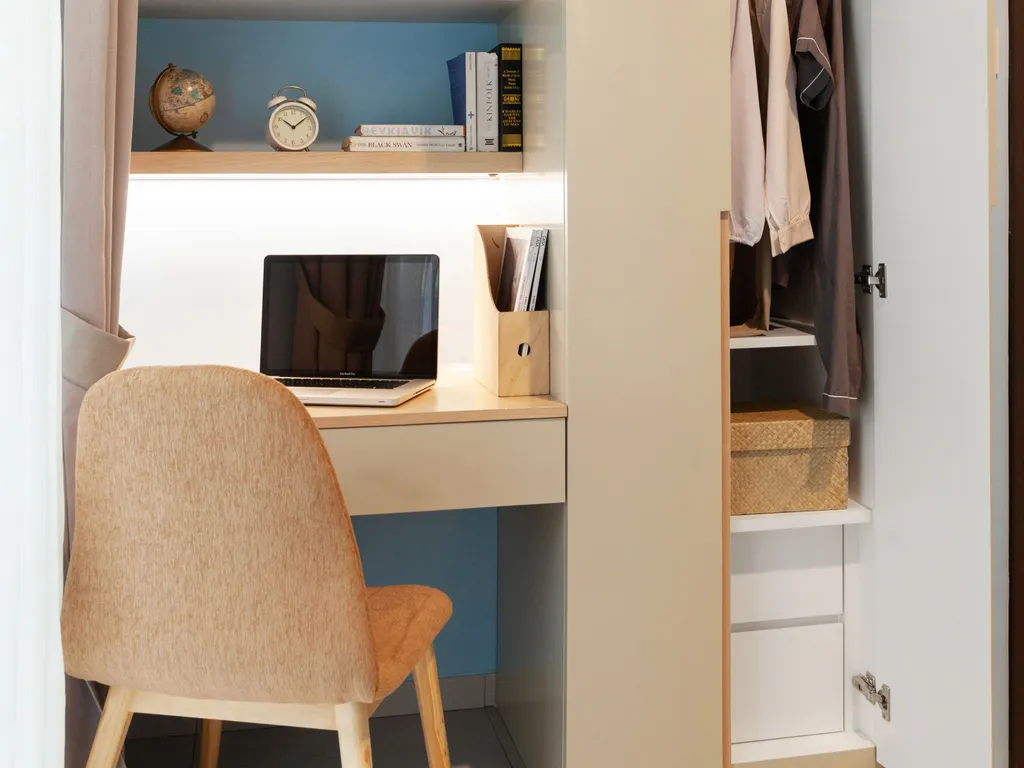
The closet office — the cloffice — is the fold-away idea at room scale. A desktop cut wall-to-wall on cleats, shelves above it, a chair that tucks fully inside, and the doors do the disappearing: close them and the office ceases to exist. A desktop depth of 24–30 inches is ideal; standard reach-in closets are about 24 inches deep, which still works for laptop work.
The conversion checklist is well established — Living Spaces’ cloffice guide recommends a desk surface fitted to the closet, shelves that maximise the vertical space, task lighting, planned power, and a light palette so the small volume feels airy. In a guest room the conversion is doubly kind: our guest bedroom setup ideas argue the room should earn its keep between visitors, and a cloffice is exactly that — an office 350 days a year, a guest room when it matters.
4. The Kitchen Fold-Down Table: Breakfast Down, Deadline Down

The kitchen already owns the best light, the coffee and — for laptop work between meals — a table height the body accepts (counter height, 36 inches, is a stretch; table height, 30, is not). A fold-down kitchen table earns both shifts: lowered for breakfast, cleared and lowered again — or raised and worked at — for the morning’s deadlines, then flat to the wall by lunch.
The kitchen version of the mechanism adds two rules. Seating must fold too, or the stools become the permanent footprint the table just saved. And the folded panel’s underside faces the room all day, so finish it like furniture — painted, panelled or papered — rather than leaving raw board and brackets on show.
5. The Rolling Cart Desk: For Rooms That Cannot Commit
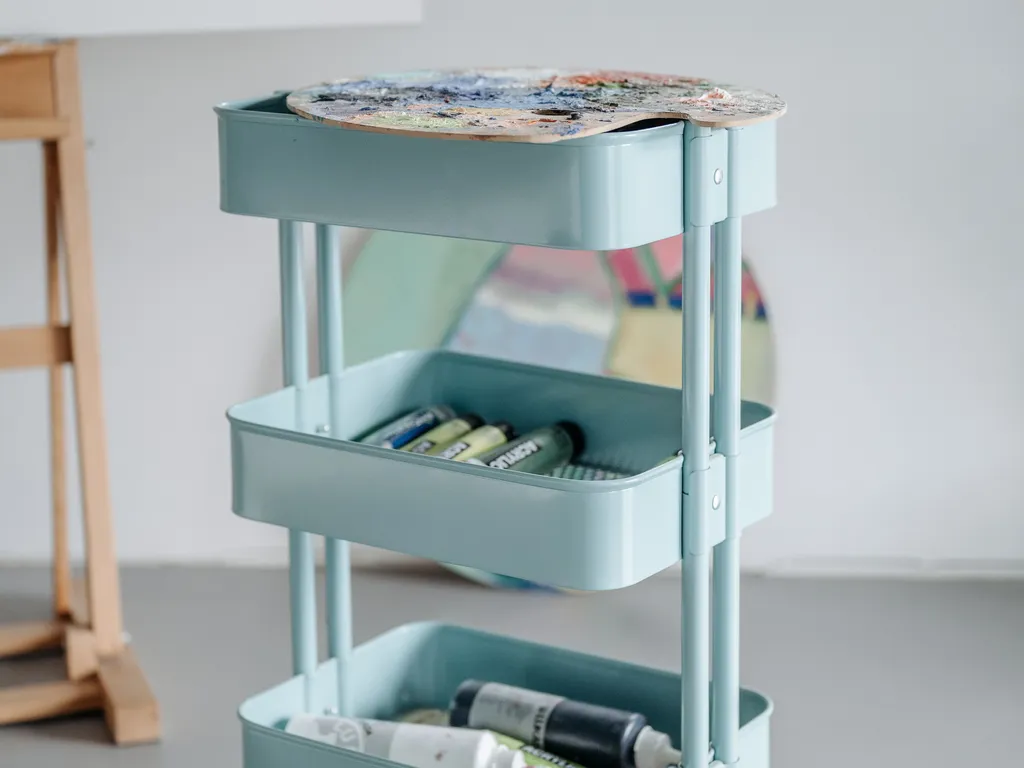
When nothing may be fixed to a wall and no closet is spare, put the office on wheels. The spec is strict: a top tier at laptop height or a laptop tray that clamps to it, casters that roll on your actual floor, and a parked footprint measured before purchase — a cupboard interior, a closet, the gap beside the refrigerator.
The cart’s real advantage is social: it works in whichever room is free today — the quiet bedroom during a call, the living room after — and parks out of sight at night. A permanent desk cannot follow the quiet around a shared home. A cart can.
6. Folding Chairs: The Seat Half of the Vanishing Act
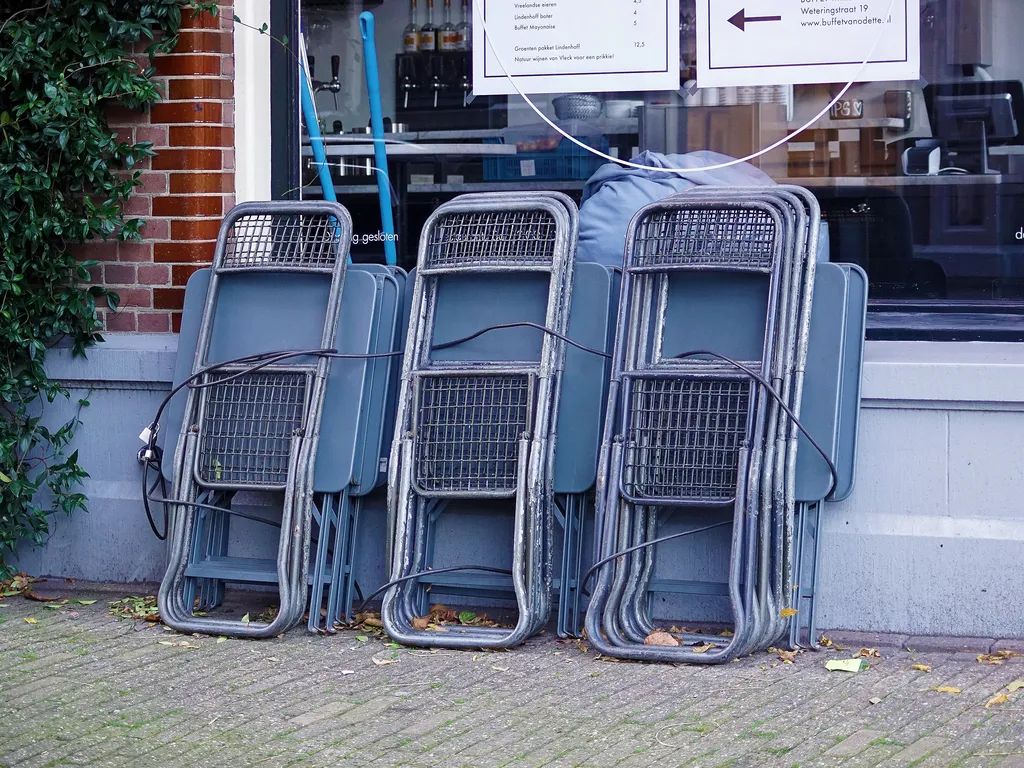
Every folding desk secretly needs a folding chair, and a chair stored in another room is a daily friction that quietly kills the ritual. The closed loop is a chair that stores in the same sightline as the desk: hung on two hooks beside the closed panel, or slim enough — under four inches folded — to slide behind a sofa or into the gap the desk itself vacates.
Comfort is where cheap folding chairs fail, in a specific way: no lumbar support and a seat height that ignores the desk. Seat height should land at 17–19 inches so feet rest flat and elbows meet the §8 numbers — and if you plan three-hour stretches, a folding chair with a padded seat is worth its hook.
7. The Power-and-Cable Kit That Folds With the Desk

Cables are where fold-away desks die. A charger that must be fetched, plugged and unplugged twice a day turns a ten-second fold into a five-minute chore, and chores get skipped. So the power lives on the desk: a power strip screwed to the underside, one cable dropping to the wall socket, and a cable tray or velcro bundle for the charger brick and its lead.
Then the daily circuit is three moves: open the desk, plug ONE cable into the wall, open the laptop. Closing reverses it — one plug pulled, everything else rides with the fold. If your setup needs a monitor, the honest answer is a laptop-height arm fixed to the desk panel itself, or accepting the monitor as the one permanent object; half-fixed monitors are the worst of both.
8. The Ergonomic Numbers: Making a Folding Desk Comfy

A folding desk lives or dies by three numbers, and they are worth measuring before anything is ordered. Set them once and the fold is comfortable for years; get them wrong and the prettiest mechanism becomes a perch you avoid.
- Desk height 28–30 in. Elbows at roughly 90° with shoulders relaxed — Contour Design’s workstation example sets the classic test: forearms parallel to the floor, wrists flat.
- Screen top at or slightly below eye level. On a fold-away setup this means a laptop stand or a riser that lives in the secretary’s pigeonholes or the cloffice shelf — not a book fetched daily.
- Knee clearance under the surface. Brackets and trays sit at the edges, not the middle — test the open desk with your actual chair tucked in before final tightening.
9. The 60-Second Close-Down Ritual

The mechanism is only half the idea; the ritual is the other half. Sixty seconds, the same order every evening: laptop closed and into its slot, notebook on top, the one cable unplugged, chair folded and hung, desk folded shut, cushion back on the sofa. Done in a fixed sequence it stops being tidying and becomes a closing door between work and home — the benefit remote workers say they miss most from an office.
In a studio, that ritual is also a zoning tool: our studio apartment zoning ideas use the same floor for several lives across the day, and folding the desk away is the clearest end-of-shift signal a single room can give.
10. Wall Damage, Rentals and Buying for Two Homes

Picture the closed desk after a year of renting: two bracket holes per side, honestly filled in twenty minutes with filler and a dab of paint — cheap and reversible, and usually unremarkable in a deposit conversation. The damage fear belongs to the install day, not the exit day: drill into studs and there is nothing to tear out.
If screws are truly off the table, the hierarchy is: secretary desk (freestanding, zero holes), rolling cart (zero holes), cloffice built on cleats inside the closet (holes nobody sees). And buy for the next home as well as this one — a desk panel of standard width, a chair that folds under four inches and a cart that fits a standard cupboard will all move house with you.
Frequently Asked Questions
What is a fold-away work zone?
A work area built on a disappearing mechanism — a drop-leaf or folding desk, a secretary’s drop front, closet doors, or wheels — so the office occupies floor space only while it is in use and the room returns to its other life when the workday ends.
How much wall space does a drop-leaf desk need when closed?
Very little: closed, a drop-leaf desk projects about 2–4 inches from the wall and takes no floor space at all. Open, you need the desktop depth — 24 inches is the practical minimum — plus chair space behind it.
What height should a folding desk be?
28–30 inches, the standard desk height, so elbows rest at about 90 degrees with shoulders down. Chair seat height of 17–19 inches pairs with it. Fixed mechanisms make these numbers permanent, so measure before drilling.
Can a cloffice work in a shallow closet?
Yes, with compromises: standard reach-in closets are about 24 inches deep, enough for a laptop desktop on cleats, provided the chair tucks fully inside so the doors still close. Deeper closets allow a monitor and more storage.
Do folding desks wobble?
Only the badly fixed ones. Brackets into studs, a hinge rated for the load, and brackets kept out of the knee zone give a surface as stable as a freestanding desk; drywall-only fixings are the wobble — and the eventual failure.
What do I do with the chair?
Fold it and store it in the same sightline as the desk — on hooks beside the closed panel, behind the sofa or inside the cloffice — so opening and closing the zone is one trip, not two rooms.
How do I handle cables on a folding desk?
Mount the power on the desk itself: a strip on the underside and a tray for the charger, with a single cable to the wall socket. The daily routine becomes one plug in, one plug out.
Is a fold-away desk renter-friendly?
The freestanding options — secretary desk and rolling cart — involve no holes at all. Wall mechanisms leave a few screw holes that fill in minutes; the truly visible fixings inside a closet rarely raise a deposit question.
Can two people share one fold-away work zone?
Yes, if the mechanism resets to neutral between users: a height both can use, per-person storage (a pigeonhole, a shelf box each) and the close-down ritual leaving the surface clear. The cart version even lets each person work in a different room.
What is the smallest room that can hold a work zone?
Any room with 24 inches of spare wall and a chair’s depth of floor in front of it can hold a drop-leaf zone. The mechanism catalog in this article needs no dedicated room at all — that is rather the point.
Conclusion
A fold-away work zone is not a smaller office; it is an office with office hours. Pick the mechanism your room allows — the four-inch drop-leaf, the secretary’s handsome lie, the cloffice behind its doors, the cart that follows the quiet — give it a folding chair, one plug and the right heights, and close it down in sixty seconds a day. The room you get back every evening is the entire argument.