
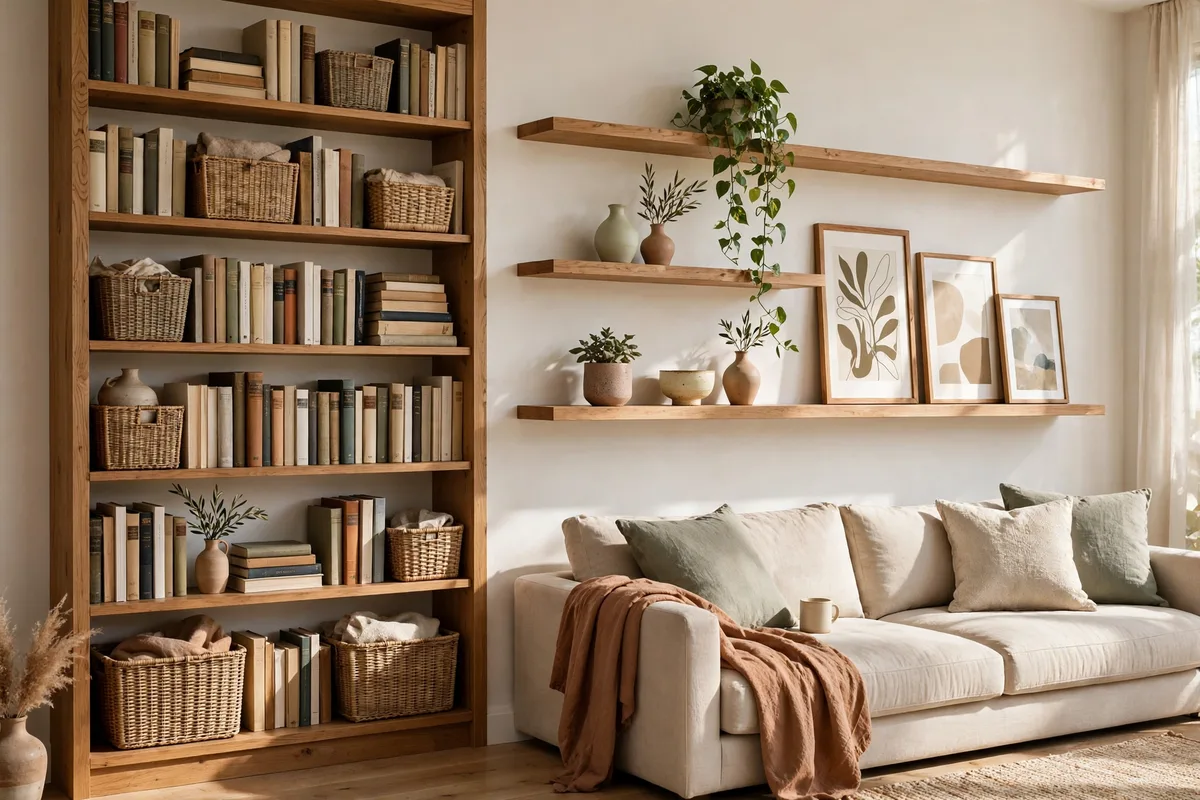
Every room has a second room hiding above it. Above the furniture sits a band of wall most homes use for exactly one picture — while the floor below carries another bookcase and another homeless box. Vertical storage is the decision to use that band: shelves, rails, tall cases and door backs organised by one system, so the wall stores like furniture while still reading as decoration.
The system has three parts: a height map, the right hardware for each wall, and a styling discipline strict enough that storage never looks like storage. Ten ideas, in that order.
The Vertical Height Map at a Glance
| Height zone | What lives there | Why |
|---|---|---|
| Eye level (about 4–6 ft) | Daily items: dishes, current books, toiletries | No stretching and no stool — the daily band |
| Stretch zone (6–7 ft) | Weekly items: serving pieces, spare towels, games | A stretch is acceptable once a week |
| Above 7 ft | Seasonal and archival: luggage, decorations, documents | Light and rarely needed — step-stool territory |
| Top shelf near the ceiling | Display only: plants, ceramics, art | Seen daily and touched rarely |
| Floor to knee height | Heavy and bulky: baskets, shoes, storage boxes | Weight kept low keeps tall storage stable |
1. The Height Map: Reach Decides Membership
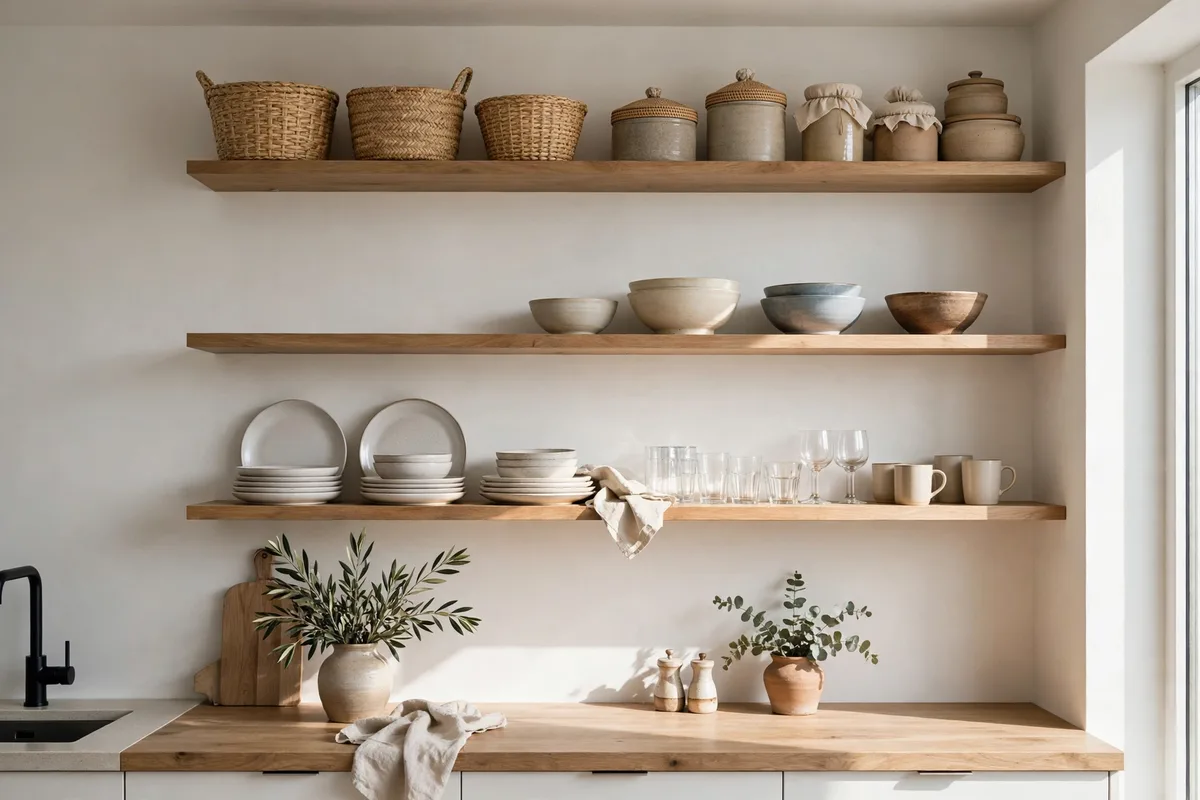
Before any hardware is bought, map the wall into bands and let reach assign the contents. The daily band runs from about knee height to eye level: everything used every day lives there, grabbable without stretching or a stool. Above it, the weekly band — a comfortable stretch — takes serving pieces, spare linen and Friday-night games. Above seven feet, only the light and the rare. NestTidy’s vertical space guide makes the same division and adds the styling corollary: resist filling the whole wall, because blank space keeps a small room calm.
The map is self-enforcing. An item that migrates down from the top band twice in a month is confessing it is a daily item in a seasonal costume — promote it, and demote something quieter. Height discipline fails only when membership is negotiated item by item; the bands make it a rule instead of a mood.
2. Tall Bookcases: The Anchor Piece
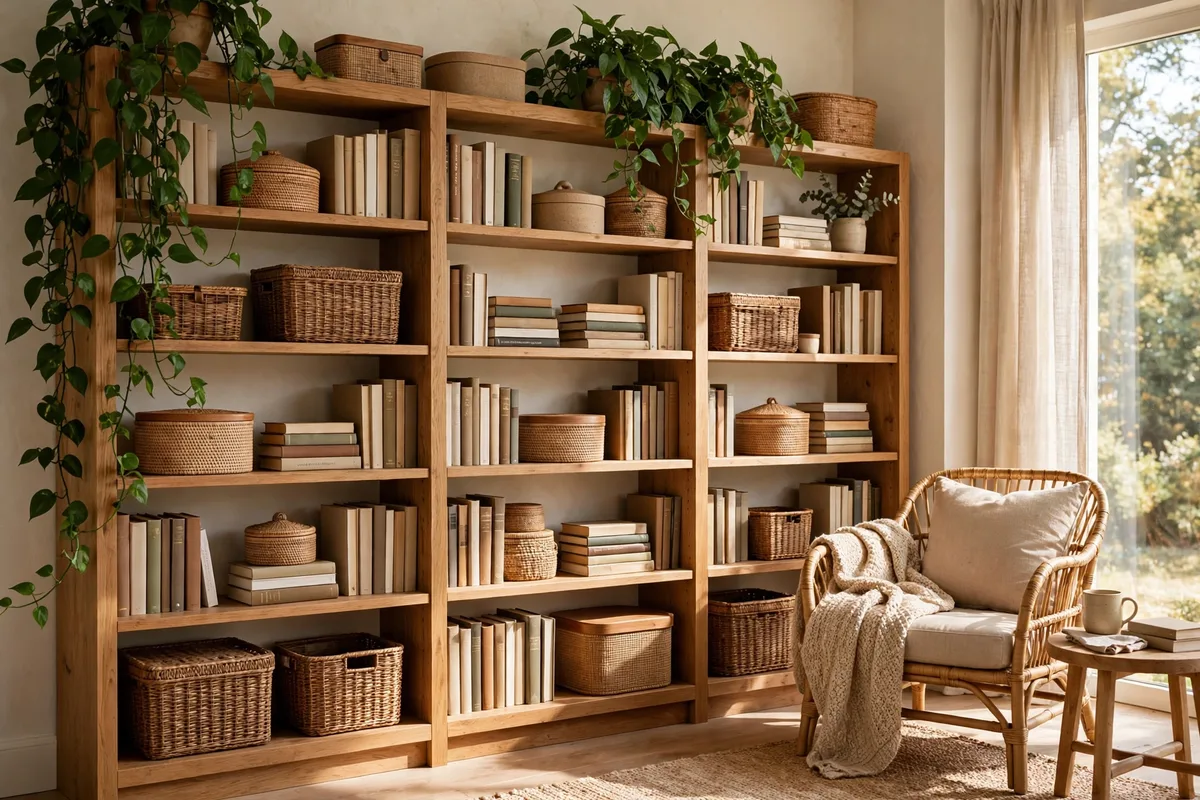
The tall bookcase is the system’s anchor piece — the element that goes floor to ceiling and turns a wall into architecture. Choose the tallest case the room accepts (one that stops a foot short reads as furniture; one that nearly touches reads as built-in) and style it by the bare-third rule: on every shelf, about a third of the run stays empty or holds one low stack, so books, baskets and boxes read as groups, not inventory. Heavy storage low, books mid-height, plants and ceramics on top.
A tall case earns a second job in open-plan rooms: placed perpendicular, it becomes the wall that divides living from dining — the structural move at the heart of our studio apartment zoning ideas, where a bookcase zones a single room without closing it. Whichever job it does, it is anchored to the wall (§9) before it is styled: tall, narrow and loaded must never stand free.
3. Wall Rails and Peg Rails: Storage at Hand Height
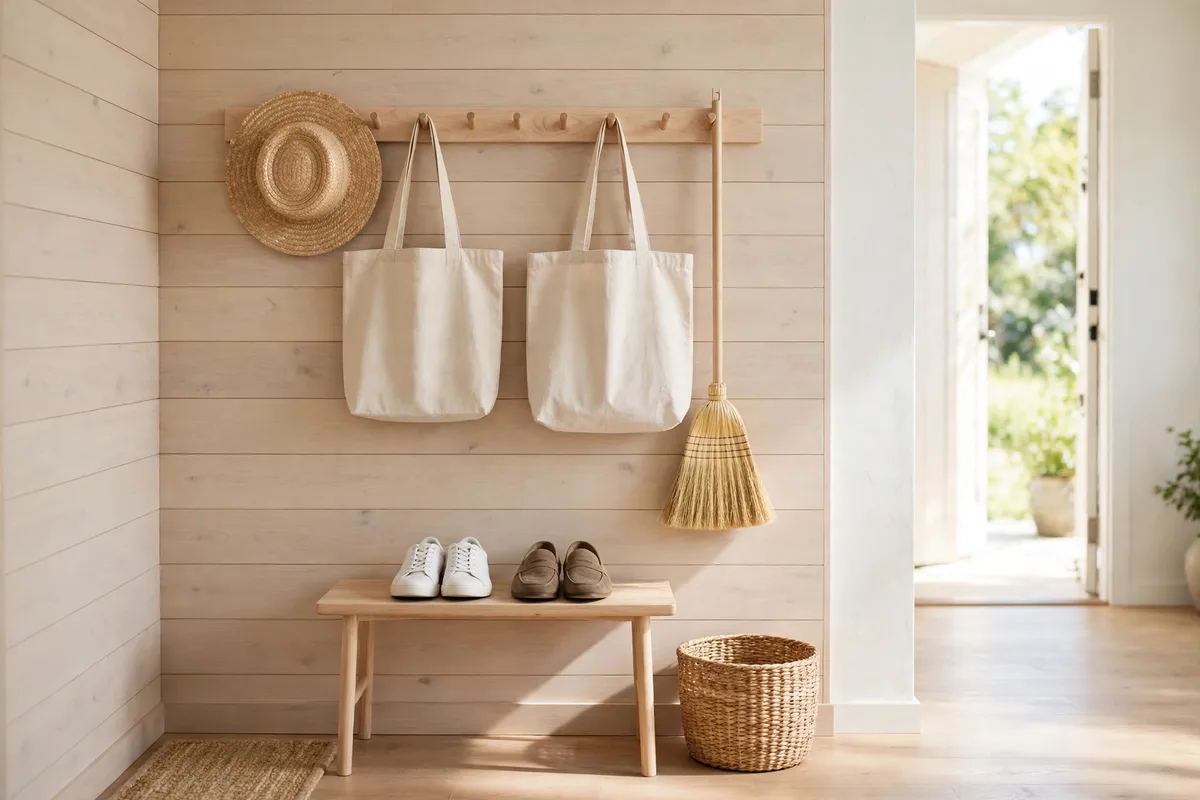
Not all vertical storage is shelving. The rail — a bar or pegged board at hand height — stores what shelves handle worst: hats, bags, the broom, the lead, the keys that colonise every flat surface. A Shaker-style peg rail in the entryway is the classic: pegs at regular intervals, each with an assigned tenant, and a bench beneath — a station that swallows the arriving-home routine in one square metre of wall.
Rails work because they match how the items want to live — hanging, visible, grabbed on the move — and because their styling is built in: a row of similar objects on pegs is a composition all by itself. Keep to the household’s real palette (straw hat, canvas tote, wooden broom all agree), leave every third peg empty, and the rail reads as a feature. Fill every peg and it reads as a jumble sale with better joinery.
4. Over-Door Storage That Earns Its Place
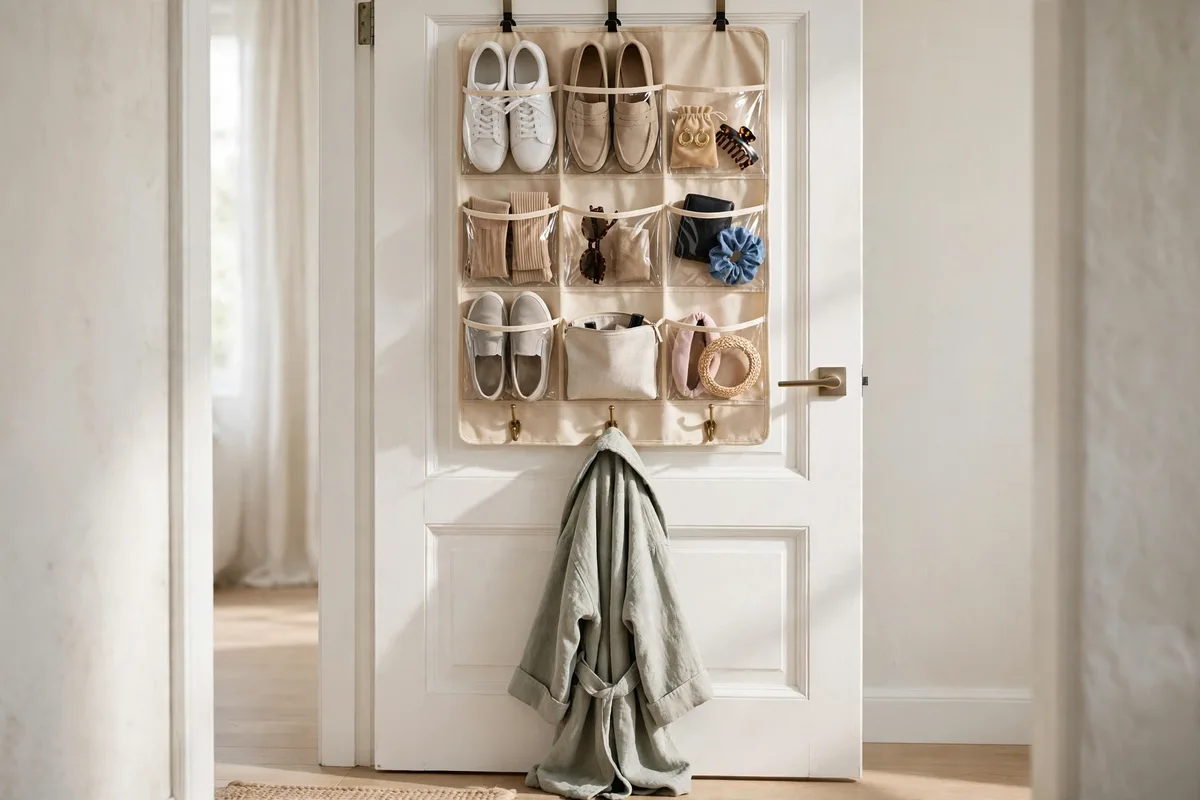
Every door has two faces, and the back one is storage nobody had to build. Over-door systems earn their bad reputation honestly — the sagging dorm version is ugly — but the contents are the problem, not the category. A canvas or rigid organizer in a calm colour, holding one category only (shoes, or accessories, or cleaning supplies) with every pocket filled to the same visual weight, looks as deliberate as any shelf. The door becomes a shallow closet.
The checks are mechanical: the door must still close fully, hardware must not rattle or mark the frame, and loads stay light and soft — doors are moving parts, and heavy loads swing and strain hinges. One category per door: towels on the bathroom door, shoes on the bedroom door, wraps and spices on the pantry door.
5. Floating Shelves: The Room-by-Room Layer

Floating shelves are the system’s most flexible layer — no uprights, no footprint, mountable above sofas, desks and doors. Their styling rule governs every shelf in this series: groups with gaps. A stack of books, a vase, a small plant, then empty wall — the rhythm that makes a shelf read as display even when the groups are pure storage. Stagger them or run them level, but keep spacing generous; shelves edge-to-edge are a bookcase that lost its frame.
In the kitchen this layer has its own discipline — daily dishes low, grease-honest placement, the workflow zones of our open shelving styling ideas — and the same height map applies unchanged. Elsewhere they carry the middle bands — weekly items and the display tier — fixed into studs or with brackets rated for the load: a floating shelf is only as honest as its bracket (§9).
6. Ladder Shelves: Furniture That Leans In
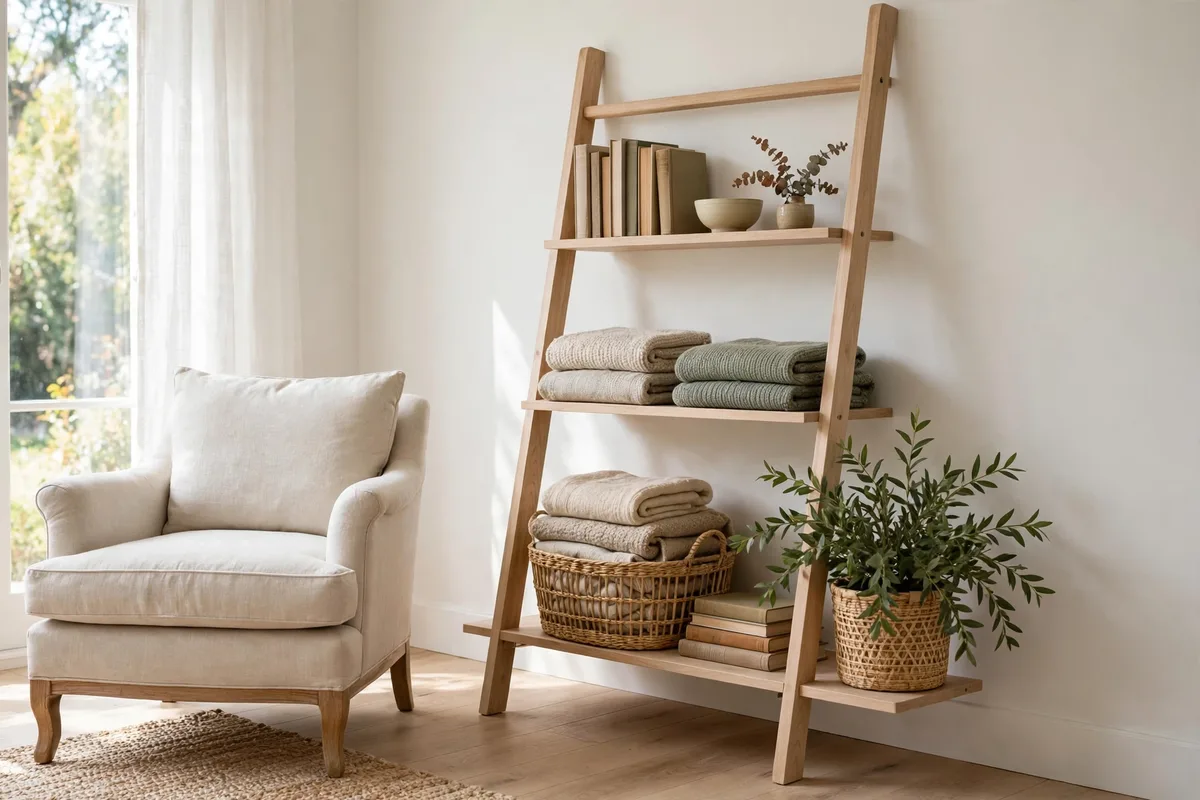
The ladder shelf is the renter’s vertical storage: it leans, so it asks for no holes beyond one safety fixing, and its shelves graduate, deep below and shallow above — the height map expressed as furniture. The deep low shelves take baskets, folded throws and big books; the shallow top shelf takes only the light and decorative — the geometry enforces the rule for you.
It is also a proud member of the double-duty family in our multifunctional furniture ideas — storage that is simultaneously the room’s sculpture, movable in an afternoon, equally at home as towel tower, hallway library or bedroom display. Style it bottom-heavy: weight low is both its stability strategy and its visual one, the planted base making the narrow top look intentional rather than precarious.
7. Kitchen Vertical: Rails, Strips and the Working Wall
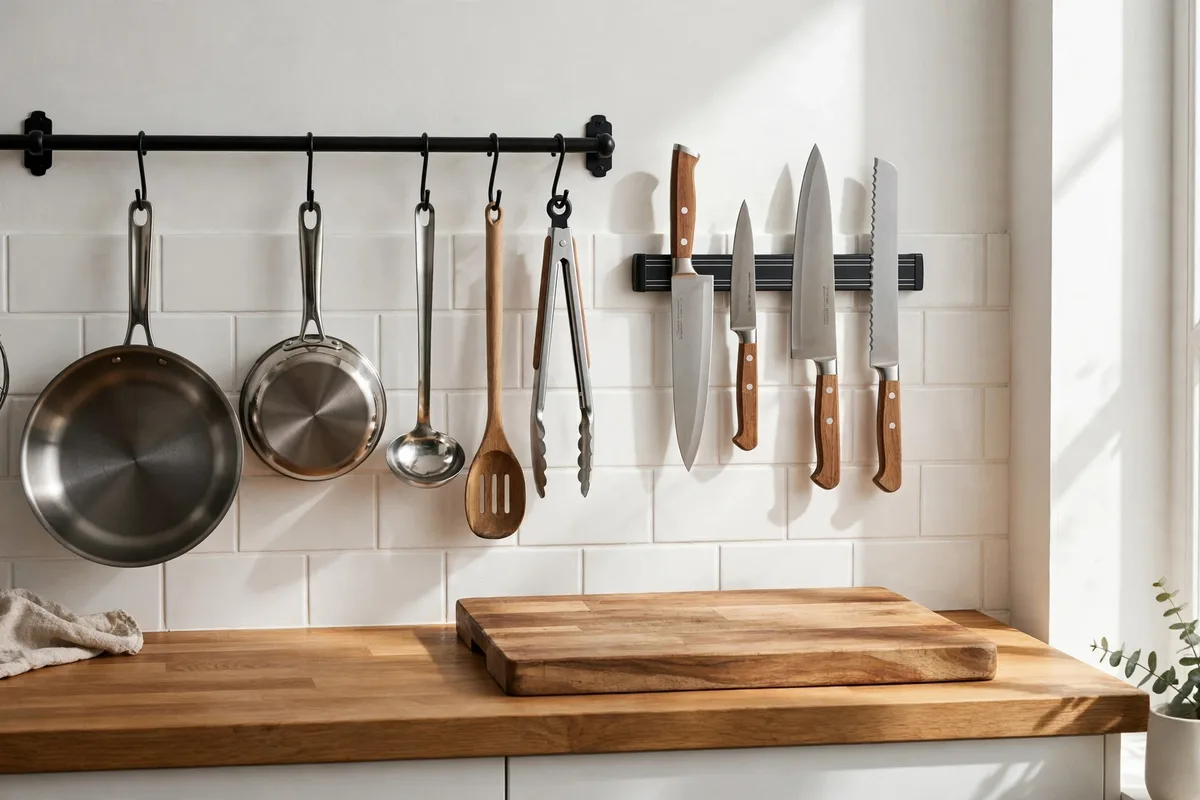
The kitchen proves the principle at its most practical: the wall between counter and cabinets is storage most kitchens leave as bare tile. A rail with S-hooks turns it into the working wall — pans, ladles, tongs and scissors hanging in the order they are used, freed from the drawers that used to jam. A magnetic strip does the same for knives, returning a whole drawer and putting every blade in view. Both mount in an hour and repay their wall many times over.
The kitchen’s rules are placement rules. Rails live within reach of stove and sink but out of the splash and steam arcs where possible; the strip mounts where no hand slides blindly and never above a walkway. Keep the hanging set tight — weekly tools, one finish family — and the wall reads as a chef’s station. Hang everything you own and it reads as a yard sale in a wind.
8. Bathroom Vertical: Up, Over and Tall
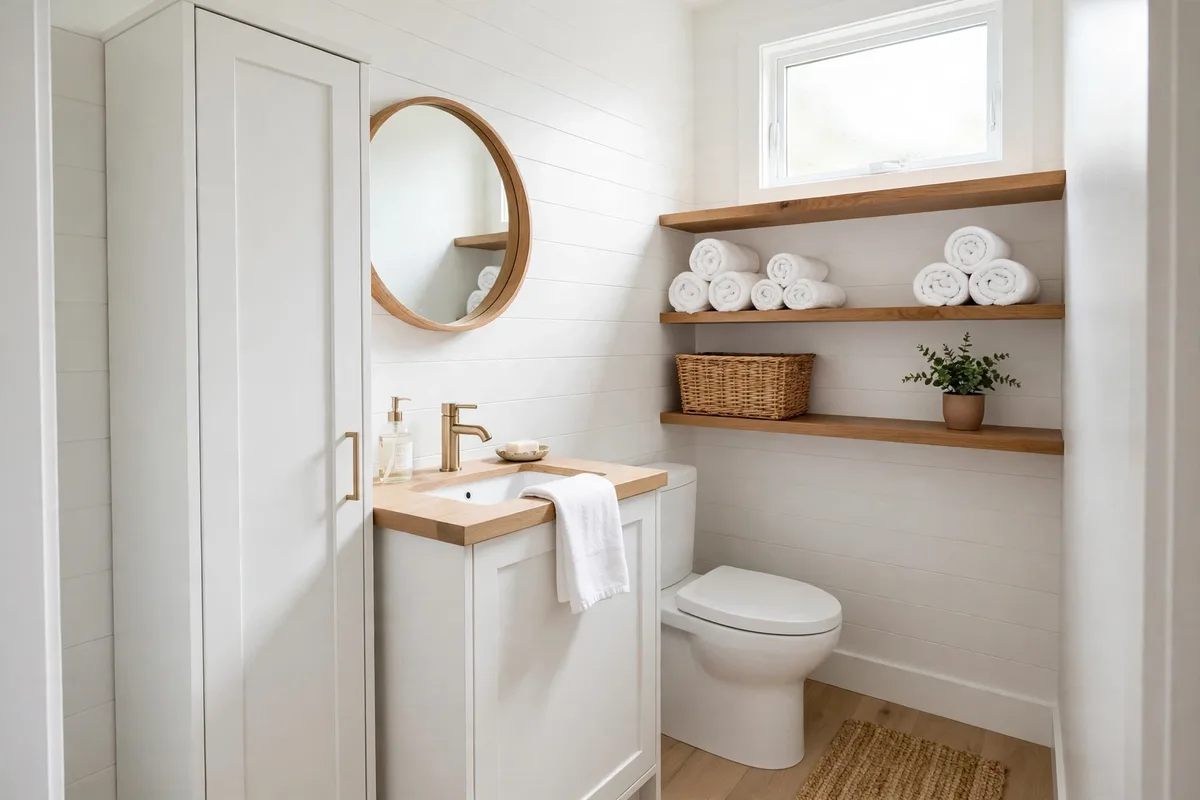
The bathroom is the smallest room with the most to store, and its floor gives up first — which is why its vertical band matters most. The wall above the toilet is the classic found space: two or three shelves there hold the towel stock and the basket of spares that otherwise live on the floor. Beside the sink, a tall narrow cabinet — twelve to fifteen inches wide, ceiling-aspiring — swallows linen and cleaning bottles in a footprint smaller than a bath mat.
The styling arithmetic from our bathroom shelf styling ideas applies in full: groups of three, a third left bare, towels rolled so their ends make the pattern. Bathroom vertical adds one law — humidity edits membership. What lives high must shrug off damp: towels, sealed containers, the plant that likes it. Paper and rust-prone things belong behind the tall cabinet’s door.
9. Anchor Everything Tall: Studs, Straps and Loads
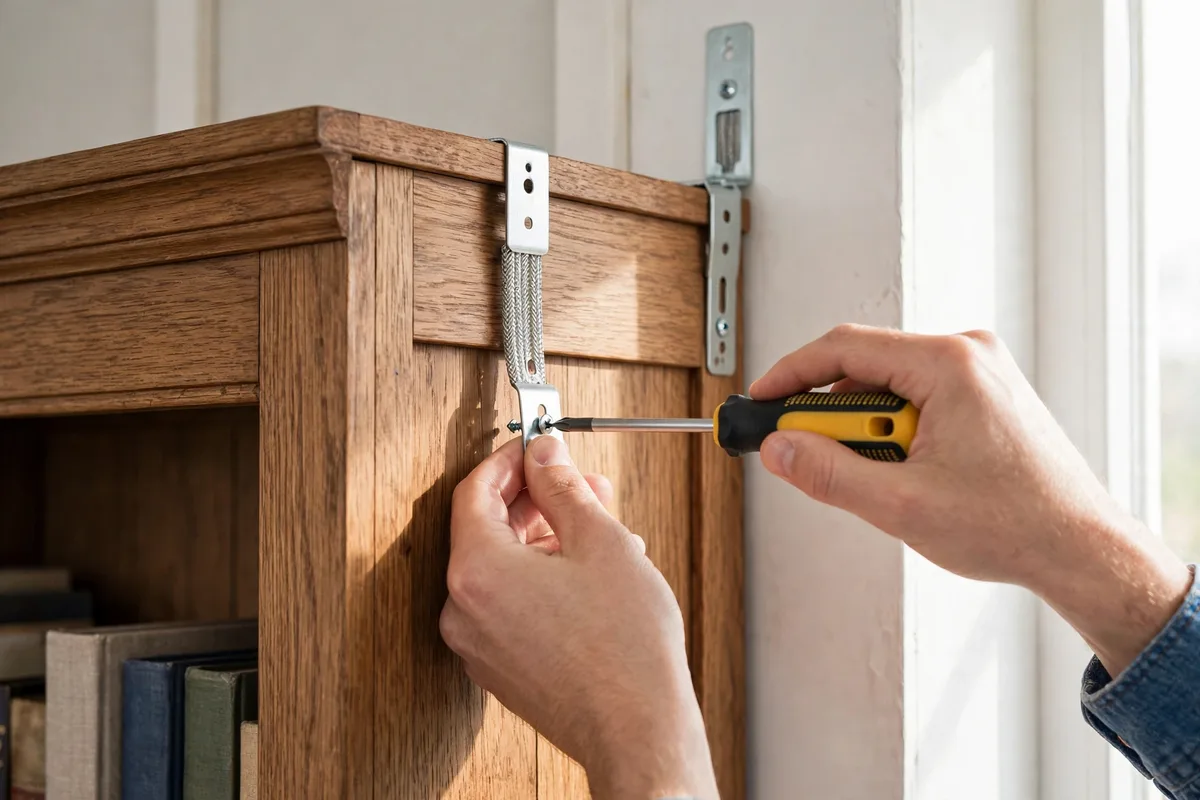
Vertical storage concentrates weight high and narrow, so its safety rule is absolute: everything tall gets fixed to the wall. Bookcases, ladder shelves and tall cabinets are anchored with anti-tip straps or brackets screwed into studs — never drywall alone — two fixings per piece, rechecked after any move. The CPSC’s Anchor It! campaign exists because bookcase and dresser tip-overs injure thousands a year, most of them small children; its guidance matches: anchor securely, keep heavy items low, store nothing tempting where a child might climb.
Load discipline completes the picture: the heaviest items in the bottom third of any tall piece, fixings rated above the load they will actually carry — a metre of hardbacks is far heavier than it looks — and wall shelves lagged into studs at every bracket. Anchoring takes twenty minutes per piece: the cheapest line in the system, and the only one that is not optional.
10. The Styling Discipline: One Palette, Gaps, Repetition
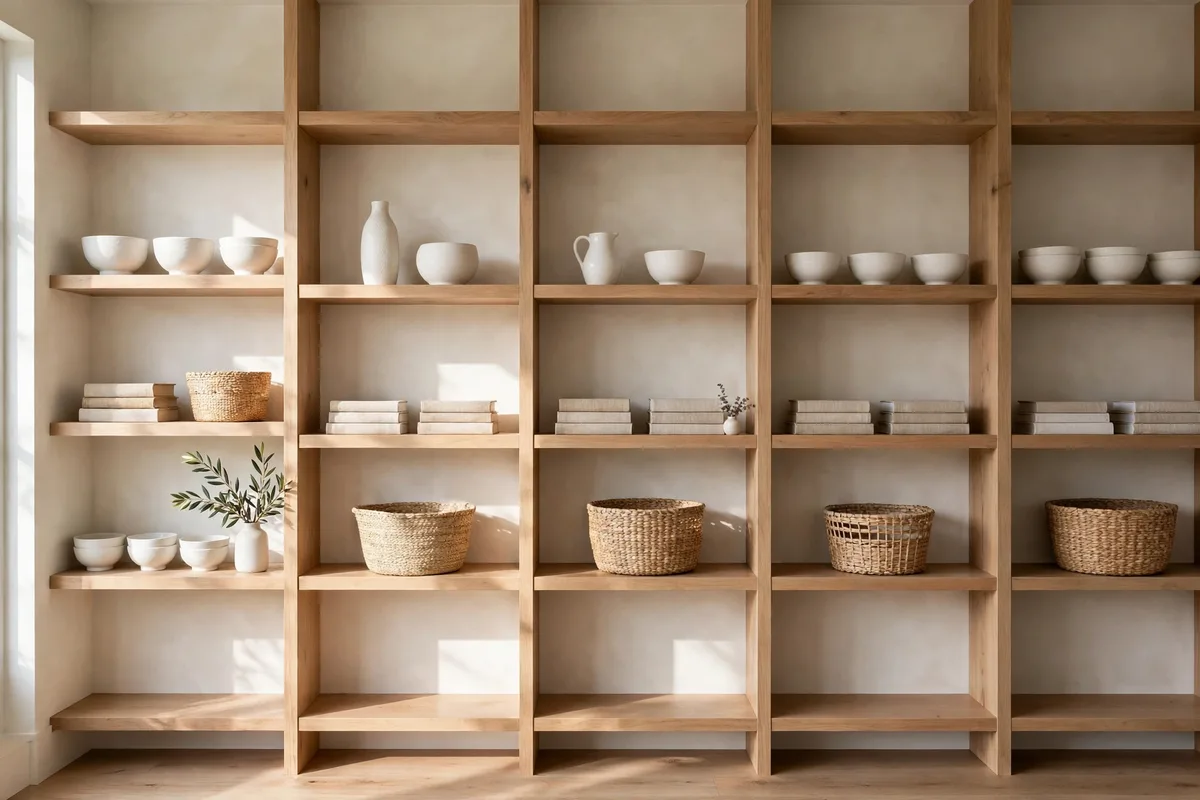
Everything above decides where storage goes; this section decides whether it looks like storage. The discipline has three rules. One palette: containers stay inside two or three colours plus one material — white ceramics, natural wood, woven basket, as in the photograph — so five shelves of unrelated stuff read as one composition. Repetition: the same basket three times, books in rhythmic groups; repeated shapes read as pattern, and pattern reads as design. Gaps: the bare third on every shelf, defended.
Maintenance is a five-minute monthly pass: photograph the wall, and whatever shouts — the one red box, the shelf filled edge to edge, the item in the wrong band — gets moved, decanted or demoted. Styled this way, vertical storage becomes the room’s main decorative event: a whole wall working as hard as the furniture.
Frequently Asked Questions About Vertical Storage Styling
What is the best height for everyday items on shelves?
The daily band runs from about knee height to eye level. Everything used daily should be grabbable without stretching or a stool; weekly items take the band above, and only light, rarely used things live higher.
How do I stop tall storage from looking cluttered?
One palette across all containers, repetition of the same shapes, and a bare third on every shelf. Clutter is usually a membership problem — too many unrelated things — not an arrangement problem.
Do tall bookcases really need to be anchored?
Yes — always. Anchor bookcases, ladder shelves and tall cabinets to wall studs with anti-tip straps or brackets, keep heavy items low, and recheck fixings after any move. The CPSC’s Anchor It! campaign exists because unanchored tip-overs are a serious, preventable hazard.
What can I store above a toilet?
Rolled towels, a basket of spare toiletries and paper, and a humidity-happy plant, on shelves or in a shallow cabinet. Keep it light and damp-proof; paper goods and rust-prone items belong in a closed cabinet.
Are ladder shelves stable enough for books?
Yes, loaded correctly: heavy books and baskets on the deep bottom shelves, light decorative items up top, and the frame fixed to the wall with its safety strap. The graduated shelves enforce the right loading.
How much weight can floating shelves hold?
It depends on the fixing: shelves lagged into studs with proper brackets can carry a full run of books; drywall-only fixings are for light display. Check the bracket rating — a metre of hardbacks is roughly 20–25 kg.
What should go on the very top shelf?
Display and the light-and-rare only: a trailing plant, ceramics, framed pieces, seasonal items in light boxes. Nothing heavy, nothing daily, nothing a child might climb to reach. Needed monthly or more? Wrong band.
Can renters use vertical storage without drilling?
Much of it, yes: ladder shelves, over-door organizers, and adhesive or tension rails for light loads. Tall bookcases still need anchoring — ask the landlord (usually permitted for safety). Save drilling for pieces carrying real weight.
How do I use vertical storage in a kitchen?
Work the wall between counter and cabinets: a rail for pans and utensils near the stove, a magnetic strip for knives, open shelves zoned by the height map. Keep the hanging set to weekly tools in one finish family.
How often should I restyle vertical storage?
A five-minute monthly pass: photograph the wall, spot the shelf that shouts — too full, off-palette, wrong band — and fix just that. The bands and palette do the daily work; the edit stops the drift.
Conclusion
Map the wall by reach, give each band its right hardware — cases, rails, ladders, doors, strips — anchor everything tall, and hold the system to one palette with gaps and repetition. Do that, and the emptiest surface in the house becomes its hardest-working: storage that fills the wall you already own and reads as the best-looking thing in the room.





Pingback: 10 Tiny Entryway Solutions Ideas (Hooks, Bench, Order)