
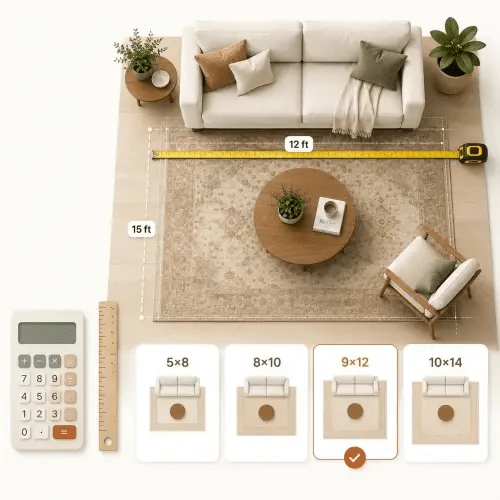
Rug Size Calculator
Find the perfect rug size for your room and furniture arrangement.
Free Space Planning ToolChoosing the right rug size can completely change how a room looks and feels. A rug that is too small can make furniture feel disconnected, while a rug that is too large may overwhelm the space. The good news is that you do not need to guess.
Our free Rug Size Calculator helps you estimate the right rug dimensions for your room based on the room size, furniture arrangement, and the area you want the rug to cover.
Whether you are decorating a living room, bedroom, dining room, home office, or another space, this guide will help you understand common rug sizes, placement rules, and how to choose a rug that fits your room.
How to Use the Rug Size Calculator
Start by measuring the length and width of the area where you want to place the rug. Use feet and inches for common U.S. measurements, or choose metric measurements if needed.
Enter your room dimensions into the calculator and select the room type. You can then compare the recommended rug size with the available space.
For the most useful result:
- Measure the actual room, not just the open floor area.
- Measure your major furniture pieces.
- Think about how much furniture you want sitting on the rug.
- Leave enough visible flooring around the rug.
- Check door swings before choosing a thick or large rug.
- Consider the shape of your room and furniture.
The calculator provides a planning estimate. It is always a good idea to mark the proposed rug dimensions on your floor using painter’s tape before buying a rug.
How to Choose the Right Rug Size
The best rug size depends on more than the room’s dimensions. Your furniture arrangement is often just as important.
For example, two living rooms calculator can have the same floor area but require different rug sizes because one has a large sectional while the other has a small sofa and two chairs.
A good rug should visually connect the furniture rather than sit like a small island in the middle of the room.
Before shopping, ask yourself:
- What furniture will sit on the rug?
- Do I want all furniture legs on the rug?
- Should only the front legs sit on the rug?
- How much flooring should remain visible?
- Will the rug interfere with doors or walkways?
- Is the room rectangular, square, or irregular?
In many U.S. homes, 8 × 10 feet and 9 × 12 feet are popular living room rug sizes because they work well with common furniture arrangements.
Living Room Rug Sizes
The living room is one of the most important places to get rug sizing right because the rug usually connects the sofa, chairs, coffee table, and other furniture.
For a medium-sized living room, an 8 × 10 rug can often provide enough coverage for a sofa and chairs. Larger rooms may look better with a 9 × 12 rug or another larger option.
Instead of choosing a rug simply because it looks attractive in a store, consider the complete furniture arrangement.
What Size Rug for a 10 × 12 Living Room?
A 10 × 12-foot living room has 120 square feet of floor area.
An 8 × 10-foot rug is often a practical starting point for this size room. It provides 80 square feet of rug coverage while leaving visible flooring around the edges.
However, the best choice depends on furniture placement.
For example, an 8 × 10 rug can work well when:
- The sofa is positioned along one wall.
- The front legs of the sofa and chairs sit on the rug.
- A coffee table sits completely on the rug.
- There is enough space around the rug for walking.
A smaller 5 × 8 rug may work for a compact seating arrangement, but it can look undersized if the living room contains a large sectional.
What Size Rug for a 12 × 14 Living Room?
A 12 × 14 room provides 168 square feet of floor area.
An 8 × 10 or 9 × 12 rug can work depending on your furniture layout.
A 9 × 12 rug is particularly useful when you want the rug to connect a larger sofa, chairs, and coffee table.
Before purchasing, use painter’s tape to mark a 9 × 12 rectangle on the floor. This simple step can help you understand whether the rug will feel balanced.
Should a Living Room Rug Go Under the Sofa?
Usually, yes. A living room rug generally looks more intentional when it connects the major seating pieces.
There are three common approaches:
All furniture on the rug:
This works especially well in large rooms where a large rug can accommodate the sofa, chairs, and table.
Front legs on the rug:
This is one of the most flexible arrangements for medium-sized rooms. The sofa and chairs partially overlap the rug while their back legs remain on the floor.
Coffee table only:
This can work in very small spaces, but the rug should still be large enough to visually connect the seating area.
Avoid using a very small rug that only sits underneath the coffee table when the surrounding furniture is spread far apart.
Bedroom Rug Sizes
A bedroom rug can add warmth and make the bed feel like the central feature of the room.
The right size depends on the bed size, nightstands, room dimensions, and desired placement.
Popular choices include:
- 5 × 8 feet
- 6 × 9 feet
- 8 × 10 feet
- 9 × 12 feet
- Runners placed along the sides of the bed
The rug should be large enough to create a comfortable visual area around the bed.
What Size Rug Goes Under a Queen Bed?
A queen mattress is approximately 60 × 80 inches.
An 8 × 10 rug is a popular starting point for a queen bed because it can extend beyond the sides and foot of the bed.
A 9 × 12 rug provides even more coverage and can work particularly well in a larger bedroom.
If you use an 8 × 10 rug, position it so that the rug extends beyond the sides of the bed and provides a comfortable area near the foot.
What Size Rug Goes Under a King Bed?
A standard king mattress is approximately 76 × 80 inches.
Because a king bed is wider than a queen, a larger rug is usually more appropriate.
Common options include:
- 8 × 10 feet for tighter rooms
- 9 × 12 feet for more generous coverage
- Larger rugs for spacious bedrooms
A 9 × 12 rug can create a strong foundation for a king bed, especially when nightstands and additional bedroom furniture are arranged around it.
What Size Rug for a Twin Bed?
A twin mattress is approximately 38 × 75 inches.
Smaller rugs can work well with twin beds, especially in children’s bedrooms or compact guest rooms.
Possible options include:
- 5 × 8 feet
- 6 × 9 feet
- A runner beside the bed
- Two smaller rugs on both sides
The room’s furniture arrangement should guide the final decision.
Dining Room Rug Sizes
Dining room rugs need special attention because chairs must remain on the rug even when they are pulled away from the table.
A rug that is only slightly larger than the dining table may look good when the chairs are pushed in but become uncomfortable when someone sits down.
How Big Should a Dining Room Rug Be?
A practical approach is to choose a rug that extends beyond the dining table on all sides.
For example, a 6 × 9-foot rug can work with some smaller dining tables, while an 8 × 10 or 9 × 12 rug may be better for larger tables.
Before buying, measure the table and allow enough additional space for chairs.
Consider:
- Table length
- Table width
- Chair depth
- Space needed to pull chairs backward
- Walkways around the dining area
The goal is for the chair legs to remain on the rug when people pull the chairs out.
Common Rug Sizes in the USA
Rugs are commonly sold in standardized dimensions, although actual sizes can vary slightly by manufacturer.
Some common rectangular sizes include:
- 3 × 5 feet
- 4 × 6 feet
- 5 × 7 feet
- 5 × 8 feet
- 6 × 9 feet
- 8 × 10 feet
- 9 × 12 feet
- 10 × 14 feet
- 12 × 15 feet
Round rugs are also available in common diameters such as 5, 6, 7, 8, and 10 feet.
When shopping online, always check the manufacturer’s exact dimensions instead of assuming the listed size is exact.
How Much Floor Should a Rug Cover?
There is no single percentage that works for every room.
Instead, think about the relationship between the rug and the furniture.
In a living room, the rug should generally connect the seating arrangement. In a dining room, it should accommodate the table and chairs. In a bedroom, it should provide a comfortable visual and physical area around the bed.
A useful design principle is to avoid making the rug look like a small floating rectangle surrounded by large amounts of furniture.
At the same time, a rug does not need to cover almost the entire room.
Leave a reasonable border of visible flooring around the rug so the room still feels spacious.
Rug Placement Rules for Different Rooms
Different rooms require different approaches.
Living Room
For a living room:
- Connect the main seating furniture.
- Place the coffee table on the rug when possible.
- Consider putting the front legs of seating furniture on the rug.
- Use a larger rug for larger seating arrangements.
Bedroom
For a bedroom:
- Center the rug around the bed.
- Allow the rug to extend beyond the sides of the bed.
- Make sure the rug does not create a tripping hazard.
- Consider runners for narrow bedrooms.
Dining Room
For a dining room:
- Center the rug under the table.
- Make sure chairs remain on the rug when pulled out.
- Avoid rugs that are too small for the table.
Home Office
For a home office:
- Consider the desk and chair movement.
- Make sure the chair can roll without catching on the rug edge.
- A rectangular rug often works well beneath a desk.
8 × 10 vs. 9 × 12 Rug: Which Should You Choose?
The difference between an 8 × 10 and 9 × 12 rug may look small on paper, but it can make a significant difference in a room.
An 8 × 10 rug covers:
80 square feet
A 9 × 12 rug covers:
108 square feet
That means the 9 × 12 rug provides 28 more square feet of coverage.
Choose an 8 × 10 when:
- Your room is medium-sized.
- You have a standard sofa and chairs.
- You want more visible flooring around the rug.
- A 9 × 12 would feel crowded.
Choose a 9 × 12 when:
- Your room is larger.
- You have a sectional.
- You want more furniture on the rug.
- The room feels visually disconnected with an 8 × 10.
When unsure, tape both sizes on the floor. Seeing the actual footprint is often more helpful than looking at rug photos online.
How to Measure Your Room for a Rug
Accurate measurements make rug shopping much easier.
Start with the room’s length and width. Then measure the furniture that will sit on or around the rug.
Write down your measurements before shopping.
For example:
Room: 12 × 14 feet
Sofa: 84 inches wide
Coffee table: 48 × 24 inches
Potential rug: 8 × 10 or 9 × 12 feet
Next, mark the rug dimensions on the floor with painter’s tape.
This helps you check:
- Furniture alignment
- Walking space
- Door clearance
- Rug proportions
- Distance from walls
- Overall visual balance
For an open-plan room, measure the specific seating or dining zone instead of treating the entire open floor as one room.
Common Rug Size Mistakes
Choosing a rug is not only about finding a beautiful pattern. Size mistakes can make an otherwise well-designed room feel unbalanced.
Choosing a Rug That Is Too Small
This is one of the most common problems.
A tiny rug under a coffee table may not visually connect the rest of the furniture.
Ignoring Furniture Placement
A rug should work with the furniture arrangement, not just the room’s dimensions.
Forgetting Dining Chair Movement
Dining chairs need enough rug underneath them when people pull them away from the table.
Measuring Only the Open Floor
Furniture occupies space too. Measure the entire arrangement before choosing your rug.
Forgetting Door Clearance
A thick rug can interfere with a door that opens over it.
Check doors, closets, cabinets, and other moving parts before purchasing.
Buying Before Testing the Size
Painter’s tape is inexpensive and can save you from an expensive sizing mistake.
Rug Size by Room Type
Different rooms often benefit from different rug approaches.
| Room | Common Rug Starting Point |
|---|---|
| Small Living Room | 5 × 8 ft |
| Medium Living Room | 8 × 10 ft |
| Large Living Room | 9 × 12 ft or larger |
| Queen Bedroom | 8 × 10 ft |
| King Bedroom | 9 × 12 ft |
| Small Dining Area | 6 × 9 ft |
| Medium Dining Room | 8 × 10 ft |
| Large Dining Room | 9 × 12 ft |
| Home Office | 5 × 8 ft or 6 × 9 ft |
These are starting points, not strict rules. Furniture dimensions and room layout should always be considered.
Rug Size Chart
Use this quick chart when comparing common rug dimensions.
| Rug Size | Area |
|---|---|
| 3 × 5 ft | 15 sq. ft. |
| 4 × 6 ft | 24 sq. ft. |
| 5 × 7 ft | 35 sq. ft. |
| 5 × 8 ft | 40 sq. ft. |
| 6 × 9 ft | 54 sq. ft. |
| 8 × 10 ft | 80 sq. ft. |
| 9 × 12 ft | 108 sq. ft. |
| 10 × 14 ft | 140 sq. ft. |
| 12 × 15 ft | 180 sq. ft. |
The area is calculated by multiplying rug length by rug width.
For example:
8 × 10 = 80 square feet
9 × 12 = 108 square feet
This can help you compare how much floor coverage you gain when moving to a larger rug.
How Do You Calculate Rug Size?
To calculate the area of a rectangular rug, multiply its length by its width.
For example:
8 ft × 10 ft = 80 square feet
However, calculating rug area is different from choosing the right rug size. The best size depends on furniture placement, room proportions, walking space, and the visual effect you want.
That is why our Rug Size Calculator focuses on practical room planning rather than simply calculating square footage.
What Size Rug Should I Get for My Living Room?
Start by measuring the room and the furniture arrangement.
For many medium-sized living rooms, 8 × 10 feet is a useful starting point. Larger rooms or sectional sofas may require a 9 × 12-foot rug or larger.
If you are between two sizes, the larger rug often creates a more connected furniture arrangement, provided it does not interfere with doors or walkways.
Is an 8 × 10 Rug Big Enough for a Living Room?
An 8 × 10 rug can work very well in many medium-sized living rooms.
It is large enough to connect a typical sofa, coffee table, and chairs in many layouts.
However, room proportions matter. A large sectional in a spacious room may look better with a 9 × 12 rug or larger.
Is a 9 × 12 Rug Too Big for a Room?
Not necessarily.
A 9 × 12 rug can work beautifully in a larger living room, bedroom, dining room, or open-plan area.
The key is to leave enough surrounding space for walking and to avoid blocking doors, vents, cabinets, or other functional areas.
Should a Rug Be Centered in a Room?
Usually, a rug should be centered relative to the furniture arrangement rather than automatically centered relative to the walls.
For example, in an open-plan living room, the seating area may not be exactly in the center of the entire floor.
Centering the rug under the seating arrangement can make the space feel more balanced.
Should All Furniture Be on the Rug?
No.
There are several successful rug placement styles.
You can place all furniture on the rug, only the front legs on the rug, or use the rug mainly under a smaller furniture grouping.
The best option depends on the size of the room and rug.
How Far Should a Rug Be From the Wall?
There is no universal distance that works for every room.
Leaving visible flooring around the rug can help define the space. The amount depends on room size, furniture placement, and architectural features.
The important thing is to create a deliberate border rather than forcing the rug against the walls.
Can I Use the Rug Size Calculator for an Open-Plan Room?
Yes.
For open-plan spaces, focus on the specific zone you want to define.
For example, measure the living room seating area separately from the dining area.
A rug can help visually divide an open floor plan without adding physical walls.
Final Tips for Choosing the Perfect Rug Size
The right rug should make your room feel connected, comfortable, and intentional.
Before ordering your rug, follow these simple steps:
- Measure your room.
- Measure the main furniture.
- Decide which furniture should sit on the rug.
- Compare two or three rug sizes.
- Mark the sizes on the floor with painter’s tape.
- Check doors and walking paths.
- Consider the rug’s thickness.
- Confirm the manufacturer’s exact dimensions.
- Think about the room’s overall proportions.
- Choose the size that creates the best balance between furniture and open floor.
A rug is more than a decorative accessory. It can define a seating area, add warmth to a bedroom, make a dining space feel finished, and visually connect furniture throughout a room.
Using a rug size calculator before shopping can make the decision easier and reduce the risk of choosing a rug that is too small or too large.
Frequently Asked Questions
What is the most common rug size for a living room?
8 × 10 feet is a popular starting size for many medium-sized living rooms. Larger rooms and larger furniture arrangements may benefit from a 9 × 12-foot rug or larger.
What size rug should I use under a queen bed?
An 8 × 10-foot rug is a common starting point for a queen bed. A 9 × 12-foot rug can provide additional coverage in a larger bedroom.
What size rug should I use under a king bed?
A 9 × 12-foot rug is a common choice for a king bed because it provides generous coverage around the bed. Larger rooms may accommodate an even larger rug.
Is 5 × 8 a good rug size for a living room?
A 5 × 8-foot rug can work in a small living room or compact seating area. It may look too small in a larger room with a sectional or multiple chairs.
Is 8 × 10 bigger than 9 × 12?
No. A 9 × 12 rug is larger.
An 8 × 10 rug covers 80 square feet, while a 9 × 12 rug covers 108 square feet.
How do I choose a rug size for a dining table?
Measure the dining table and allow enough extra rug space around all sides so chairs remain on the rug when pulled out.
Should a rug be bigger than the sofa?
Not always, but a rug that extends beyond the sofa or connects the sofa with other seating often creates a more balanced arrangement.
How do I know if my rug is too small?
If the rug looks disconnected from the furniture, sits only under a coffee table, or leaves the seating arrangement visually separated, it may be too small.
Can I use a round rug instead of a rectangular rug?
Yes. Round rugs can work particularly well in square rooms, entryways, reading areas, breakfast spaces, and rooms with round furniture.
Can I use two rugs in one open-plan room?
Yes. Two rugs can help define separate zones, such as a living room and dining area. Choose rugs that complement each other without making the space feel visually cluttered.
How accurate is a rug size calculator?
A calculator can provide a useful planning estimate based on the dimensions you enter. Final rug selection should still account for furniture, doors, walkways, and the manufacturer’s actual rug dimensions.
Related Home Design Tools
If you are planning a room renovation or decorating project, you may also find these tools useful:
- Room Size Calculator – Calculate room dimensions, square footage, and floor area.
- Paint Calculator – Estimate the amount of paint needed for walls.
- Flooring Calculator – Estimate flooring area and material requirements.
- Curtain Size Calculator – Find suitable curtain dimensions.
- TV Size & Viewing Distance Calculator – Plan TV size and viewing distance.
- Sofa Size Calculator – Check sofa dimensions against available room space.
Final Thoughts
Choosing the right rug size does not have to be complicated.
The best approach is to start with accurate room measurements, consider your furniture arrangement, and then compare practical rug sizes.
For many rooms, common sizes such as 5 × 8, 8 × 10, and 9 × 12 feet provide useful starting points. But your furniture layout and room proportions should always have the final say.
Use the Rug Size Calculator above to estimate the right size for your space, then mark the proposed dimensions on your floor before purchasing. A few minutes of planning can help you create a room that feels more comfortable, balanced, and professionally designed.
Disclaimer: Rug size recommendations on this page are general home-planning guidance. Actual requirements can vary depending on furniture dimensions, room layout, door clearance, manufacturer sizing, and personal design preferences.




Pingback: Backyard Landscaping Calculator - Estimate Cost & Materials