
Disclosure: As an Amazon Associate I earn from qualifying purchases. This article contains affiliate links. If you purchase through these links, we may earn a commission at no additional cost to you.
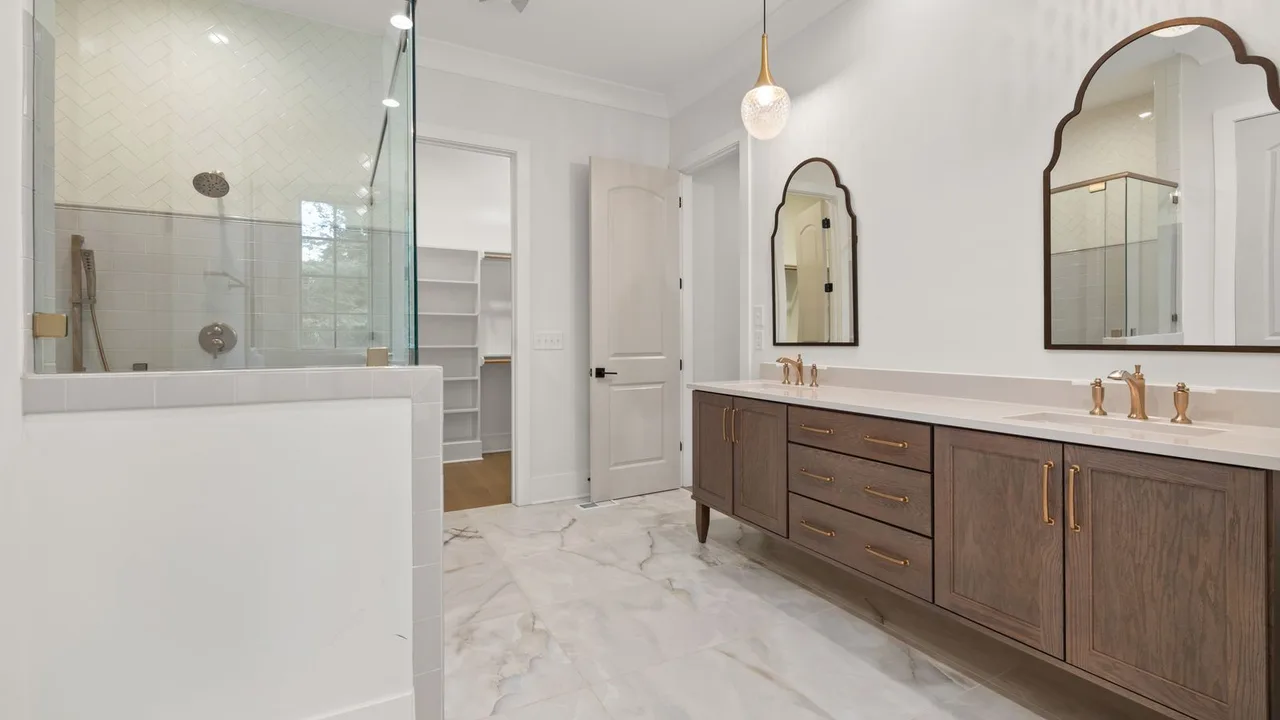
Two arch mirrors over a double vanity is the arrangement that made the arch a bathroom staple — one curve per person, a shared rhythm across the wall. It is also an arrangement that punishes guesswork: a pair hung two inches too high, or centred on the vanity instead of the sinks, looks wrong every single morning. This guide gives you the measurements that work — mirror width against vanity size, hanging height, the spacing between the pair, and the lighting positions that make faces look like faces.
In this guide: The Three Rules That Decide Everything · Measurements at a Glance · Step by Step: Measuring and Marking · Lighting That Works With a Pair of Arches · Choosing the Pair · Five Mistakes That Ruin a Good Pair · When One Wide Mirror Beats a Pair (and Other Layouts) · Hanging Day: Tools and the Order of Work · Frequently Asked Questions · The Short Version
The Three Rules That Decide Everything
Rule 1 — Centre each mirror over its sink. Not over the vanity unit, not over the gap between the sinks. In remodelled bathrooms the sinks are not always where the cabinet suggests, and the eye reads the mirror-to-faucet alignment, not the mirror-to-cabinet one.
Rule 2 — Each mirror stays narrower than its half of the vanity. A few inches of breathing room on each side of each arch. Two mirrors that touch the edges of the counter or crowd each other in the middle read as one mistake, twice.
Rule 3 — Hang by centre height, not by the top. Arches have shoulders and a peak; heights are planned from the mirror’s centre (around eye level, 57–60 inches from the floor) so both mirrors of the pair share one level line regardless of their shape.
Important: Mark both mirror positions in painter’s tape and live with them for a day before drilling. Height and spacing mistakes are invisible on paper and obvious at the sink.
Measurements at a Glance
| Vanity width | Sink arrangement | Mirror width (each) | Notes |
|---|---|---|---|
| 60 in | Two sinks, tight spacing | 20–24 in | Keep a clear gap between the pair; slim frames help |
| 72 in | Two sinks, standard | 24 in | The most forgiving size — the 24×36 arch class fits perfectly |
| 84 in | Two sinks, generous | 24–28 in | Wider arches or taller sconces between the mirrors |
| 96 in + | Two sinks + dressing space | 28 in + | Scale up, or add a third element (sconce / shelf) between the pair |
Step by Step: Measuring and Marking
Step 1 — Find each sink’s centre line
Measure from the wall corner (or the vanity’s end) to the centre of each faucet and mark that vertical line on the wall in tape. Everything else — mirror centre, sconce centre — keys off these two lines.
Step 2 — Set the pair’s shared centre height
Choose the centre height for the household: 57–60 inches from the floor covers most adults. If the two users differ a lot in height, favour the taller user’s comfort slightly — a mirror can be used a few inches below its centre more gracefully than above it. Mark one horizontal tape line at that height across both stations.
Step 3 — Check the bottom edge against the faucet
With the centre set, work out where the mirror’s bottom edge lands and confirm it clears the backsplash by a few inches and never collides with a tall faucet’s arc or handles. For a 36-inch-tall arch centred at 58 inches, the bottom edge sits at 40 inches — comfortably above a standard counter and faucet. Vessel sinks and tall faucets eat into that clearance, so measure your actual hardware, not the catalogue version.
Step 4 — Check the gap between the pair
Two 24-inch arches on a 72-inch vanity with sinks centred at 18 and 54 inches leave a calm central gap. On a 60-inch vanity the same mirrors get neighbourly — this is where slim frames earn their price, and where dropping to a 20–22-inch arch keeps the wall breathing. — at 60 inches, treat 24 inches as the ceiling, not the default.
Step 5 — Live with the tape, then drill
Tape the full outline of both arches (shoulders and peak, not just a rectangle) and use the sinks normally for a day. Check reflections standing and seated if anyone uses a stool, morning light and evening light. Then drill once, correctly, into fixings suited to your wall.
Lighting That Works With a Pair of Arches
Sconces between the mirrors
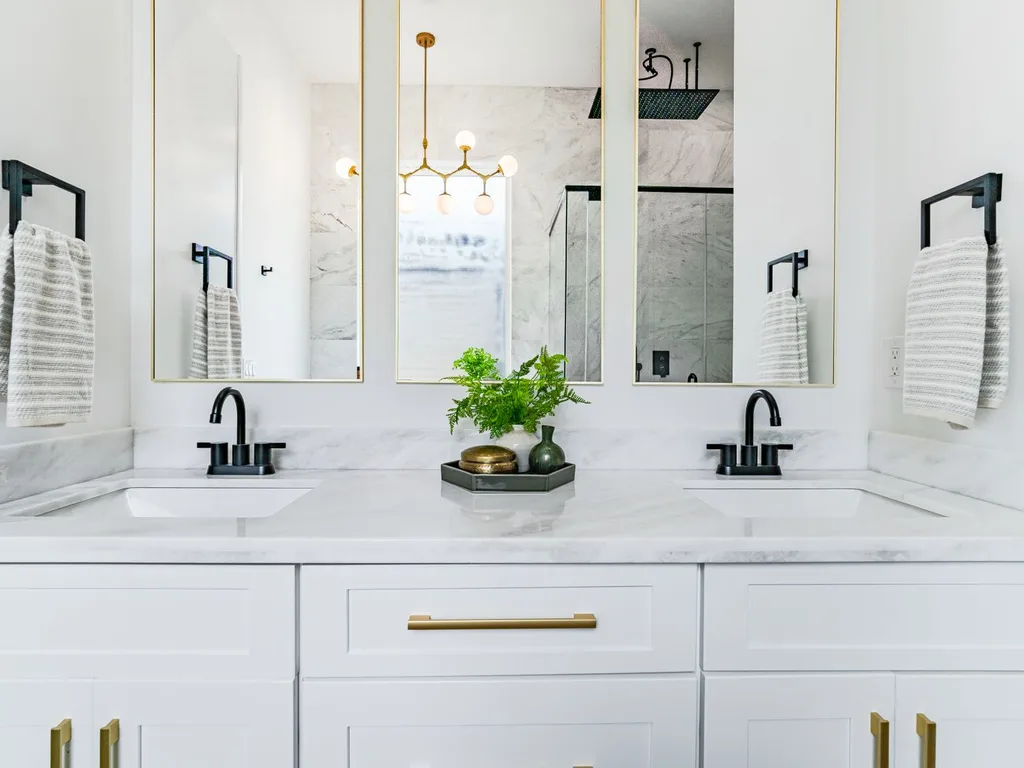
The classic double-vanity arrangement: one sconce in the centre gap, or one between the pair plus one outside each mirror on wide walls. Light at face height, on both sides of each face, is what grooming actually needs. With arches, keep sconces clear of the curved shoulders — the tape outlines from Step 5 should include the fixtures.
Sconces outside the pair
On a tight 60-inch vanity where the centre gap is precious, move the sconces to the outside edges of the two mirrors. Slightly less even light per face, but the wall keeps its calm symmetry — and nobody’s arch gets visually bumped by a fixture.
Pendants and overhead bars
Pendants hung in front of the mirrors (one per sink, centred on the same lines) suit tall ceilings and add the vertical note arches love. A single overhead bar is the weakest option for faces — it lights the top of the head and shadows the eyes — so if a bar is what the room has, treat it as ambient light and add what you can at face level.
One colour temperature, everywhere
Whatever fixtures you choose, keep every bulb in the room the same temperature — the warm-to-neutral range most people find honest for skin — and the same bulb in mirrored pairs. The Kelvin choices behind that range live in our bathroom lighting layers guide. Two mirrors under two different light colours will make one station look like a different bathroom.
Choosing the Pair
Everything in our comparison of arch mirrors for bathroom vanities applies twice over here, with one addition: buy the two mirrors as a matched set, or two units of the same model in the same order, so the finish and glass match exactly across the pair. For a standard 72-inch double vanity, the proportions in this guide point straight at the 24×36 class — the size of the TRAHOME arch we reviewed in full: aluminium matte-gold frames that will not rust, 5 mm shatterproof-listed glass, and at 8 lb each, a pair that almost any bathroom wall can hold. One class this guide does not size: backlit LED arches are a separate, hardwired product family, lit from inside and wired into the wall — the framed-pair measurements here do not transfer to them, and the roundup explains why this cluster works with framed mirrors instead.
Five Mistakes That Ruin a Good Pair
- Centring on the vanity instead of the sinks — the single most common error, and visible in every reflection.
- Matching tops instead of centres — two arches of slightly different heights hung by their peaks will sit at two different eye levels.
- Mirrors that meet in the middle — no gap, no rhythm; the wall reads as one wide mirror with a seam.
- Bottom edges in the splash zone — too low, and every handwash spots the glass; too high, and shorter users lose their reflection. The tape test catches both.
- Buying the second mirror later — a different production run can mean a visibly different gold. Pairs are bought together.
Important: If your double vanity’s sinks are not symmetrically placed (common in remodels), trust the sinks. A pair centred on the faucets looks deliberate even when the gaps at the wall’s ends differ; a pair centred on the room looks wrong at both sinks.
When One Wide Mirror Beats a Pair (and Other Layouts)
This guide assumes the classic pair, but three situations argue otherwise. Very small doubles (under 60 inches, sinks close together) can look calmer with one wide mirror spanning both stations — the pair’s gap nearly disappears at that width anyway, and one sheet of glass is honest about it. Asymmetric remodels, where one sink sits oddly close to a side wall, sometimes suit a single mirror over the main station and open shelving or art over the second. And a centre third element — a narrow mirror, a sconce, or open shelves between two arches — stretches a pair gracefully across very wide vanities (96 inches and beyond) where the two sinks alone leave the middle empty. In every variant, the same rules survive: centre over each sink, share one centre line, keep the glass out of the splash zone.
Hanging Day: Tools and the Order of Work
You need: painter’s tape, a tape measure, a spirit level (a long one earns its keep across two mirrors), a pencil, a stud finder, a drill, and fixings rated for each mirror’s weight on your wall type. Two people — one to hold, one to look — because judging level and alignment alone, at arm’s length, holding glass, is how small errors get permanent.
The order that keeps the pair honest
- Tape both outlines from your Step 1–5 measurements and confirm the sink centre lines one last time.
- Mark fixing points for the first mirror (start with the left if you are right-handed — you will sight across it to place the second).
- Drill, fit anchors, hang the first mirror, and check it with the level and from the sink position.
- For the second mirror, level against the first mirror’s centre line, not against the wall or the counter — counters are not always level, and the pair must agree with each other above all.
- Stand at each sink in turn. Each user should see their face comfortably inside their own arch without ducking or stretching; that is the test the whole guide exists to pass.
- Only then remove tape, clean the glass, and call it done.
Weight is the quiet ally here: a slim aluminium arch of the 24×36 class weighs around 8 lb, so a pair totals less than many single framed mirrors — ordinary good anchors, correctly fitted, are up to the job on most walls.
Frequently Asked Questions
How high should arch mirrors hang over a double vanity?
Plan by the centre: 57–60 inches from the floor suits most adults. For a 36-inch-tall arch that puts the bottom edge near 40 inches — a few inches above a standard backsplash — but always check against your own faucet height and the users’ eye levels.
How far apart should the two mirrors be?
There is no fixed number — the distance is set by your sink centres, which is why centring over the sinks is Rule 1. What you are checking is the result: a clear, calm gap between the pair, and a few inches of breathing room at each outer edge.
What size arch mirrors suit a 72-inch double vanity?
The 24-inch-wide class is the classic fit — one centred over each sink with room to spare on both sides. It is the most common double-vanity size because the proportions work without any special pleading.
Should the two mirrors be identical?
Yes, in almost every bathroom. Identical size, frame and finish is what creates the rhythm. Deliberately mismatched pairs belong to eclectic schemes — and even there, the heights are kept on one shared centre line.
Where do sconces go with two arch mirrors?
First choice: at face height in the centre gap and/or outside the pair, kept clear of the arches’ shoulders. Pendants centred over each sink are the tall-ceiling alternative. Avoid relying on a single overhead bar for grooming light.
Can I hang a pair of arch mirrors in a rental?
Only within your lease’s rules on wall fixings. A pair of slim arches is light — around 8 lb each in the 24×36 aluminium class — but glass deserves real anchors, not adhesive strips, and leaning mirrors of this size on a vanity is not a safe substitute. If holes are forbidden, this is an upgrade to agree with the landlord or save for a home you can drill in.
The Short Version
Centre over the sinks. Hang by a shared centre line at 57–60 inches. Keep each arch narrower than its half of the vanity, buy the pair together, light faces from the sides, and tape before you drill. Six habits, and the double-vanity arch arrangement that fills your feed becomes the one on your wall — measured, level, and right every morning.
See the 24×36 Arch From This Guide
Disclosure: As an Amazon Associate I earn from qualifying purchases.


Pingback: Arch Mirror for Bathroom Vanity: 4 Picks & a Size Guide
Pingback: Trahome Arch Wall Mirror Review: 24×36 Gold, Spec by Spec