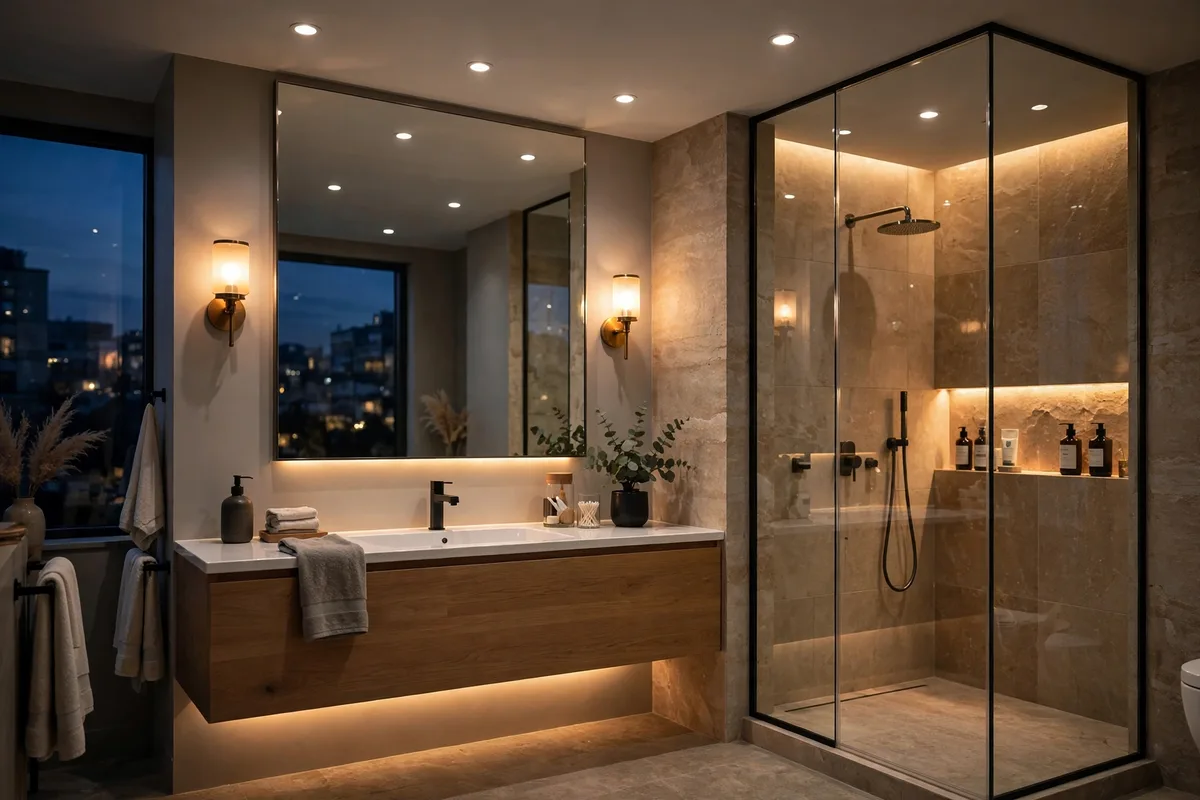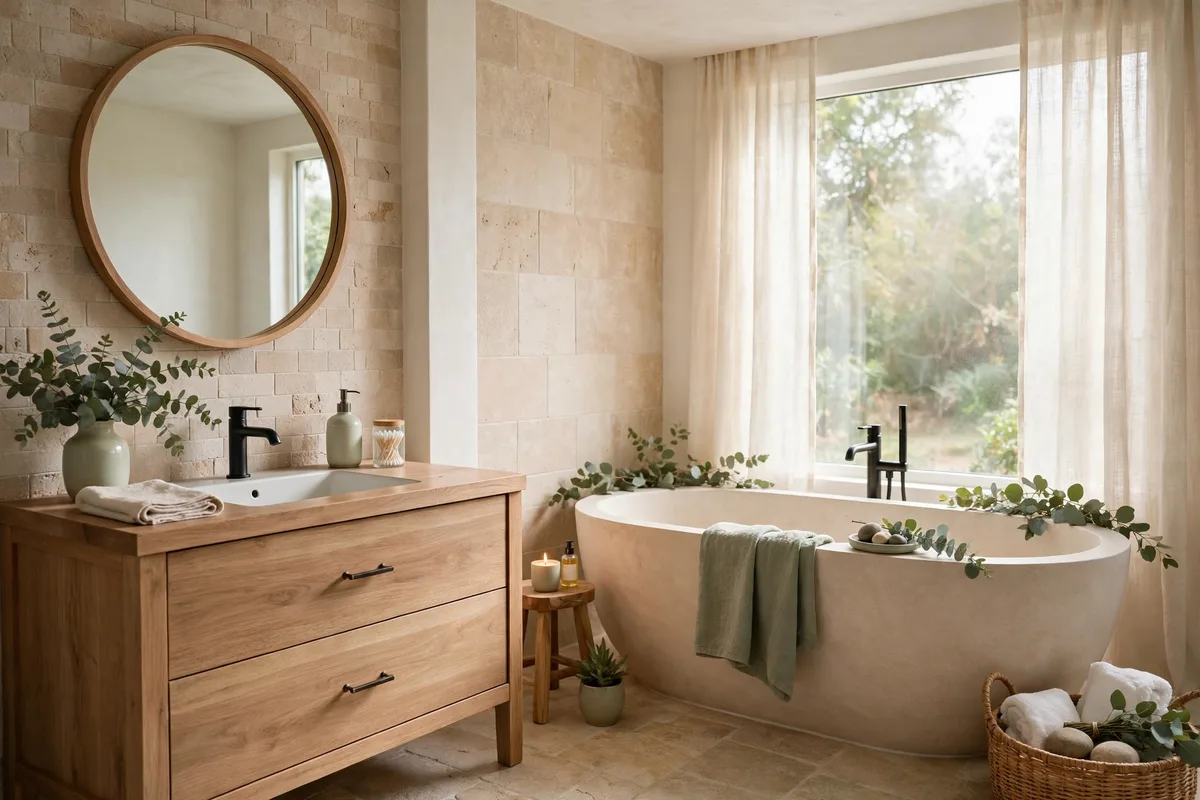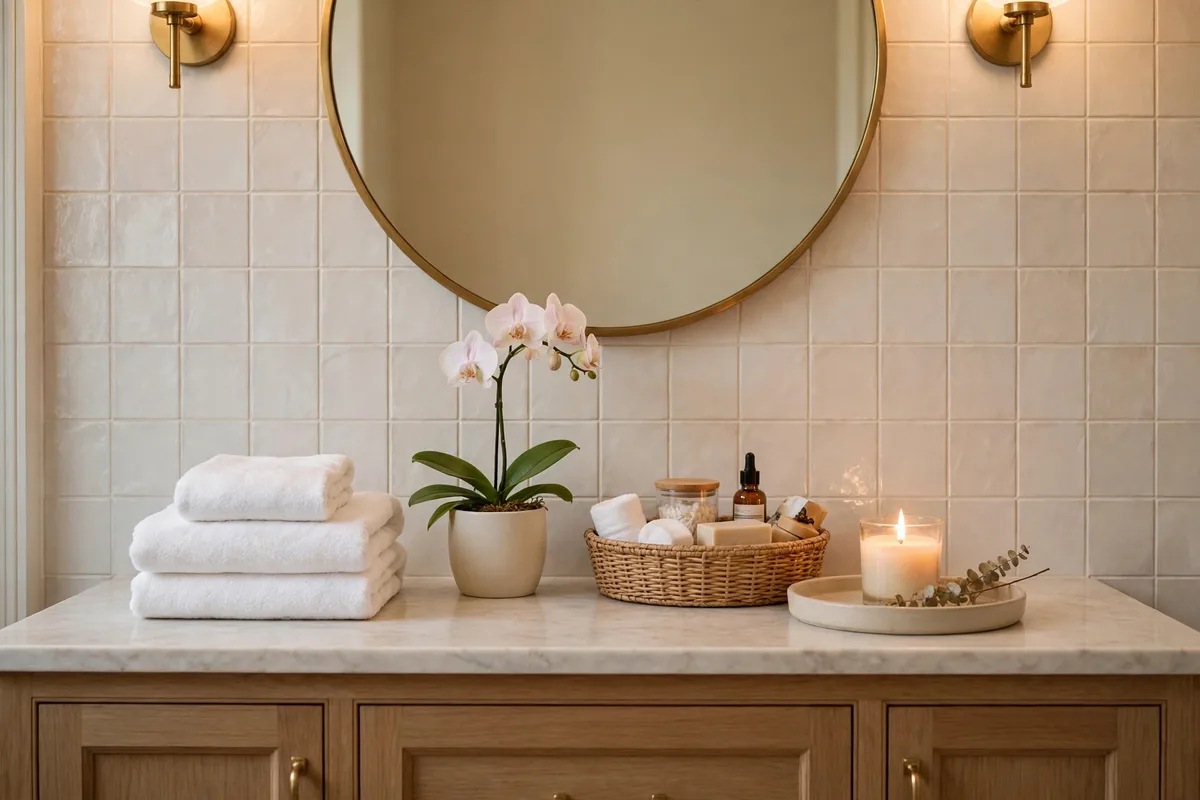
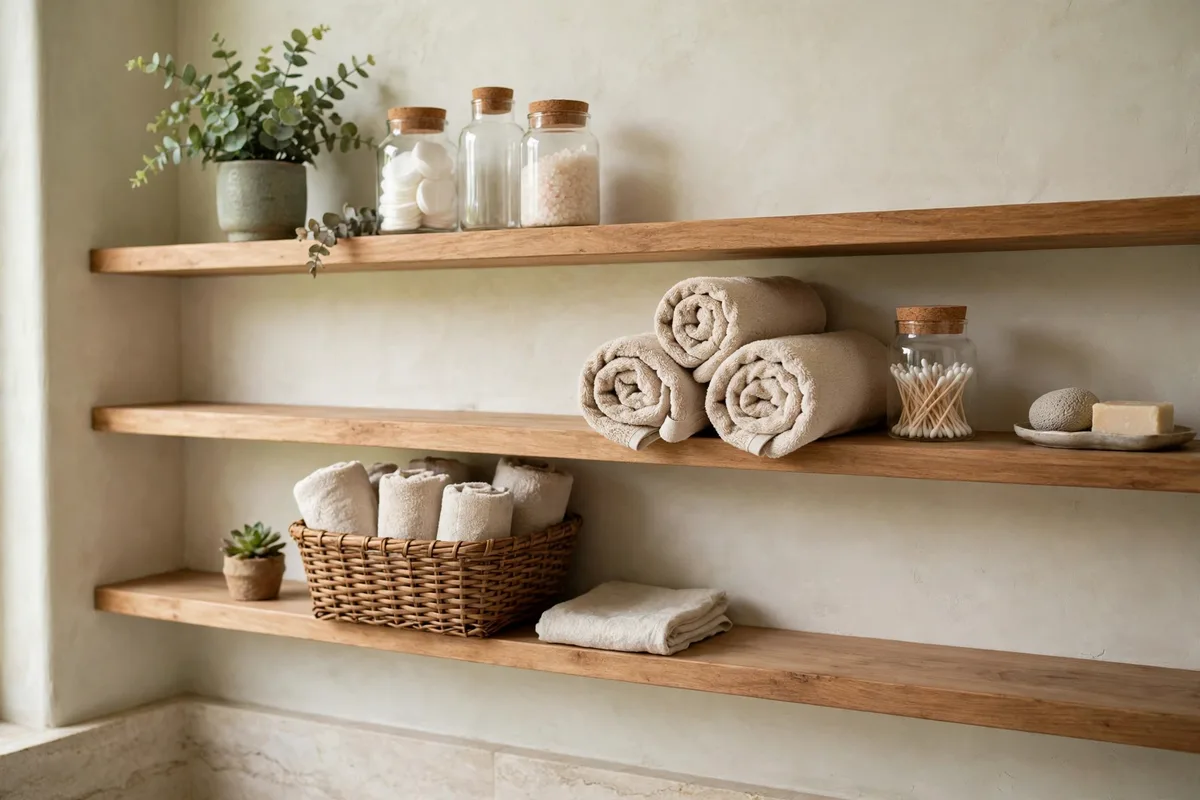
Open shelves are the bathroom’s honesty test: everything on them is visible, all the time, to everyone. Styled well, they are the cheapest design feature in the room — storage that doubles as decor. Styled badly, they are a shop shelf of mismatched bottles that makes the whole bathroom feel untidy no matter how clean it is. The difference is not taste or budget; it is a small set of repeatable moves: give each shelf one job, group in odd numbers, decant into containers, and leave a third of every shelf empty.
Ten styling ideas, in the order you would actually do them — placement numbers first, then the arrangement rules that make any shelf look chosen.
In this guide: The Shelf Numbers at a Glance · 1. Give Every Shelf One Job · 2. Placement: Heights and Gaps That Work · Copy This Shelf: Five Finished Set Pieces · 3. Start Empty, Place the Anchor First · 4. Group in Threes, Build Triangles · 5. Leave a Third Bare: Negative Space Is a Material · 6. Decant: Containers Turn Products Into Decor · 7. Towels Are Decor That Works · 8. One Living Thing, One Scent, One Personal Object · 9. Materials That Survive the Room · 10. The Five-Minute Reset: Maintenance Is the Styling · Frequently Asked Questions About Bathroom Shelf Styling · Conclusion
Small bathroom? Shallow shelves and the strict bare-third rule (Sections 2 and 5) matter more than any object you buy. Renting? The ladder and picture-ledge rows in the shelf-types table below need no drilling. Guest bathroom? Start with the towel rule (Section 7) — it is the fastest shelf in this guide to get right.
Where the numbers come from: The placement figures in this guide follow the styling guidance of Lily Ann Cabinets and the measurements compiled by Bathroom Insights, cross-checked against each other where they overlap; the humidity and maintenance rules are this site’s own, from the materials audit in Section 9.
The Shelf Numbers at a Glance
| Placement | Working gap | What lives there |
|---|---|---|
| Above the toilet | Bottom shelf 10–12 in above the tank | Rolled towels, a lidded jar, one plant |
| Stacked shelves | 10–12 in apart (up to 18 for tall pieces) | Practical below, decor above |
| Beside the vanity | Within arm’s reach of the basin | Daily items, decanted |
| Shelf fullness | 60–70% full — a bare third | Groups, not lines |
| Grouping | Odd numbers: 3s and 5s | Tall + mid + low per group |
| The practical/pretty split | Practical below, decor above | Working shelves mostly functional with a decorative minority; the top shelf reverses the ratio |
1. Give Every Shelf One Job
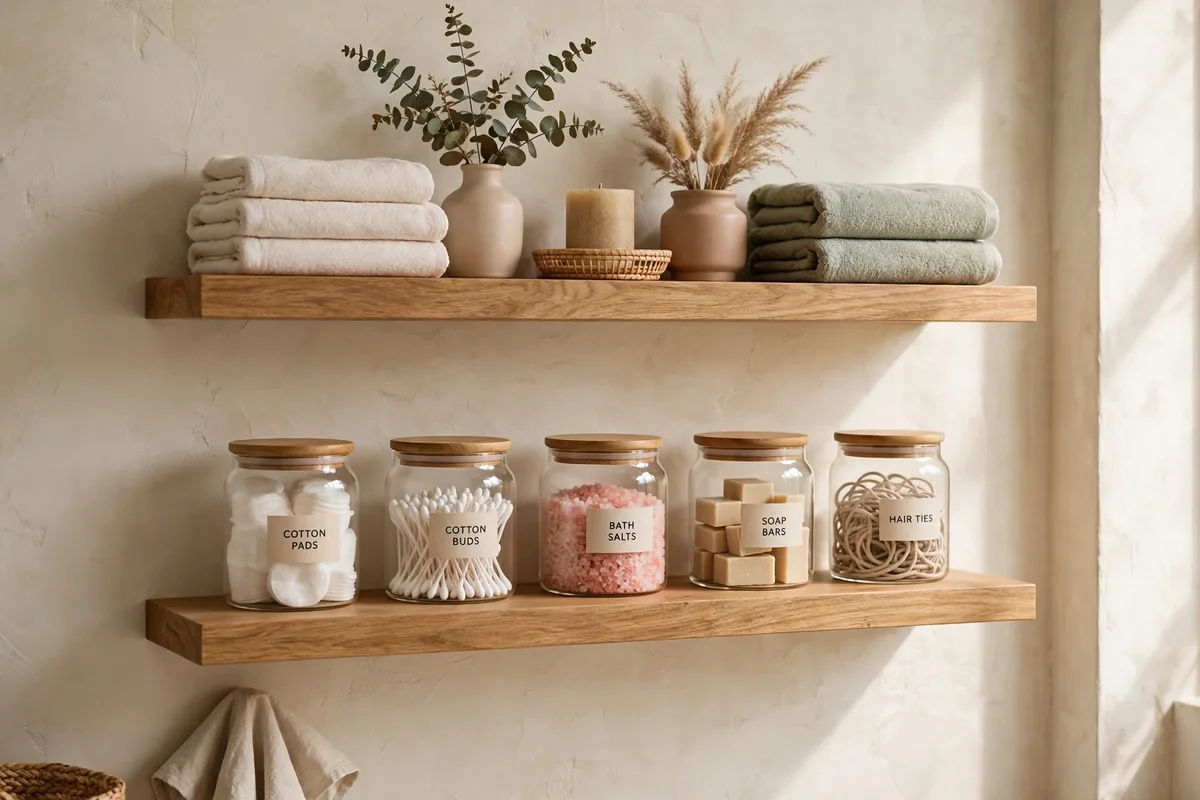
Before arranging anything, assign: this shelf is daily storage, that one is towels, the top one is mostly decor. Lily Ann Cabinets’ floating-shelf styling guide starts with exactly this rule — give each shelf a job, then build its display in layers — because mixed-job shelves are where clutter breeds: the toothpaste migrates beside the orchid and both look wrong. One job per shelf also sets the styling budget: working shelves get containers and discipline; the decor shelf gets the plant and the candle.
Reach decides the assignment. Daily items live between knee and eye height; the top shelf — the one you see but cannot easily reach — is for the light, the pretty and the rarely used. Heavy things go low and close to the wall, where both safety and the shelf’s fixings prefer them.
2. Placement: Heights and Gaps That Work
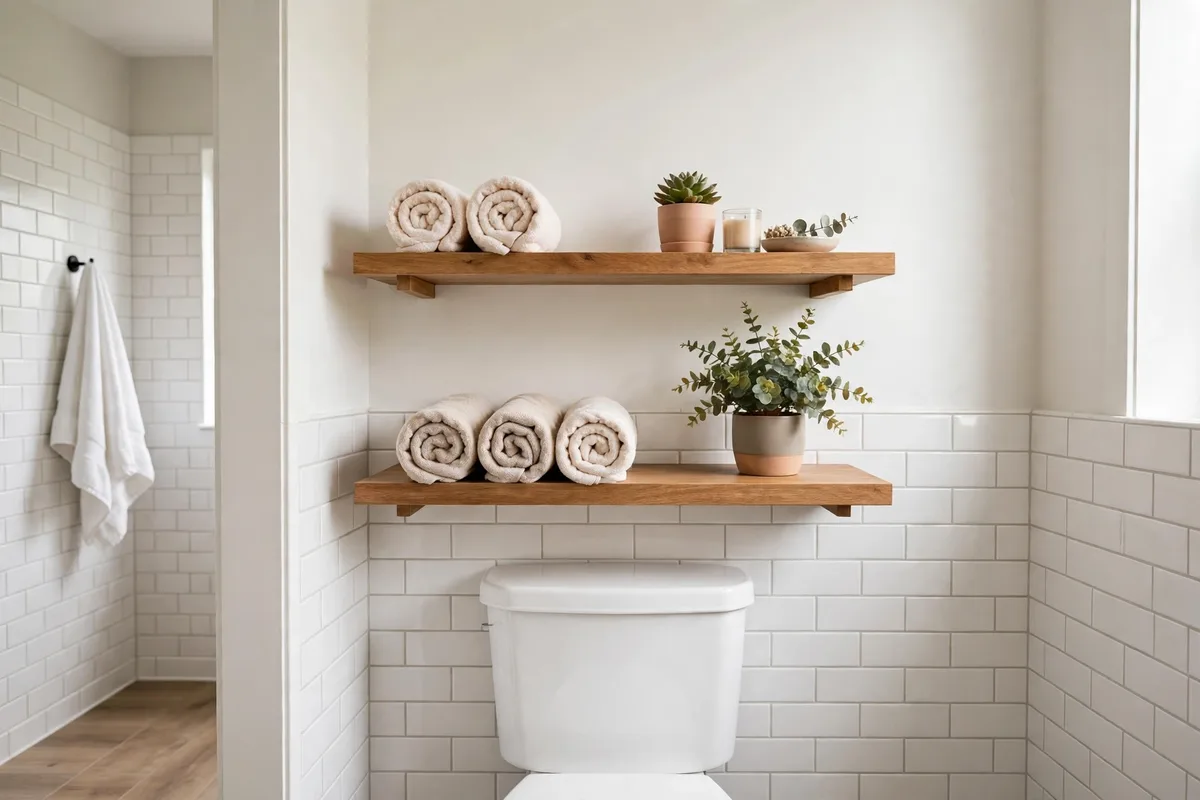
Shelves fail on spacing before they fail on styling. The working numbers, collected in Bathroom Insights’ shelf decor measurements: above a toilet, the bottom shelf sits 10–12 inches above the tank so the lid can lift and nothing feels crowded; stacked shelves run 10–12 inches apart for standard items, opening to 18 where tall bottles or plants need the air; beside a mirror, keep a few inches clear of the frame so the two never argue. Measure your tallest intended object first and let it set the gap — a shelf spacing chosen by eye is a shelf spacing your tallest jar will veto.
Depth matters as much: bathroom shelves work at roughly 6–10 inches deep — enough for a rolled towel or a basket, shallow enough that nothing hides behind anything else. Deep shelves in small bathrooms become cupboards without doors, which is the clutter problem wearing a disguise.
Copy This Shelf: Five Finished Set Pieces
The Two-Shelf Above-Toilet Split
The lower shelf is practical — rolled hand towels and a lidded jar — while the upper shelf is decor: one trailing plant and one framed print. The shelves start 10–12 inches above the tank, with gaps of 10–12 inches between them.
The Above-Sink Tray Shelf
One shelf at comfortable reach holds one tray corralling the whole daily set — soap, toothbrush holder, one scent — so the shelf reads as a single group, not a queue of bottles.
The Corner Stack
Two or three corner shelves fill the dead angle beside the vanity: heavy and practical low (jars, folded towels), light and decorative high (plant, small frame) — the triangle rule doing the work vertically.
The Tank-Top Tray
No fixings at all — a tray on the tank holding a spare roll, a small plant and a scent. It is the renter’s shelf that is not a shelf.
The One-Object Statement Shelf
A single shelf carrying one tall object — a vase with branches, or a stacked pair of books under a ceramic — with the rest of the shelf deliberately bare. The bare third taken to its limit.
Choosing the Shelf Itself
| Shelf type | Best location | Renter-friendly? | Styling note |
|---|---|---|---|
| Floating shelf | Above the toilet, above the sink | No — screws into studs | The default: 6–10 inches deep is enough; concealed brackets keep the line clean |
| Glass shelf | Small or fully tiled bathrooms | No | Disappears against tile and suits the humidity — wipe marks are its tax |
| Picture ledge | Above the sink, along a spare wall | No (two screws, easily filled) | Shallow by design — bottles, frames and small plants only, nothing heavy |
| Ladder shelf | A floor corner, over-tank floor space | Yes — freestanding | The no-drill route; shelves narrow as they rise, which enforces heavy-low, light-high |
| Corner shelf | The dead angle beside the vanity or tub | Depends on fixing | Buys back wasted space; style it as a stack, one group per shelf |
| Recessed niche | In the shower wall or above the bath | No — a building job | The permanent answer; keep its contents to the shower set plus one plant at most |
3. Start Empty, Place the Anchor First
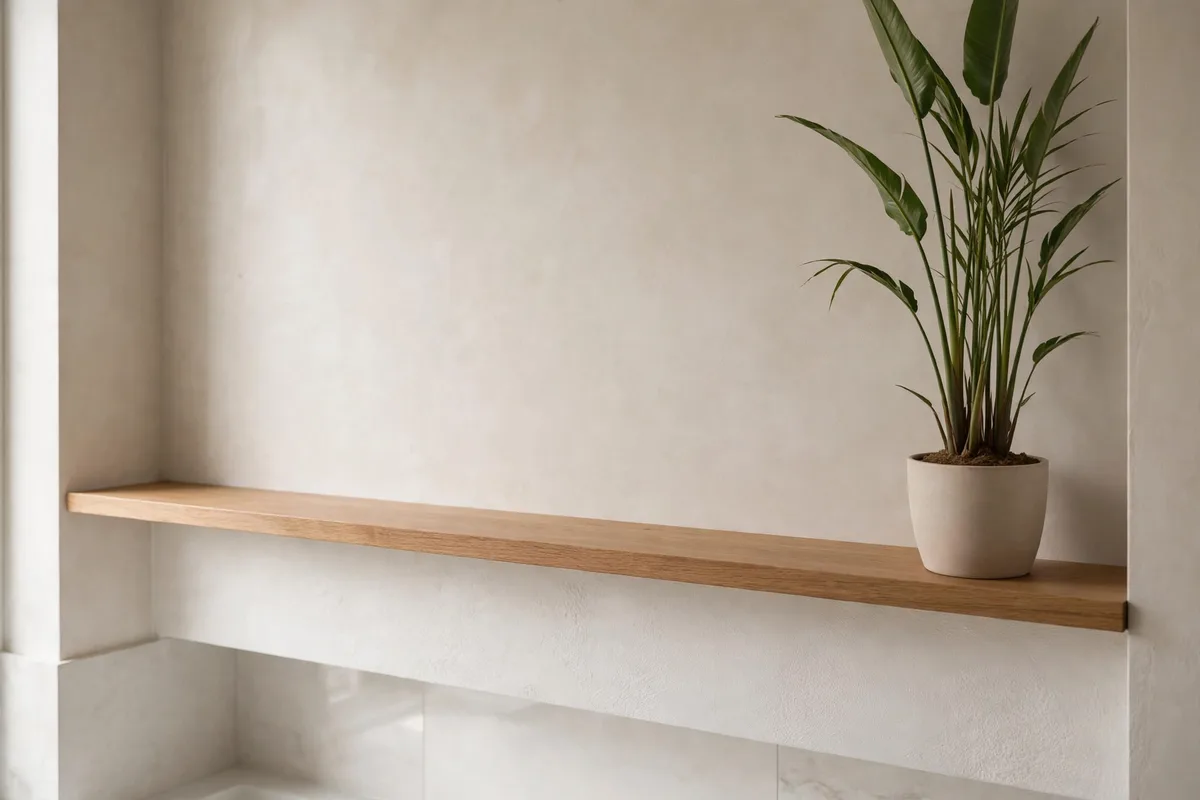
Every good shelf starts as an empty, wiped shelf. Adding to an existing arrangement never fixes it — the eye keeps negotiating with whatever was there. Clear everything off, then place one anchor: the tallest or heaviest piece — a plant, a stack of towels, a large jar — set toward one end rather than the centre. Bathroom Insights’ six-move sequence puts the anchor first for a reason: it fixes the shelf’s high point, and every later piece is placed in relation to it.
Off-centre is deliberate. A centred anchor splits the shelf into two competing halves; an anchor at one end creates a slope — tall to low — that the eye reads as calm composition. Centre placement is for symmetry addicts with matched pairs, and bathrooms rarely have the pairs to sustain it.
4. Group in Threes, Build Triangles
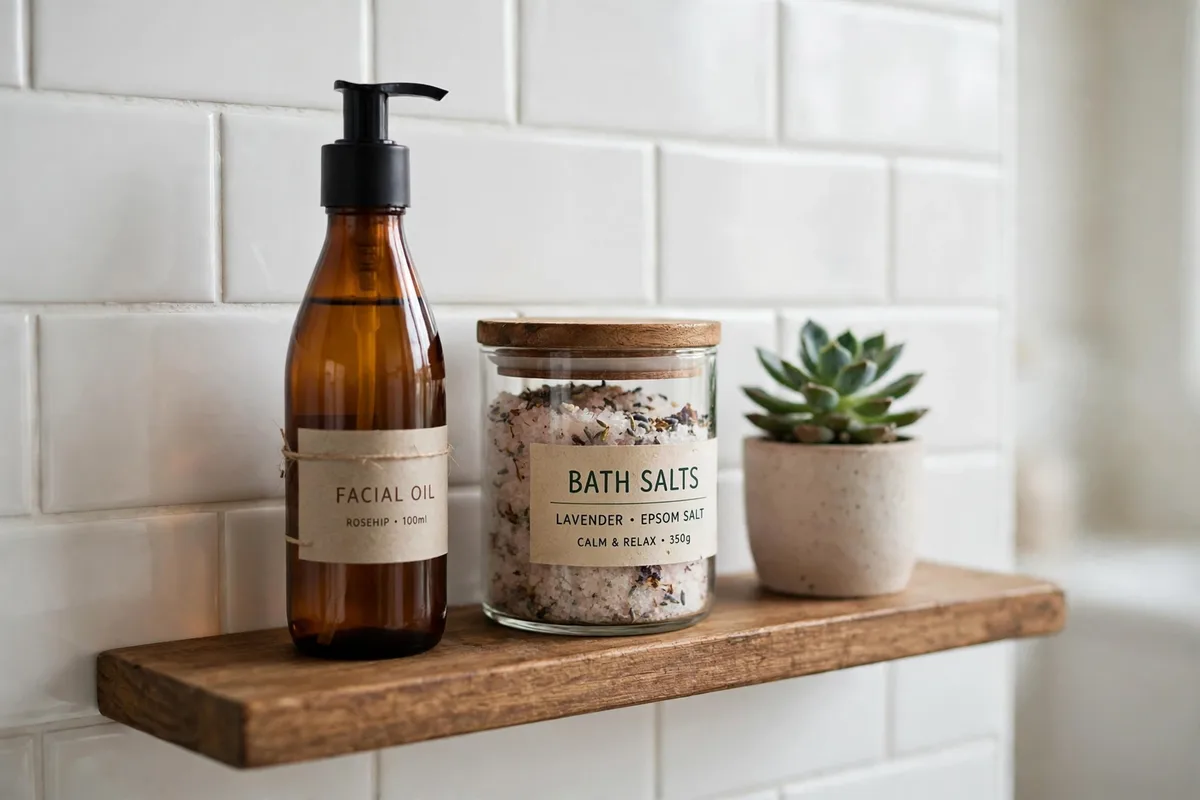
The most reliable styling rule ever written: group in odd numbers — threes and fives — and vary the heights inside each group so it forms a loose triangle: tall, medium, low. Lily Ann’s guide and Bathroom Insights agree on the mechanics: odd groups look natural where even groups look lined up, and a triangle gives the eye a path instead of a row. Between groups, leave a hand’s width of bare shelf — the groups must read as groups, not as a crowd.
Work shelf-wide in one colour story — the two-or-three-tone discipline from our spa-style bathroom palette ideas (white + wood + green is the classic bathroom trio). Colour unity lets the shapes vary freely; shape unity with clashing colours does not return the favour.
5. Leave a Third Bare: Negative Space Is a Material
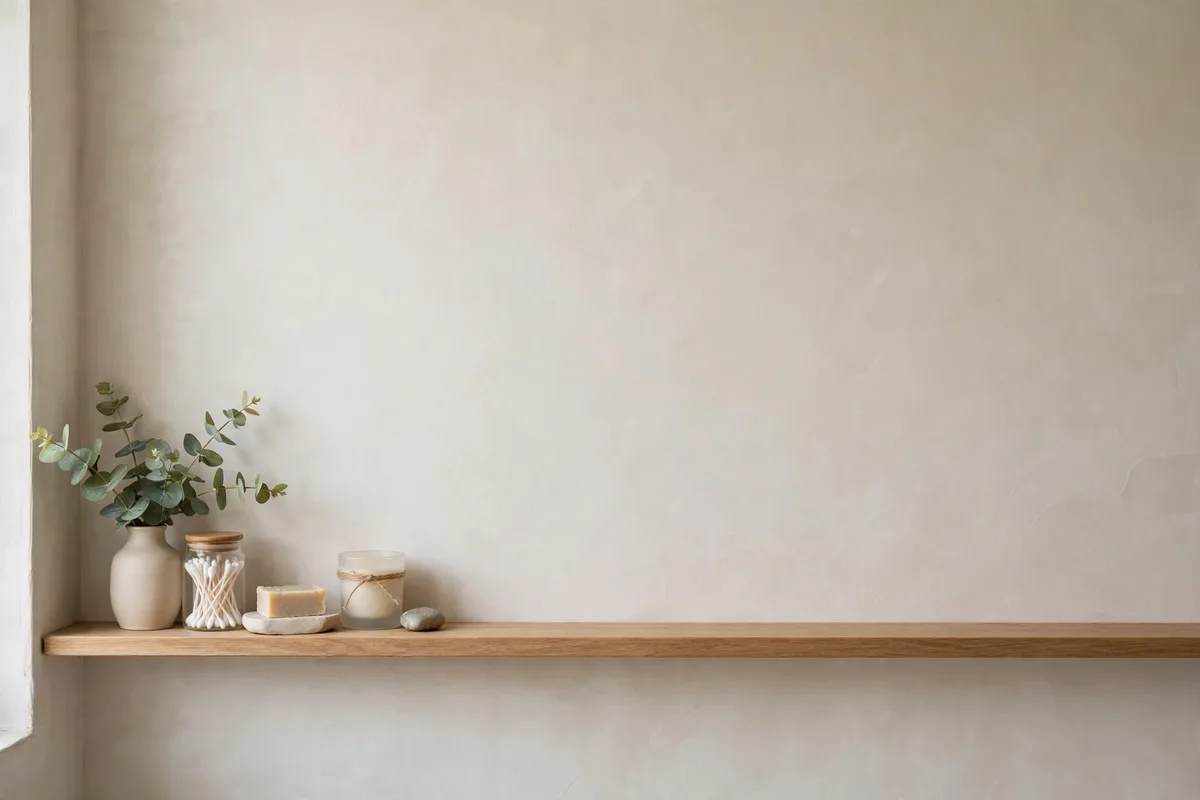
The difference between a styled shelf and a storage shelf is the empty part. The working target across the guides: shelves 60–70% full, roughly a third left bare. That bare third is not wasted storage — it is the visual rest that lets everything else read as chosen, and it is the first thing clutter destroys. When a shelf starts looking busy, the fix is almost never rearranging; it is removing.
In genuinely small bathrooms the temptation to use every inch is strongest and the rule matters most: a crowded shelf shrinks the room it sits in, while a calm shelf borrows the openness logic of our small bathroom visual space ideas — uninterrupted surfaces read as space. Store the overflow in a closed cabinet or a basket elsewhere; the shelf keeps only its cast, not the whole company.
6. Decant: Containers Turn Products Into Decor
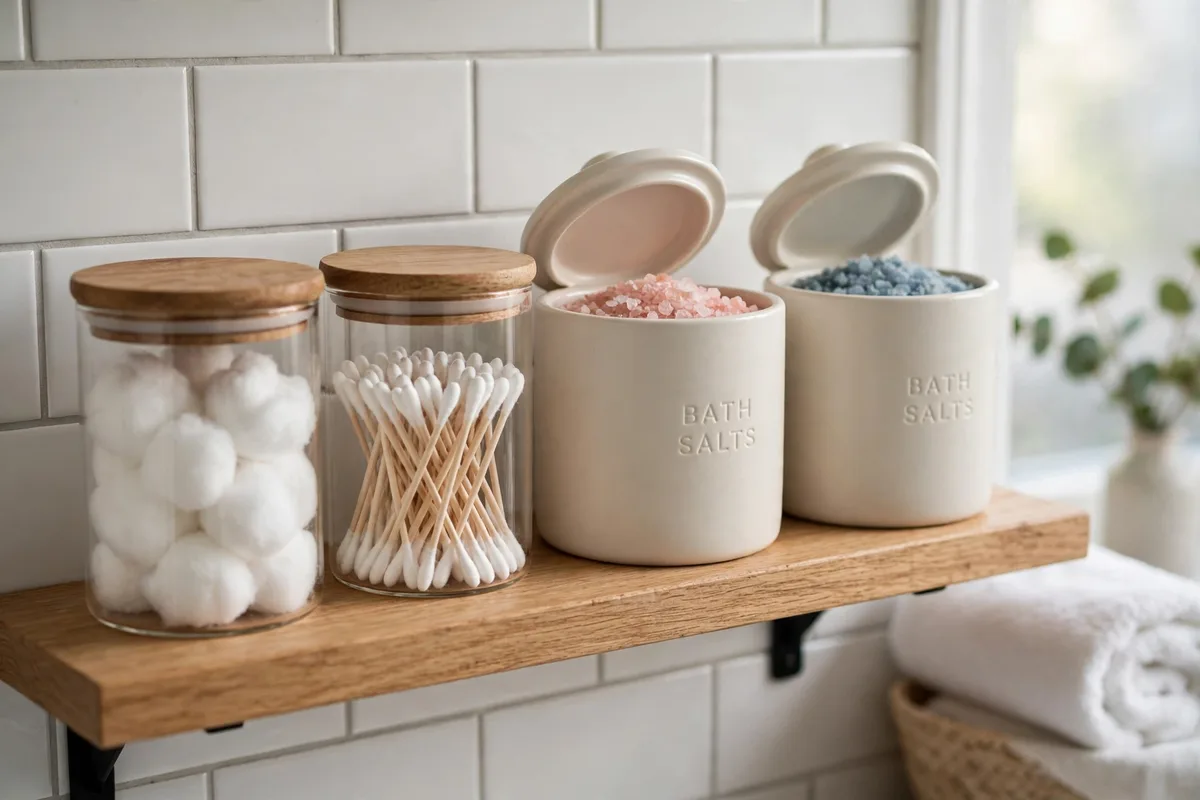
Nothing on an open shelf is neutral: every branded bottle is a tiny billboard in a clashing colour. Decanting is the transformation — cotton goods into glass jars, salts into a lidded canister, the daily products into one matched set of dispensers. The objects become a palette instead of an argument. It is the same move the counter makes in our bathroom vanity styling ideas: one tray, matched vessels, calm.
Choose one container family per shelf — all glass, all ceramic, all woven — and repeat it. Baskets earn a special mention: they are the open shelf’s closed storage, swallowing the visually noisy necessities (spare rolls, hair tools, the medicine-adjacent clutter) while adding the texture every shelf wants. What should never live open: medicine itself (closed cabinet, always) and anything in flimsy packaging that humidity will curl.
7. Towels Are Decor That Works
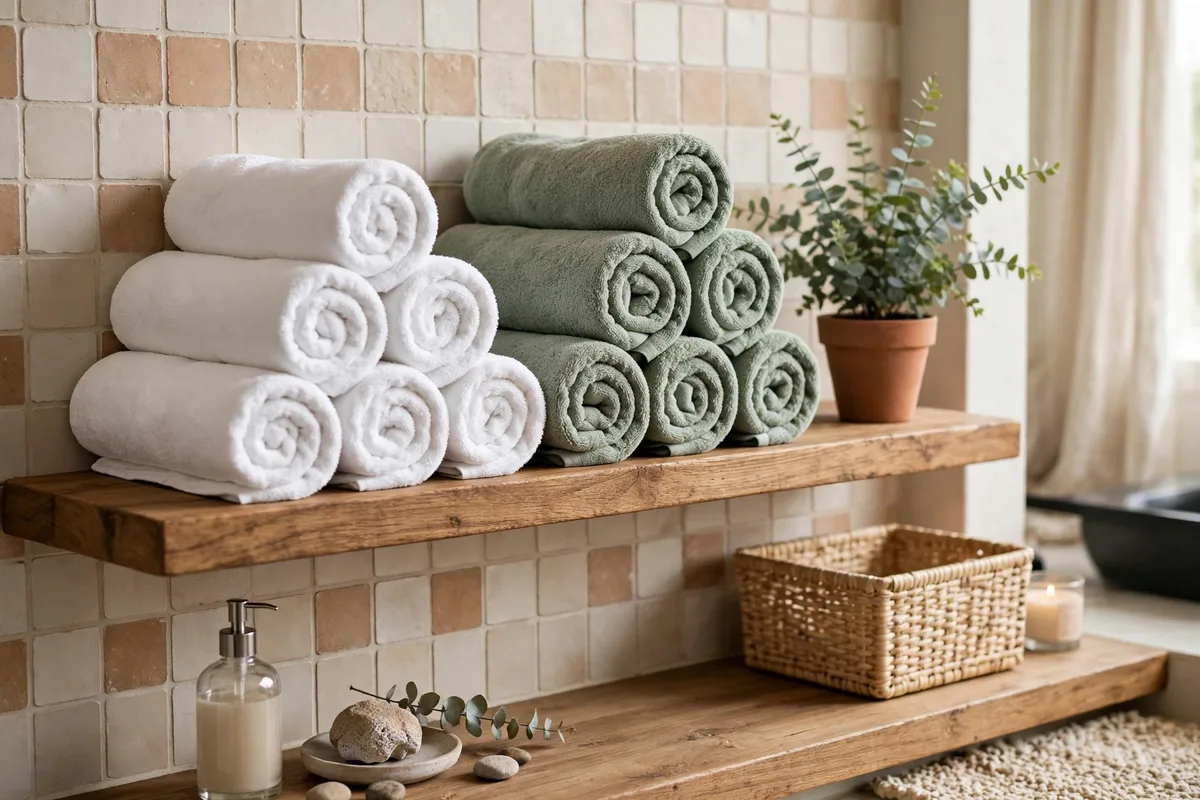
The bathroom shelf’s hardest-working citizen: the towel. Rolled, towels become soft cylinders that fill space, add texture and signal spa; folded in a tidy stack, they become a block of colour. Either way they outperform most decor objects because they are storage and styling in one — and they are the one item whose absence looks wrong. Keep the shelf set matched (the guest set logic from our guest bathroom accents ideas applies): one colour family, consistent size, edges aligned.
Placement: towels anchor beautifully (§3) and they belong on the middle shelves — reachable, visible, and away from both the floor’s splash and the top shelf’s dust. Rotate them through the laundry so the shelf set is always the fresh set, never the archive of towels nobody uses.
8. One Living Thing, One Scent, One Personal Object
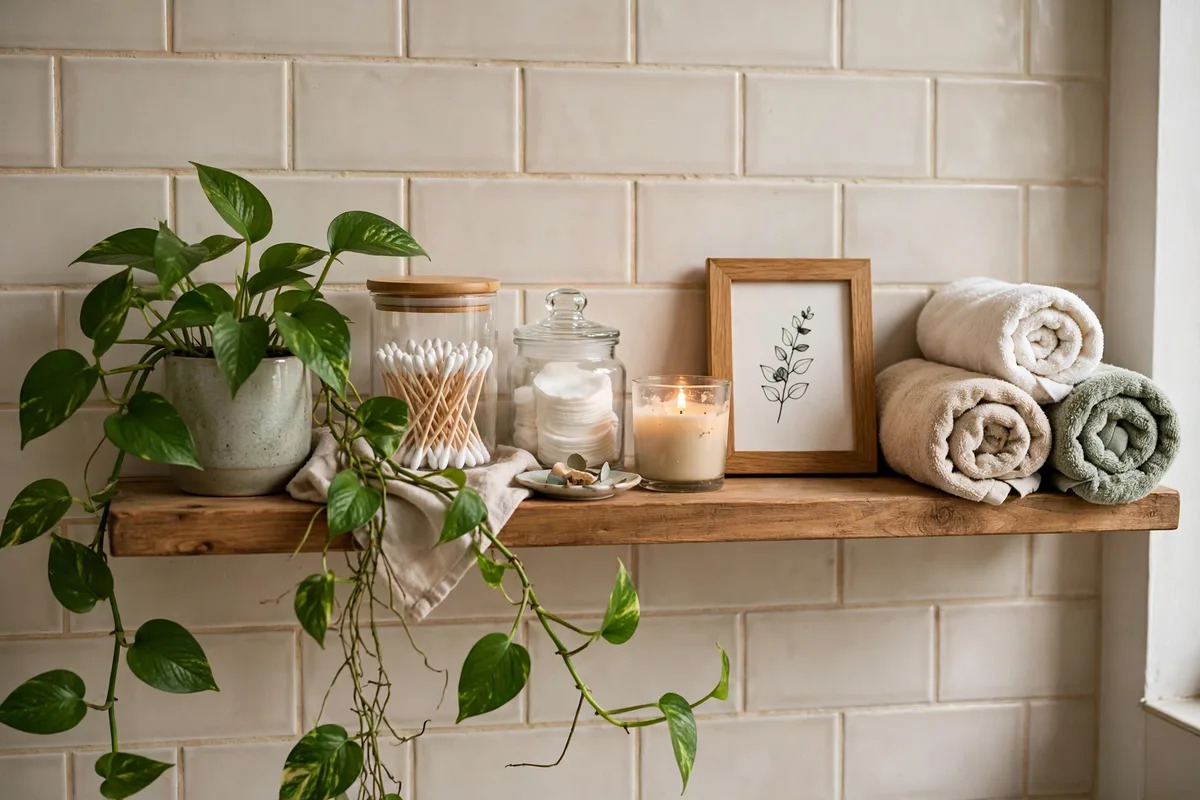
After the functional cast is placed, a shelf needs exactly three non-functional citizens: something living (a pothos trailing off the end, a small fern that drinks the humidity), something scented (one candle or diffuser, unlit décor when not in use), and something personal (a small framed print behind glass, a stone from a beach, one object with a story). One of each — the discipline is in the singularity. Two plants compete; three candles become a shop.
The living thing wants the top shelf or the shelf end, where trailing growth has somewhere to go and light from a window or the vanity layer can reach it. Choose humidity-happy plants; a crispy succulent on a steamy shelf tells a sad story at close range.
9. Materials That Survive the Room
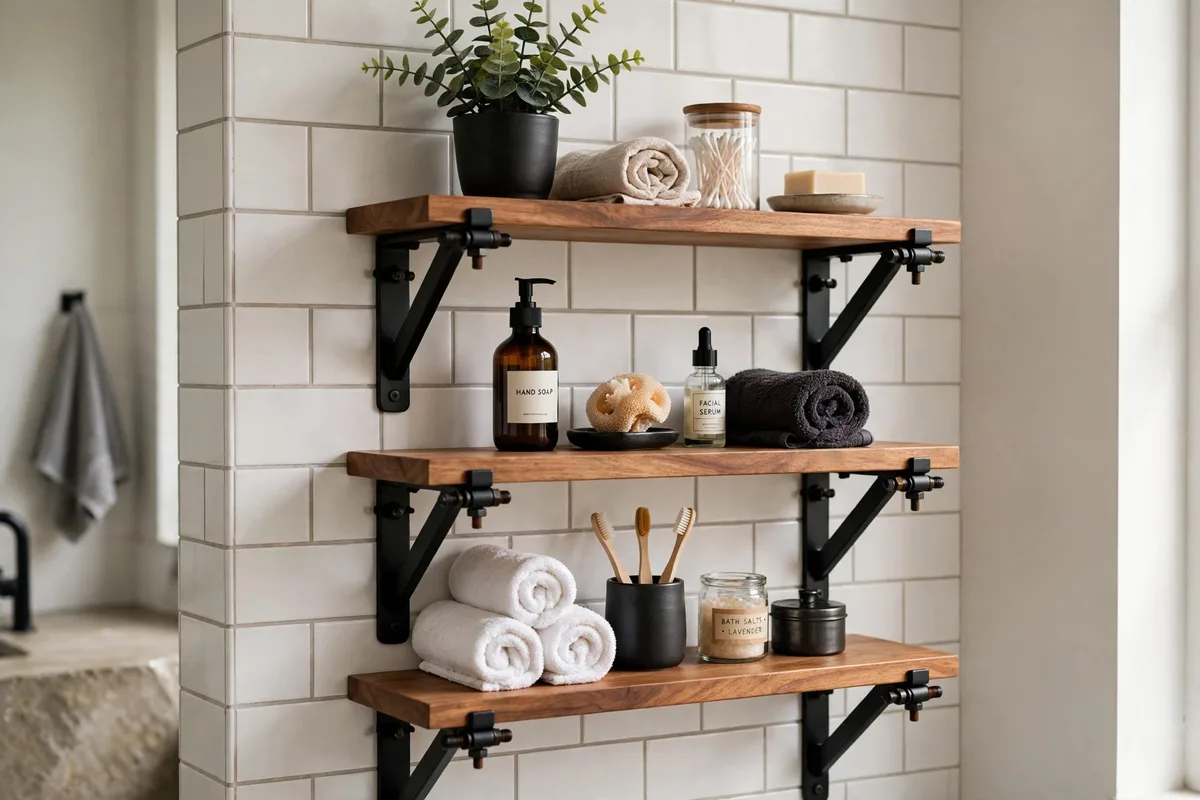
A bathroom shelf lives in the wettest air in the house, and material choice is a survival decision: sealed hardwood, powder-coated or stainless metal, acrylic and glass all shrug off humidity; untreated softwood warps, ordinary steel rusts at the screw heads, and raw MDF swells at the edges. Brackets and fixings follow the same rule — rust-resistant hardware, anchored into studs or with proper tile/drywall anchors, because a shelf’s styling career ends the day it sags.
Contents need the same audit: paper and cardboard packaging curl, electronics corrode, and anything that cannot survive a steamy hour does not belong on an open bathroom shelf no matter how pretty. When in doubt, the shower test decides — if it would suffer in the shower’s air for a week, it lives somewhere else.
10. The Five-Minute Reset: Maintenance Is the Styling
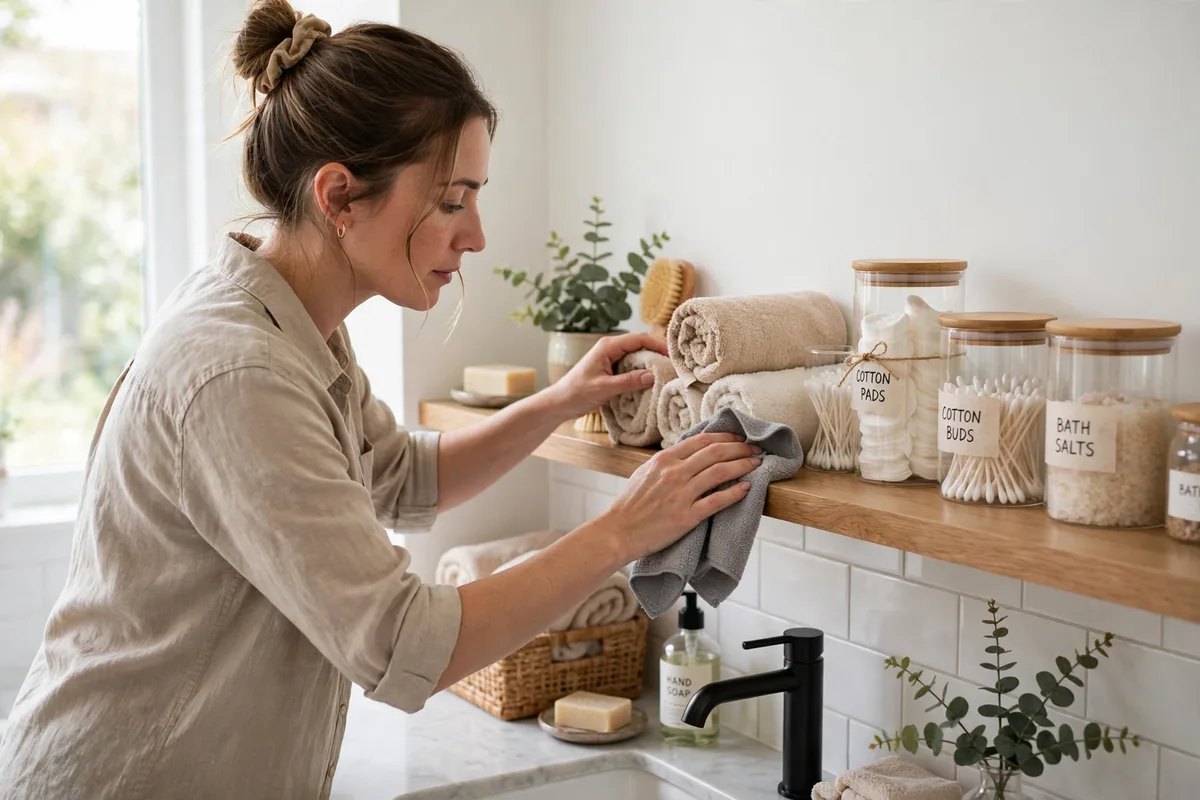
Open shelves are a subscription, not a purchase: they collect dust, product creep and the slow return of every bottle you decanted away. The maintenance rhythm that keeps the styling alive is small and scheduled — a weekly wipe as part of bathroom cleaning, a monthly edit where anything that crept in without a job is evicted, and the doorway test after each edit: stand where visitors stand, squint, and photograph. Bathroom Insights makes the same point — a photo shows crowding the eye forgives in person.
The reset ritual is also the refresh opportunity: rotate one object seasonally (the candle’s scent, the plant, the print) and the shelf feels new without a purchase. Styling is not a state shelves achieve; it is a habit their owners keep — five minutes at a time.
Frequently Asked Questions About Bathroom Shelf Styling
What should I put on bathroom shelves?
Three categories: the useful (towels, decanted daily products, spare rolls in a basket), the living (one humidity-happy plant) and the personal (one candle, one framed print or object). Give each shelf one main job, group items in threes, and leave about a third of the shelf bare.
How far apart should bathroom shelves be?
About 10–12 inches apart for standard items, up to 18 inches where tall bottles or plants need room. Above a toilet, start the lowest shelf 10–12 inches above the tank. Measure your tallest intended object first and let it set the gaps.
How do I stop open shelves looking cluttered?
Remove before you rearrange: cut to 60–70% full, decant products out of branded packaging into one container family, group in odd numbers with bare shelf between groups, and evict anything without a job at a monthly edit. Clutter is a quantity problem, not an arrangement problem.
What materials are best for bathroom shelves?
Sealed hardwood, powder-coated or stainless metal, glass and acrylic — all humidity-proof. Avoid untreated softwood and raw MDF (they warp and swell) and ordinary steel fixings (they rust). Anchor into studs or use proper anchors for tile and drywall.
Should towels be rolled or folded on shelves?
Both work; rolled towels read spa-like and fill round baskets well, folded stacks read tailored and stack higher. Consistency matters more than the choice — one method, one colour family, edges aligned, and the set rotated through the laundry so shelf towels stay fresh.
Can I style shelves in a very small bathroom?
Yes — the rules matter more, not less. Keep shelves shallow (6–10 inches), edit to the bare third strictly, and let one shelf do display while closed storage elsewhere does the hiding. A calm shelf makes a small room feel bigger; a packed one does the opposite.
What should never go on an open bathroom shelf?
Medicine (closed cabinet, especially with children visiting), electronics, paper or cardboard packaging that humidity will curl, and heavy items up high. Also: nothing you would not want a guest to see — open shelves have no privacy, which is their charm and their rule.
How many decorative objects does a bathroom shelf need?
Fewer than you think: one living thing, one scent, one personal object per shelf run is the full cast. Singular objects read as chosen; multiples of decor read as retail. If a shelf feels plain, add texture (a basket, a towel stack) before adding objects.
How do I style shelves above a toilet?
Start the bottom shelf 10–12 inches above the tank, keep the group light and secure (nothing heavy or breakable teetering over porcelain), and favour the calm cast: rolled towels, a lidded jar, one plant. It is the most-seen shelf in most bathrooms, so it earns the strictest edit.
How often do bathroom shelves need restyling?
They need maintenance, not restyling: a weekly wipe, a monthly five-minute edit against product creep, and an occasional seasonal swap of one object. If you follow the rhythm, the original styling lasts indefinitely; if you don’t, no styling survives contact with daily life.
Can I style bathroom shelves without drilling?
Yes. A freestanding ladder shelf, a tray on the tank top, and over-toilet floor-standing frames all style like shelves with no fixings at all; a picture ledge needs only two screws that fill in minutes. Everything in this guide’s grouping, gap and humidity rules applies to them unchanged — only the fixing differs.
Conclusion
A styled bathroom shelf is arithmetic plus honesty: one job per shelf, gaps measured before objects, groups of three with a third left bare, products decanted into one quiet family of containers, and a five-minute monthly edit to hold the line. Do those and the most exposed storage in the house becomes the feature guests photograph — with the same objects you already own.