
The wall behind your bed is the first thing you see from the doorway and the last thing framing the room at night, yet in most bedrooms it is also the plainest wall in the house. An accent wall fixes that imbalance in a single project. Instead of spreading effort thinly across four walls, you give one wall color, texture, pattern, or built-up detail, and the bed instantly becomes a deliberate focal point rather than furniture pushed against drywall.
This guide walks through twelve distinct treatments, from a one-afternoon coat of deep paint to wood slats, molding, wallpaper, limewash, upholstered panels, and fluted walls with lighting. Each idea explains the materials, colors that stay restful, effort involved, and rooms it suits best — whether you own or rent, and whether your bedroom is spacious or compact.
Start with the headboard wall. It is the wall the bed already anchors, it is usually free of doors, and you enjoy it on entry without staring at a busy pattern while falling asleep. Keep the other walls quieter, repeat one accent color in a small dose elsewhere, and test samples in morning and evening light. The same principles in our living room accent wall ideas show how a single focal wall behaves around seating instead of a bed.
| Approach | Effort | Permanence | Rental-friendly? |
|---|---|---|---|
| Deep paint, arch, or two-tone | One afternoon to one day | Easy to repaint | With permission |
| Peel-and-stick wallpaper or fabric panels | A few hours | Removable | Yes |
| Board and batten or picture-frame molding | One weekend | Semi-permanent | Rarely |
| Wood slats, shiplap, or fluted panels | One weekend | Semi-permanent | No |
| Limewash or plaster finish | Half a weekend | Paint over to change | No |
| Stone or brick veneer | Weekend or professional | Permanent | No |
Twelve bedroom accent wall ideas follow — but they sort fastest by four questions: are you a beginner, do you rent, is the room small or low on light, and how much time do you have? Beginners start with paint or a painted arch, the lowest-effort routes in the table. Renters stay with the removable routes in the final section — peel-and-stick and fabric panels — and the table’s rental-friendly column. Small or low-light rooms take a tonal treatment — molding, limewash or pale wallpaper — over a dark one. And one free weekend points to molding, slats, shiplap or veneer, in the table and the time budgets alike.
In this guide: Deep Moody Paint in Forest Green, Navy, or Charcoal · Vertical Wood Slat Wall for Warmth and Height · Board and Batten and Picture-Frame Molding · Botanical Wallpaper and Scenic Murals · Limewash and Soft Plaster Finishes · Upholstered Panel Wall That Replaces the Headboard · Painted Arch and Two-Tone Color Blocking · Faux Stone and Whitewashed Brick Veneer · Gallery Wall and Oversized Art Above the Bed · Fluted Panels with Warm Integrated Lighting · Shiplap and Reclaimed Wood for Cozy Character · Peel-and-Stick and Fabric Panels for Renters · Frequently Asked Questions About Bedroom Accent Walls · Conclusion
1. Deep Moody Paint in Forest Green, Navy, or Charcoal
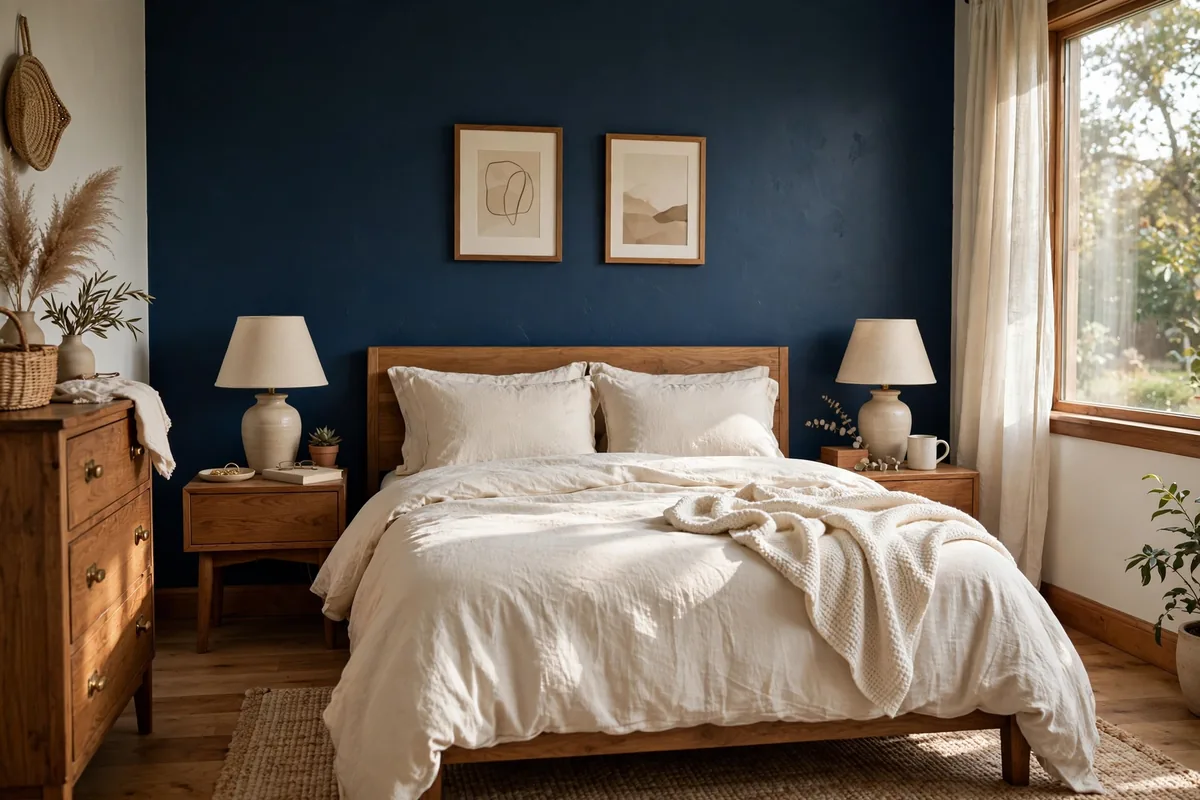
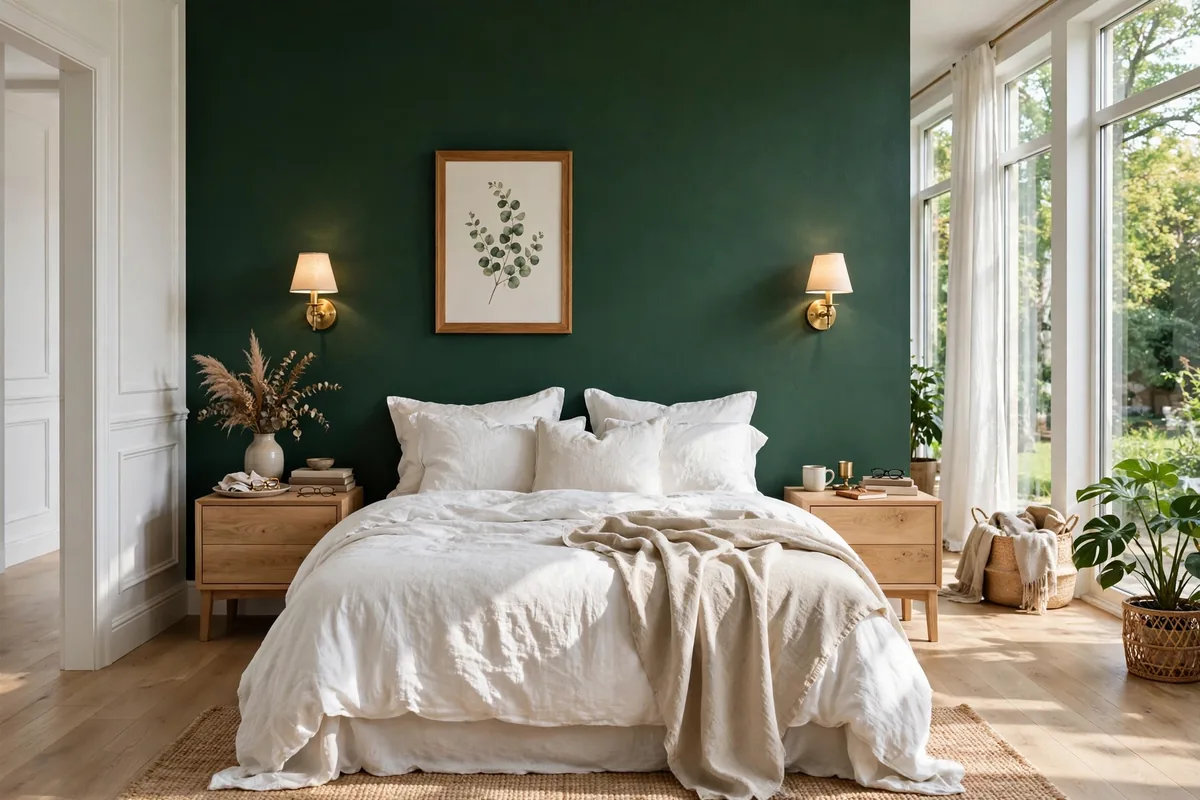
A single wall painted two or three shades deeper than the rest of the room is still the fastest, most reliable bedroom accent wall. Deep forest green, inky navy, warm charcoal, and soft near-black all make white and cream bedding glow by contrast, hide minor scuffs behind the headboard, and create the cocooning feeling most people actually want at bedtime. Choose matte or eggshell: matte reads richest and hides imperfections, while eggshell wipes clean more easily if the wall sits close to a busy doorway.
The method is simple but the testing matters. Paint a large swatch, at least a foot square, and live with it through a full day of changing light before you commit. North-facing rooms cool every color down, so warmer greens and charcoals stay balanced there; bright south-facing rooms can carry cooler navy and slate easily. Roll two coats for true depth, keep the ceiling and side walls light, and finish with warm wood, brass, or aged bronze at the nightstands so the darkness feels warm rather than flat.
Make a dark wall work in a small bedroom
A dark headboard wall does not automatically shrink a small room. Keep bedding pale, choose a low or open headboard, add a light rug, and use two sources of warm lamplight instead of one ceiling light. The dark wall then reads as depth behind the bed, not as a lid on the room. Choosing that restful colour is its own discipline — eight muted palettes compared side by side, with their light pairing, are our calming bedroom color palettes guide.
2. Vertical Wood Slat Wall for Warmth and Height
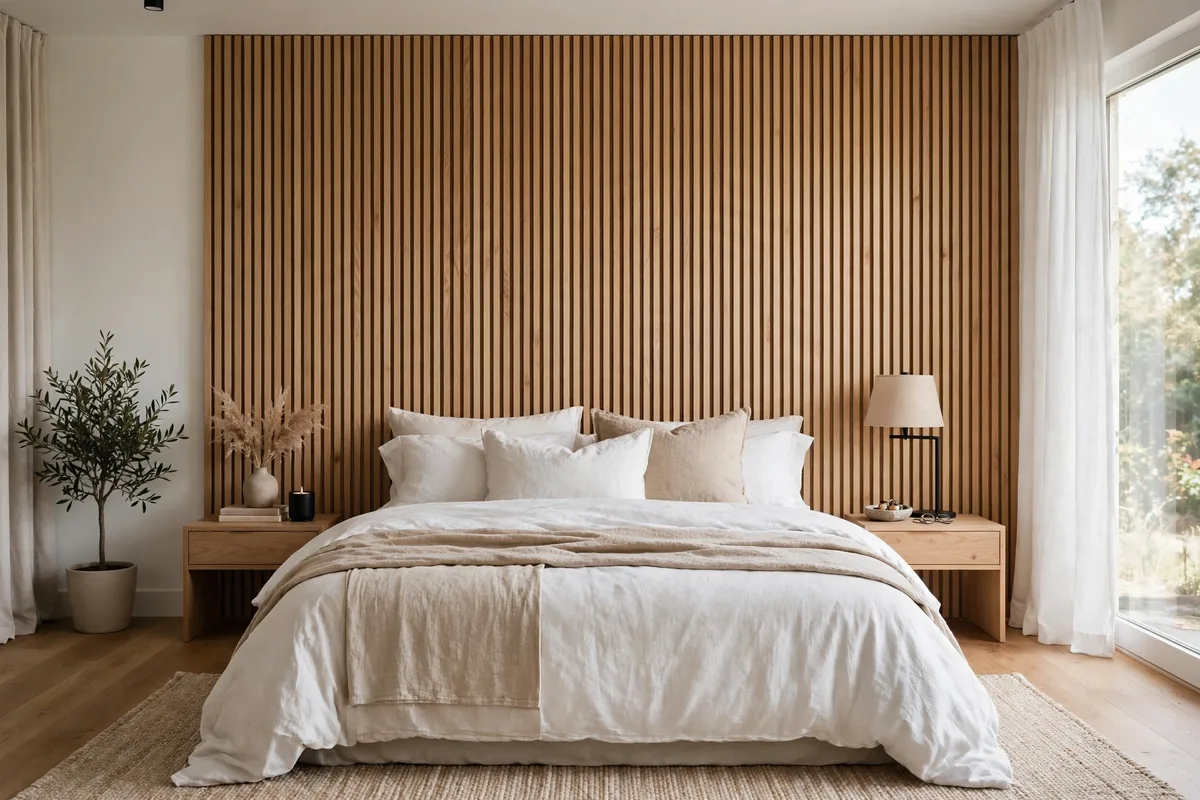
Vertical wood slats turn a flat wall into architecture. Slim battens of oak, walnut, ash, or painted pine, run floor to ceiling behind the bed, add rhythm, shadow lines, and natural warmth that no flat paint can copy. Because the lines point upward, standard ceilings feel taller, and because the material is natural, the wall pairs as easily with Scandinavian and Japandi rooms as with modern and organic ones.
Build it from individual battens over a painted backing, or install ready-made slat panels on felt or plywood for speed. Paint the wall behind a deep tone first, so gaps read as shadow. Keep spacing even, work carefully around outlets, and make the section either the full wall or a centered panel noticeably wider than the bed — an undersized panel looks accidental. Finish with simple bedding; sconces or pendants cast gentle shadows that deepen the effect in the evening.
3. Board and Batten and Picture-Frame Molding
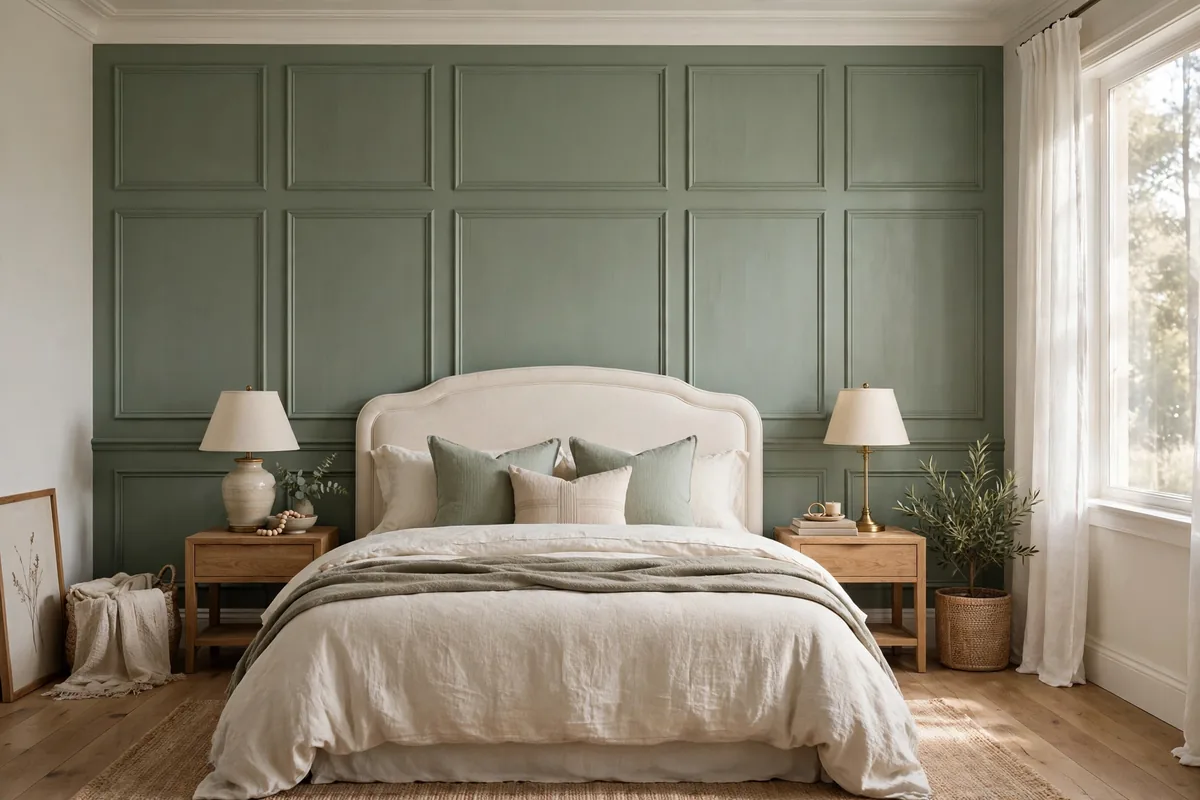
If you like order more than pattern, molding is your accent wall. Board and batten uses vertical battens, often with a horizontal rail, to build a structured grid. Picture-frame molding uses thin trim to create clean rectangles across the wall. Both are painted the same color as the wall beneath them, so the effect is texture and shadow rather than contrast, and both make a plain new-build bedroom feel custom and older in the best way.
Plan the layout with painter’s tape before you cut anything. Decide on three large panels, a symmetrical grid, or tall narrow frames, and check that no batten lands awkwardly across an outlet or switch. Use MDF or primed pine strips, attach, caulk every seam, fill nail holes, sand, and then paint the whole wall as one surface. Sage green, mushroom beige, dusty blue, warm white, and deep olive all show molding beautifully. If your headboard is tall or ornate, choose fewer, larger frames; if the headboard is simple, a finer grid can carry the detail.
- Best for: traditional, transitional, farmhouse, coastal, and modern-classic bedrooms.
- Effort: one weekend with a level, saw, nailer, caulk, and paint.
- Key mistake to avoid: skipping the tape mock-up and discovering uneven spacing after painting.
4. Botanical Wallpaper and Scenic Murals

Wallpaper does what paint cannot: it brings drawn pattern, layered color, and a sense of scene to the wall. A large-scale botanical print, a soft watercolor landscape, a forest mural, or a vintage floral behind the bed can set the entire palette of the room in one move. Papering only the headboard wall keeps the cost and the visual energy under control, while the side walls stay calm in a color pulled quietly from the paper.
Scale makes or breaks this idea. In a generous room, an oversized mural feels luxurious. In a small room, choose a smaller, paler pattern with plenty of background showing. Order extra for pattern matching, and repeat just one or two wallpaper colors in cushions or curtains. Paste paper gives the richest finish; quality peel-and-stick gives renters a removable route, if a hidden test patch removes cleanly.
5. Limewash and Soft Plaster Finishes

Limewash is the accent wall for people who want movement without pattern. Applied with a large block brush in loose, crossing strokes, it dries into soft, cloudy layers of tone that shift as daylight moves across the room. Warm clay, sand, mushroom, creamy taupe, dusty rose, and muted terracotta are natural bedroom choices: they feel aged and calm, and they flatter linen bedding, pale wood, ceramic lamps, and woven rugs.
True limewash needs a mineral surface or its specified primer; limewash-effect paints for ordinary walls are simpler for most bedrooms. Work in small sections, keep a wet edge, and expect two or three coats — one thin coat looks patchy rather than artful. Keep decor minimal: the wall is the artwork. Unsealed limewash is porous and marks where headboard edges rub, so leave a small gap behind the bed and consider a compatible flat sealer.
6. Upholstered Panel Wall That Replaces the Headboard
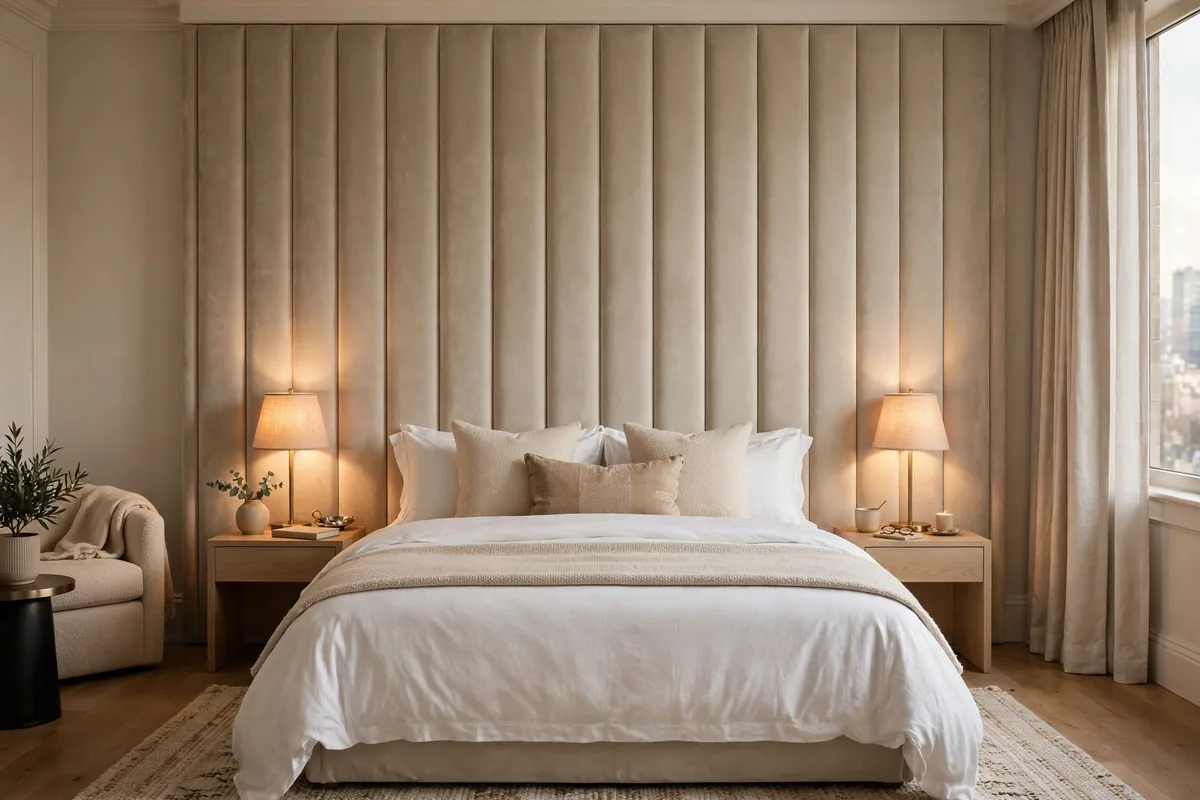
An upholstered wall is the softest possible backdrop for sleep. Fabric-wrapped panels in linen, boucle, velvet, or a suede-look textile, run across most or all of the headboard wall, replace the traditional headboard entirely. Vertical channel panels feel tailored and hotel-like; large square or rectangular panels feel calmer and more contemporary. Beyond looks, the padding softens echo and makes the bed zone feel genuinely quieter and more cocooned.
Neutral fabrics age best: oatmeal, ivory, taupe, camel, dusty blue, and charcoal survive several bedding changes. Mount DIY foam-and-fabric panels, buy modular panels, or commission a full installation. Plan cleaning first — fabric should vacuum easily and tolerate spot cleaning, and pale panels show marks sooner. Add pendants instead of table lamps if panels run behind the nightstands.
7. Painted Arch and Two-Tone Color Blocking
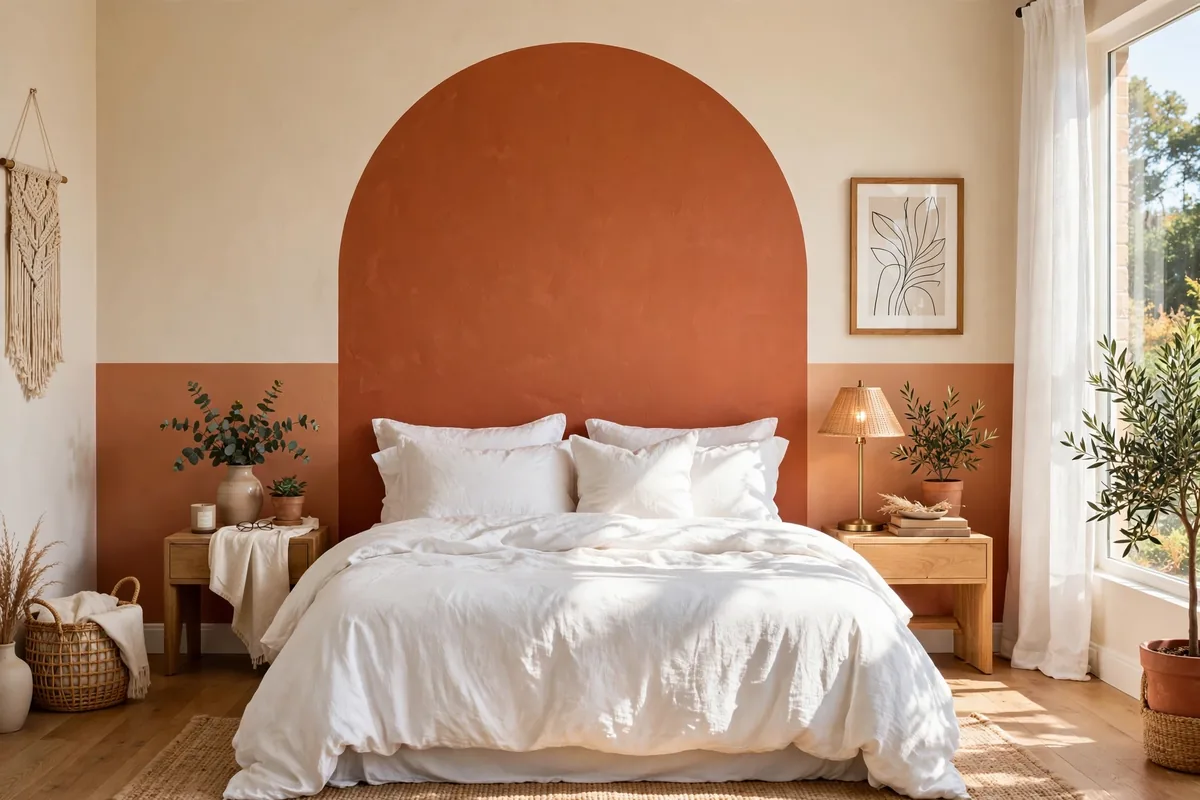
Not every accent wall needs to cover the whole wall. A large painted arch centered behind the bed, a rectangle that frames the headboard like a panel, or a two-tone split with the darker color on the lower portion creates a focal point with paint alone — and leaves most of the wall its original color. Terracotta arches, sage rectangles, and warm beige color fields are especially friendly in small rooms and rentals-with-permission because the shape does the work instead of darkness or pattern.
Measure and draw the shape carefully: the arch or panel should be wider than the bed by a comfortable margin on each side and tall enough to remain visible above pillows and headboard. Use quality painter’s tape or a steady freehand edge with a small brush, seal tape edges with a thin coat of the base color first for a crisp line, then fill the shape in two coats. Keep the palette to two colors plus your bedding neutrals. This is also the kindest budget idea in the guide: one small tin of accent paint can transform the room in an afternoon and repaint just as quickly.
8. Faux Stone and Whitewashed Brick Veneer
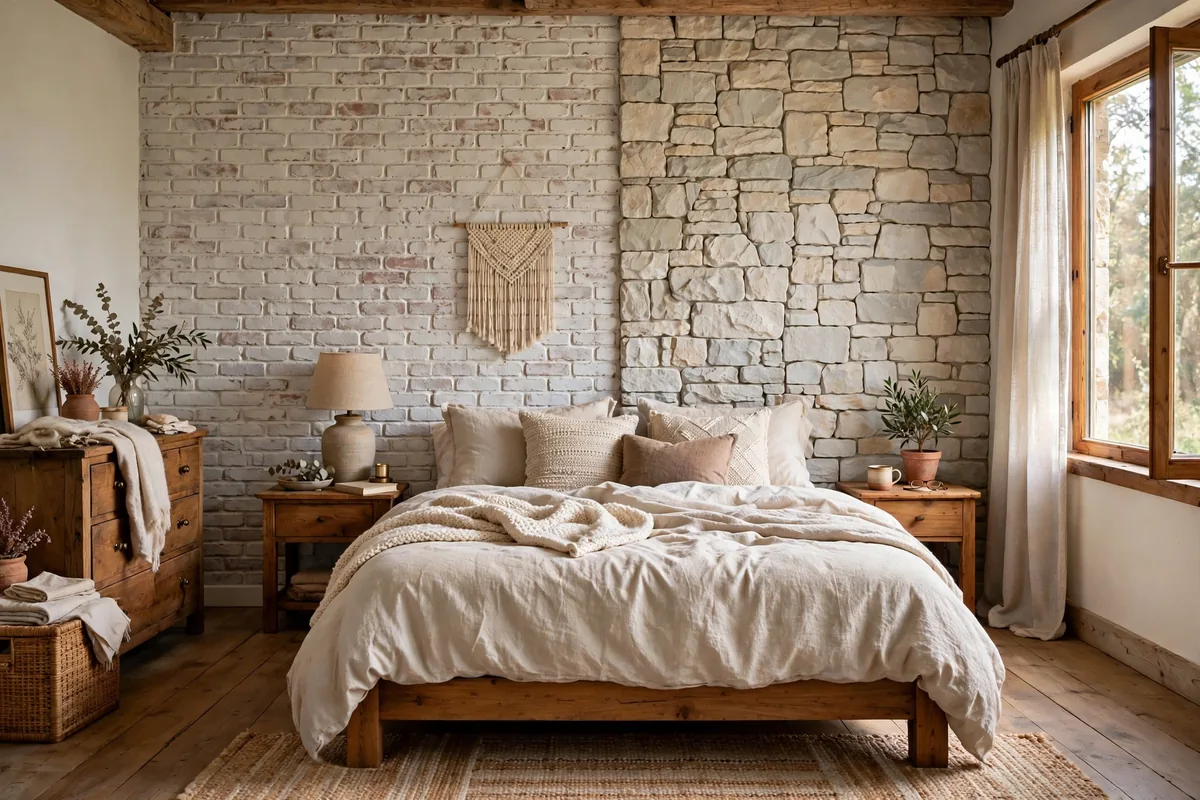
Stone and brick bring weight and history to a bedroom, but real masonry is heavy, costly, and permanent. Veneer solves the problem: thin stone panels, brick slips, and manufactured veneer reproduce the texture and color variation at a fraction of the weight, and many systems install over prepared drywall with adhesive and basic tools over a weekend. Whitewashed or pale brick keeps the look light and coastal; warm stacked stone suits rustic, mountain, and Mediterranean rooms; deeper brick leans industrial and loft-like.
Balance is essential because this material is visually heavy. Pair it with soft, plain bedding, light curtains, and simple nightstands, and skip busy art — at most, one mirror or a pair of sconces. Warm light aimed across the surface reveals the relief that makes veneer convincing. Because cutting is less forgiving than paint, first-timers should use a panel system, follow its fixing instructions exactly, or hire the installation.
9. Gallery Wall and Oversized Art Above the Bed

Sometimes the treatment is not a finish, but what you hang on it. A gallery wall or single oversized artwork turns a plain wall into a personal focal point — and it is the most changeable idea here. One large landscape, abstract canvas, framed textile, or tapestry wide enough to relate to the bed feels more intentional than a scatter of small frames.
Lay the arrangement on the floor or tape paper templates to the wall first. Keep frames a consistent two to three inches apart, hang the center of the group at a comfortable viewing height from standing, and leave clear space between the headboard and the lowest frame so pillows never crowd the art. Choose pieces that share at least one color with your bedding or rug, and keep the wall color quiet so the art leads. For a calmer bedroom mood, favor soft landscapes, muted photography, and textile pieces over high-contrast graphics. If you love the nook-like feeling art can create, a reading chair styled like the corners in our cozy reading corner ideas completes the retreat effect on the other side of the room.
Gallery layouts that work above a bed
- Single statement: one oversized piece centered on the bed — calmest and easiest to hang.
- Triptych: three equal panels in a row — structured, good for wide beds.
- Tight grid: matching frames and mats — formal, forgiving of mixed art.
- Picture ledge: one long ledge with layered frames — changeable without new holes.
10. Fluted Panels with Warm Integrated Lighting

Fluted panels — closely spaced vertical half-rounds or grooves — are the contemporary cousin of wood slats, with a softer, more sculptural profile. Painted fluting in charcoal, deep olive, warm black, or even the same cream as the room creates a wall that changes through the day as light rakes across its curves. Add warm LED strips tucked into a recess, behind a floating panel edge, or along the top of the wall, and the texture glows in the evening instead of going flat.
This is the most planned project here. Decide lighting before panels go up — wiring is far easier first — and use a qualified electrician for hardwired work. Keep light warm and dimmable; cool light turns the wall clinical. Primed, painted fluted MDF is the accessible route. Pair with a simple bed and minimal art: the shadow play is the decoration.
11. Shiplap and Reclaimed Wood for Cozy Character
Shiplap and reclaimed wood are the warmest route to a farmhouse, coastal, or rustic bedroom. Horizontal shiplap reads classic; vertical shiplap draws the eye upward in low rooms. Paint it white for a coastal feel, or sage, navy, or charcoal for a modern take. Reclaimed planks bring real variation in grain and tone, but inspect, clean, and seal salvaged wood before it goes behind a bed.
Installation rewards patience: find studs, keep boards level, and stagger joints so the wall looks built rather than tiled. In small bedrooms, limit strong wood tones to the headboard wall and keep flooring lighter, so the room does not turn into a wooden box. A single large artwork or a pair of simple pendants is enough styling on top; busy decor competes with the boards.
12. Peel-and-Stick and Fabric Panels for Renters
Renters are not limited to posters. Removable wallpaper, fabric panels, tapestries on a slim rail, and even a folding screen or extra-wide headboard can create an accent effect that leaves with you. Linen stretched over lightweight frames makes soft panels; peel-and-stick grasscloth-look paper adds texture without paste.
Protect your deposit with three habits. First, test any adhesive product in a hidden area and wait to see how it removes. Second, photograph the wall before you start, so move-out comparisons are easy. Third, keep fixings minimal and removable — adhesive hooks and strips rated for the weight, picture ledges resting on existing fixings where possible, and nothing heavier than you would trust above your own pillows without a proper anchor. Choose one strong idea and do it neatly; a tidy removable wall always looks better than several half-committed ones.
Frequently Asked Questions About Bedroom Accent Walls
Which wall should be the accent wall in a bedroom?
Choose the wall behind the headboard in almost every case. The bed is already the largest piece of furniture and the natural focal point, so accenting its wall reinforces the room’s order instead of creating a competing one. Only choose a different wall if the headboard wall is mostly windows, doors, or built-in storage.
Should a bedroom accent wall be darker or lighter than the other walls?
Darker usually works better behind a bed because it adds depth and makes pale bedding stand out. Lighter or tonal accent walls — molding, limewash, pale wallpaper, or fluting painted the room color — suit very small or low-light bedrooms where darkness would feel heavy, and they work through texture rather than contrast.
Will a dark accent wall make my small bedroom feel smaller?
Not if you balance it. Keep the ceiling, side walls, bedding, and rug light, use a low headboard, and add warm lamplight on both sides of the bed. The dark wall then reads as a deep backdrop that pushes the bed forward visually, rather than closing the room in.
What is the easiest bedroom accent wall for a beginner?
Paint is the easiest: a solid deep color, a two-tone split, or a painted arch needs only tape, a roller, and an afternoon. Peel-and-stick wallpaper is the next step up. Save molding, slats, and veneer for when you are comfortable measuring, cutting, and filling, or hire those stages out.
How do I choose an accent color that stays restful?
Start from colors already in the room — pull a deeper version of a tone in your rug, curtains, or bedding rather than introducing a brand-new hue. Favor muted, slightly grayed colors over pure brights, test a large swatch in morning and evening light, and repeat the color in only one or two small accessories.
Can I combine an accent wall with a tall or ornate headboard?
Yes, if one of them steps back. Pair a tall or detailed headboard with a simple wall — flat paint, limewash, or large-scale molding — and pair busy wallpaper or strong texture with a low, plain headboard. When both compete at the same visual weight, the bed zone looks restless instead of layered.
What wallpaper pattern scale works best behind a bed?
Large-scale patterns and murals suit larger rooms and wide beds, where the motif can repeat or unfold properly. Small rooms and narrow walls do better with smaller, paler patterns with plenty of background showing. Always check how much of the pattern the headboard and pillows will hide before you order.
Are accent walls still a good idea, or do they date a bedroom?
A single considered wall does not date a room; rushed, overly themed treatments do. Timeless choices — deep paint, wood, molding, plaster, and quiet wallpaper in colors drawn from your own furniture — age slowly and repaint or repaper easily. Choose the treatment you would still like if the trend pages moved on.
How much should I budget in time for each type of accent wall?
Allow an afternoon for paint or a painted arch, a few hours for peel-and-stick wallpaper or hanging a gallery, half a weekend for limewash, and a full weekend for molding, slats, shiplap, or veneer. Fluted walls with new lighting take the longest because the electrical work comes first. Always add prep and drying time on top of installation time.
How do I maintain and clean an accent wall behind a bed?
Dust textured walls, slats, fluting, and veneer regularly with a soft brush or vacuum attachment, since the headboard zone collects dust quietly. Wipe painted eggshell and sealed surfaces with a barely damp cloth, vacuum upholstered panels gently, and avoid soaking limewash, grasscloth, and unsealed plaster. Check fixings on art and ledges above the bed at least once a year.
Conclusion
A bedroom accent wall succeeds when it does one job clearly: it gives the bed a backdrop worthy of the rest you want the room to deliver. Deep paint offers that transformation in an afternoon, wood and molding build it into the architecture, wallpaper and murals paint it as a scene, limewash softens it into atmosphere, and upholstered or fluted walls turn it into comfort and light. The right choice is simply the one that matches your room’s light, your headboard, your tenure in the home, and the hours you honestly have.
Pick one idea from this guide, test its color or a sample of its material on the real wall, and finish it completely — including the bedding tweak, the lighting balance, and the one small repeat of its color across the room. That finished single wall will do more for your bedroom than a month of scattered decorating, and it will greet you, calmly and deliberately, every single night.



Pingback: Calming Bedroom Color Palettes: 8 Compared Side by Side