Most reading corners do not fail because the chair is wrong. They fail in the first two minutes: the lamp glares, the blanket is in another room, your glasses are in the kitchen, and by the time you have gathered everything, the moment has passed. Coziness is rarely about buying a better corner. It is about the small sensory details and rituals that make the corner you have feel like a retreat the second you sit down.
That is what these ten tips are for. Each is a quick upgrade you can copy tonight — where to aim the warm light, how to set up a tray so a session starts in seconds, which blanket belongs in which season, how to quiet an echoey wall, and how to fake enclosure. None requires new furniture. If you are still building your corner from scratch, our step-by-step cozy reading corner design guide covers the full setup in order; this article picks up where that one ends, with the finishing touches that make a corner actually get used.
1. Set a Warm Glow at Shoulder Height for Evening Reads

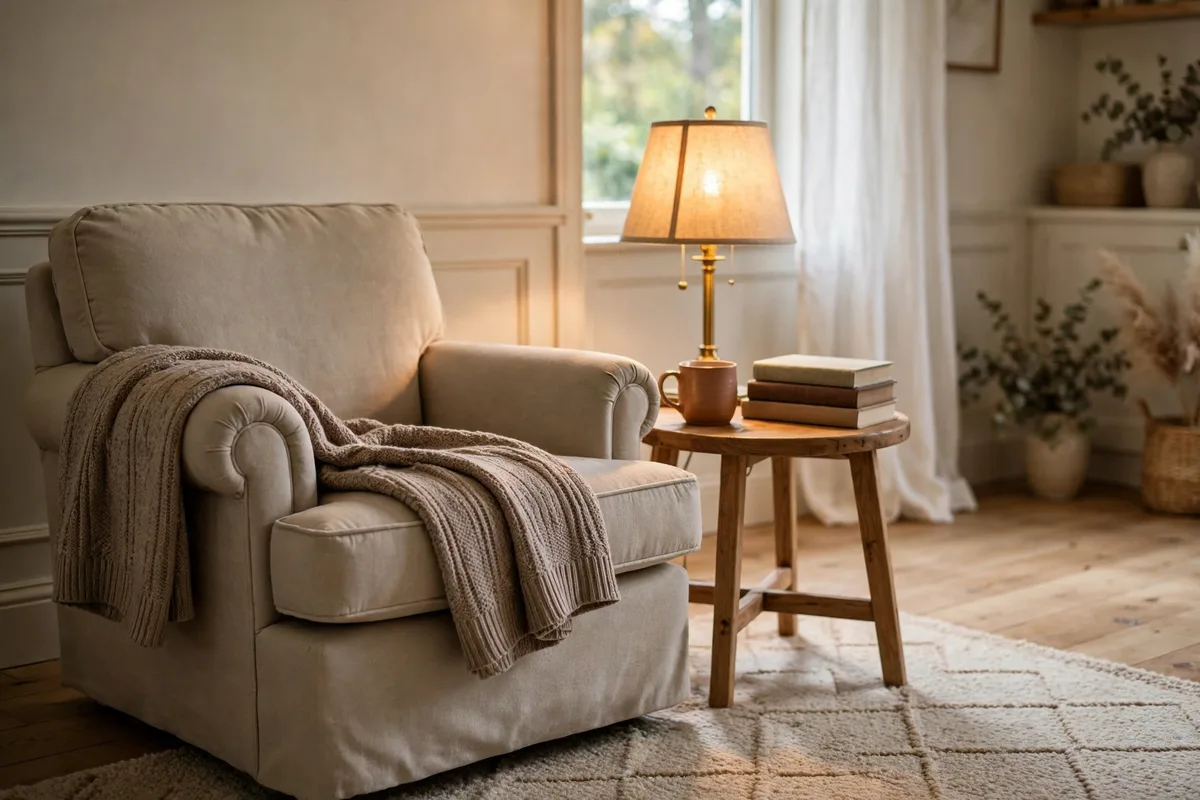
Daylight flatters every reading corner, but most reading happens after dark — and that is where one placement change makes the biggest difference. Instead of relying on a ceiling light, put a warm light source at about shoulder height, just behind and to one side of your chair. Sit down, hold your book where you normally hold it, and adjust until light falls across the page from over your shoulder, not into your eyes. A table lamp raised on books, a floor lamp pulled closer than you think it should be, or a clip-on light all work — height and angle matter more than the fixture.
Test it honestly: read two full pages. If you are squinting, leaning toward the light, or seeing your head’s shadow, move the lamp higher and further behind you and test again. Warm-toned bulbs feel calmer than cool white ones, and a fabric shade softens the glow so the corner feels lit, not spotlit. Once you find the spot, leave the lamp there — a light that must be fetched and aimed gets skipped.
Evening light checks
- Light lands on the page from over your shoulder, never in your eyes.
- The glow is warm, not blue-white — check the bulb first.
- A shade or diffuser softens the edges of the glow.
- The switch is reachable from the chair.
2. Keep a Ready-to-Read Tray So the Ritual Starts in Seconds

Corners that get used daily share one secret: everything the session needs is there. Set a small tray on your side table and load it once — a coaster, your bookmark, your glasses, a lip balm if you use one, and room for a mug. That tray is the whole ritual. Making tea and setting the mug on the tray becomes the two-minute ceremony that tells your brain the day is over and the book is starting.
Size the tray to the table: it should hold the mug and small items with air around them, leaving part of the surface free for the book. Raised edges keep glasses and bookmarks from migrating to the floor, and a grippable rim makes it easy to lift everything away in one move. Restock as you leave — glasses on the tray, bookmark in the book — so tomorrow’s session needs nothing but the tea.
What lives on the tray
- A coaster and space for one mug — the drink has a home.
- Your reading glasses, so they stop travelling the house.
- The current book’s bookmark, kept with the book.
- One small comfort: lip balm, hand cream, or a glasses cloth.
3. Match Your Blanket Weight to the Season

A reading blanket has a different job from a bed blanket: you sit upright under it, pull it on and off in a session, and it lives in the open, where it must look right folded as well as feel right in use. The mistake most corners make is owning one blanket for the whole year — too hot in July, not enough in January — so the corner goes unused for months. The fix is a small rotation of weights, swapped as the room’s temperature changes, not as the calendar dictates.
Keep the everyday blanket folded in thirds over the chair arm, where it pulls across your lap in one motion and looks intentional. Store off-season weights in a basket beside the chair, washed and ready, so the swap takes a minute. Two lighter layers adjust more precisely than one heavy one — shed the top layer mid-chapter without standing up — so when in doubt, layer rather than bulk up.
| Season | Blanket choice | Why it works |
|---|---|---|
| Summer | Light cotton or linen throw | Breathes in a warm room without trapping heat |
| Spring and fall | Mid-weight knit or plush throw | The everyday default — warm, and easy to shed |
| Winter | Heavy wool throw or a weighted lap blanket | Blocks drafts and adds settling, even pressure |
| Cold snap | Your winter blanket plus a second light layer | Two layers trap warmth and adjust easily |
Choosing the weight you will actually use
- Lap size is plenty for one reader — oversized throws pool on the floor.
- Pick fabrics that grip upholstery; slippery weaves slide off all evening.
- Washable beats precious: the blanket meets skin, drinks, and pets daily.
4. Soften Echo With One Soft Surface Behind the Chair

Some corners look perfect and still feel wrong, and the culprit is usually sound. A chair against a bare wall in a hard-floored room bounces every page turn and noise from the rest of the house back at you, and the corner feels exposed instead of sheltered. You do not need to soundproof anything. One soft surface behind the chair — the wall closest to your head — absorbs enough bounce to make the corner feel quieter and more separate.
The options are ordinary household things: a curtain panel behind the chair, a woven hanging, a folded throw over the chair’s back, or a filled bookshelf, whose uneven spines break up sound beautifully. A rug helps, but the surface behind you does the most work — it sits nearest your ears. Test it: hang a spare blanket over the chair back for one evening. If the corner feels calmer — in most hard-surfaced rooms it does — make the soft layer permanent in a form you like looking at.
Soft-surface options by effort
- Zero effort: a folded throw over the chair back.
- Low effort: a curtain panel on a tension rod behind the chair.
- Medium effort: a woven hanging or tapestry on the wall.
- Already there: a filled bookshelf behind the chair.
5. Put a Plant or Natural Texture at Eye Level

Try a small test: sit in your chair, look up from the page as you do when you pause to think, and notice where your eyes land. In most corners it is a blank wall, a door frame, or the back of the television. Whatever sits in that sightline becomes the backdrop of every session, so choose deliberately: one plant or natural texture, at seated eye level where your gaze rests.
It need not be a statement plant. A small pot on a wall shelf, a trailing plant on a bookcase top, or dried grasses in a vase all work, as long as they sit where your eyes lift to — not by the floor, not over your head. If a live plant is not realistic in a dim corner, cheat honestly: dried stems, a woven basket, driftwood, or a botanical print give the same texture without the watering schedule. Keep it to one piece. A shelf of plants turns the sightline into a chore list; one calm green shape turns it into a view.
Placing the eye-level piece
- Sit down and look up — place the plant where your eyes land.
- One piece is enough: a small pot, trailing leaves, or dried stems.
- In dim corners, choose dried or woven textures over a live plant.
- If table space is tight, use a wall shelf or bookcase top instead.
6. Fake Enclosure With a Curtain or Screen Backdrop
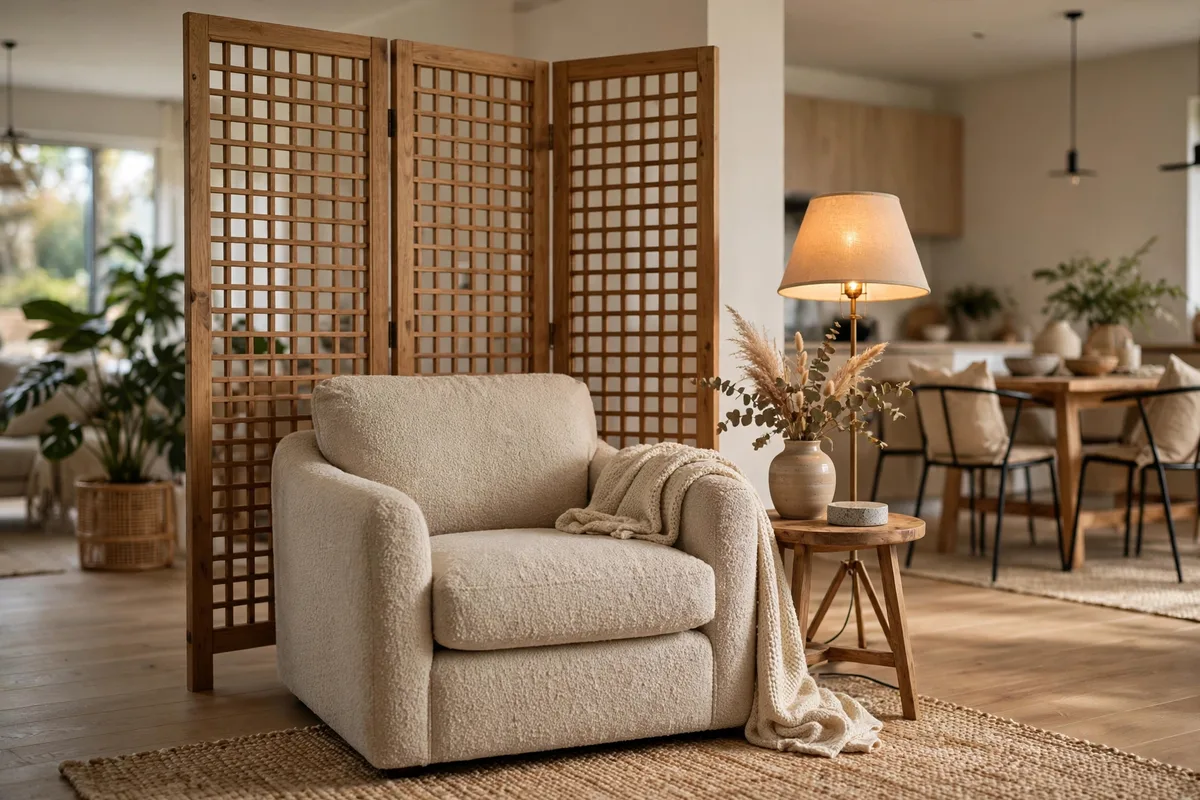
Corners feel cozy partly because two walls wrap around you. In an open-plan room, a chair often gets one wall — or none — and never feels like a retreat, however good the chair is. The fix is to manufacture the missing wall: a backdrop behind the chair that gives your back something solid to rest against. A folding screen, a curtain panel on a stand, or a tall bookcase turned as a divider all create that shallow sense of enclosure.
Placement is simple: the backdrop goes a short distance behind the chair — close enough to feel part of the corner, far enough that you can tilt the chair back without knocking it. A curtain is the softest option and pairs with the echo-softening tip above; a screen is the most flexible, folding away when the room opens up; a bookcase works hardest, adding storage as it divides. Keep the front open — enclosure should wrap your back, not box you in. Readers browsing complete cozy reading corner ideas will notice how many inviting looks quietly use this same backdrop trick.
Choosing your backdrop
- Curtain panel: softest feel, best sound softening, needs a rod or stand.
- Folding screen: most flexible, folds flat when the room changes.
- Tall bookcase: adds storage while it divides, heaviest to move.
- Tall plant row: lightest touch — partial enclosure, light still passes.
7. Limit Your Current Reads Stack to Three Books
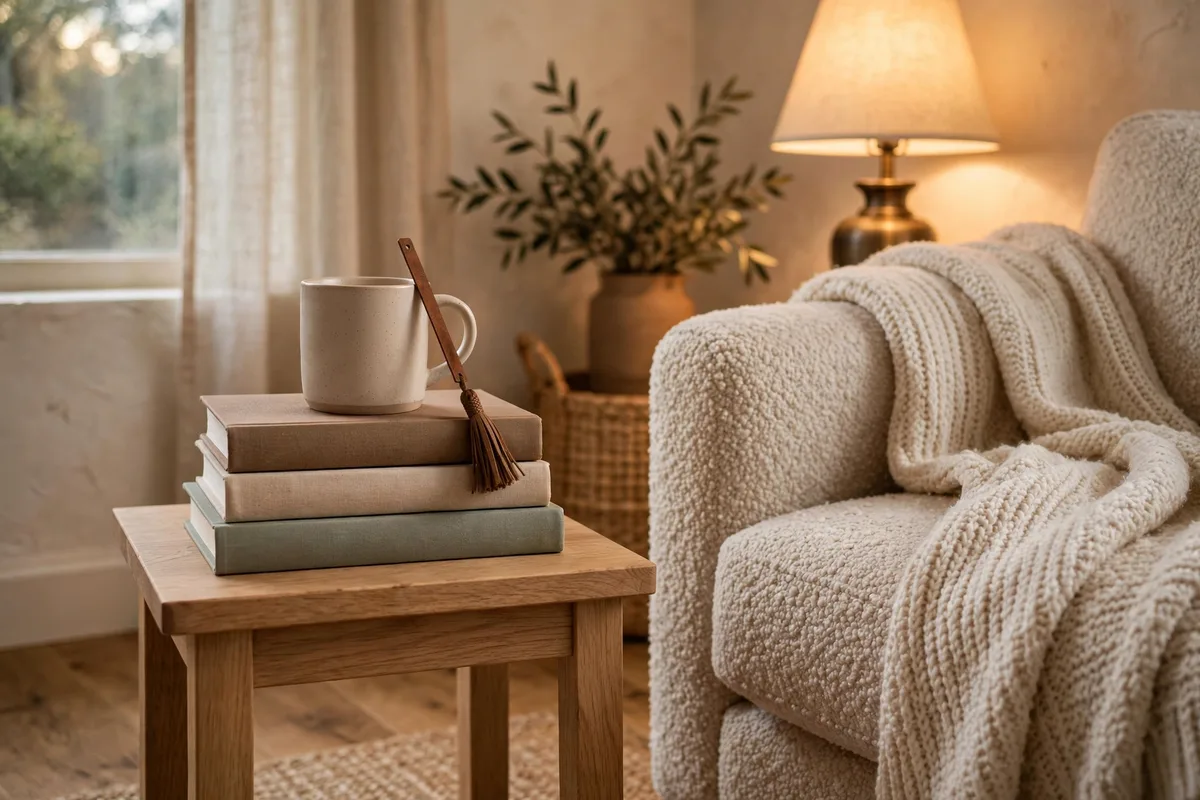
Every reading corner grows a stack, and the stack decides whether the corner invites you or accuses you. Three books read as intent — the one you are in the middle of, the one you dip into, and the one that is next. Twelve read as backlog, and sitting beside them feels like homework, not a retreat. The three-book rule keeps the corner honest: current read, companion read (the poetry or magazine you pick up between chapters), and next up. Nothing else lives on the side table.
Enforce it with a system, not willpower. Finished books leave the same evening — back to the shelf or the returns pile. New arrivals wait on the shelf until a slot opens. If three feels strict, remember the rotation is the pleasure: choosing which book earns the third slot is a small weekly ritual, and a slimmer stack leaves room for the tray and mug. A basket beside the chair can hold chargers or a notebook — the rule applies to books, not comfort.
Running the three-book stack
- Slot one: the book you are actively reading.
- Slot two: a dip-in companion — poems, essays, a magazine.
- Slot three: the next book, chosen and waiting.
- Finished or stalled books leave the same day.
8. Reserve One Scent Cue for Reading Time Only
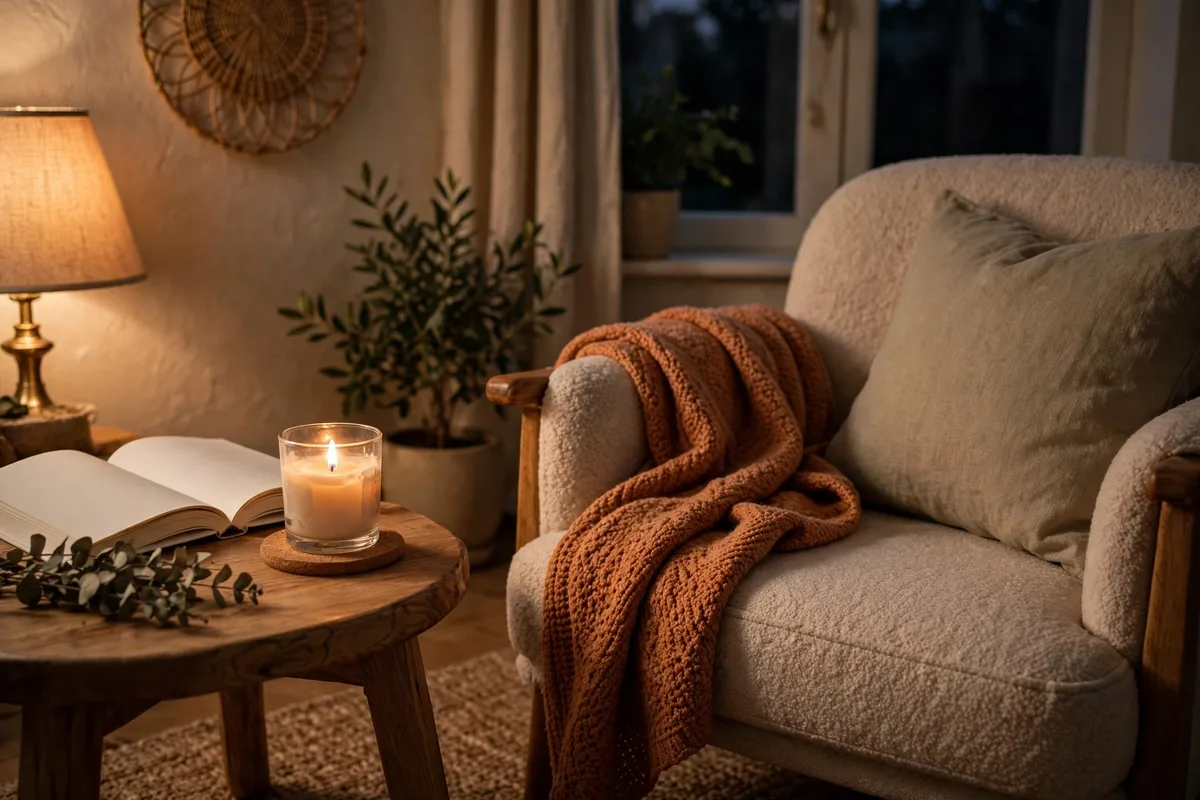
Smell is the fastest sense at changing how a room feels — and the most underused in reading corners. Choose one scent and make it exclusive to reading: a candle, a reed diffuser you uncap when you sit down, or a wax melt used only in that corner. Light or open it first — before the tea, before the book. Within a couple of weeks the association builds, and the scent alone does the settling work — your shoulders drop before page one ends.
Keep the cue contained. A candle belongs on a heat-proof base, away from blanket, curtain, and book stack — or choose a flameless option if the corner is tight or pets and children are around. With a diffuser, turn the sticks when you sit down for a fresh wave of scent. Rotate the scent seasonally if you like — green and light in spring, warm and spiced in winter — but keep one per season so the signal stays clear.
Making the scent cue work
- One scent, one purpose: never use the reading candle elsewhere.
- Start the cue first — scent, then tea, then book.
- Keep flames on a stable, heat-proof base, clear of throws and paper.
- Flameless options — diffuser, wax melt — work in any corner.
9. Set Your Footrest Height for Knee Comfort on Long Reads
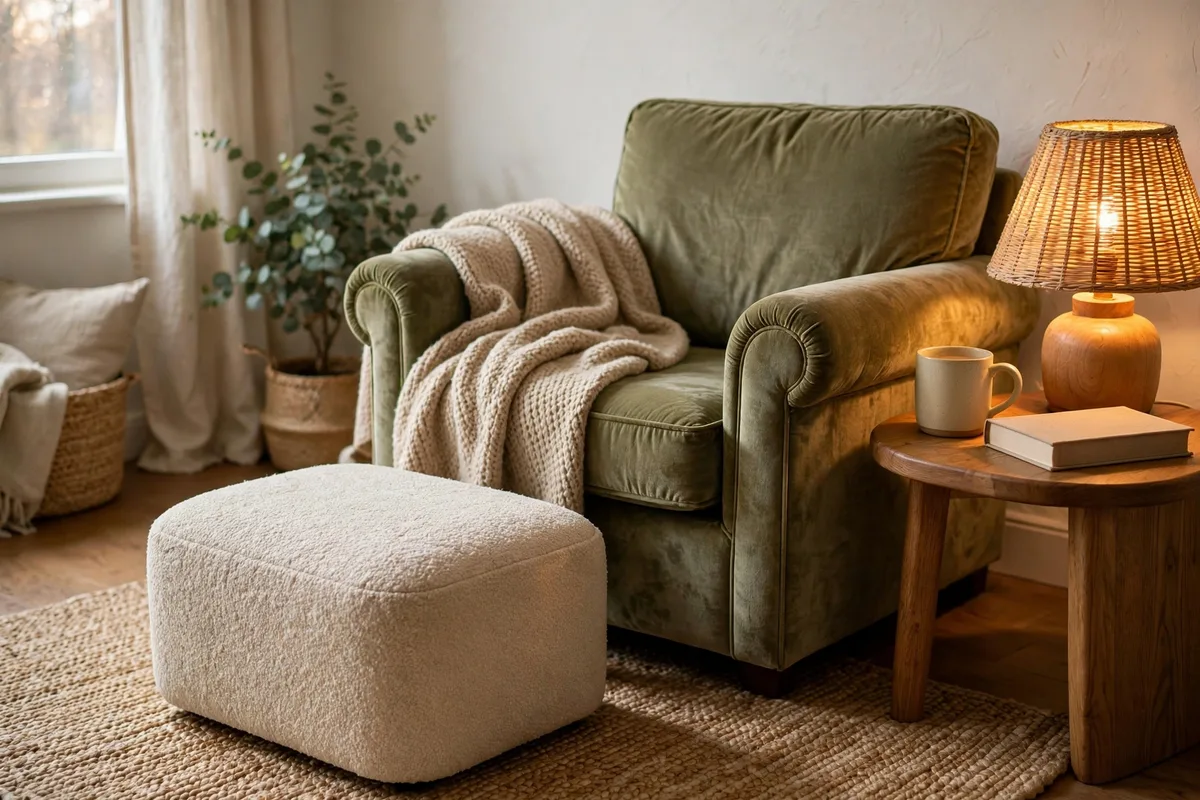
A footrest is standard advice; its height is not, and height is where the comfort lives. The goal is simple: feet supported, knees roughly level with your hips or a touch lower, no pressure digging into the backs of your thighs. Sit down, feet up, and check honestly. Knees riding higher than your hips mean the rest is too tall and nudges you into a slouch. Dangling feet mean it is too low, and your lower back does the work.
Adjust with what the house holds. A storage ottoman is the classic; a low stool with a cushion on top gains height and softness; stacked firm cushions work surprisingly well. Shim a too-low rest up on a sturdy book or folded throw, and move a too-high one a few inches further away, which lowers the angle. Retest after twenty minutes of real reading, not twenty seconds — knee comfort is a chapter-three issue, not a page-one one.
The knee-comfort check
- Sit, feet up: knees level with hips or slightly below.
- Pressure under the thighs means the rest is too high.
- Dangling feet or an aching back means it is too low.
- Recheck after twenty minutes of real reading.
10. Do a 10-Minute Seasonal Refresh Swap

Reading corners rarely die dramatically; they fade, one wrong detail at a time, until the chair becomes a clothes rack. A short seasonal refresh — ten minutes, four times a year — prevents the fade. Tie it to moments you already notice: the first cold evening, the first warm one. Then run the same short list every time.
Swap the blanket weight for the season ahead (Tip 3) and wash the one going away. Change the scent cue (Tip 8). Wipe the side table and lamp shade — dust dims your light surprisingly. Reset the stack to three (Tip 7) and check the tray. Finally, sit down and read one page. If anything still feels off — a flat cushion, a tired bulb — fix just that. Ten minutes, four times a year, stands between a corner lovely once and one lovely every week.
The 10-minute refresh list
- Blanket: swap the weight; wash and store the old one.
- Scent: refresh the reading-only cue.
- Surfaces: wipe table, tray, and lamp shade; check the bulb.
- Stack and tray: reset to three books; restock the tray.
- Sit test: read one page and fix what still feels off.
Frequently Asked Questions About Cozy Reading Corners
How can I make my reading corner feel cozy without buying new furniture?
Work on the senses, not the furniture. Move a warm lamp to shoulder height behind the chair, add a ready-to-read tray, drape a soft layer behind the chair to quiet echo, and set out a scent used only for reading. It costs little or nothing, and changes the corner more than a new chair would.
Where should the lamp go in a reading corner?
Just behind and to one side of the chair, at about shoulder height, so light falls over your shoulder and across the page. If your head shadows the book or the light hits your eyes, the lamp is too low or too far forward. A warm bulb and soft shade keep the glow calm.
How many books should I keep in my reading corner?
Three is a good limit: the book you are reading, a lighter companion, and the next one waiting. More turns the table into a backlog pile that makes sitting down feel like a chore. Finished books return to the shelf the same evening.
What blanket is best for a reading corner?
Choose by season rather than buying one blanket for the year. A light cotton throw suits summer, a mid-weight knit covers spring and fall, and a heavy wool or weighted lap blanket earns its place in winter. Lap size — covering your legs without pooling on the floor — is the most practical shape.
How do I make a reading corner feel private in an open-plan room?
Fake the missing wall. A folding screen, curtain panel, or tall bookcase behind the chair gives your back a boundary and makes the corner a room within the room. Keep the front open so it feels sheltered, not boxed in, and add a rug to mark the zone.
Can a scent really make a reading corner feel cozier?
Yes — scent builds a fast association. Light the same candle or open the same diffuser only when you read, and within a few sessions that smell feels like the beginning of reading time itself. Keep one scent per season, and flames on a stable base away from fabric and paper.
My reading corner echoes and feels exposed. How do I fix that?
Add one soft surface behind the chair — a curtain panel, a woven hanging, a throw over the chair back, or a filled bookshelf. Hard walls and floors bounce sound back at you, which reads as exposure; one absorbent layer near your head makes the corner feel quieter and more sheltered.
What height should a footrest be for reading?
Aim for knees roughly level with your hips, or a touch lower, feet fully supported. Knees pushed high cause slouching; dangling feet strain your back. Raise a low rest with a cushion or folded throw, and move a high one slightly further away to soften the angle.
What should I keep on a reading corner side table?
Less than you think: a tray holding a coaster, your glasses, and your bookmark, plus your current book and a mug when you are sitting there. Everything lifts away in one move, and the short list means the session starts in seconds, not after a tidying round.
How often should I refresh my reading corner?
Do a light refresh each season — ten minutes, four times a year. Swap the blanket weight, refresh the scent, wipe the lamp shade and table, reset the stack to three, and restock the tray. A deeper rethink is only needed when the room changes: new chair, new paint, a different corner.
Conclusion
A cozy reading corner is not a look; it is a set of small comforts. Warm light over your shoulder. A tray that starts the ritual in seconds. A blanket matched to the season, a soft wall quieting the echo, one green thing where your eyes land, a backdrop that makes the corner feel held. A stack capped at three, a scent that means reading and nothing else, a footrest set for your knees, and ten minutes of care each season.
None of these tips asks for a renovation, a new chair, or a bigger room — most ask for things already in your house, placed with more intention. Start with the two that nag you most — the glaring lamp, the missing glasses — and add the rest one evening at a time. Within a week the corner stops being furniture and becomes the place your day points toward: book open, tea warm, nowhere else to be.