A family living room rarely fails because of one big design mistake. It fails in small, ordinary moments: juice hits the sofa while everyone hunts for a cloth, the same cushion flattens while the others stay plump, toys spread further every day, and a “five minutes away” text sends the house into a panic. The furniture is usually fine — what is missing is small systems running in the background.
These family-friendly living room design ideas tips are not about buying a new room, but running the one you have. Below are ten everyday-survival routines, each procedural: what to keep where, what to do first, how long it takes. None needs a weekend or a renovation — just a stocked basket, a simple schedule, and habits small enough for a tired Tuesday. For the bigger style picture, our guide to family-friendly living room styles shows how a room keeps its look through all of it.
1. Keep a Spill-Response Kit Within Arm’s Reach
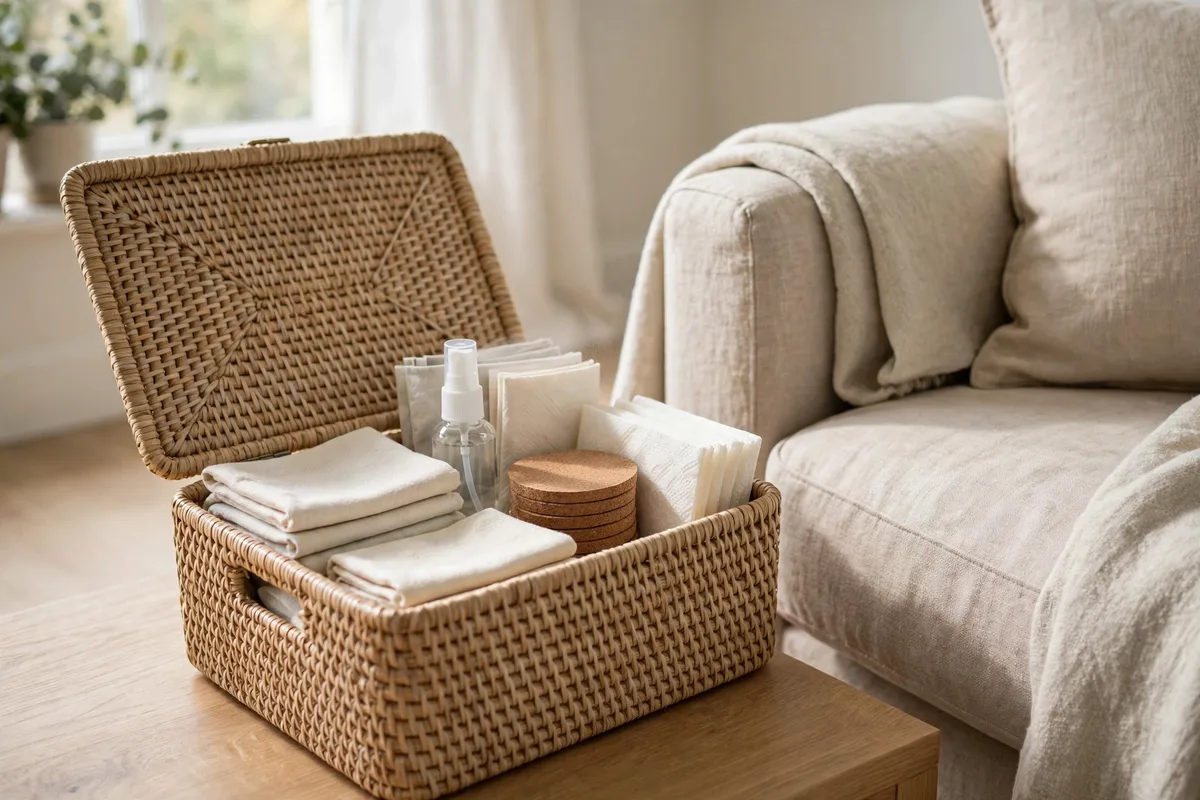
Spills are not the problem — slow responses are. Juice blotted in the first minute usually lifts out with water alone; the same splash found after a film becomes a stain-removal project. The fix is not a better sofa, but a spill kit living inside the room, within arm’s reach of the seats.
Build it in a small lidded basket and park it in the same spot every day — inside an ottoman or beside the sofa. Restock it on laundry day so it is never empty at the worst moment.
| Kit item | What it is for |
|---|---|
| Two plain white or light cloths | Blotting without transferring dye onto upholstery |
| Small spray bottle of plain water | Dampening a cloth for juice, milk, and everyday spills |
| Paper towels or spare napkins | First lift of anything thick — yogurt, sauce, mud |
| Blunt knife or old loyalty card | Scraping up solids before wiping spreads them |
| Spare stack of coasters | So the next drink lands safely while you clean |
| Small hand towel | Protecting the floor under the spot you treat |
The 60-second spill order
- Lift solids first with the card or knife — scrape, never rub.
- Blot liquids with a dry cloth, pressing straight down, working from the outside of the mark inward.
- Dampen the second cloth with water and keep blotting until it comes away clean.
- Press a dry towel over the spot if the cushion underneath feels damp.
Teach the order to everyone old enough to carry a cup — “scrape, blot, tell an adult” turns most accidents into non-events.
2. Rotate and Flip Your Cushions on a Weekly Rhythm
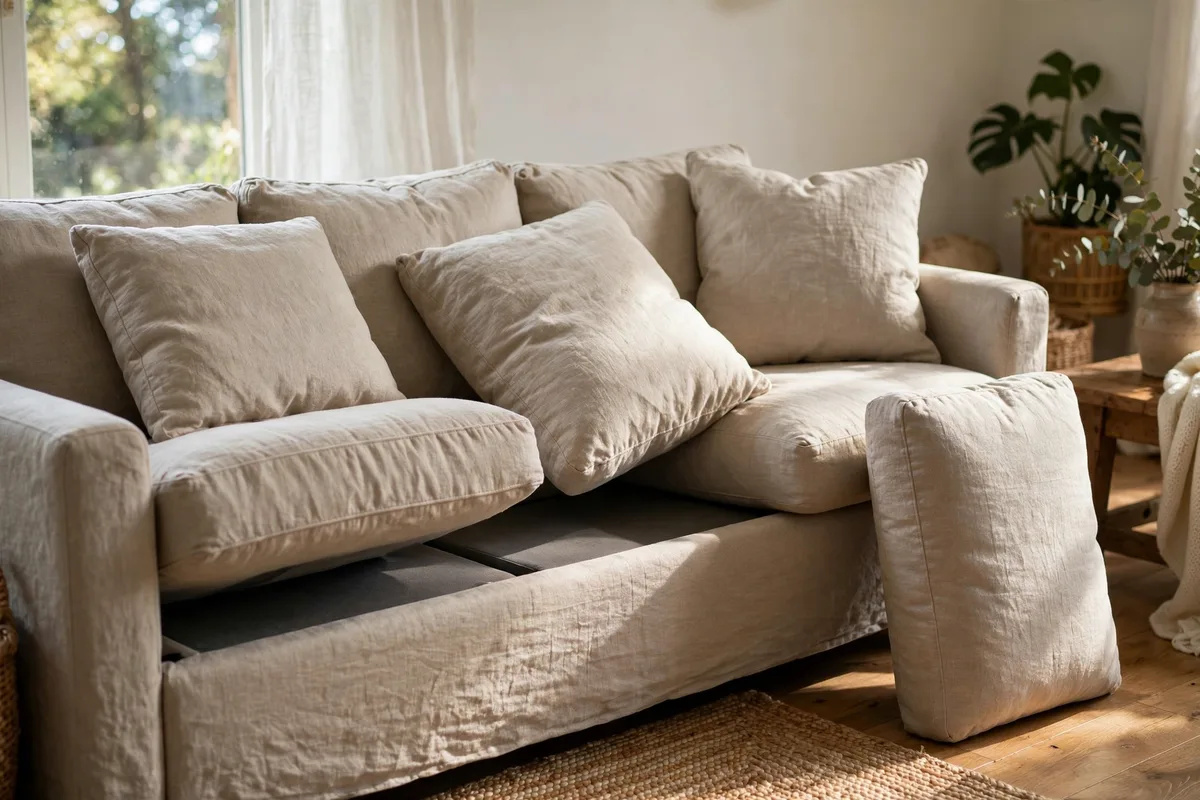
Every family sofa has a favourite seat — nearest the lamp, the charger, or the best TV angle. That seat gets sat in, napped on, and bounced on far more than the others, so its cushion flattens and fades faster, and within a year the sofa looks worn even though most of it is barely used. Rotation spreads the wear so the whole sofa ages evenly.
The routine takes about three minutes. Pick a fixed cue — laundry day works well, because the throw from Tip 4 is already going into the wash. Pull each seat cushion off, shake and pat the filling back into shape, then return it to a different position: left to right, right to middle. Flip each over if the fabric matches both sides, and swap back cushions too.
A simple cushion-care rhythm
- Weekly: swap seat cushion positions and plump each one by hand.
- Weekly: flip cushions if reversible; if not, rotate them end to end.
- Monthly: stand cushions on end for an afternoon so the filling settles evenly.
Even wear is the difference between a sofa that looks tired in two years and one still cared-for in five — no purchase involved.
3. Run a Two-Bin Toy Rotation So the Room Resets in Minutes
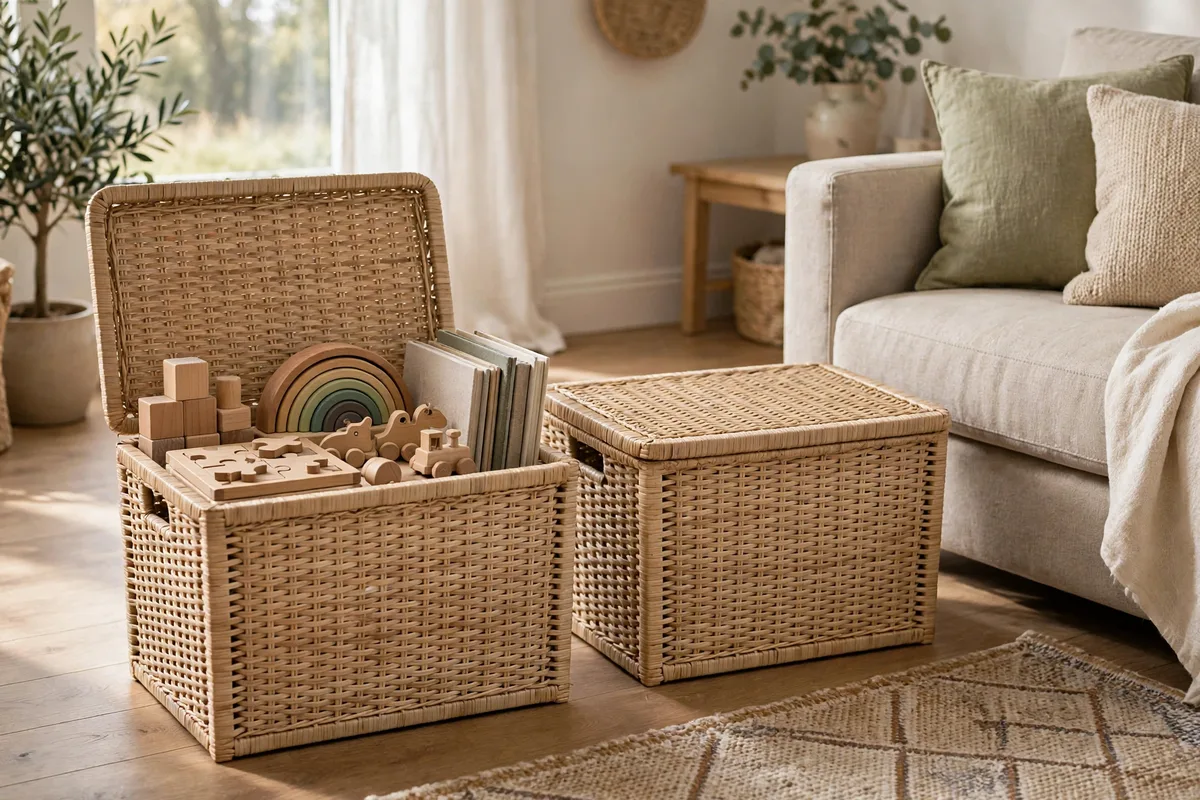
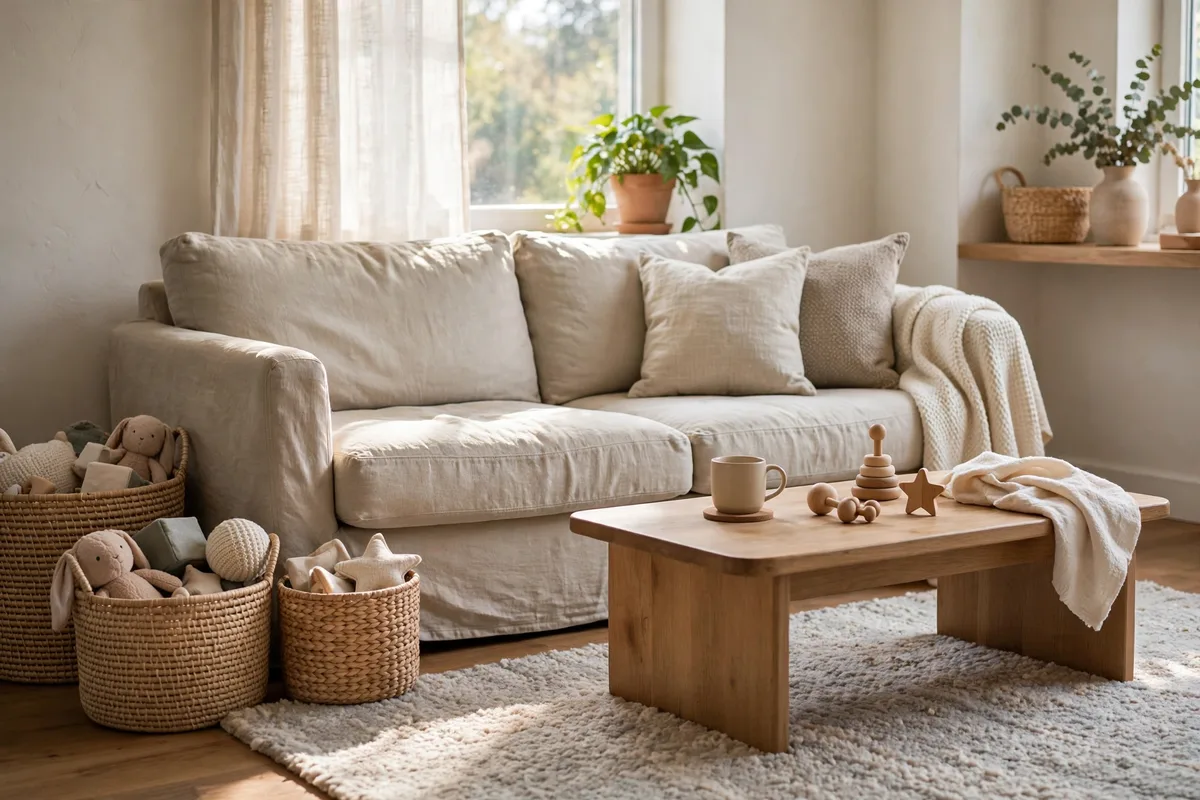
Toy clutter is rarely about owning too many toys. It is about all of them being out at once. A two-bin rotation fixes the volume: only one bin of toys lives in the room, and the second waits out of sight. When the bins swap, returning toys feel new again, play gets more focused, and the nightly reset (Tip 6) shrinks because there is simply less to put away. Our roundup of family-friendly living room ideas shows how good this looks in real rooms; this routine is what keeps it that way.
Use two similar lidded bins. Bin A gets a balanced mix — something to build, something to cuddle, something to drive, a puzzle, a few books; Bin B gets the rest and waits in a cupboard. Swap on a fixed day — Sunday evening, or cushion-rotation day. Lids on, bins exchanged, done.
Rules that make rotation work
- Favourites are exempt: one or two beloved items stay out permanently.
- One in, one out: anything new entering the room pushes something into Bin B.
- Small pieces live in a zip pouch inside the bin, so it never becomes a rummage pit.
- A toy ignored through two full rotations is a donation candidate — decide with the kids.
The payoff is reset speed: one bin of toys clears in minutes, because every item has exactly one home.
4. Give the High-Traffic Seat Its Own Washable Throw
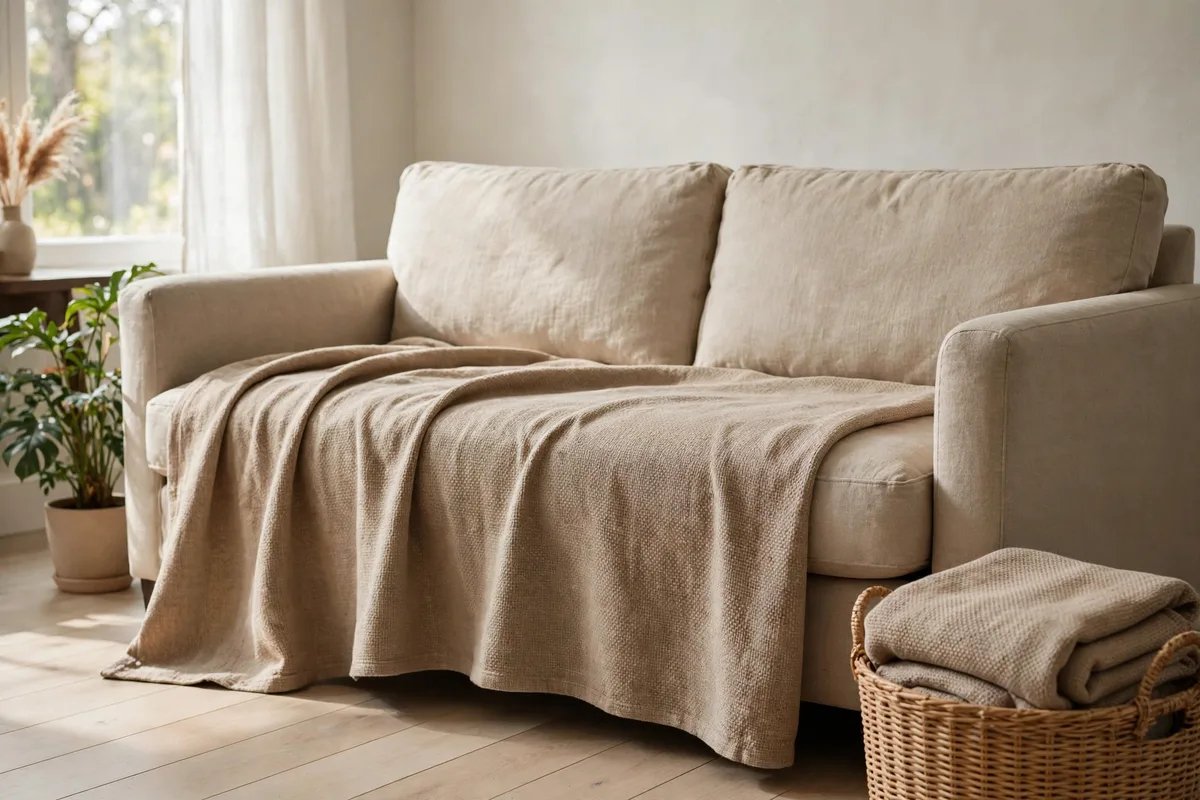
You already know which seat takes the beating: the sectional corner where homework happens, the cushion where the dog waits by the window, the spot where a toddler eats toast in front of cartoons. Instead of protecting the whole sofa equally — which usually means protecting none of it — assign one washable throw to that single seat and let it take the damage on the sofa’s behalf.
Choose a throw that survives a normal wash, draped over the seat cushion and the front edge where legs, paws, and soles rub. Smooth it back during the nightly reset — that two-second straighten keeps it looking like styling, not laundry. On laundry day, swap it for a second clean throw: two matching throws, rotated like towels, is the version that survives real life.
Making the throw system stick
- Keep the spare throw in the ottoman or spill-kit basket, never in another room.
- Choose a colour close to the sofa, or a pattern busy enough to hide crumbs between washes.
- Shake it outside before washing so crumbs and pet hair stay out of the machine.
- For an extreme seat — a teething puppy’s corner — layer the throw over a plain waterproof liner.
Sticky fingers, muddy paws, and snack dust land on a washable layer instead of your upholstery.
5. Keep a Touch-Up Paint Pen Ready for Wall Scuffs
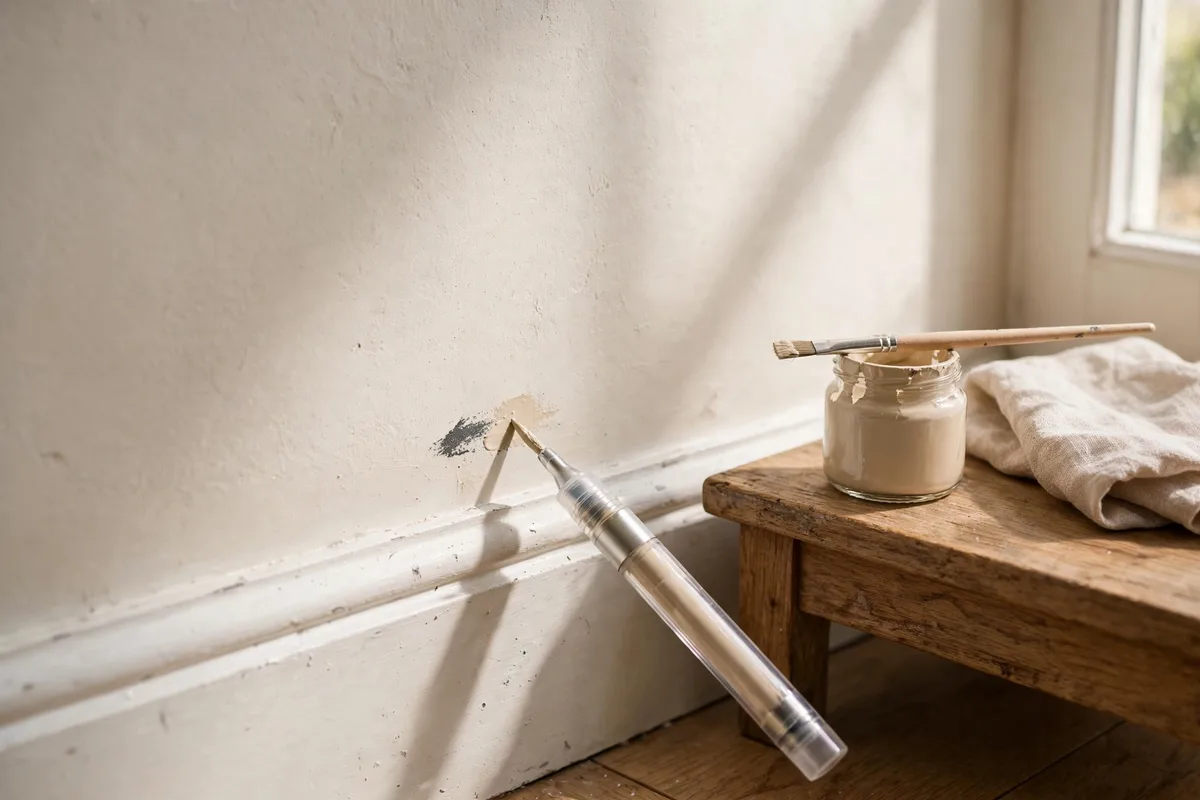
Family living room walls collect a diary of the household: a dark rub where the toy bin bumps the wall, a scuff at pushchair height, a crayon line at toddler-hand level. Left alone, these marks make a clean room feel grubby. The counter-move is a touch-up system so quick that fixing a scuff takes less time than noticing it daily for a month.
A refillable touch-up paint pen, filled from your leftover wall paint and stored upright in a drawer, handles chips and thin scuffs in seconds: shake, dab, done. For bigger marks, keep a small sealed jar of the same paint, labelled with the room and colour, plus a cheap artist’s brush. The label matters — unlabelled leftover paint is just future confusion.
The five-minute scuff routine
- Wipe the mark first with a barely damp cloth — many scuffs are surface dirt and vanish here.
- Dab paint with the pen or brush tip, feathering the edges so no hard outline shows.
- Use two whisper-thin coats rather than one thick blob, letting the first dry before judging.
- Work the whole room in one pass, pen in hand, instead of fixing marks one complaint at a time.
Do this walk monthly, alongside the furniture check in Tip 9, and walls keep looking freshly painted for years between real repaints.
6. Run a Five-Minute Nightly Reset Everyone Can Do
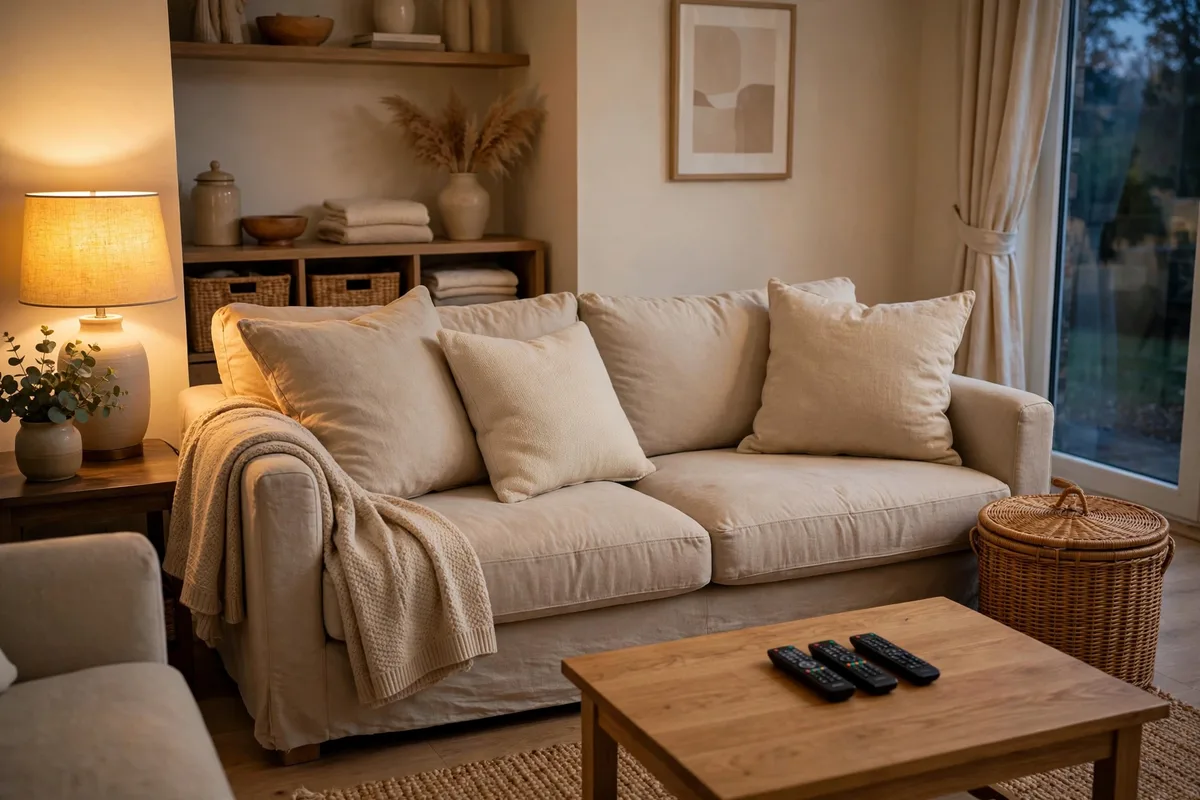
The nightly reset is the routine all the others feed into. Five minutes, at the same point every evening — after dinner, or just before bedtime routines — when the whole family returns the room to its morning state. Not deep-cleaned, not showroom tidy. Just reset: everything home, surfaces clear, ready for tomorrow. A room reset nightly never reaches the state where tidying feels like an event.
Run it like a drill — same order, same micro-jobs — so nobody needs managing. Put on one song or set a timer; the deadline makes it a game for kids. One person does floors and toys (into Bin A from Tip 3), one does surfaces and remotes, and the youngest handles cushions and throws, doubling as the plumping from Tip 2.
The reset, in order
- Minutes 0–1: floor clear — toys to the bin, shoes and bags out of the room.
- Minutes 1–2: surfaces — cups to the kitchen, snack trays (Tip 8) stacked and carried out.
- Minutes 2–3: textiles — cushions plumped, throw straightened over its seat.
- Minutes 3–4: small stuff home — remotes to their spot, chargers coiled, books stacked.
- Minute 5: doorway scan — anything still homeless gets a decision, not a new pile.
That scan is the secret step: piles form where decisions get postponed.
7. Beat Pet Hair With a Two-Minute Daily Pass
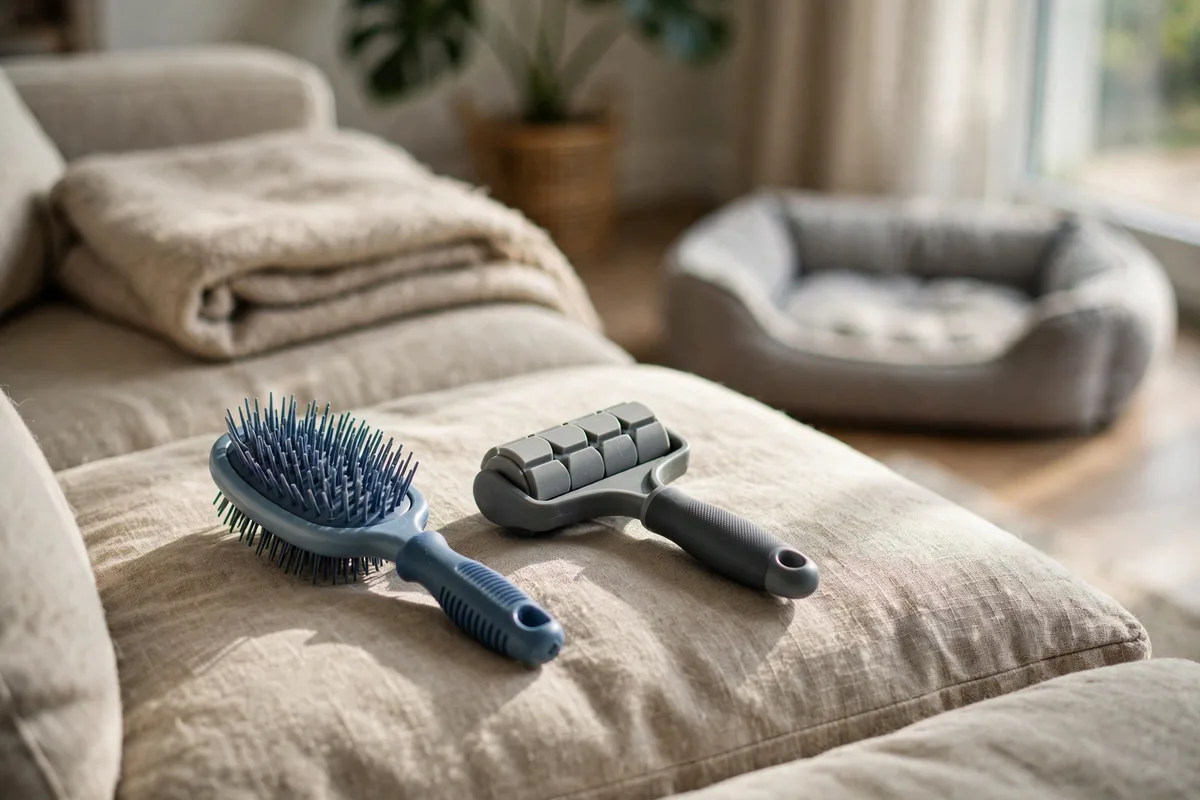
Pet hair feels overwhelming only when tackled occasionally. A sofa de-furred once a fortnight is a grim job; the same sofa given a two-minute daily pass never builds up enough hair to look furry — and the tools live in the room, not in a cupboard nobody opens.
Keep a lint roller or rubber pet-hair brush in the side-table drawer or the spill basket from Tip 1. The pass happens while you are already in the room — kettle boiling, opening titles, or inside the nightly reset. Work in one direction: seat cushions, then back-cushion seams, then the throw from Tip 4, which catches most of it anyway.
Keeping the daily pass at two minutes
- One direction, light pressure — rubber brushes pull hair into clumps you can lift off.
- Do your pet’s favourite spot twice and everything else once: effort where the hair is.
- Empty the roller or brush into the nearest small bin immediately, ready for tomorrow.
- On wash day, throw and cushion covers go in together — one pet-hair load a week.
- Vacuum just the rug twice a week to catch what the pass shakes loose.
Hair worked deep into a weave by weeks of sitting is what becomes hard to remove — the daily pass prevents exactly that.
8. Set Up a Snack-and-Screen Zone With Washable Lap Trays
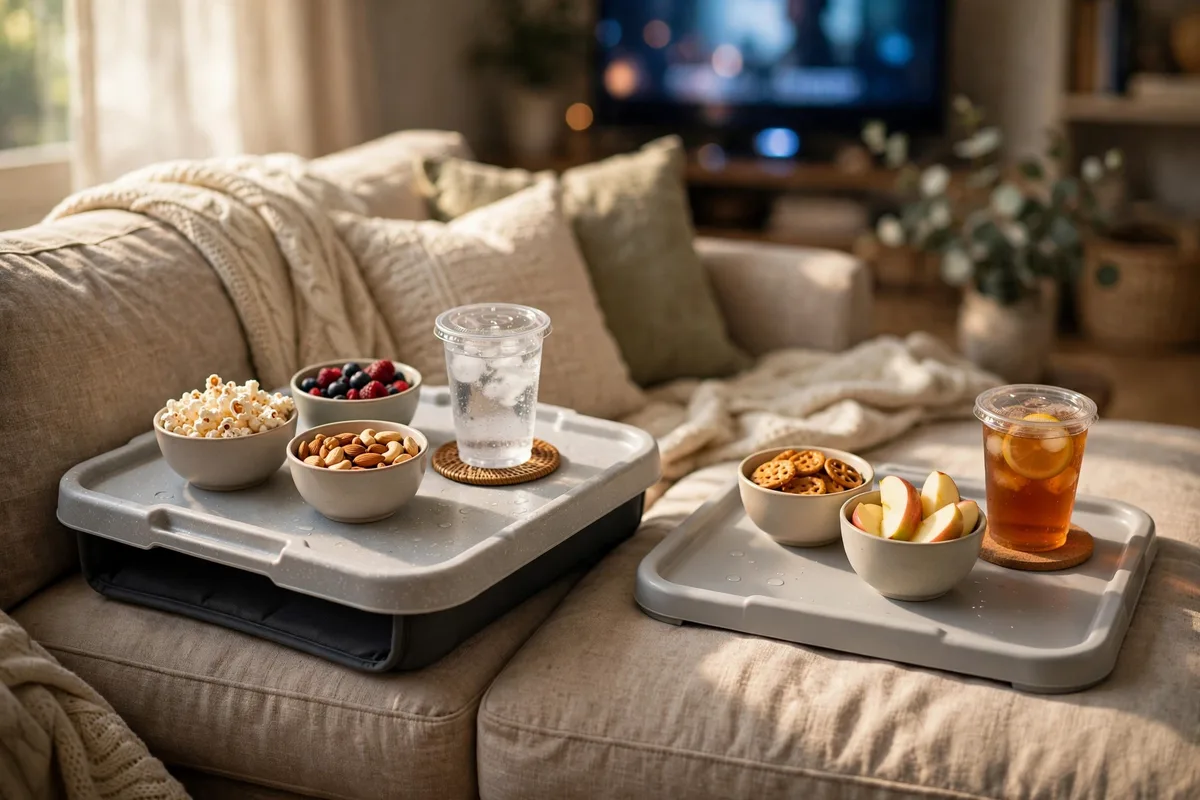
“Absolutely no food in the living room” survives until the first film night, the first illness on the sofa, or the first rainy Saturday. A rule that collapses teaches kids that rules are decorative. A snack-and-screen zone takes the opposite approach: food is welcome here, under a small system that contains it — and the system, not willpower, protects the furniture.
The kit is simple: one washable lap tray per regular snacker, with a raised edge, stacked beside the sofa. Snacks happen on trays, in designated seats — usually the throw-protected seat from Tip 4 and its neighbours. Younger children get lidded cups, every drink lands on a coaster, and bowls stay small: a small bowl refilled beats a family-size bag migrating over the cushions.
House rules the zone runs on
- Trays out, snacks out; trays back, snacks finished — the tray is the on/off switch.
- Whoever carries the tray in carries it back to the kitchen at the end.
- Wipe trays over the kitchen bin straight away; wash them with the week’s throw when needed.
- Keep napkins and a spill cloth from Tip 1 in the tray stack, so drips are a reach, not a run.
Because the zone is generous, it holds — film-night popcorn, homework apples, and grandparents’ tea all fit, and the sofa survives.
9. Do a Monthly Glide, Corner and Wobble Check
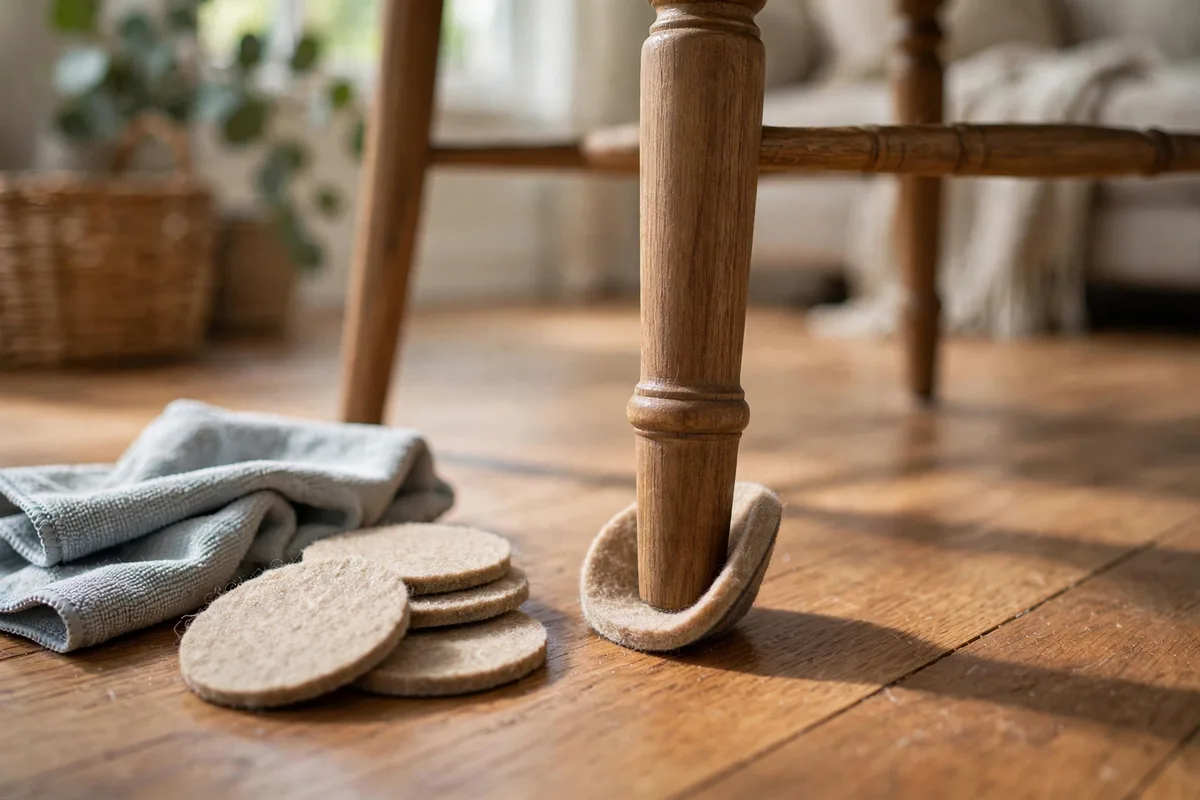
Family furniture loosens: legs get dragged, tables leaned on, shelves climbed, screws quietly slack. A monthly ten-minute check — glides, corners, wobbles — catches it all while fixes are still free, and pairs naturally with the wall touch-up walk in Tip 5.
Work around the room in one direction carrying replacement glide pads, a cloth, and your touch-up pen. Under every leg, check the glide pad: missing, curled, or worn through means replace it on the spot — pads stop floor scratches and dragging noise. Then the wobble test: a firm two-handed rock on each table, chair, and shelf. Anything that rocks gets screws hand-tightened and feet checked for an uneven pad, the hidden cause of most wobbles.
What the monthly check covers
- Glide pads under every leg, replaced the moment one is missing or peeling.
- Wobble test on tables, chairs, and shelves; tighten what loosens, note what needs repair.
- Corners and edges: a hand run along table and shelf edges for new chips or splinters.
- Cords and chargers: re-coiled, checked for trapped or fraying cables behind furniture.
- Spill kit and touch-up pen: cloths restocked, spray refilled, pen tested.
Ten minutes a month is cheap insurance: floors keep their finish and furniture keeps its joints.
10. Keep a 10-Minute Guest-Ready Reset in Your Pocket

Guests do not really see your housekeeping — they see surfaces, the sofa, and whether there is somewhere to sit and set down a drink. A guest-ready reset targets only those things, in a set order, against the clock. If your nightly reset (Tip 6) is running, this is theatre on top of a tidy room: ten minutes from “they’re nearly here” to opening the door unbothered.
Split jobs if you have help — one person on the room, one on the door path. Work big to small: clear a landing strip first (coffee table wiped and emptied except coasters and one object, every cushion plumped, throws straightened), then the floor, where anything homeless goes home or into one holding cupboard for the duration. One hidden holding spot, used on purpose, is a system, not a cheat.
The last ten minutes, timed
- Minutes 0–3: seats and table — plump, straighten, wipe, coasters out.
- Minutes 3–5: floors and surfaces — homeless items into the holding cupboard, remotes lined up.
- Minutes 5–7: light and air — lamps on, curtains adjusted, a window cracked if the room smells of dog and toast.
- Minutes 7–9: entry path — shoes and bags off the route from door to sofa.
- Minute 10: doorway scan, same as the nightly reset — one look, one last item dealt with, done.
Practise it twice when nobody is coming and it stops feeling like panic at all.
Frequently Asked Questions About Family-Friendly Living Rooms
What should I do in the first minute after a spill on the sofa?
Scrape up solids with a blunt knife or card, then blot — never rub — with a dry light-coloured cloth, working from the outside inward. Follow with a cloth dampened with plain water until it comes away clean. Speed matters more than products, which is why the spill kit lives in the room.
How often should I rotate sofa cushions in a family home?
Swap and flip loose cushions once a week, ideally tied to laundry day so the habit piggybacks on an existing routine. If one seat is used dramatically more — a homework corner, a feeding chair — swap that cushion with the least-used one midweek as well.
How does a two-bin toy rotation actually work day to day?
One lidded bin of toys lives in the room; the second waits out of sight. Children play from the room bin only, and everything returns to it at the nightly reset. On a fixed swap day you exchange the bins. Toys feel fresh again, volume stays capped, and tidying takes minutes.
Will a throw really protect my sofa, or does it just look messy?
Yes — most daily damage (crumbs, sticky hands, paw prints, denim dye) lands on the throw instead of the upholstery. It stays tidy if you straighten it during the nightly reset and swap it for an identical clean one on laundry day. Two matching washable throws, rotated, works long term.
What is the easiest way to fix wall scuffs without repainting?
Wipe the mark first with a barely damp cloth — many scuffs are surface dirt and disappear. For marks that remain, a refillable touch-up paint pen filled from your leftover wall paint dabs on in seconds. Do the whole room in one monthly pass.
What does a five-minute nightly reset include?
Floor clear, surfaces clear, textiles straightened, small items home, and a final doorway scan. Toys go in the bin, cups and trays to the kitchen, cushions get plumped, and remotes return to their one spot. Timed and done in the same order nightly, it takes about five minutes.
How can I keep on top of pet hair without vacuuming every day?
Do a two-minute daily pass with a rubber pet-hair brush or lint roller kept in the room, over seat cushions, seams, and your pet’s favourite spot. Protect the worst seat with a washable throw washed weekly, and vacuum just the rug twice a week. Small and daily beats big and occasional.
How do I allow snacks in the living room without ruining the furniture?
Give snacks a system instead of a ban: washable lap trays with raised edges, small bowls instead of big bags, lidded cups for younger children, and coasters under every drink. Food happens in designated, throw-protected seats, and the tray returning to the kitchen ends snack time.
How often should I check furniture for wobbles and worn glide pads?
Once a month, as a single ten-minute walk around the room. Check every leg’s glide pad, rock each table, chair, and shelf firmly, and hand-tighten anything loose. Restock the spill kit and test your touch-up pen on the same round.
How can I make the living room guest-ready in ten minutes?
Follow a timed order: seats and coffee table first, then floors and surfaces with anything homeless going into one holding cupboard, then light and air, then the entry path, finishing with a doorway scan. If the nightly reset is already a habit, the ten minutes is mostly finishing touches.
Conclusion
A family-friendly living room is not a purchase — it is a practice. The rooms that survive juice, toddlers, dogs, and surprise guests are not the ones with the most expensive fabrics. They are the ones with a spill kit within reach, cushions that rotate, one bin of toys, a throw guarding the busy seat, a pen that erases scuffs, and resets too small and regular to ever get ahead of the family.
Start with two systems this week: stock the spill kit, and run the five-minute nightly reset for seven evenings. Add cushion rotation and the two-bin swap on laundry day, and the rest slots in around them. Ten small routines, none longer than ten minutes, will do more for this room than any single piece of furniture you could buy.