
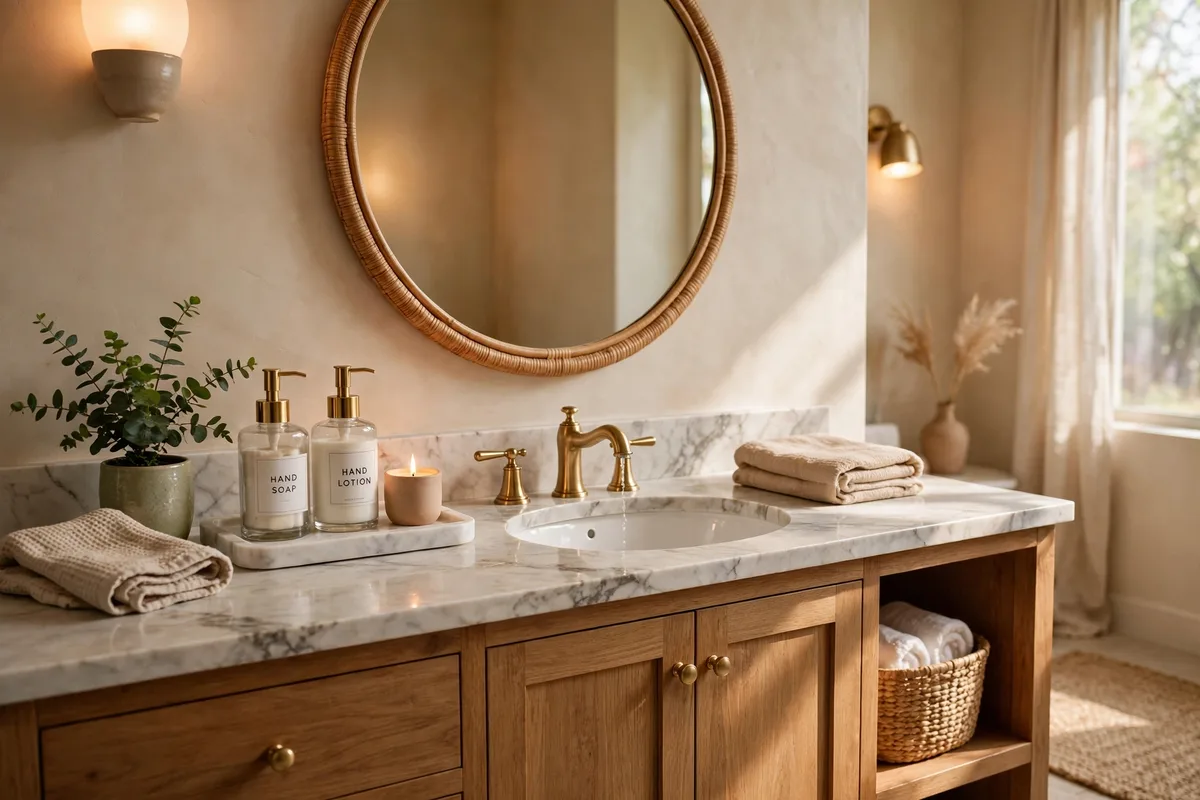
The vanity is the most-looked-at square metre in the house: it is where the day starts and where it ends, at the exact distance of a mirror. And in most bathrooms it is styled by accident — a landing strip where products arrive, multiply, and slowly form a skyline. Styling a vanity is not about buying decor. It is about editing what is already there into a composition: a few objects, deliberately grouped, with the counter’s breathing room protected like it matters — because it does.
Ten moves, in the order a stylist works them: subtract first, then build the composition, then finish with light, scent and zones.
In this guide: The Vanity Styling System at a Glance · 1. Start With Subtraction: The Empty-Counter Edit · 2. The Tray That Turns Clutter Into a Composition · 3. The Rule of Three, Arranged in Heights · 4. Decant the Everyday: Kill the Packaging · 5. Style Up: The Mirror Is Half the Vanity · 6. Light at Face Height, Not From the Ceiling · 7. One Living Thing · 8. The Hand Towel Is a Textile Moment · 9. Scent: One Candle, One Source, Stop · 10. Zones: Style for the People Who Actually Use It · Copy This Counter: Three Finished Set Pieces · Frequently Asked Questions About Bathroom Vanity Styling · Conclusion
This page styles the counter you already have — what sits on it and above it, and in what order. Choosing a new vanity unit itself is a different job; the tile and layout pages linked through this guide are the way in for that.
The Vanity Styling System at a Glance
| Move | What it does | Cost |
|---|---|---|
| The empty-counter edit | Removes everything that has a home elsewhere | Free |
| One tray | Turns loose items into one composition | Low |
| Rule of three + heights | Makes the grouping read as designed | Free |
| Decant into matching vessels | Deletes packaging noise | Low |
| Mirror + face-height light | Styles the wall, flatters the user | Swap |
| One living thing | One green thing, scaled to the counter | Low |
| The hand-towel moment | The softening layer; the accent that changes | Low |
| One scent | The layer guests remember; one source, then stop | Low |
| Zones | One zone per person, so the system survives mornings | Free |
1. Start With Subtraction: The Empty-Counter Edit
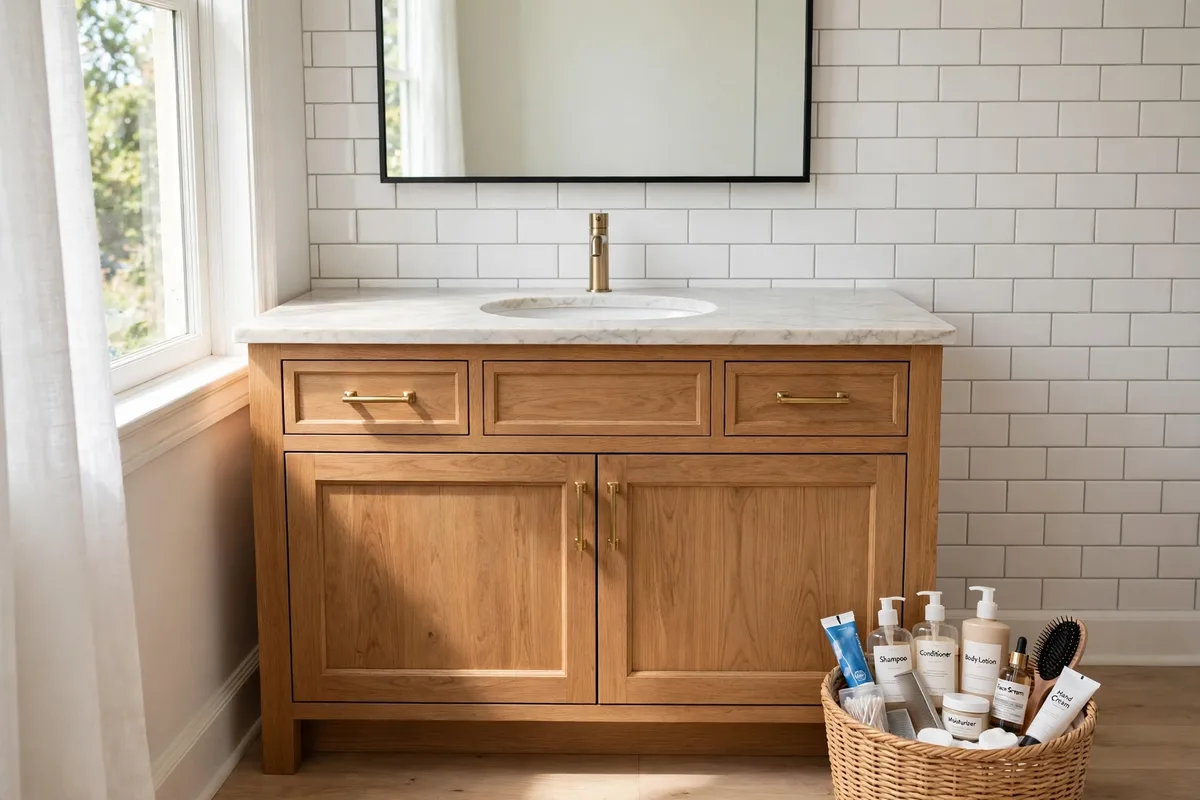
Every styling job on a vanity begins the same way: take everything off. Not tidied — off, into a basket, counter wiped bare. The Badeloft guide’s whole method is in its title order: subtract first, then add layers. A bare counter is the only honest starting point, because from zero you choose what returns — and most of what was living there will not make the cut.
Sort the basket into three fates: daily (used every single day — eligible to return), weekly (goes in a drawer or cabinet), and squatting (it lives here out of habit, not need — it gets a home elsewhere or leaves). In most bathrooms the daily pile is shockingly small: soap, toothbrush, one or two products per person. Everything in this article styles around that pile, not around the skyline.
2. The Tray That Turns Clutter Into a Composition
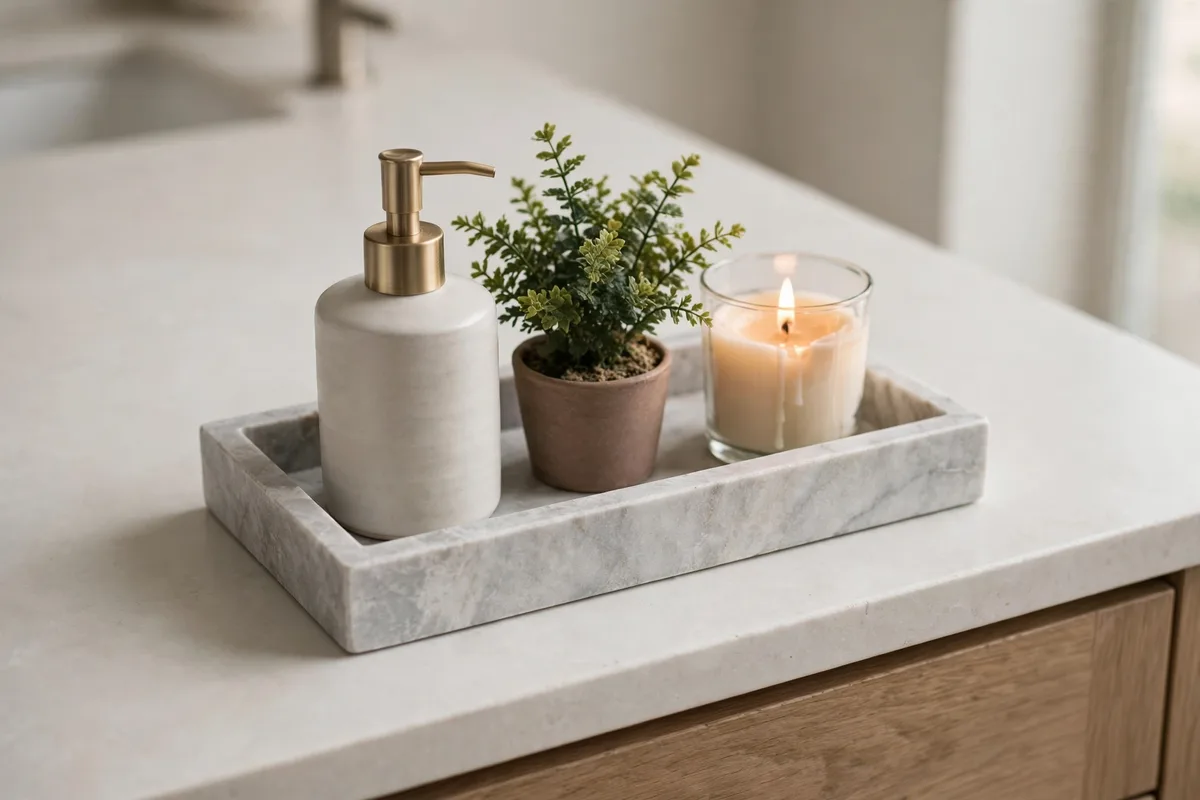
One tray is the highest-leverage styling object in the bathroom. As Engineer Fix’s vanity decorating guide explains, a tray corrals small items and instantly reduces the appearance of clutter — the brain reads everything on it as a single unit, one composition instead of five loose objects. The daily pile from §1 goes on the tray; the tray goes beside the basin; the composition is already half built.
Choose the tray against the counter: carved marble or stone on a wood vanity, woven water hyacinth or wood on stone — the contrast is what makes it read as chosen. Mind the material’s honesty, though: bathrooms are humid and splashy, so resin, acrylic, sealed stone and ceramic forgive wet bottles, while unsealed marble stains and untreated metal rusts. Size it to the pile with room to spare — a tray at 90% capacity looks like storage; at 60% it looks like styling.
3. The Rule of Three, Arranged in Heights
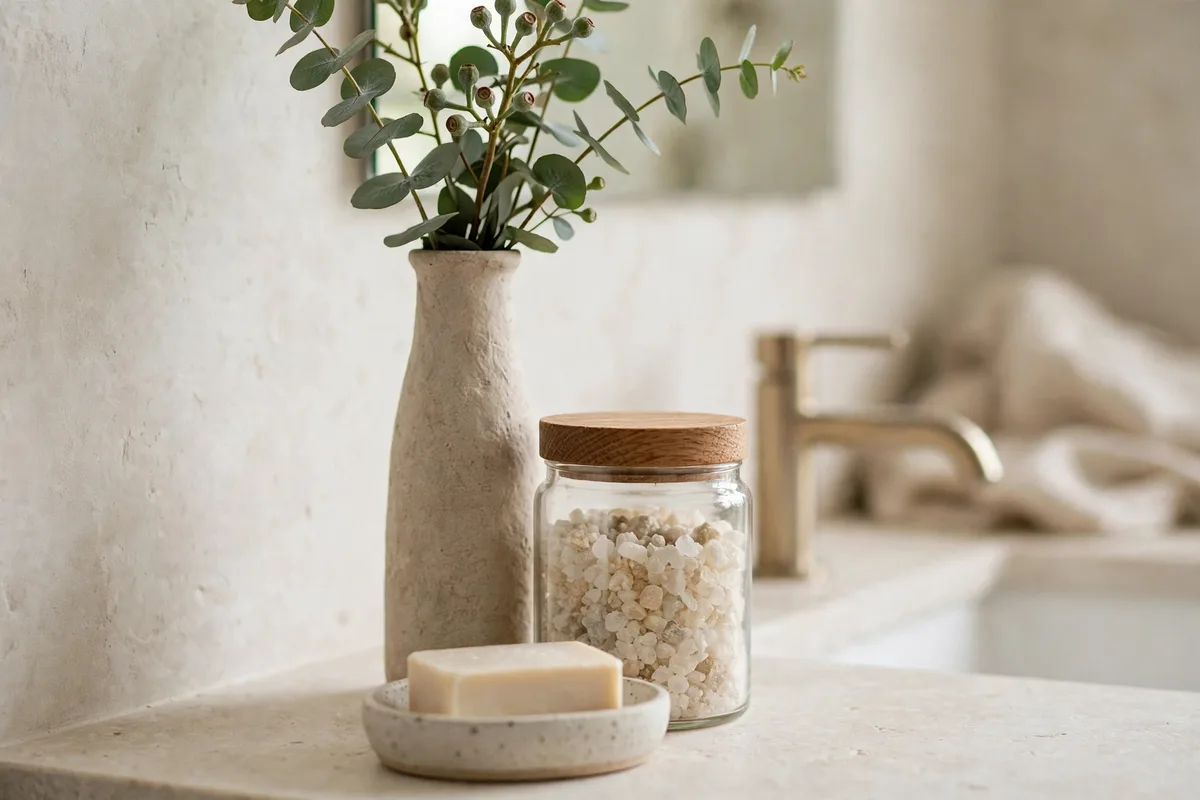
Odd numbers compose; even numbers line up. The rule of three is the stylist’s oldest tool: group in threes (or fives on a long double vanity), and vary the heights so the eye travels a triangle — tall at the back, medium in the middle, low at the front. A tray of three same-height bottles reads as a shop shelf; the same bottles with one tall stem vase behind and a low dish in front read as a designed vignette.
Build the triangle from the daily pile first: the tallest real object (a dispenser, a vase of eucalyptus), the middle (a jar, a candle), the low (a soap dish, a ring dish, a folded hand towel). Keep the group’s colours inside the bathroom’s palette — the discipline behind the looks in our small bathroom theme design ideas applies at counter scale too: three objects in the room’s colours compose, three strangers merely gather.
4. Decant the Everyday: Kill the Packaging
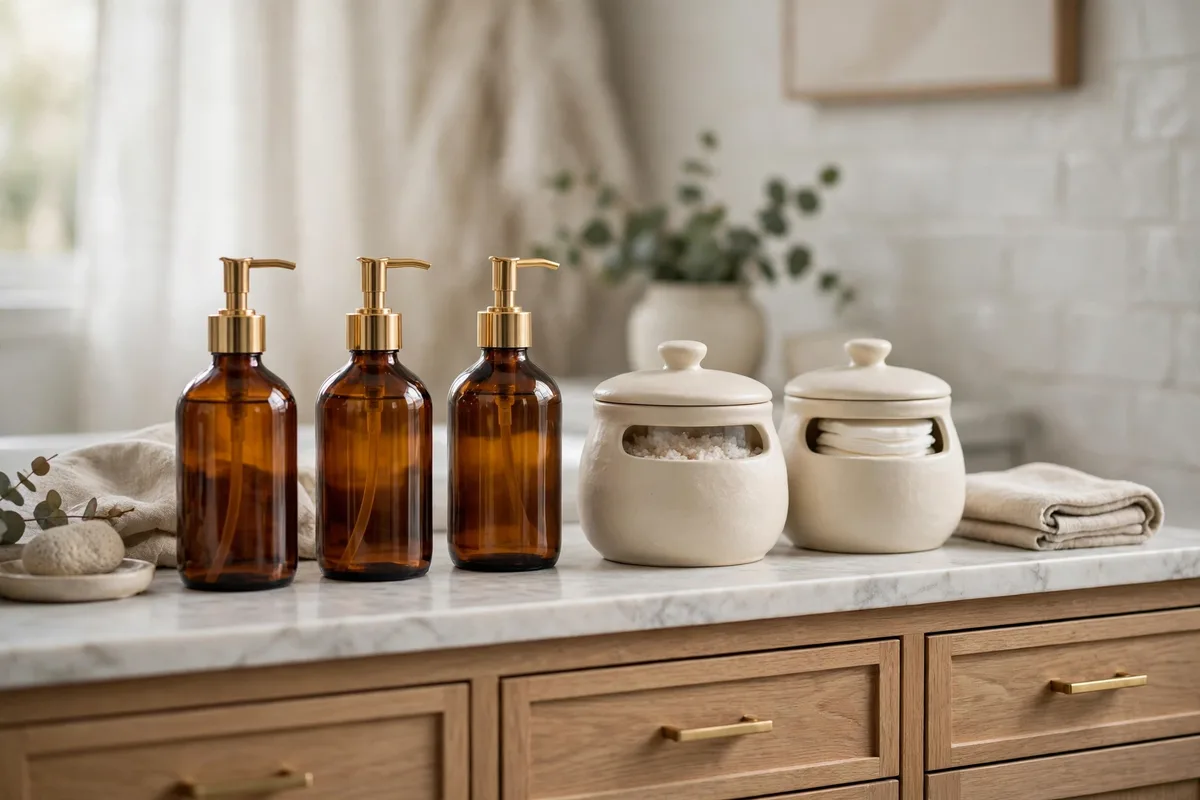
Nothing cheapens a styled vanity faster than packaging: five brands shouting in five typefaces across your composition. Decanting is the silent fix — hand soap and lotion into matching pump dispensers, cotton balls and swabs into lidded glass or ceramic jars, mouthwash into a stoppered bottle. The products stay identical; the noise disappears.
Choose one vessel family and commit: all amber glass, all matte ceramic, all clear glass with the same lid finish. It is the same one-palette logic as the tray combos designers repeat — white bottles on wood, amber on marble, black on stone — because coherence, not expense, is what reads as luxury. Label discreetly if your household needs it, and keep the original bottles under the sink for refills.
5. Style Up: The Mirror Is Half the Vanity
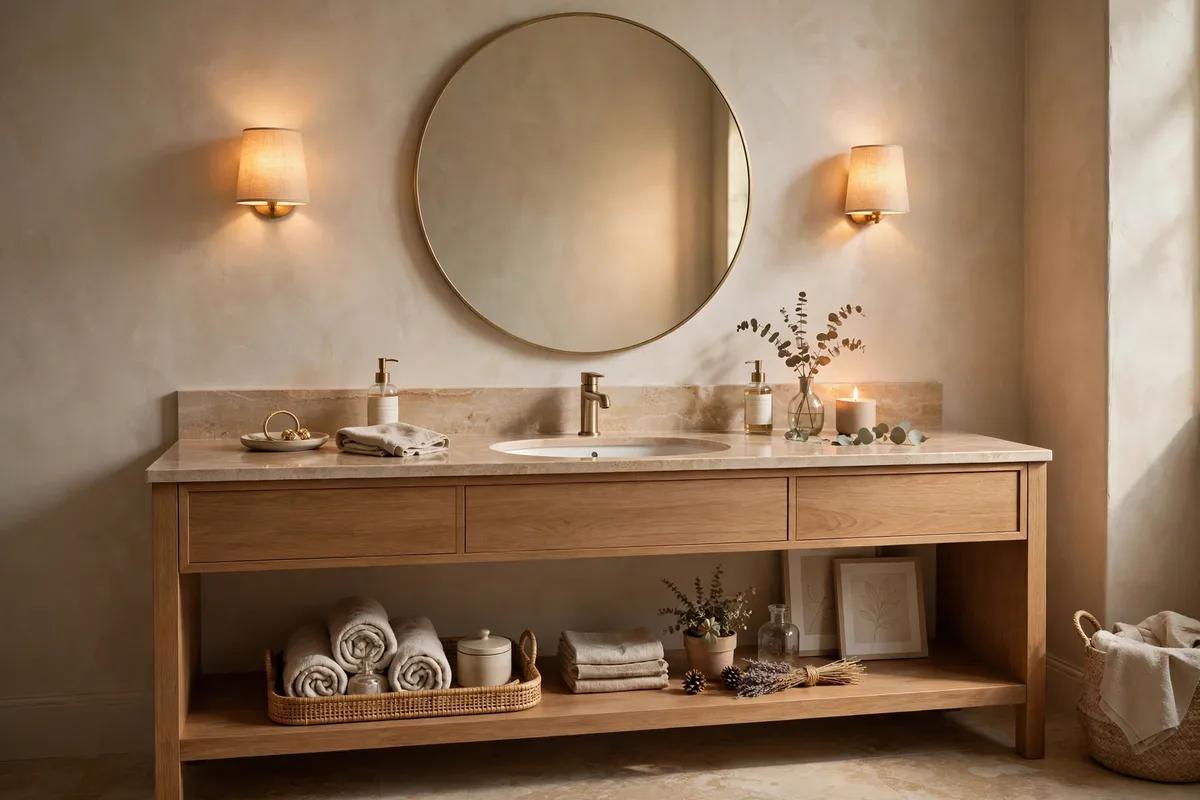
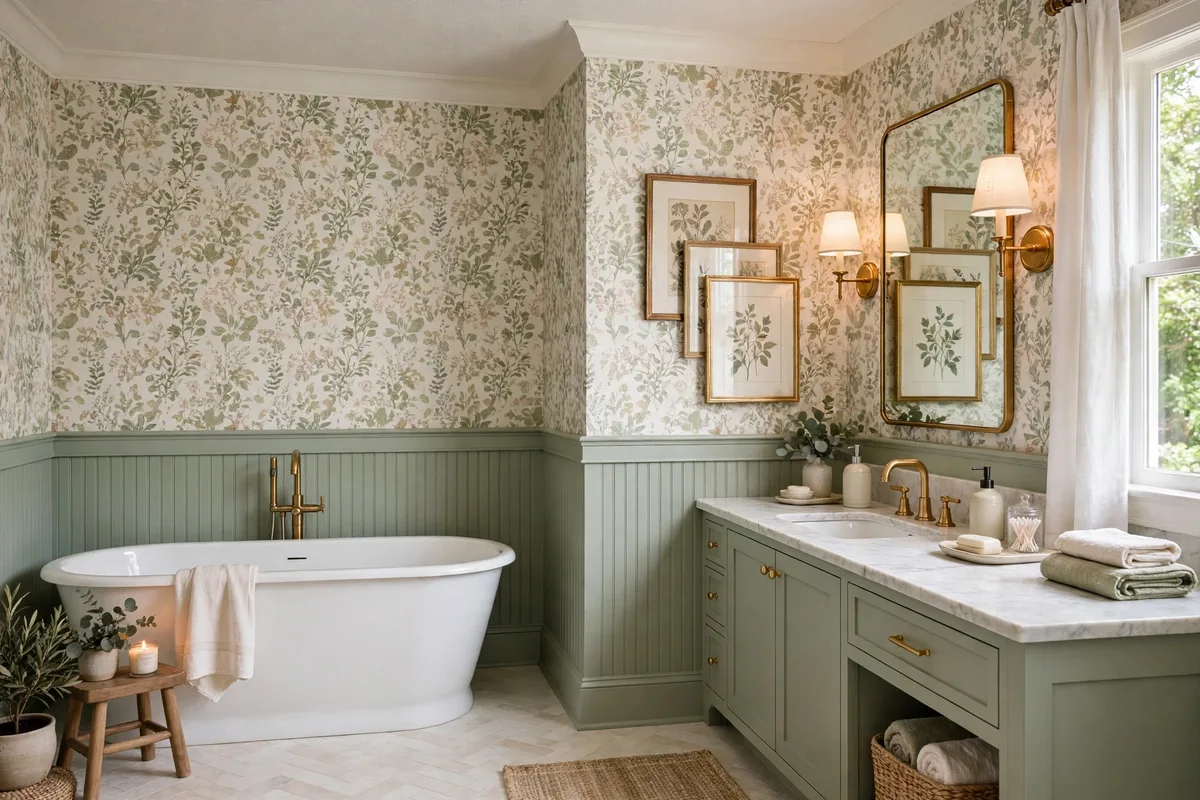
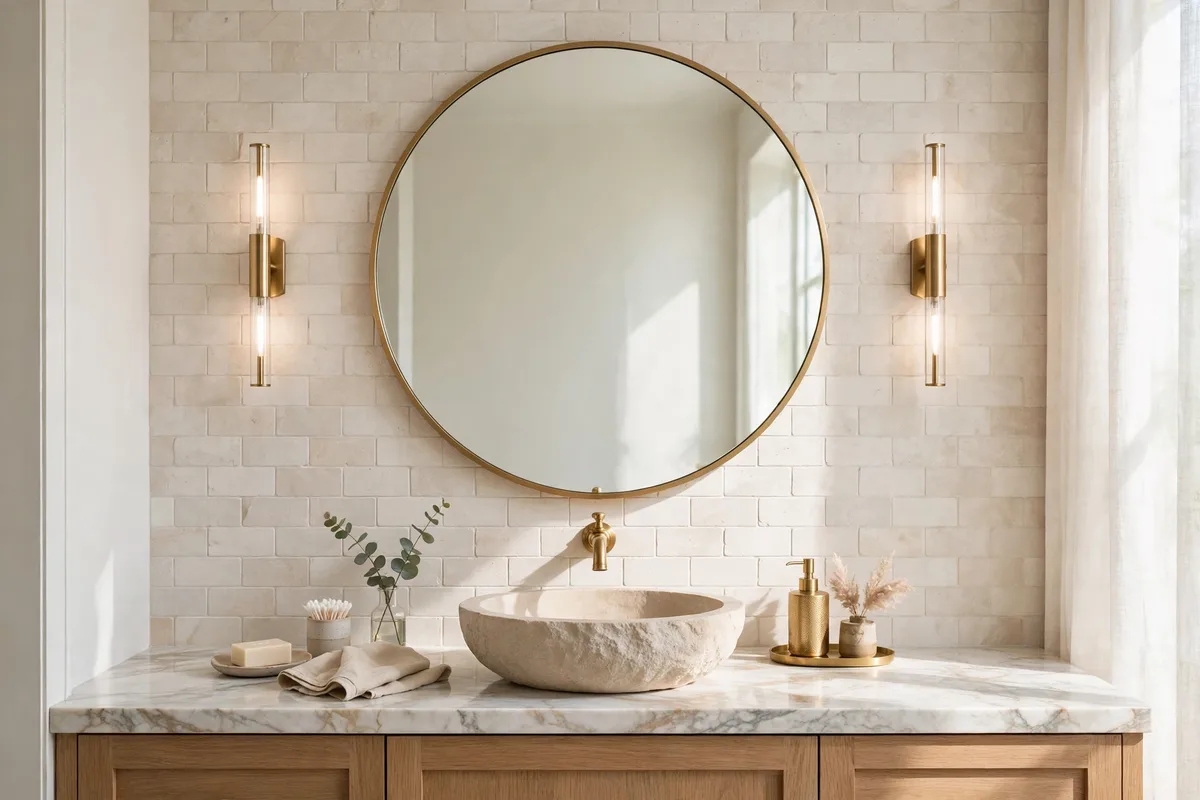
A vanity is a two-storey composition: the counter is the ground floor, the mirror is the facade. A small, builder-basic mirror caps the whole arrangement at ordinary, whatever the counter does. Size and shape do the styling here — a mirror around 70–80% of the vanity’s width, round or arched to soften a rectilinear room, framed to match the room’s metal or frameless to keep it light.
The sizing science lives in our small bathroom visual space ideas — the same mirror that makes the room feel bigger also anchors the vanity’s composition. Centre it on the basin (not the wall, if they differ), and let the counter vignette sit asymmetrically beneath it; perfect symmetry is a showroom, a slight offset is a home.
6. Light at Face Height, Not From the Ceiling
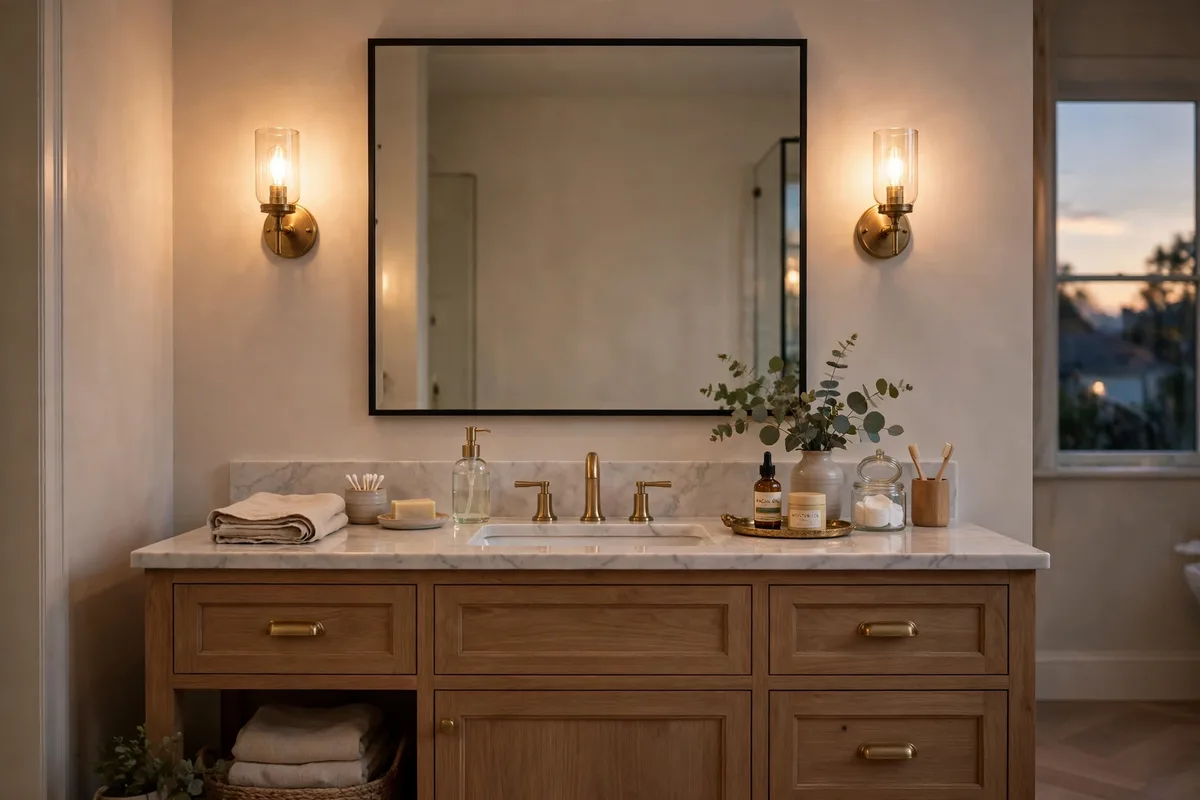
Styling fails in bad light no matter what the counter does. A single overhead fixture throws shadows down the face — the vanity looks harsh, the user looks tired, and the room reads clinical. The designed answer is light at face height: sconces on both sides of the mirror (or a backlit mirror) washing the face evenly from the sides, in a warm-neutral temperature around 2700–3000K that flatters skin and materials alike.
Renters and the wiring-shy have a softer version: a small countertop lamp or LED votives for evening, which layer a glow the overhead cannot. Light is also a styling material for the surfaces themselves — a satin or gloss tile behind the vanity bounces it back into the room, one more reason the tile choices in our best bathroom tile ideas matter beyond the shower.
7. One Living Thing
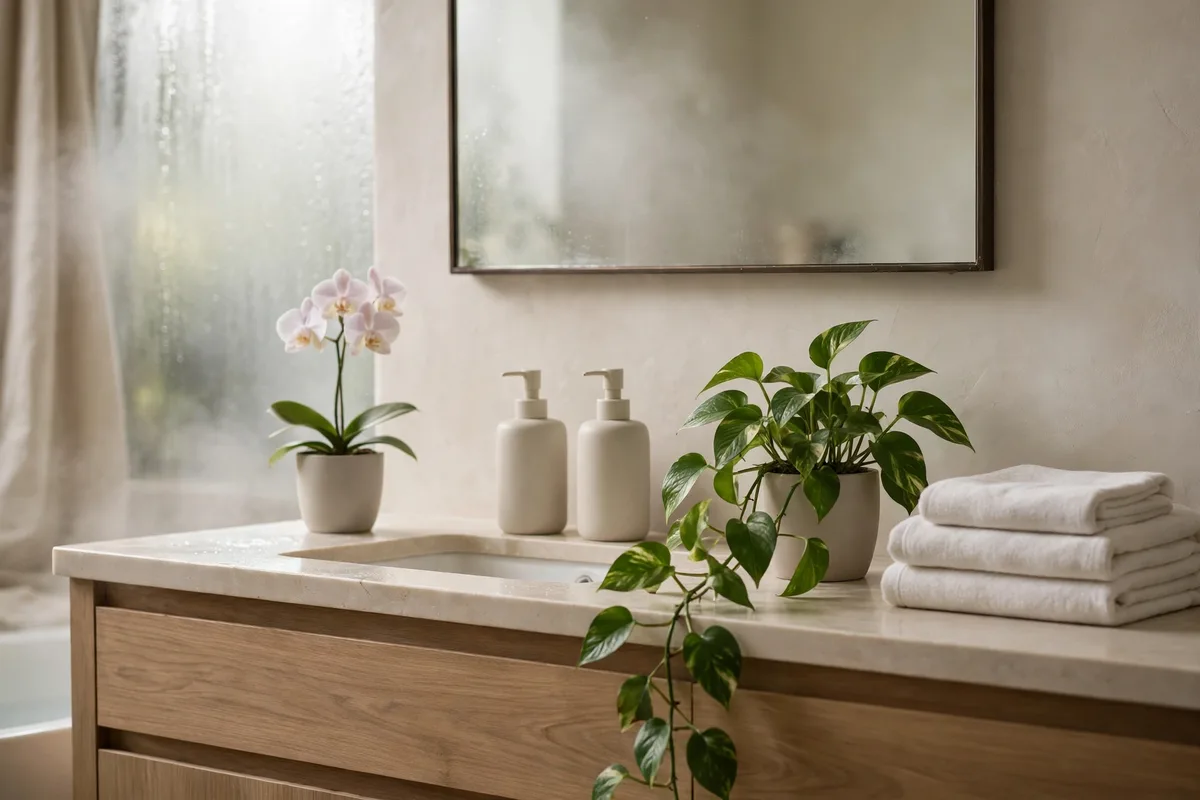
Every stylist’s vanity has exactly one green thing on it. The bathroom’s humidity is a feature here: orchids, ferns, snake plants and ZZ plants tolerate the low light and actively enjoy the shower steam, as Engineer Fix’s guide notes — and a pothos will forgive even a windowless room, trailing off the counter’s edge or a shelf. One plant, chosen for the light you actually have.
Scale it to the counter: a small orchid or a bud vase of stems on a single vanity, something trailing on a double. Keep it singular — two plants is a collection starting, and collections are what §1 removed. No natural light and no shame: one good faux stem in a real vase beats a dying real plant in a stylish pot, every day of the week.
8. The Hand Towel Is a Textile Moment
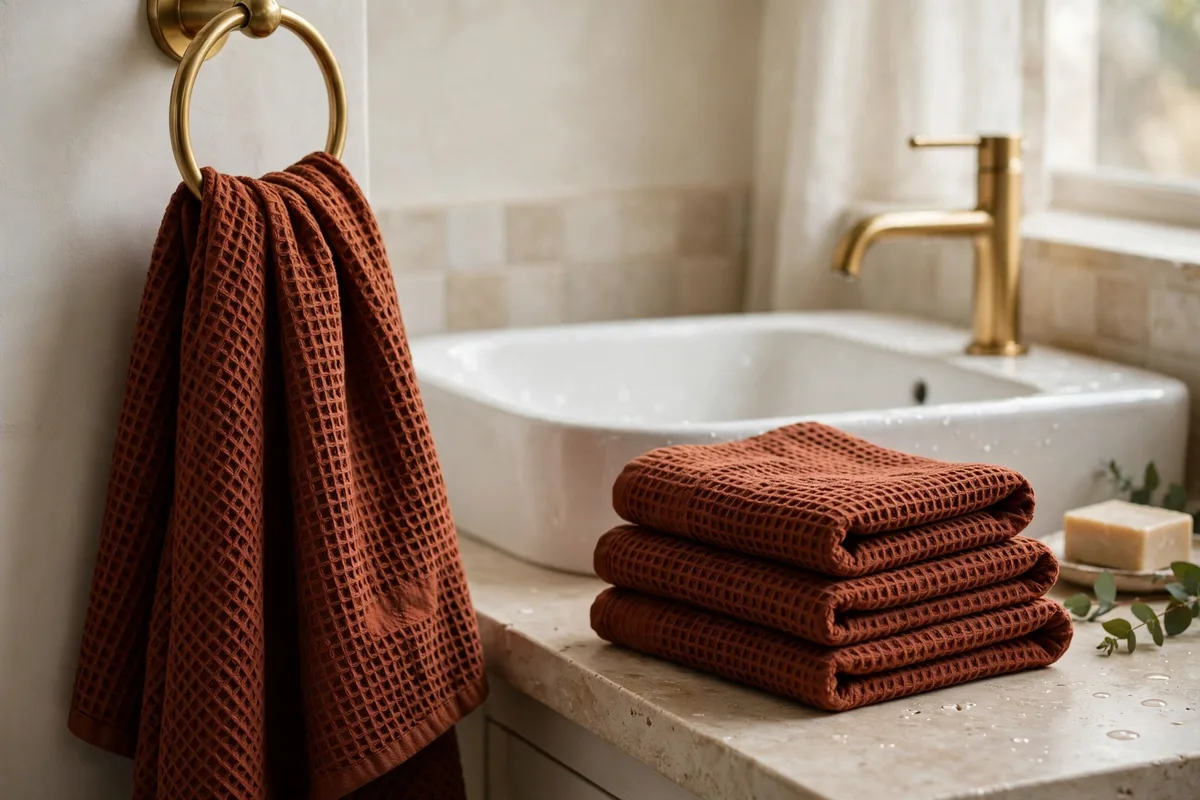
The hand towel is the vanity’s only textile, which makes it the composition’s softening layer — and the easiest seasonal update in the room. Choose texture over pattern at this scale: waffle weave, Turkish cotton, a fringed or striped edge reads rich at arm’s length, while a loud print fights the vignette. Drape it through a ring or fold it in thirds over the bar so it hangs with intention, not by accident.
Colour strategy: match the towels to the room’s palette and let them be the accent that changes — white for the hotel register, a deep tone picked from the tile for the designed one. Buy the set as a set (hand towels that match each other, bath towels that match them), and retire the odd survivors to the cleaning cupboard; mismatched towels undo a styled counter faster than any clutter, a truth the storage-first layouts in our small design bathrooms ideas keep demonstrating.
9. Scent: One Candle, One Source, Stop
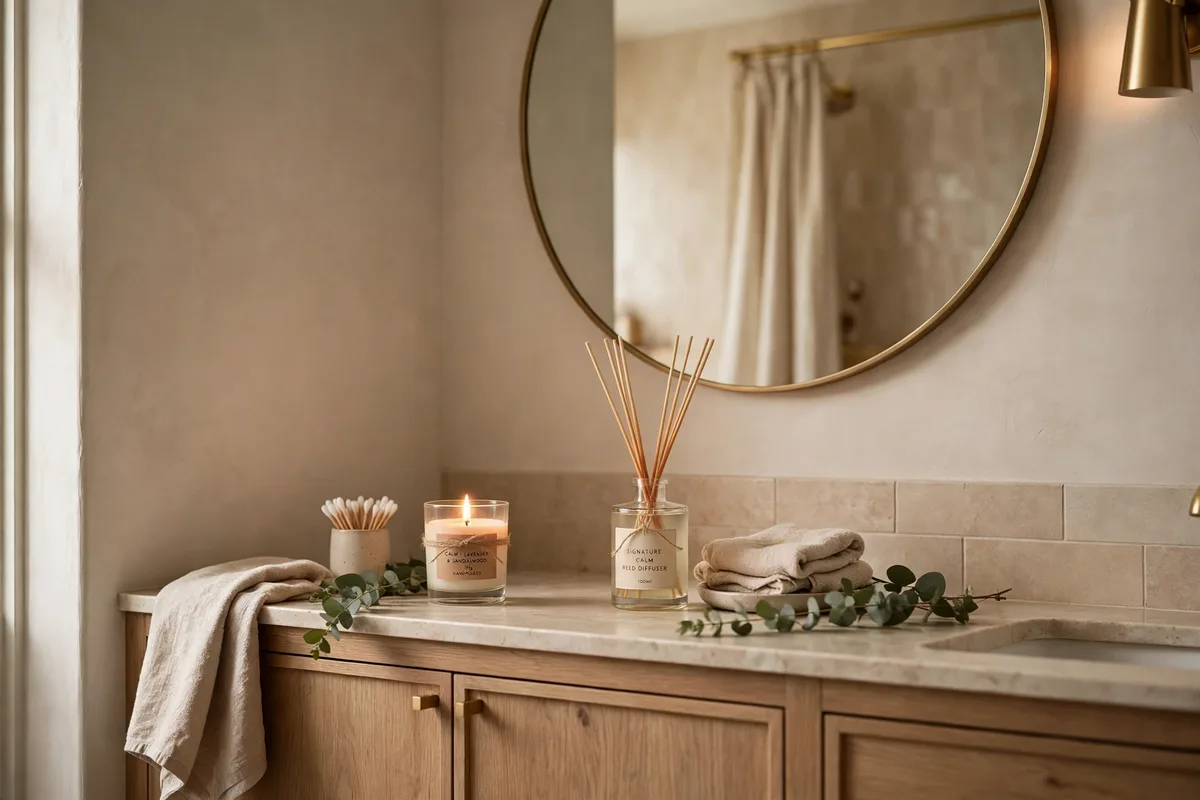
Scent is the styling layer guests remember and residents stop noticing — which is why it must be singular. The Badeloft method finishes with one candle or one diffuser, and stops: two competing fragrances read as an accident in a small room. Choose the bathroom’s one signature (something green or clean — eucalyptus, fig, neroli) and let the candle double as the vignette’s low or middle height.
Practical styling around scent: keep candles off the tray if the tray is crowded — beside it, on the counter’s other end, balances the composition. And treat anything paper or fabric near the mirror with suspicion: humidity is hard on unframed art and prints, so if you want art at the vanity, frame it behind glass with a sealed back, and never hang anything irreplaceable over a basin.
10. Zones: Style for the People Who Actually Use It
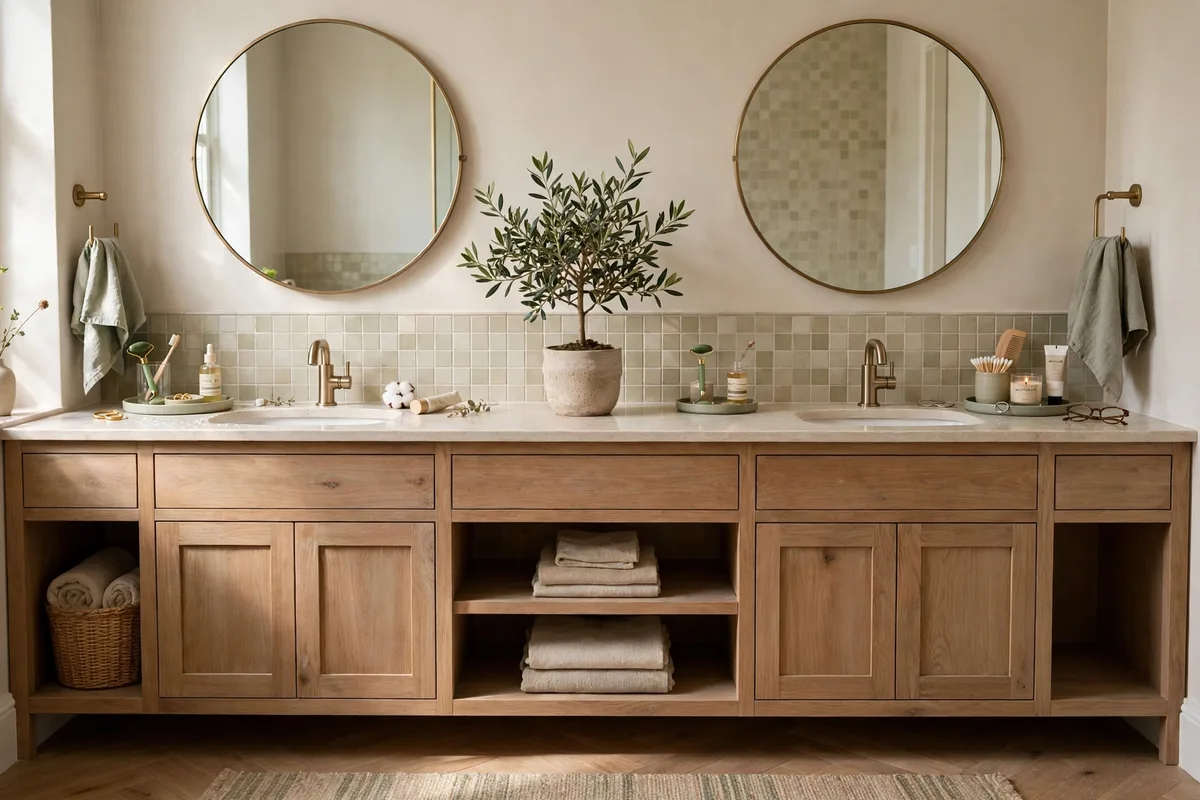
A styled vanity that ignores the morning routine lasts four days. The final move is zoning: on a double vanity, each person gets a zone — their own tray or tray-half, their daily three, their towel — built with the same rules (§2–§4) at half scale. Shared items (soap, the plant, the candle) live in the middle and belong to the composition, not to either side.
Single vanity, multiple users? Zone vertically instead: counter for the shared daily three, a drawer or cabinet shelf per person beneath. The test of the whole system is a weekday morning at speed — if styling survives it without anything migrating back onto the counter, the composition was built from real life, and real life is the only brief that matters.
The drawer half: The counter’s composition only survives if the drawer’s does. Give the weekly pile from Section 1 a divided drawer — one zone per person, mirroring the counter zones above it — and keep backups (refills, spare heads, the rarely used) in the lowest drawer or below the sink. Styling that has to be rebuilt every morning was never finished; the drawer is where the system hides its working parts.
Copy This Counter: Three Finished Set Pieces
The single-vanity daily three: the tray at 60 percent (Section 2), holding the rule-of-three in heights (Section 3) — dispenser tall, jar or candle mid, small dish low — everything decanted (Section 4), one plant at the end of the counter (Section 7). The rest of the counter stays empty on purpose.
The double-vanity zoned pair: two tray-halves, one per person (Section 10), each running its own rule of three; the centre is shared — one plant, one candle (Sections 7 and 9) — and the towels match each other, not their owners (Section 8).
The guest-ready counter: the zones collapse into one shared composition; the towel moment and the single scent do the hosting (Sections 8 and 9), and the whole maintenance between guests is the seasonal swap — towel colour, stems, scent. The full hosting system for that room lives in our guest bathroom guide.
Frequently Asked Questions About Bathroom Vanity Styling
How much of the vanity counter should stay empty?
At least a third — many stylists aim for half. Empty counter is not wasted counter; it is the negative space that makes the grouped third read as a composition. If everything styled covers everything visible, the eye reads storage, not styling.
What belongs on a bathroom vanity tray?
The daily three, arranged by height: the soap dispenser or tallest bottle at the back, a mid-height jar or candle, and a low dish or soap plate at the front — plus the one plant if the tray is its home. Weekly products belong in drawers, not on the tray.
What is the best tray material for a bathroom?
Forgiving ones: resin, acrylic, sealed stone, ceramic or lacquered wood — materials that shrug off wet bottles and wipe clean. Unsealed marble stains, untreated metal can rust, and raw woven fibres mildew if they stay damp; if you love them, keep them on the dry side of the counter.
Should vanity accessories match?
The vessels should: one family of dispensers and jars is what deletes the packaging noise. After that, controlled variety is good — the tray, plant pot and candle can differ in material as long as they share the room’s palette and one metal finish.
How do I style a very small single vanity?
Shrink every rule, drop none: a mini tray with exactly three items, one decanted dispenser, one small plant or stem vase, the towel as the colour accent, and the strictest empty-counter discipline of all — small vanities look styled fastest because the composition is the whole counter.
Can I style a rental bathroom vanity?
Almost everything here is renter-proof: trays, decanting, textiles, plants and counter lamps change nothing permanent. Only sconces and mirror swaps touch the building — keep the landlord’s mirror and fittings stored safely and reinstall them when you leave.
What mirror shape suits a styled vanity?
Round or arched mirrors soften rooms full of hard rectangles (tile, basin, counter) and suit most vanities; a wide rectangle maximises reflection in small rooms. Either way, size it near 70–80% of the vanity width and centre it on the basin.
How often should I re-style or refresh the vanity?
Seasonally is plenty: swap the towel colour, the candle scent and the stems, keep the architecture (tray, vessels, mirror) fixed. The daily discipline is smaller — everything returns to its zone after use, and the counter gets a ten-second wipe while the kettle boils.
Where do I put the toothbrushes in a styled vanity?
In the composition, honestly: a matching holder on the tray is the classic answer, a lidded ceramic cup if you prefer them hidden, or the mirrored cabinet if counter minimalism wins. What breaks styling is the novelty holder in a clashing colour — replace the vessel, not the habit.
What is the most common vanity styling mistake?
Styling without subtracting: adding a tray, a plant and a candle to an already-full counter. The composition has nowhere to breathe, so it reads as more clutter with better PR. Empty first, then add — the order is the entire secret.
How do I style a guest bathroom vanity?
Collapse the zones into one shared composition and let two moves do the hosting: the towel moment (Section 8) — fresh, folded, clearly for the guest — and the single scent (Section 9). Everything personal leaves the counter; what stays is the guest-ready set piece above. Between guests, the seasonal swap (towel colour, stems, scent) is the entire maintenance.
Conclusion
A styled vanity is an edited one: subtract to the daily few, corral them on one tray, arrange in threes and heights, decant the noise away, and let the mirror, the light, one plant, one scent and one good towel finish the picture. None of it is expensive and most of it is free — the discipline is the decor. Build it from your real morning, and the room you start the day in will finally look like it was designed by the person who ends the day there too.



Pingback: 10 Bathroom Mirror Placement Ideas (Heights, Widths, Centrelines)