
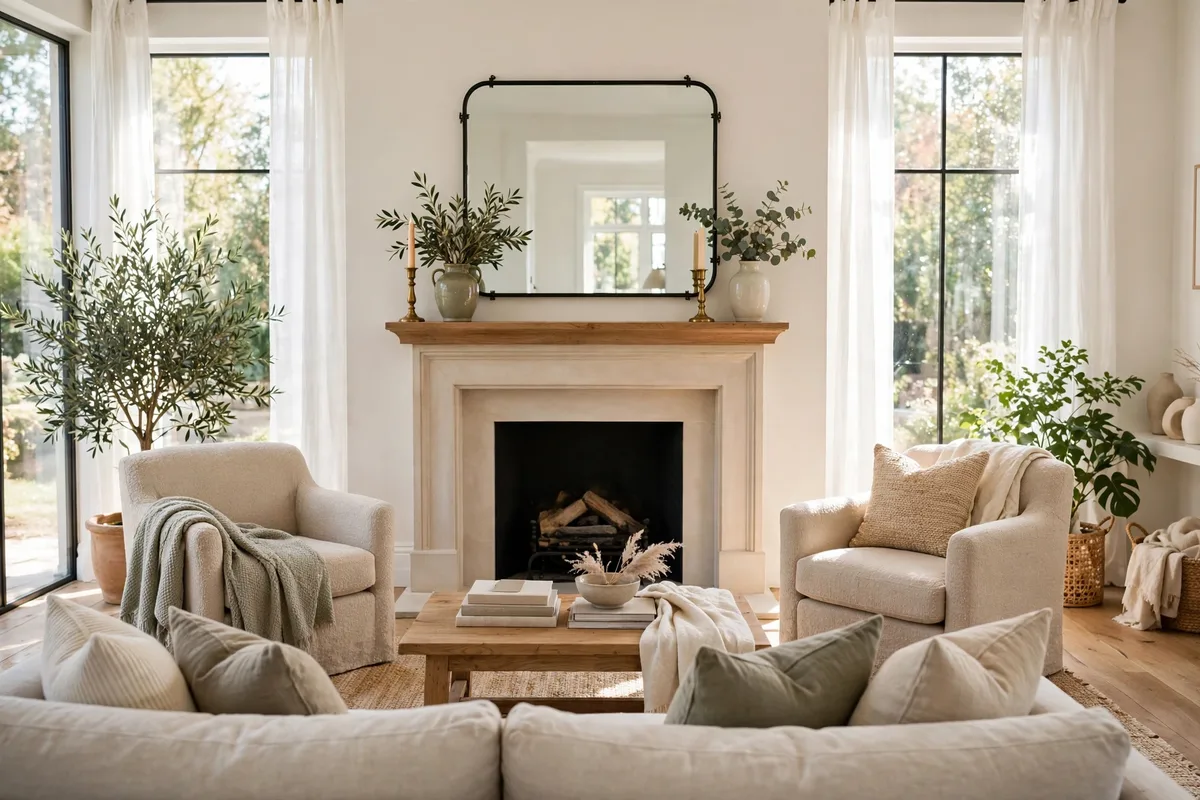
A fireplace mantel is one of the few places in a home that exists almost purely for display, which is why it so often becomes either a blank shelf or a crowded one. The mantels that look effortless are not decorated with more objects. They are arranged with a clear structure: one anchor piece, height on both sides, layered depth in front, and a deliberate amount of empty space. Once you understand that structure, styling a mantel becomes a sequence of decisions you can repeat in any room, with any fireplace, in any season.
This guide explains the whole approach, from measuring your mantel shelf to the final symmetry check, with style directions for modern, traditional, rustic, and seasonal looks. Whether your fireplace is a working focal point in a busy family room or a non-working feature in a small flat, you will learn how to build a display that looks balanced from across the room and interesting up close, and how to refresh it without starting from nothing each time.
1. Measure and Plan Before You Style
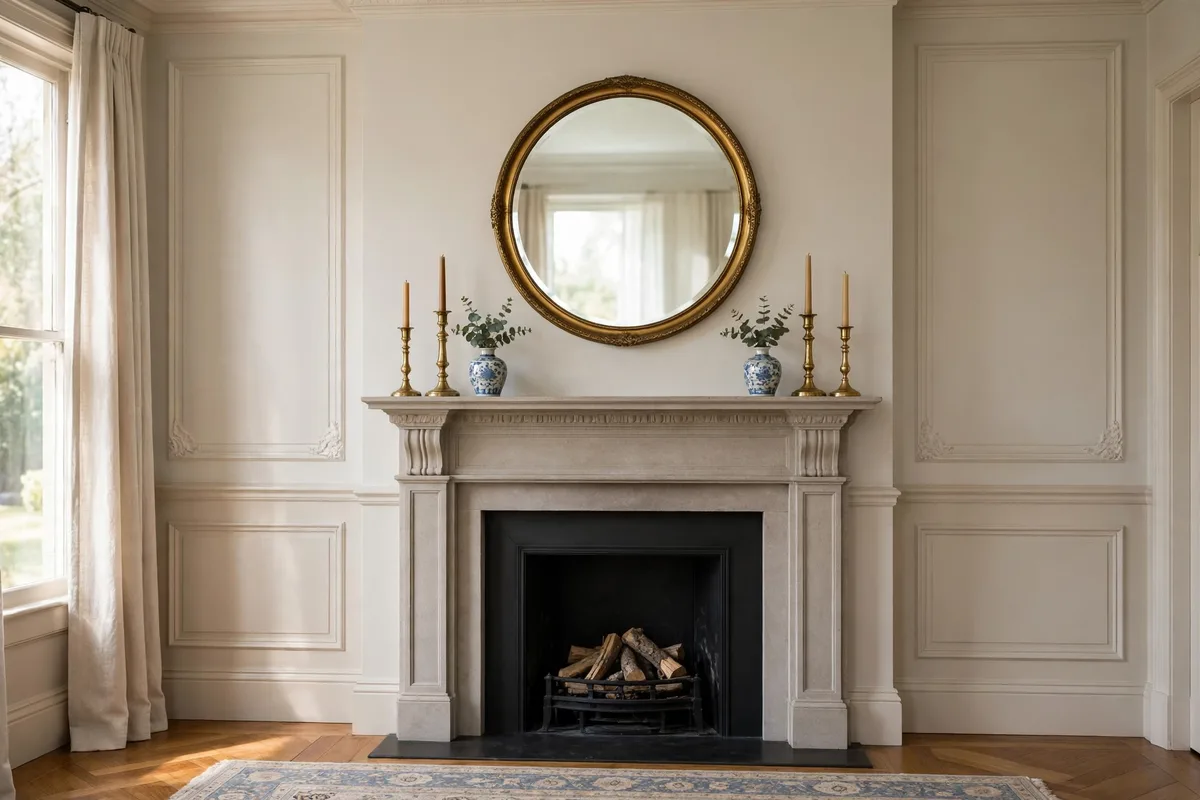
Most mantel problems are measurement problems in disguise. An anchor mirror that is too small looks lost above a wide firebox, a garland hung without checking its drop covers the opening, and objects placed without knowing the shelf depth slide into a single flat line. Ten minutes with a tape measure prevents all of it. Record four numbers: the width of the shelf, its depth, the height from the shelf to the ceiling, and the width of the firebox opening beneath it.
The proportions that guide everything
- Anchor width: Aim for a mirror, artwork, or wreath that spans about two thirds of the mantel shelf width. Much narrower and it floats; much wider and it overwhelms the fireplace.
- Shelf depth: Most mantels offer only a shallow ledge, so plan on objects with a small footprint and real weight at the base. Anything top-heavy belongs elsewhere.
- Ceiling height: Low ceilings call for wider, lower arrangements. Higher ceilings allow taller anchors and stacked layers above the shelf.
- Clearances: Keep decor safely away from the firebox opening and flue, and follow your fireplace manufacturer’s guidance for combustible materials near heat.
With those numbers written down, sketch the arrangement as simple shapes: a large central rectangle for the anchor, taller shapes at one or both ends, and smaller shapes layered in front. This little drawing becomes your shopping and arranging guide, and it stops impulse buys that do not fit the plan.
2. Choose One Anchor Piece for the Centre
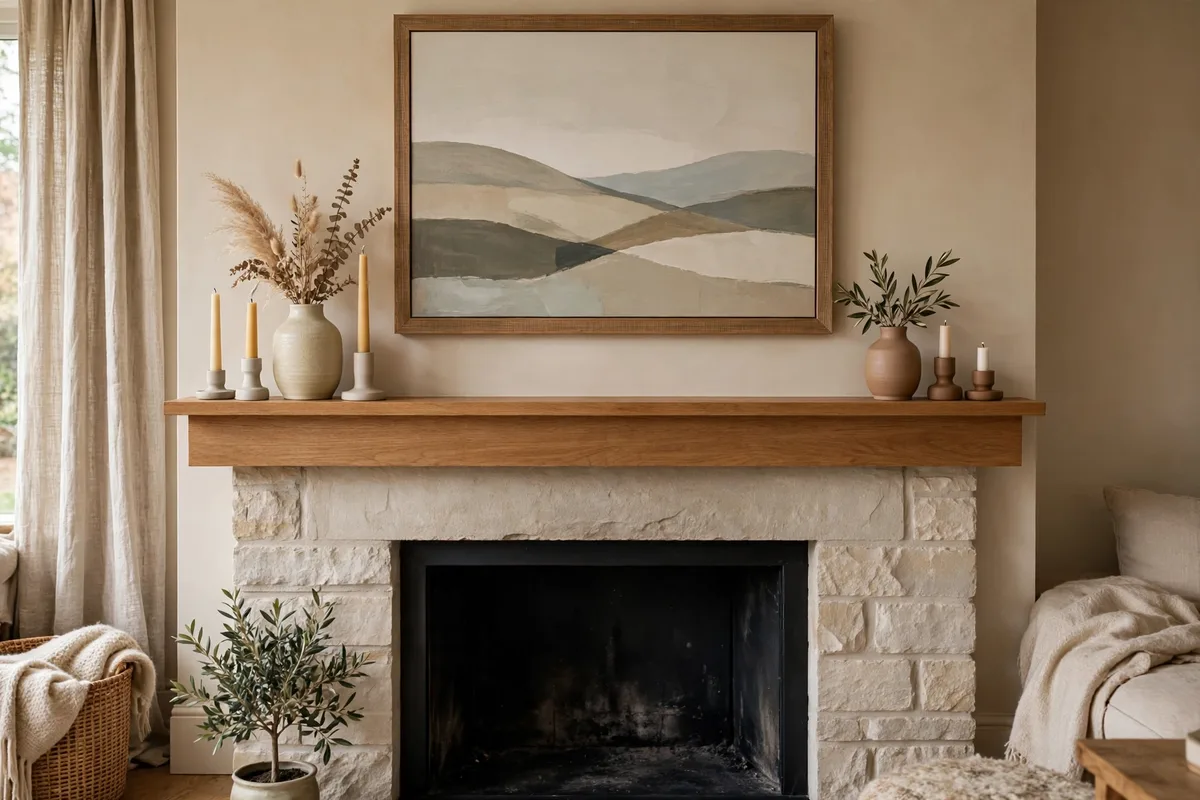
The anchor is the piece your eye lands on first, and it quietly sets the style and scale for everything else on the mantel. Choose it before you place a single candlestick. A large mirror reflects light and makes smaller rooms feel bigger; substantial artwork adds colour and personality; a wreath brings softness and suits seasonal styling; and a clock or an architectural piece, such as salvaged corbels or a framed textile, gives a distinctive, collected look that changes less often.
Matching the anchor to your style
| Anchor | Best style fit | What it adds | Watch out for |
|---|---|---|---|
| Round mirror | Modern, transitional, small rooms | Light, openness, soft curves against straight lines | Reflections of ceiling clutter or a bare opposite wall |
| Large artwork | Traditional, eclectic, colour-led rooms | Colour, subject, a clear focal statement | Heat and soot exposure on valuable originals |
| Wreath | Rustic, farmhouse, seasonal schemes | Texture, softness, easy seasonal swapping | Sizing, a small wreath looks lost above a wide firebox |
| Clock or architectural piece | Vintage, industrial, collected interiors | Character and history | Weight, secure fixing may be needed |
Hang or lean the anchor so its bottom edge sits just above the shelf, close enough to feel connected to the objects below rather than floating separately on the wall. Leaning works beautifully for mirrors and large art on deep shelves: rest the piece against the wall, then let the front layer of decor overlap its bottom edge slightly, which locks it visually into the arrangement.
3. Build Height and Symmetry at Both Ends
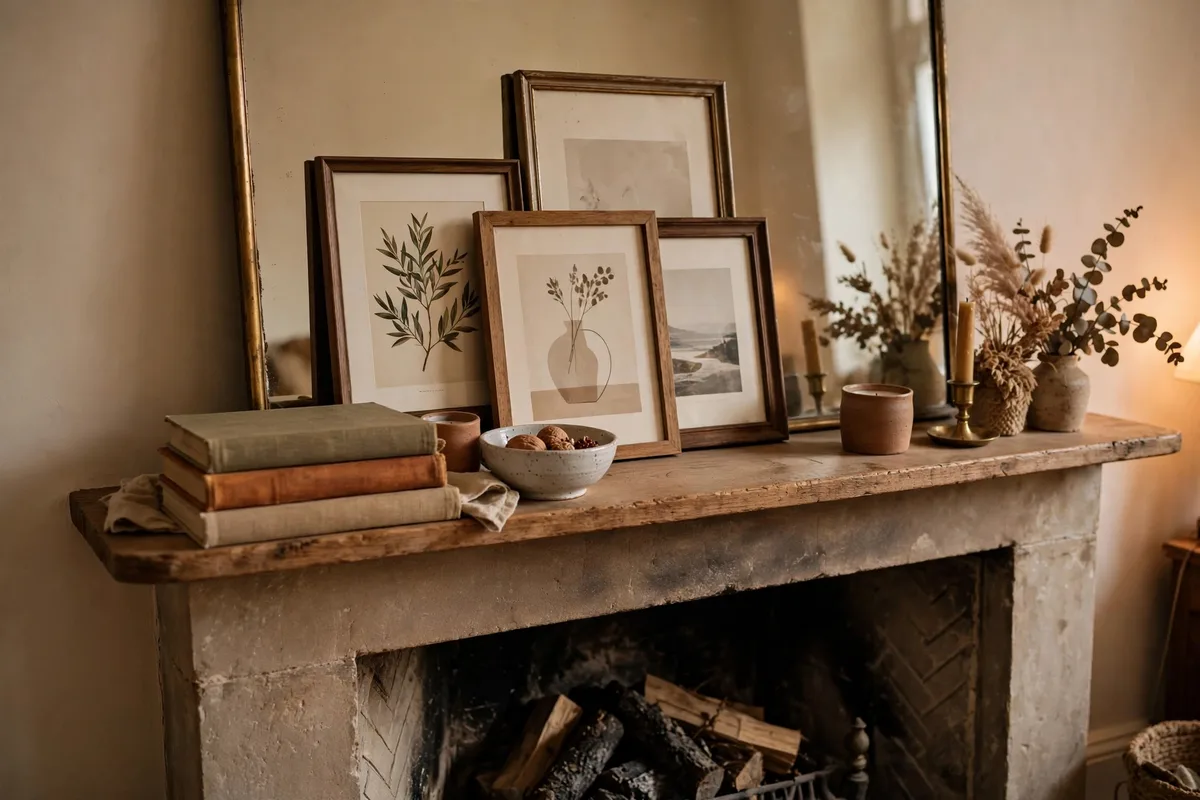
Once the anchor is placed, the ends of the mantel need height so the whole arrangement feels framed rather than centred and stranded. Candlesticks, vases, lanterns, stacked books, or small plants create that vertical punctuation. The classic approach is symmetrical: matching or near-matching heights on both sides, which suits formal fireplaces and traditional rooms. A more relaxed approach is asymmetrical: a taller grouping on one side balanced by a lower, wider grouping on the other, which feels modern and collected.
Rules for the ends
- The tallest object at each end should stay clearly below the top of the anchor, so the centre remains the hero.
- In symmetrical arrangements, exact twins are fine but near-twins, such as two vases of similar height in the same finish, feel less rigid.
- In asymmetrical arrangements, balance visual weight rather than height: one tall lantern can balance a stack of books topped with a bowl.
- Leave a small gap of empty shelf between the end groupings and the anchor zone. That breathing space is what keeps the display from looking like a crowd.
Stand across the room and squint. A well-balanced mantel reads as a pleasing skyline: high in the middle, framed at the ends, with a varied but calm profile in between.
4. Layer Depth From Back to Front
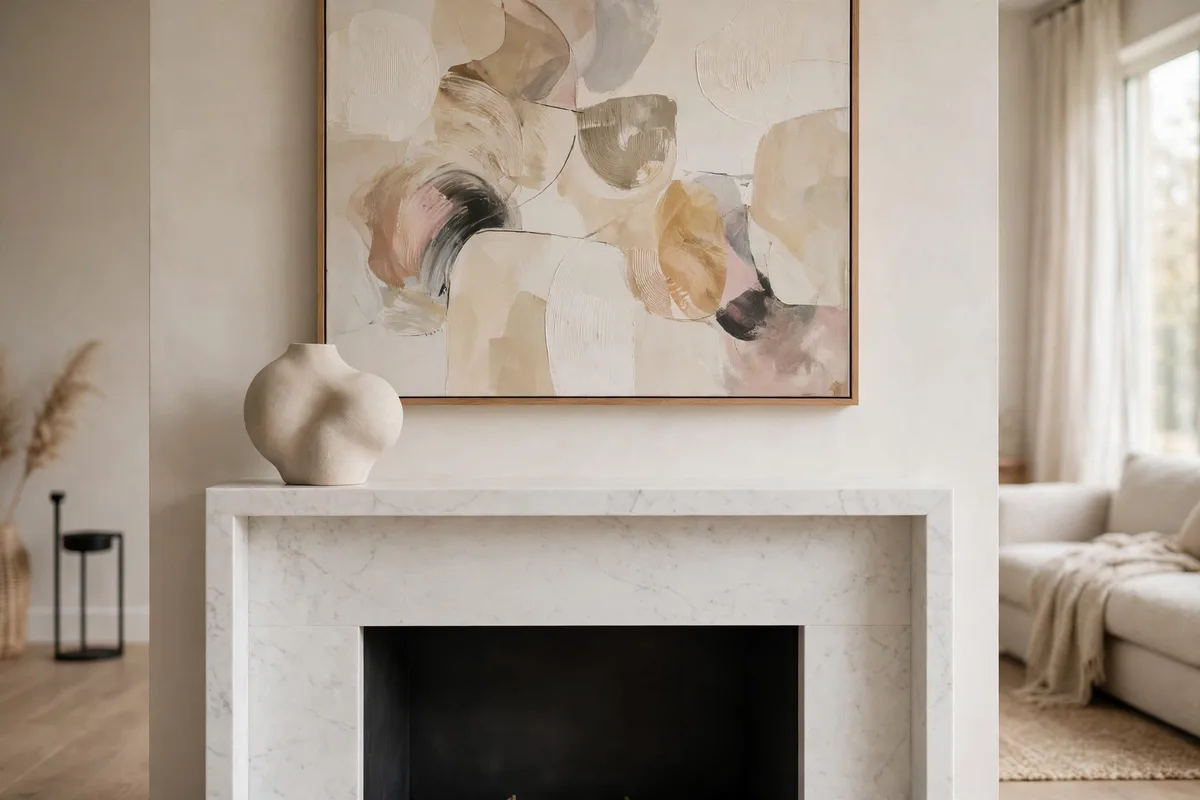
A mantel styled in a single row looks like a shop shelf. Depth is what makes it feel like a home. Work in three loose layers. The back layer is the wall itself and your anchor, plus anything tall and flat such as a leaning frame or a pair of shutters. The middle layer holds your end groupings and medium objects. The front layer is low and small: a garland draped along the front edge, a row of tealights, a small stack of books lying flat, or a trailing plant softening the shelf edge.
Objects that layer well
- Books: Laid flat in twos and threes, they raise other objects and add horizontal calm.
- Small frames and objects: A small photograph, a brass animal, a stone, or a ceramic dish gains importance when placed in front of the anchor.
- Greenery: A garland, a trailing plant, or stems in the end vases connect the layers and soften every hard line.
- Candlelight: Candlesticks in the middle layer and tealights in front multiply reflections in a mirror anchor and double the atmosphere after dark.
Each layer should be lower than the one behind it, like stadium seating, so everything stays visible. If an object disappears completely behind another, move it to the end or remove it. Depth comes from overlap, not from hiding.
5. Match the Mantel to Your Room’s Style
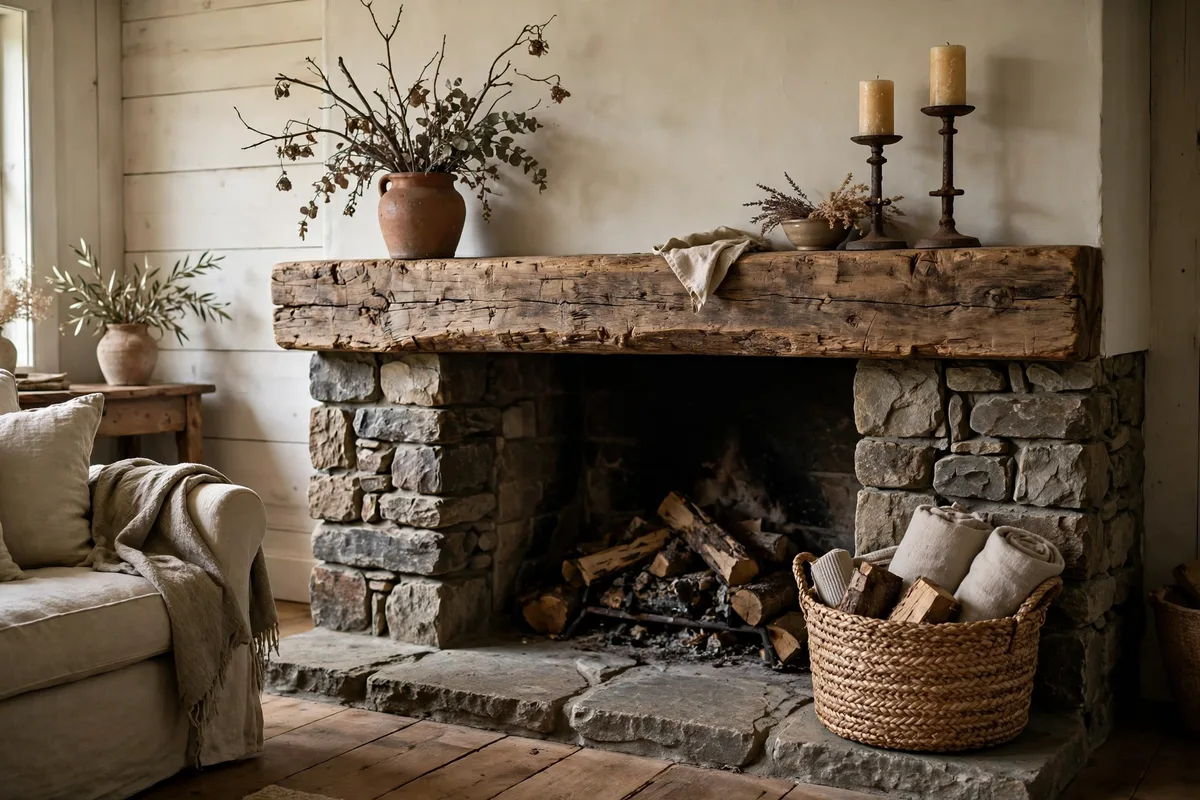
A mantel does not exist in isolation, and the most convincing displays echo the room around them. The style of your furniture, the finish of your fireplace surround, and the colours already in the room should decide the mantel’s direction. Use the style notes below as starting points, then adjust with what you own.
| Style | Anchor | Key objects | Palette and materials |
|---|---|---|---|
| Modern minimal | Large round mirror or single bold artwork | One sculptural vase, a pair of slim candlesticks | Black, white, glass, brushed metal, one plant for life |
| Traditional classic | Framed landscape or portrait artwork | Matching candlesticks, clock, symmetrical frames | Brass, wood, crystal, deep colours |
| Rustic farmhouse | Wreath or reclaimed-wood sign or frame | Lanterns, crocks, stacked books, greenery garland | Natural wood, galvanised metal, linen, warm whites |
| Bohemian eclectic | Layered art or a woven wall hanging | Mixed candlesticks, plants, travel objects, textiles | Mixed woods, global patterns, plants everywhere |
Whichever direction you choose, repeat one material or colour from the mantel somewhere else in the room: a brass candlestick echoed in a lamp base, or the green of a garland picked up in cushions. That single echo is what makes the fireplace feel integrated rather than separately decorated.
6. Add Greenery and Natural Elements

Almost every successful mantel includes something that once grew. Greenery breaks up the straight lines of shelves, frames, and fireboxes, adds texture no manufactured object quite matches, and makes even a formal arrangement feel alive. You have three main options: garlands along the shelf, stems in vases at the ends, and potted or trailing plants that soften an edge.
Choosing greenery that lasts
- Real garlands and stems: Beautiful and seasonal, but they dry out, so place them well away from heat and flames and expect a shorter display life near a working fire.
- Preserved greenery: Eucalyptus and similar preserved stems keep their shape and colour for months and need nothing but dusting.
- Good faux greenery: The most practical choice close to a working fireplace, and modern versions are convincingly textured. Mix in a few real stems to raise realism.
- Dried grasses and branches: Pampas, twigs, and bare sculptural branches add height and drama with almost no maintenance.
Whatever you choose, keep foliage clear of the firebox opening and follow common-sense heat safety. If your fireplace is decorative only, you gain freedom: a plant or a stack of books inside the firebox itself becomes an extra styling opportunity.
7. Use Candles and Lighting for Evening Atmosphere
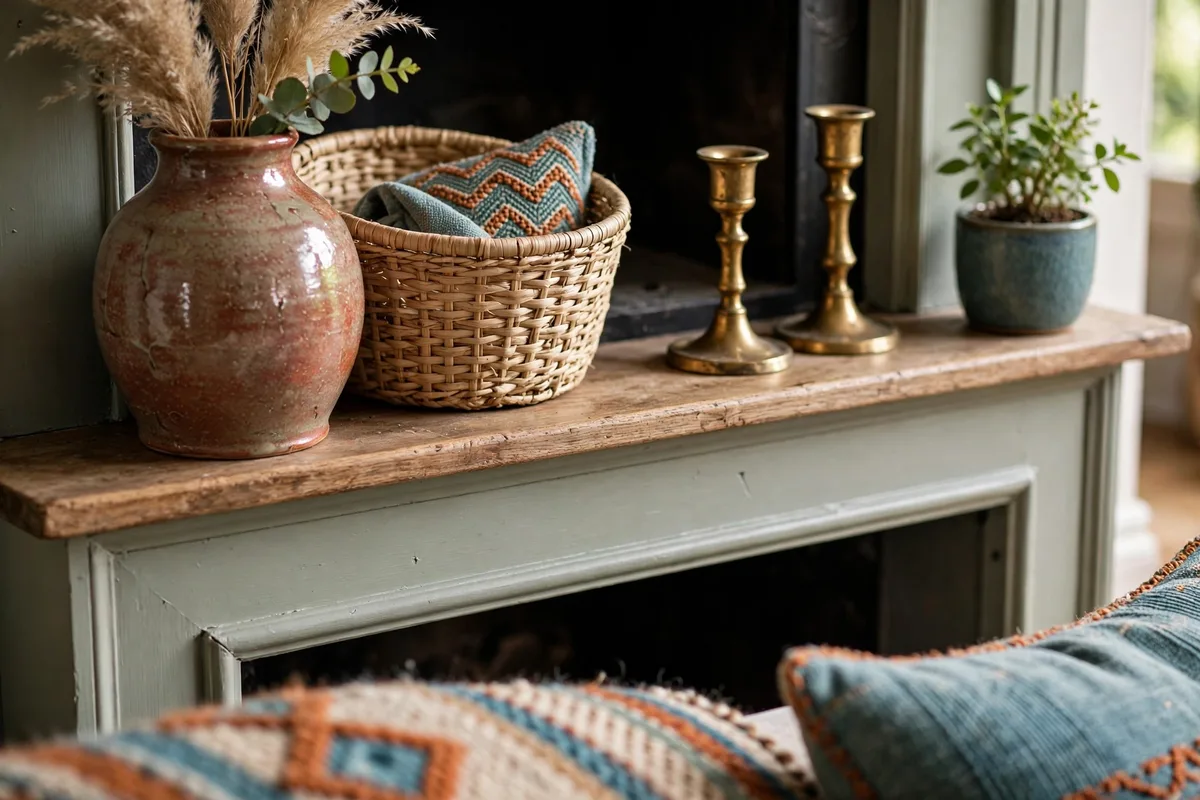
A mantel earns its keep after dark. Candlelight and soft lamp light turn the fireplace wall into the warm centre of the room even when no fire is lit. Build lighting in the same layered way as the objects: candlesticks or lanterns for height at the ends, smaller tealights or votives along the front, and, if your anchor is a mirror, the doubled reflection does half the work for you.
Safe and effective candle use
- Use sturdy holders that fully support each candle, and keep flames well away from garlands, artwork, and anything hanging above.
- Flameless candles on timers are the safest choice near greenery and in homes with children or pets, and they give the same glow at the same hour every evening.
- Vary candle heights in small clusters of three so the light feels natural rather than regimented.
- Consider a small picture light above an artwork anchor, or uplighting in the firebox of a non-working fireplace, for a permanent glow.
If you light a real fire, simplify the shelf: move greenery and anything heat-sensitive back or off the mantel entirely. Atmosphere is never worth a hazard, and a clean, spare mantel above a living fire looks classic anyway.
8. Refresh the Mantel With the Seasons

The most sustainable mantel routine keeps a permanent base and swaps a seasonal layer. Your anchor, candlesticks, and basic structure can stay in place all year. What changes are the garland, the stems, a few small objects, and the colours of books or candles. That single swap takes minutes, costs little, and makes the whole room feel current, much like rotating cushions and throws on the sofa.
A year of seasonal swaps
- Spring: A lighter garland or none at all, tulips or blossom stems in vases, pastel or fresh green accents, and artwork swapped to something brighter.
- Summer: Shells, driftwood, or a bowl of citrus on the shelf, loose greenery, and candles in glass hurricanes.
- Autumn: A richer garland, amber glass, small pumpkins or gourds used sparingly, dried grasses, and warmer candlelight.
- Winter: Evergreen garland, pinecones, taper candles, one metallic accent for glow, and stockings or festive pieces if you celebrate.
Photograph your favourite version of each season. Next year you can recreate the arrangement in minutes instead of reinventing it, and you will slowly build a small library of proven mantel looks for your own fireplace.
9. Style a Small or Narrow Mantel
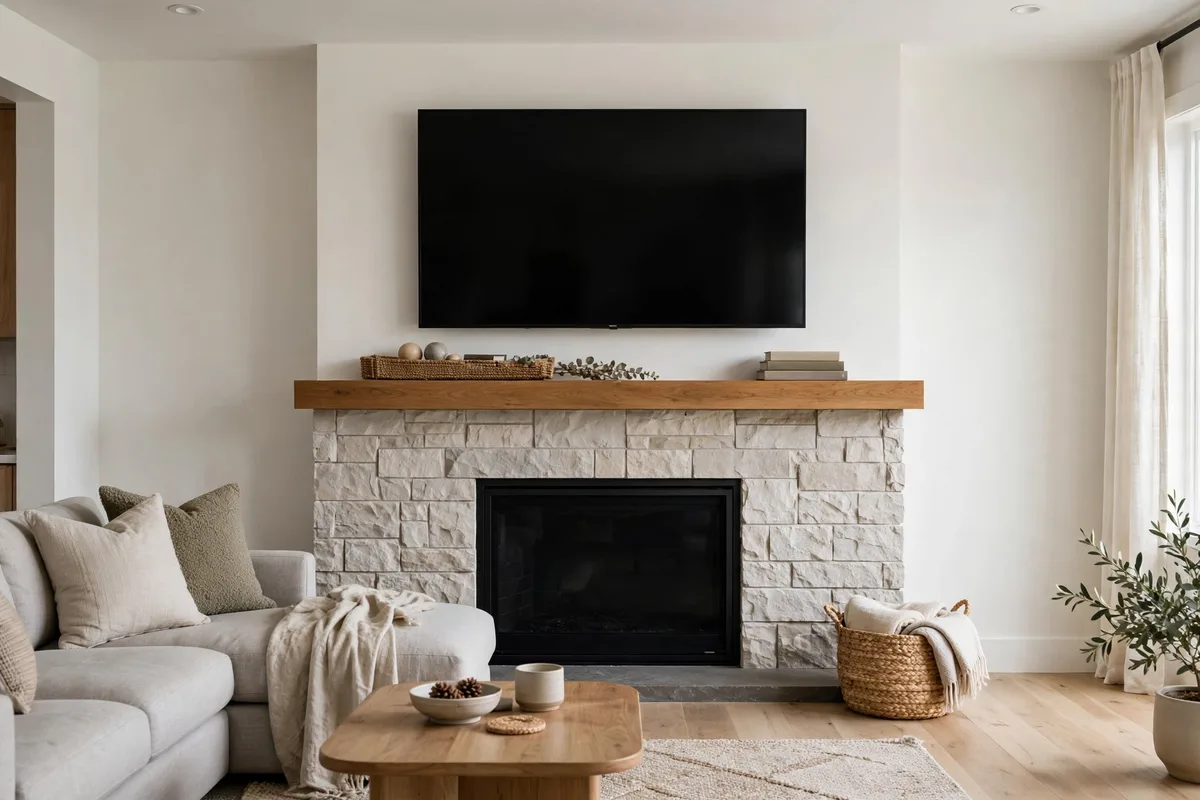
A narrow shelf punishes clutter more harshly than a wide one, because every object is close to the edge and close to its neighbours. Small mantels succeed with fewer, larger pieces: one good anchor, a single grouping at one end, and one low piece in front. Resist the temptation to line the shelf with small collectibles, which reads as dusting burden rather than decoration.
Small mantel rules
- Scale up the anchor. A generously sized mirror or artwork makes a small fireplace feel intentional and bigger.
- Use asymmetry deliberately: height at one end only, balanced by the anchor’s width.
- Keep the front layer very low, tealights or a slim garland, so nothing competes for the little depth available.
- If the shelf is too shallow for objects at all, hang the display instead: a wreath, a shelf-leaning frame on picture ledges above, or sconces either side of the firebox.
Small spaces also benefit from the room-wide thinking in these small living room layout ideas, where one strong focal point works harder than many small ones.
10. Avoid the Common Mantel Mistakes
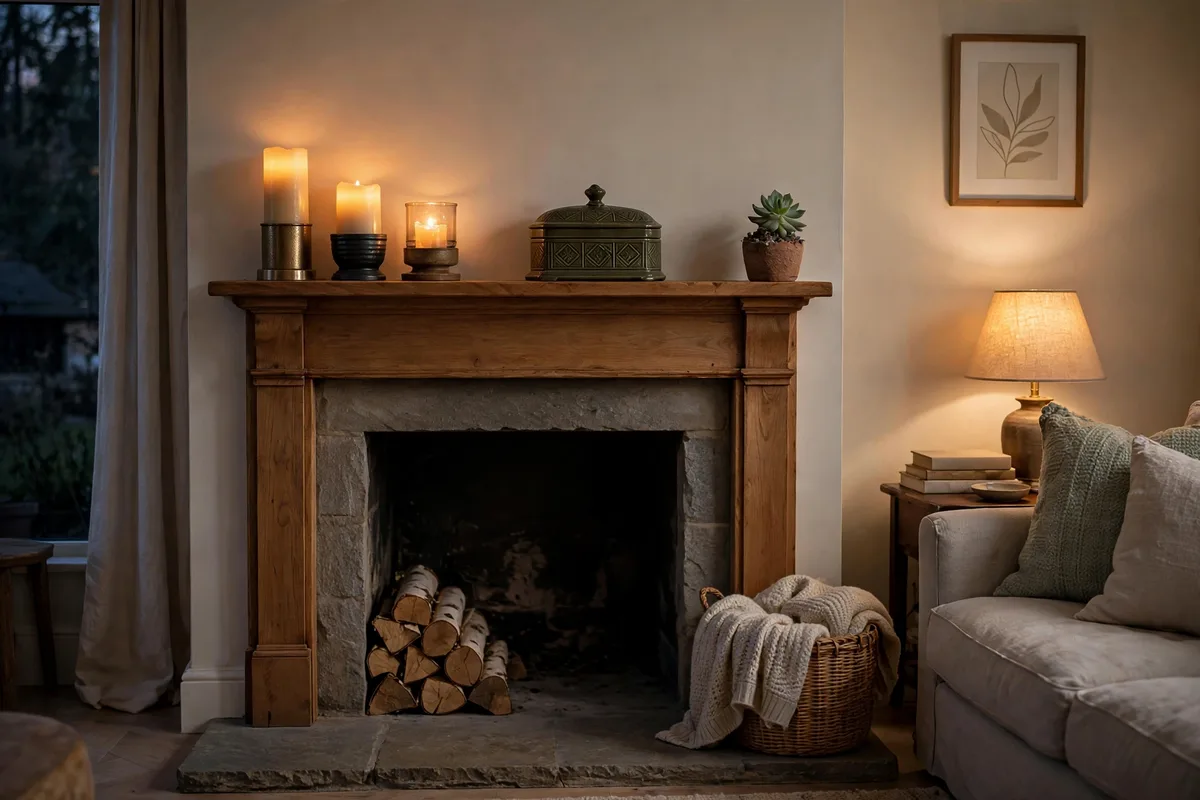
Most disappointing mantels fail in predictable ways, and every one of them is fixable without buying anything new. Work through this list with your current display in front of you, make the changes, then stand back and check the effect from the doorway before deciding anything needs replacing.
The mistakes and their fixes
- Too many small objects: Remove half, then group what remains into the layered structure. Empty space is a design element, not a gap to fill.
- Everything in a single line: Add one leaning piece at the back and one low piece in front so the arrangement gains depth.
- Anchor too small: Swap it for the largest mirror or frame you own, or group two related frames as one anchor until you can replace it.
- Symmetry that is slightly off: Either make pairs truly equal in height or commit fully to asymmetry. Almost-matching is what looks wrong.
- Ignoring the hearth and firebox: A styled shelf above an empty, dusty hearth looks unfinished. Add a log basket, a plant, or a neat stack of books at the base to complete the picture.
- TV mounted too high above the mantel: If a screen shares the wall, treat the mantel as a low shelf beneath it, simplify the display, and check the combined height honestly from your seat.
When you have fixed the structure, live with it for a week. Mantels are seen every day, and familiarity is a fair test: the arrangements that still please you after a week are the ones worth keeping.
Frequently Asked Questions About Fireplace Mantel Styling
How high above a mantel should a mirror or artwork hang?
Hang the anchor so its bottom edge sits a short distance above the shelf, close enough that it reads as part of the arrangement rather than separate wall art. If the piece leans on a deep shelf instead, rest it against the wall and overlap its lower edge slightly with front decor. In both cases the anchor should span roughly two thirds of the shelf width.
What should I put on a mantel if I do not want a mirror?
Large artwork is the most popular alternative, adding colour and a clear subject. A generous wreath suits rustic and seasonal schemes, while a clock, a framed textile, or an architectural salvage piece gives a collected, personal feel. Any anchor works if its scale is right: about two thirds of the shelf width and clearly the largest piece in the arrangement.
How many objects should a styled mantel have?
Count groups rather than objects: an anchor, one grouping at each end, and one low front layer is a complete, balanced mantel for most fireplaces. That usually means somewhere between seven and twelve individual pieces. If counting pieces makes the shelf feel crowded as you arrange it, remove items until the groups stay distinct and some shelf stays visibly empty.
Can I style a mantel with a TV above it?
Yes, but simplify. Use a low, wide arrangement beneath the screen: a garland or a row of low objects, one grouping at a single end, and nothing tall competing with the picture. Check the combined screen and mantel height from your seat, because a screen mounted high above a deep mantel can strain viewing. Art-mode screens soften the compromise considerably.
How do I style a mantel in a rental home?
Lean mirrors and artwork rather than drilling, use removable hooks only for light pieces, and build the display from objects that sit on the shelf rather than fixtures on the wall. Keep the structure the same: anchor, ends, front layer. When you move, everything comes with you and the wall needs nothing more than a quick clean.
What garland works best on a mantel?
For a working fireplace, good faux or preserved greenery is the practical choice because real garlands dry quickly near heat. Wire the garland so it drapes in gentle swags along the front edge rather than lying flat, and keep all foliage safely clear of the firebox opening. In summer, swap to a lighter garland or none at all and let stems in vases carry the green.
Should mantel decor be symmetrical?
Symmetry suits formal rooms and traditional fireplaces, and matching or near-matching end pieces make it easy to achieve. Asymmetry often looks more relaxed and modern: one taller grouping balanced by a lower, wider one. Either approach works, provided you commit. The only real mistake is symmetry that is slightly and accidentally uneven.
How do I style a mantel around a wood-burning fire?
Keep the arrangement simple and heat-aware: sturdy, non-flammable objects near the centre, greenery and candles moved to the ends or replaced with flameless versions, and nothing hanging into the firebox zone. When the fire is lit regularly, a spare, classic mantel with an anchor and candlesticks is both safest and most attractive.
How often should I restyle my mantel?
Keep a permanent base and change only the seasonal layer: garland, stems, a few small objects, and candle colours. A light refresh each season is enough for most homes. Restyle sooner if the display starts collecting unrelated objects, which is the usual sign a mantel needs an edit rather than additions.
What is the best way to light a mantel in the evening?
Layer candlelight: taller candles or lanterns at the ends, smaller votives along the front, and let a mirror anchor multiply the effect. Flameless candles on timers give the same glow safely near greenery and are ideal in homes with children or pets. A small picture light above artwork adds a permanent, gallery-like wash if you prefer fitted lighting.
Conclusion
A beautiful mantel is a structure, not an accident. Measure first so the proportions work, choose one anchor that sets the scale, frame it with height at the ends, and layer depth from back to front with greenery, books, and candlelight. Echo your room’s style and repeat one material elsewhere in the space, keep a permanent base, and swap only a seasonal layer to refresh it. Avoid the classic mistakes of clutter, flat single rows, and undersized anchors, and your fireplace will read as the calm, deliberate centre of the room in every season.



Pingback: Materials Fireplace Mantel Styling Inspiration: Materials Guide
Pingback: Fireplace Mantel Styling Ideas for Every Season
Pingback: Size Fireplace Mantel Styling Styles: Measurements Guide