

Two reading corners can contain almost the same furniture — one good chair, one lamp, somewhere for a book — and still feel completely different to sit in. The difference is style: the set of choices that decides whether the corner feels bright or cocooning, formal or sprawled, book-lined or nearly empty. Choosing that style first makes every later decision easier, because each style already knows what belongs in it.
This guide to cozy reading corner inspiration takes the comparison approach. It puts seven styles side by side — classic armchair, window nook, library-wall, Scandinavian light, boho floor lounge, traditional leather-and-lamp, and minimalist single-chair — and judges every one on the same five levers: the look, the key pieces, the light it needs, the room and budget it fits best, and its watch-outs. A master table gathers the verdicts in one place, and the closing section shows how to pick the style that matches your room and reading habits. For the building sequence once you have chosen, our companion cozy reading corner design guide covers setup step by step — this article is about choosing the destination before you start.
Seven cozy reading corner styles are judged below on the same five levers — and their verdicts, up front: cheapest to build, the boho floor lounge; brightest, the window nook; best after dark, traditional leather-and-lamp; most flexible, the classic armchair; smallest footprint, the minimalist single-chair. The master table further down earns every one of them.
In this guide: How to Compare Reading Corner Styles: The Five Levers That Matter · Classic Armchair Corner: The Timeless All-Rounder · Window Nook and Bay Seat: The Daylight-Led Style · Library-Wall Corner: The Book-First Style · Scandinavian Light Corner: The Calm, Pale and Airy Style · Boho Floor Lounge: The Relaxed, Layered, Low Style · Traditional Leather-and-Lamp Corner: The Warm, Formal Style · Minimalist Single-Chair Corner: The Quiet, Uncluttered Style · Master Comparison Table: Every Style Side by Side · How to Pick Your Style: Match the Corner to Your Room, Budget and Reading Habits · Frequently Asked Questions About Cozy Reading Corners · Conclusion
1. How to Compare Reading Corner Styles: The Five Levers That Matter
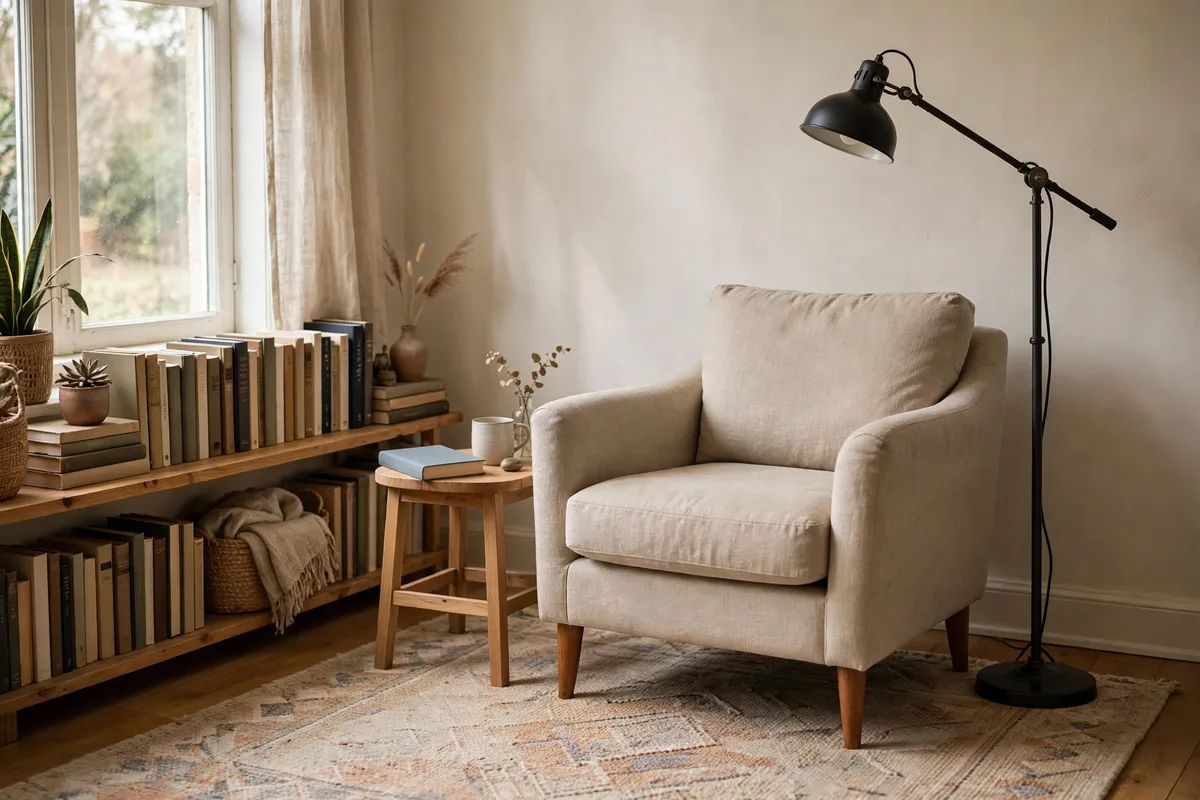
Style names are only useful if they predict something: what the corner looks like at noon and at nine in the evening, what you will need to buy, and what will quietly annoy you by winter. The five levers below make a style name earn its keep, and every style here is answered against all five, in the same order, so you can compare like with like.
The levers also separate style from setup: chair positioning, bulb warmth and layering order work almost identically across styles. What changes with style is the cast of pieces, the palette, the dependence on daylight, and how much room and money the look requires.
| Lever | What it tells you |
|---|---|
| The look | Palette, materials, mood |
| Key pieces | Items the style cannot exist without |
| Light needs | Daylight vs lamp dependence |
| Room and budget fit | Footprint, room types, spending level |
| Watch-outs | Its characteristic weakness |
Read the seven styles that follow as seven answers to the same five questions. None is the “best” in the abstract — each is the best answer for a particular room, light situation and reader. Each style’s watch-outs are that page’s whole subject — what goes wrong in one corner, and how to see it coming — in our cozy reading corner mistakes.
2. Classic Armchair Corner: The Timeless All-Rounder
The look and key pieces
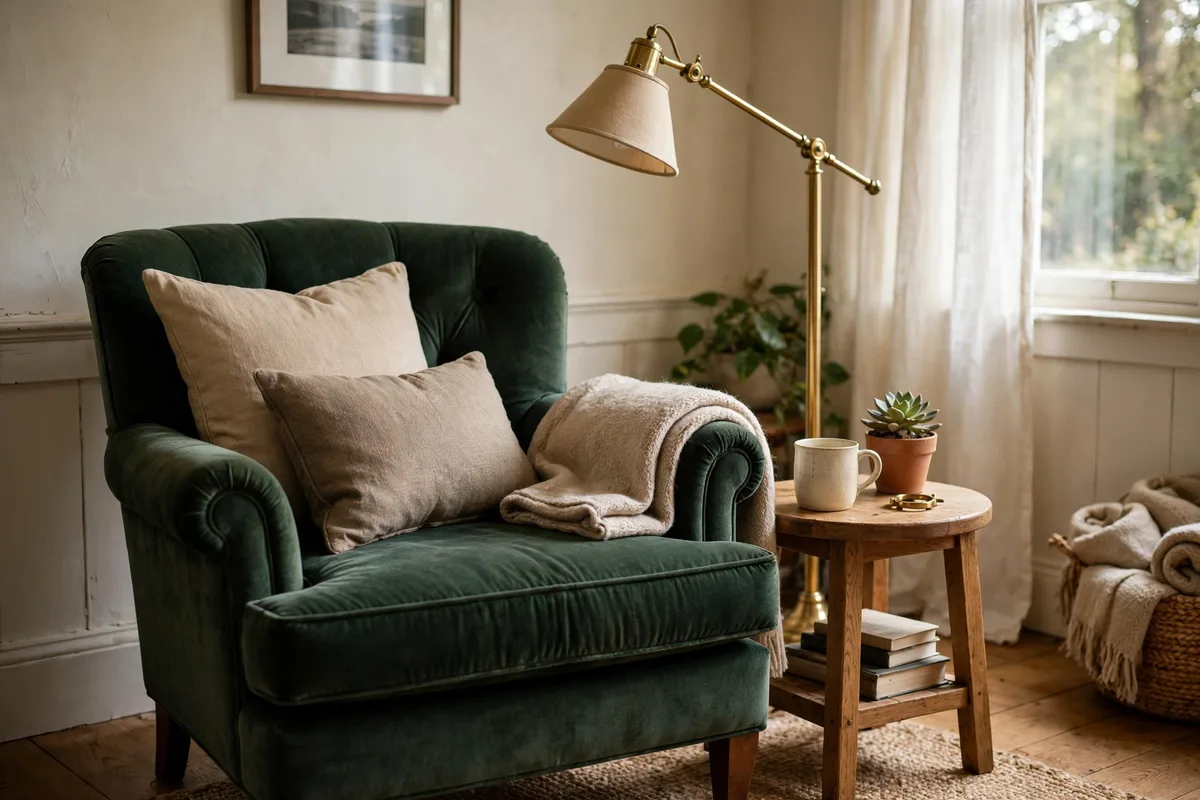
The classic corner is the reference point every other style reacts against: one generous upholstered armchair, a floor lamp beside it, a small side table, and a throw folded over the chair arm. The palette is mid-toned and forgiving — warm neutrals with a single deeper accent — in the familiar materials of a lived-in living room: fabric upholstery, wood, a woven rug underfoot. Nothing tries to make a statement, which is why it dates so slowly.
Light needs, room fit and budget fit
This is a lamp-led style that treats daylight as a bonus. It works in almost any room with a spare corner and a power socket nearby, and scales across budgets more gracefully than any other style here: the same formula reads well with a modest chair, and simply gets richer as the pieces improve.
Watch-outs
Its weakness is anonymity. Assembled carelessly, it becomes the default chair-in-a-corner nobody chose on purpose. It needs one deliberate decision — a chair with presence, a distinctive lamp, or a rug that marks the territory — to feel designed rather than leftover.
3. Window Nook and Bay Seat: The Daylight-Led Style

The look and key pieces
The window nook builds the seat into the brightest architecture in the house: a cushioned bench or deep sill seat under a window or inside a bay, backed with pillows, with daylight doing most of the decorative work. The key pieces are the seat cushion, pillows you can lean and rearrange, and a sheer curtain that softens glare without closing the view. Colours stay light and sun-tolerant, because everything here faces the sun.
Light needs, room fit and budget fit
No style is more light-dependent: glorious in a bright room, diminished in a dim one, and made for daytime readers. Fit is dictated by the house, not the furniture shop — you need a suitable window, ideally a bay or a wide sill. A cushion-and-pillow version on an existing bench is inexpensive; a built-in seat with storage is a carpentry project for a home you plan to stay in.
Watch-outs
Glare at midday, fading fabrics and a cold seat in winter are the standing costs. Evening reading needs a planned second act — a lamp that takes over when daylight goes — or the prettiest corner in the house sits dark and unused for half the year.
4. Library-Wall Corner: The Book-First Style
The look and key pieces
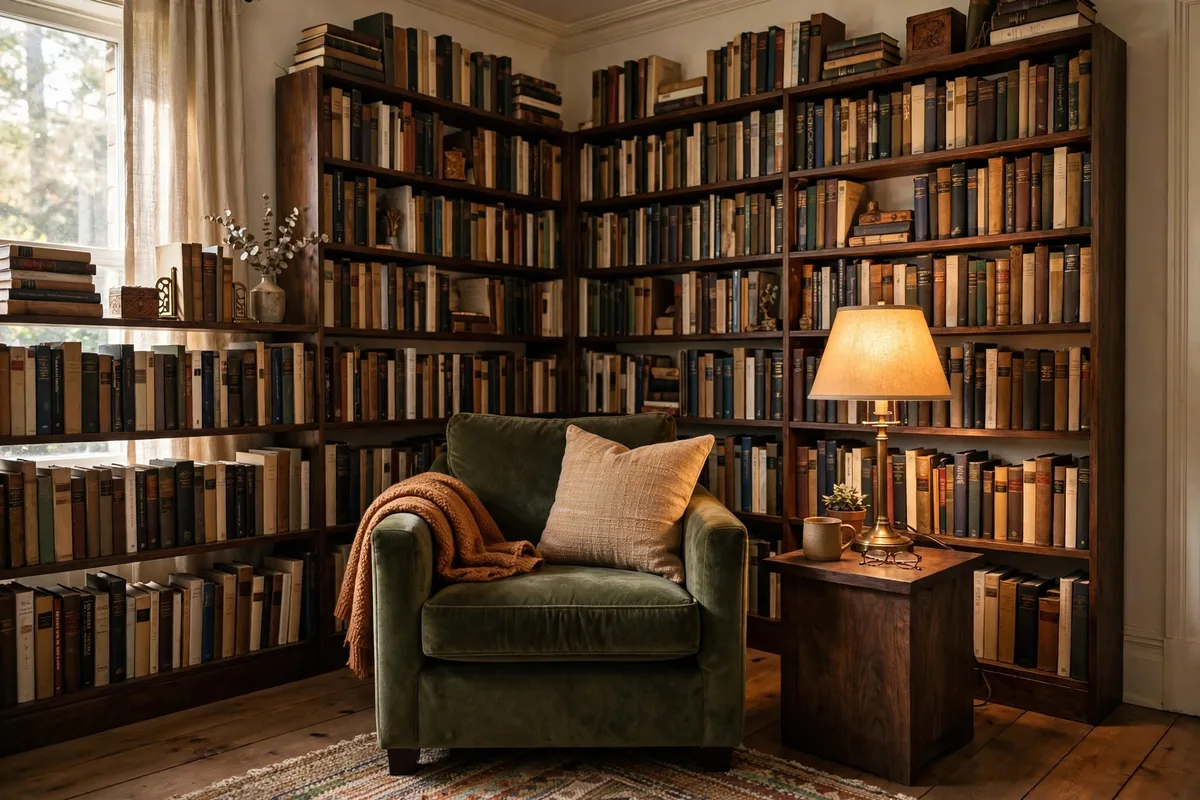
Here the books are the architecture. A chair sits against — or partly surrounded by — shelving that runs up the wall, and the collection itself supplies the colour, pattern and texture. The key pieces are the shelves, a chair substantial enough to hold its own against them, and a lamp that pushes light into a corner the shelves may shade. Wood tones usually lead the palette, with upholstery in a colour that separates the reader from the spines behind.
Light needs, room fit and budget fit
Shelving swallows light, so this style needs a nearby window or confident, warm, directed lamp light. It fits rooms with a full free wall and readers with a large, growing collection. It is the most investment-heavy freestanding style: shelving is the budget, and the chair almost an afterthought by comparison.
Watch-outs
It commits you. Shelves fix the corner’s position, collect dust at height, and can close in a small room if the shelving is dark and the chair bulky. It also exposes the collection: a wall of books you do not love looking at is decoration working against you.
5. Scandinavian Light Corner: The Calm, Pale and Airy Style
The look and key pieces
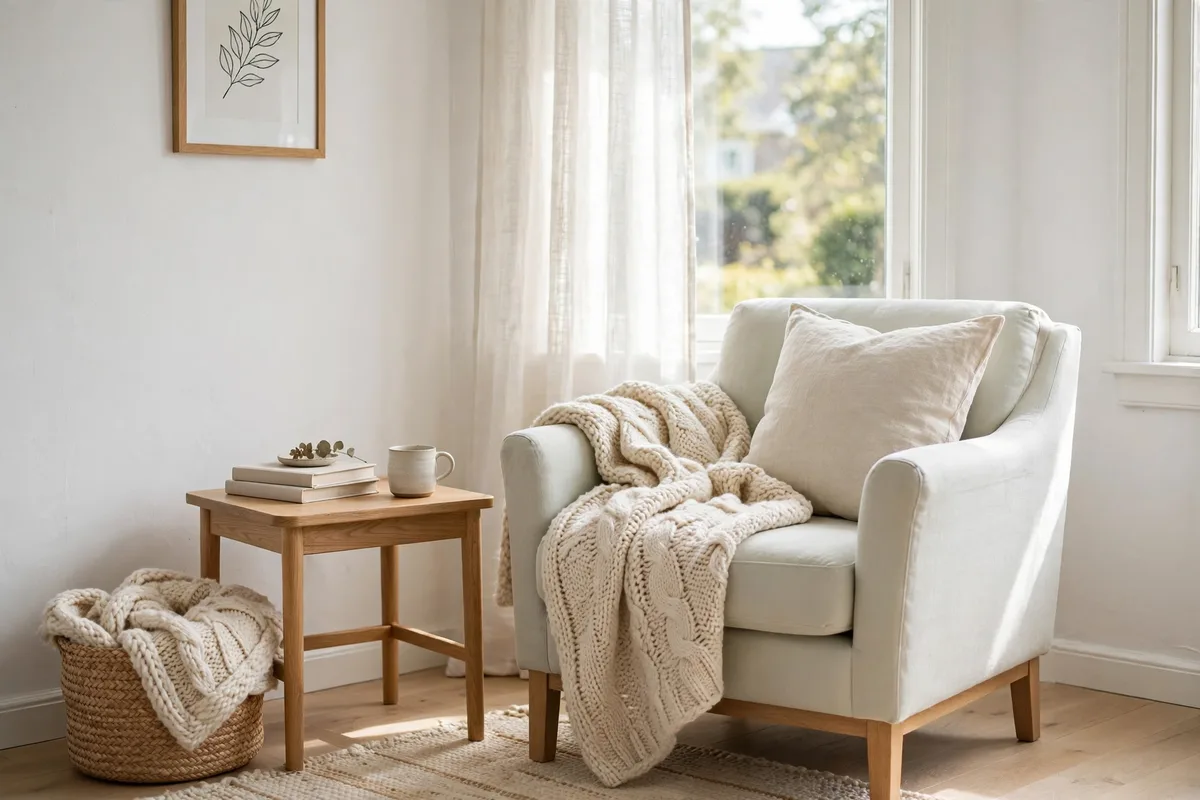
The Scandinavian corner is built around lightness in both senses: pale colours and an uncluttered outline. A light-framed chair, light wood, off-white walls and textiles in undyed-looking neutrals — wool, linen, one chunky knit throw — create a corner that seems to hold more daylight than the room around it. The key pieces are few: the pale chair, the light-wood side surface, and texture doing the work colour does elsewhere.
Light needs, room fit and budget fit
It is the best style here for brightening a dull room, because every surface bounces light rather than absorbing it, paired with a single warm lamp for evenings. It suits smaller rooms and calm-seeking readers, at a modest budget, because the look depends on restraint and palette, not expensive pieces.
Watch-outs
Pale upholstery shows life — drinks, pets, children — more honestly than any other style here. And restraint is a discipline, not a purchase: every object beyond the short list dilutes the calm.
6. Boho Floor Lounge: The Relaxed, Layered, Low Style
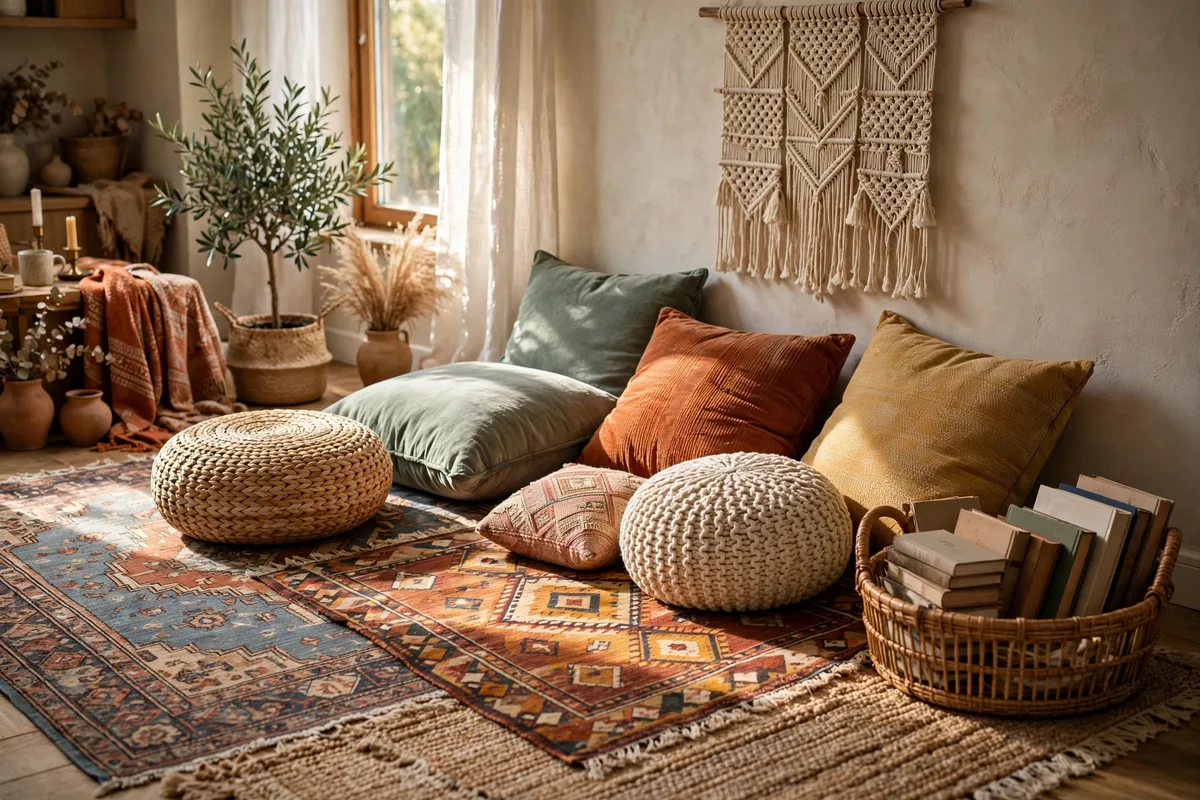
The look and key pieces
The boho lounge takes the seat down to the floor. Large cushions and a pouf sit on layered rugs, surrounded by woven textures — rattan, jute, a woven hanging — in a warm palette of rust, ochre, olive and clay over a neutral base. The key pieces are the floor cushions, the layered rugs that define the territory, and a basket for books and throws. Nothing matches, and that is the point: the style reads as gathered over time.
Light needs, room fit and budget fit
It prefers warm, low light and feels most itself in the evening, when a low lamp makes the layers glow; harsh overhead light flattens it. It fits relaxed households and anyone who likes sitting low — and it is the most budget-friendly style here, because cushions, rugs and baskets cost a fraction of a good armchair.
Watch-outs
Floor sitting is a physical commitment: readers with stiff knees or bad backs will quietly stop using it, however beautiful it looks. It also lives closest to the floor’s dust and pet hair, and needs occasional editing before “layered” slides into “strewn.”
7. Traditional Leather-and-Lamp Corner: The Warm, Formal Style
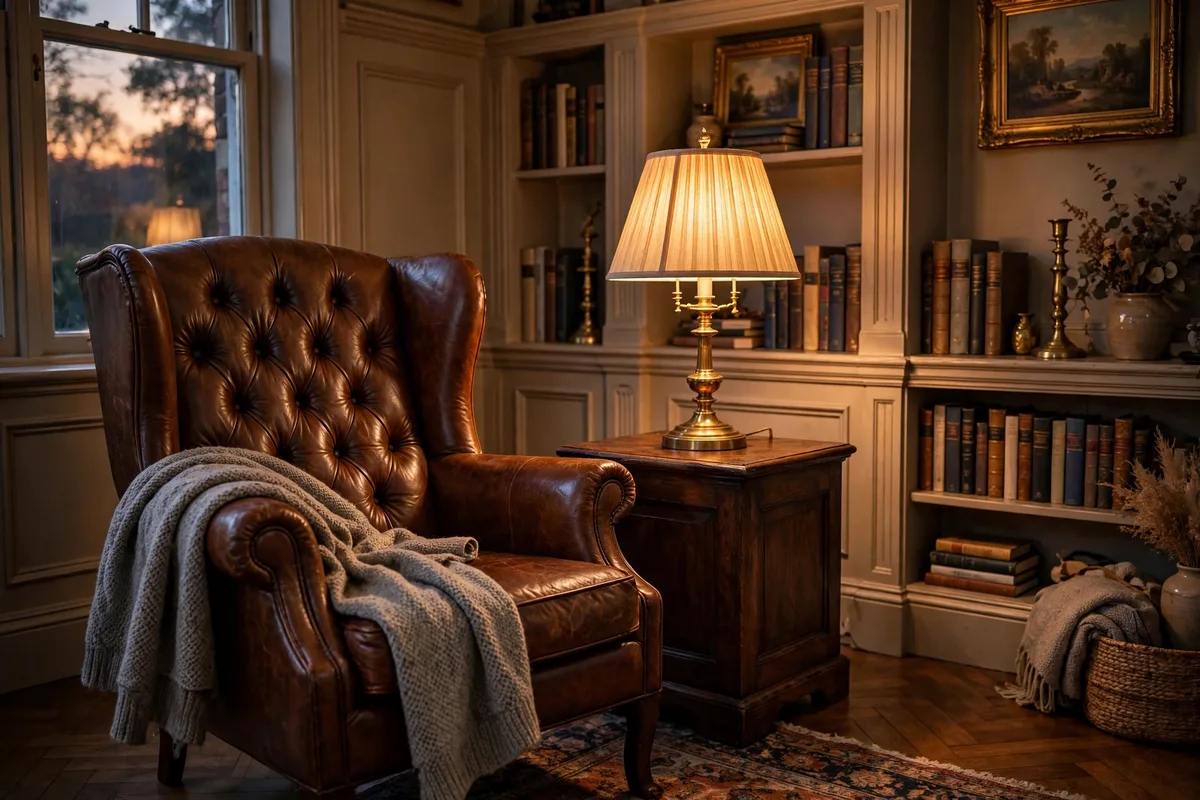
The look and key pieces
The traditional corner is the library’s more formal cousin: a leather chair — often a wingback or club shape — a brass lamp on a dark-wood side table, and deep, warm tones. Where the library-wall style is about the books, this one is about ritual and materials: leather that ages, wood with weight, metal with a warm sheen. The key pieces are the chair and the lamp; get those right and almost any quiet corner reads as traditional.
Light needs, room fit and budget fit
It is an evening style by design, built around a pool of warm lamplight, and it suits larger rooms, studies and living rooms with traditional bones — dark floors, a fireplace nearby. It is the premium-budget style here: real leather and solid wood are the look, and inexpensive imitations announce themselves quickly.
Watch-outs
In a small, bright modern room it can feel like a costume — heavy, dark, slightly theatrical. Leather has a temperature personality too, cold at first touch in winter, and the formality that delights one reader makes another sit up straighter.
8. Minimalist Single-Chair Corner: The Quiet, Uncluttered Style
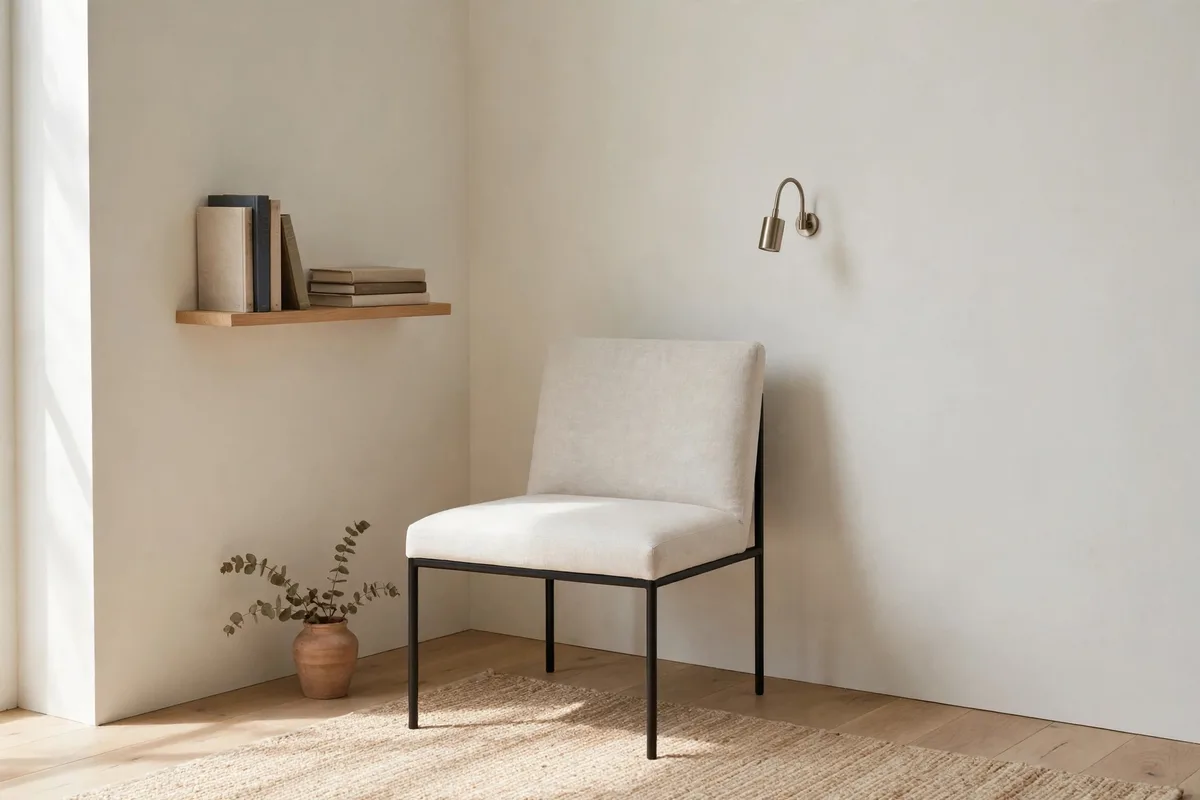
The look and key pieces
The minimalist corner is a study in subtraction: one well-chosen chair with clean lines, one light source, one small surface or wall shelf, and nothing else that is not earning its place. The palette is the narrowest here — white, stone, soft grey, natural wood — and interest comes from proportion, shadow and the quality of the single pieces. The key “piece” is arguably the empty space itself, protected as fiercely as other styles protect their shelves.
Light needs, room fit and budget fit
It works in almost any light, because there is little to shadow or fade, and a wall-mounted or slim floor lamp keeps the footprint tiny. It is the natural answer for very small rooms and tidy households, and its budget logic is distinctive: few pieces, so the money concentrates — one good chair instead of five okay accessories.
Watch-outs
There is nowhere for clutter to hide, including the reader’s own: book stack, mug and throw all become visible design decisions. Stripped of layers, the corner also offers less cocooning for long sessions — minimalism supports focus better than sprawling.
9. Master Comparison Table: Every Style Side by Side

The table below gathers all seven styles against the five levers. Read across to compare styles on one lever, or down a row for a style’s whole personality. Notice the trade-offs: the cheapest style to build (boho) is the most physically demanding, the brightest (window nook) is the least useful after dark, and the most flexible (classic) needs the most deliberate styling to feel chosen.
| Style | The look | Key pieces | Light needs | Best room and budget fit | Watch-outs |
|---|---|---|---|---|---|
| Classic armchair | Mid-toned, upholstered, familiar and timeless | Armchair, floor lamp, side table, throw | Lamp-led | Almost any room; scales at every budget | Can feel anonymous and undesigned |
| Window nook | Light, bright, view-framed | Seat cushion, pillows, sheer curtain | Daylight-dependent; lamp needed for evenings | Bays and wide windows; low cost, carpentry if built in | Glare, fading, cold seat in winter |
| Library-wall | Book-lined, woody, immersive | Wall shelving, substantial chair, directed lamp | Strong lamp light; shelves absorb light | Full free wall; highest freestanding budget | Fixed position, dust, can close in small rooms |
| Scandinavian light | Pale, airy, texture over colour | Pale chair, light wood, knit and linen | Maximises daylight; one warm evening lamp | Small and dull rooms; modest budget | Pale fabrics show wear; discipline required |
| Boho floor lounge | Low, layered, warm and collected | Floor cushions, layered rugs, basket | Warm low light; best in the evening | Relaxed households; lowest budget | Hard on knees and backs; gathers dust |
| Traditional leather-and-lamp | Deep-toned, formal, ritual-rich | Leather chair, brass lamp, dark-wood table | Evening lamp-led by design | Larger, traditional rooms; premium budget | Heavy in small modern rooms; leather temperature swings |
| Minimalist single-chair | Clean-lined, narrow palette, empty space | One chair, one light, one small surface | Most light; slim or wall-mounted lamp | Smallest rooms; concentrated budget | No hiding place for clutter; less cocooning |
Two patterns are worth carrying forward. First, light eliminates the most styles: count your usable daylight honestly and several rows rule themselves out. Second, budget rarely eliminates a style outright — except for library-wall and traditional, most styles can be built cheaply or expensively; budget decides which pieces you buy first and upgrade later.
10. How to Pick Your Style: Match the Corner to Your Room, Budget and Reading Habits
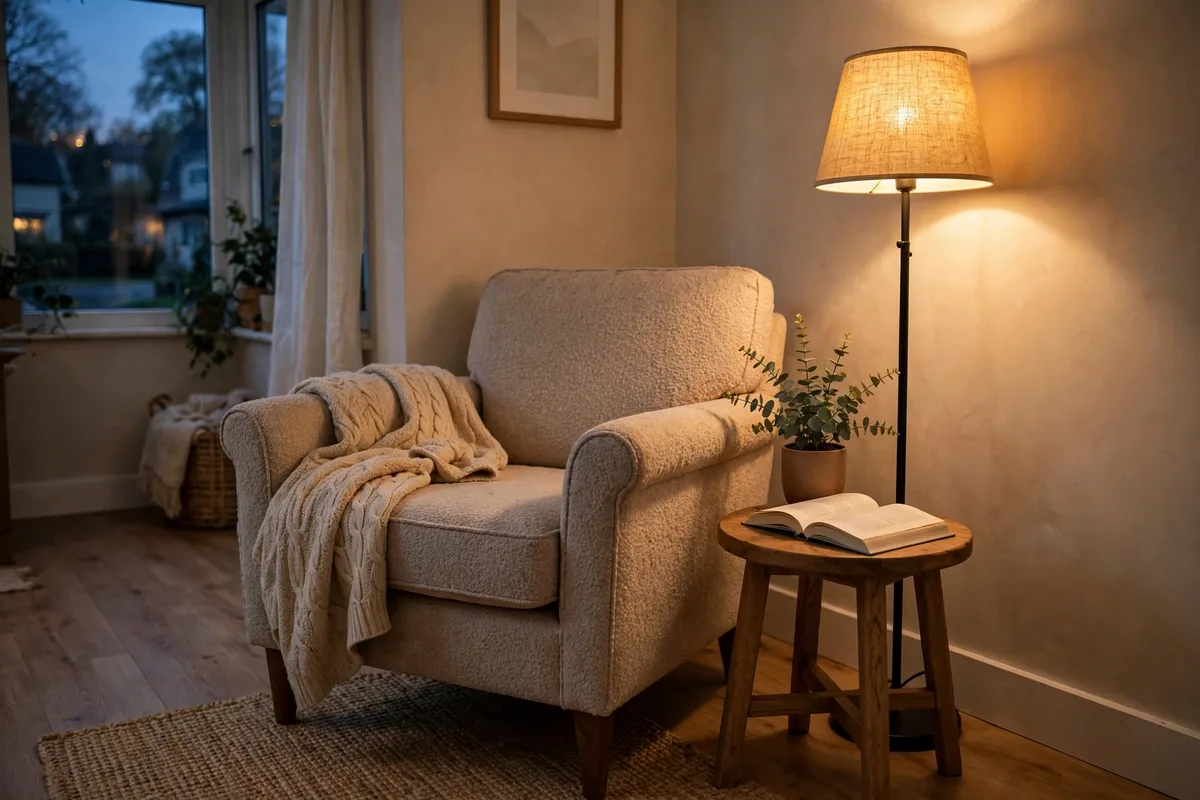
Start with the room’s fixed facts
Windows, walls and floor space cannot be negotiated with, so let them vote first. A bay or a wide, bright window makes the window nook a genuine candidate and strengthens the Scandinavian case; a long free wall with no window is the library-wall style’s natural home. A dark room rules out daylight-led styles however much you love their photos. A very small footprint points to minimalist or classic, while a room with traditional furniture absorbs the leather-and-lamp style without a fight. Styles chosen against the room’s facts cost more and satisfy less.
Then match your reading habits
When do you actually read? Daytime readers should weight the light lever toward window and Scandinavian styles; evening readers toward traditional, boho and the lamp-led classic. Sprawlers and floor-sitters belong in boho; upright, long-session readers belong in a real chair. Reading aloud with a child or partner? Floor lounges and window seats share space gracefully; single-chair styles are proudly solo.
Let budget set the order, not the ambition
Every style has a first piece — the item the look cannot exist without — and the honest way to use a budget is to buy that piece properly and let the rest arrive gradually: the chair for classic and traditional, cushions and rugs for boho, shelving for library-wall, the cushion for a window nook. If you are still deciding, browsing finished rooms sharpens the instinct — these cozy reading corner ideas show how differently the same basic corner can end up once a style takes charge.
Mixing two styles without a clash
Hybrids work when one style leads and the other only contributes an accent: Scandinavian lightness with boho textiles, a classic armchair against a run of library shelving, a minimalist corner warmed by one traditional lamp. Successful pairings share a lever — usually palette or light behaviour. Failed pairings mix opposed disciplines: minimalist emptiness cannot survive boho layering in the same few feet. Pick the leader by your room’s facts, borrow one trait from the runner-up, and stop there.
Frequently Asked Questions About Cozy Reading Corners
What is the difference between a Scandinavian and a minimalist reading corner?
Both are pale and uncluttered, but they pursue different comforts. Scandinavian styling keeps warmth in the foreground — knit throws, light wood, soft textiles — while minimalism pursues emptiness itself, with fewer, sharper pieces. Choose Scandinavian for calm with softness, minimalist for calm with clarity.
Which reading corner style suits a dark, north-facing room best?
Styles that generate their own atmosphere rather than borrowing daylight: the traditional and classic corners peak under warm lamplight, and the library-wall style turns low light into part of its immersive feel. Daylight-led window and Scandinavian styles are hardest in a genuinely dark room.
Which style is best if I rent and cannot build shelves or a window seat?
The classic, minimalist and boho styles are entirely freestanding and leave no trace when you move. The library-wall look can be approximated with tall freestanding bookcases, and a window seat imitated with a low bench and cushion under the window — both keep the style without altering the room.
Can I combine two reading corner styles in one corner?
Yes, if one style leads and the other contributes a single accent. Safe pairings share a palette or light behaviour: Scandinavian with boho textiles, classic with a short run of shelving, minimalist with one traditional lamp. Avoid pairing opposed disciplines in one small footprint.
Which reading corner style works best for reading with a child or a partner?
Styles whose seating is a surface rather than a single chair: the window seat and the boho floor lounge let two people settle at different heights and angles, and a library-wall corner with a wider chair works too. Single-chair styles — minimalist and traditional especially — are designed for one reader.
What is the most forgiving style if my room already has mixed furniture?
The classic armchair corner, because its mid-toned, familiar vocabulary coexists with ordinary living-room furniture rather than replacing it. Boho is the runner-up: its collected, nothing-matches logic absorbs odd existing pieces as long as the palette is held roughly together with textiles.
Which style is best for long evening reading sessions?
The traditional leather-and-lamp corner is built precisely for this — a supportive chair and a deliberate pool of warm light. The classic corner runs it close and suits more rooms. The window nook is the weakest evening performer unless a proper lamp was planned into it from the start.
How does a library-wall corner differ from a classic armchair corner?
In the classic corner, the chair is the subject and the books are nearby. In the library-wall corner, the shelving and collection are the subject and the chair sits inside them. The practical differences follow: the library style needs more wall, more budget and more light management, and it fixes the corner’s position in a way the freestanding classic never does.
Which style is easiest to change later if my taste shifts?
Boho and classic, because both are assembled from movable, inexpensive layers — swap textiles and cushions and the corner changes character. Minimalist is also flexible, since there is so little to replace. Built-in window seats and fixed shelving are the hardest styles to walk back, which is worth weighing before committing carpentry.
Does my reading corner style need to match my living room style?
No — a corner is a small, bounded territory, and a deliberate contrast often reads as intentional: a traditional leather corner in a modern room, or a pale Scandinavian chair in a darker one. What matters is one shared thread — a repeated wood tone or metal finish — so the corner looks chosen, not stranded.
Conclusion
A reading corner style is not a theme to apply but a set of trade-offs to choose between. The window nook trades evenings for daylight, the boho lounge trades posture for price, the library wall trades flexibility for immersion, and the classic trades distinctiveness for the freedom to fit anywhere. Judge each style on the same five levers — look, key pieces, light, room and budget fit, watch-outs — and the right answer stops being a matter of taste and becomes a matter of fit. Pick the style your room and your reading hours already agree with, and the corner that follows will feel less decorated and more inevitable — which is what cozy actually means.


Pingback: Cozy Reading Corner Ideas for Small & Large Spaces