
Your sectional is already in the room. The layout is decided, the size is right, and it is genuinely comfortable — so why does it still not look like the sectionals in the photos? Because most sectional problems are not layout problems. They are styling problems: pillows that migrate into the corner and die there, a throw that slides onto the floor by Tuesday, a chaise that has become a laundry landing strip, one end of the sofa beautifully dressed and the other end completely bare.
The good news is that every one of those problems has a procedural fix. The ten tips below are written for people who already own a sectional — no measuring for a purchase, no choosing configurations, just pillow counts, folding techniques, placement rules, and upkeep routines. If you are still deciding where the sofa should go, our step-by-step sectional sofa layout inspiration guide covers choosing and arranging from scratch; this article starts where that one ends.
1. Use a Pillow Formula That Survives the Corner Seat

Most sectional pillow arrangements fail in the same place: the corner. People line pillows evenly along the back, everyone avoids the deep corner seat, and within a week every pillow has drifted into that unused corner in a sad pile. The fix is to stop distributing pillows evenly and place them by formula — anchored at the structural points of the sofa, where arms and corners hold them upright.
Work from the ends inward. Each arm end gets your largest square pillow, 20 to 22 inches, braced by the arm. The corner gets one pillow placed diagonally, tucked into the angle — the anchor the arrangement leans against, not a dumping ground. Fill the runs between with one smaller 18-inch square per seat, layered in front of the back cushions. Start with these counts:
| Sectional size | Large squares (20–22 in) | Smaller squares (18 in) | Lumbar or bolster | Total pillows |
|---|---|---|---|---|
| Compact L (2 seats + chaise) | 2 | 1 | 1 | 4 |
| Standard L (3 seats + corner) | 3 | 2 | 1 | 6 |
| Large L or U-shape (4+ seats) | 4 | 2–3 | 1–2 | 7–9 |
Making the formula stick
- Anchor pillows against arms and corners first; fill middles last.
- Put your firmest pillow in the corner; soft fills collapse there first.
- Never cover more than a quarter of the seat depth; a pillow that keeps landing on the floor is one too many.
2. Anchor Your Throws So They Stop Sliding Off
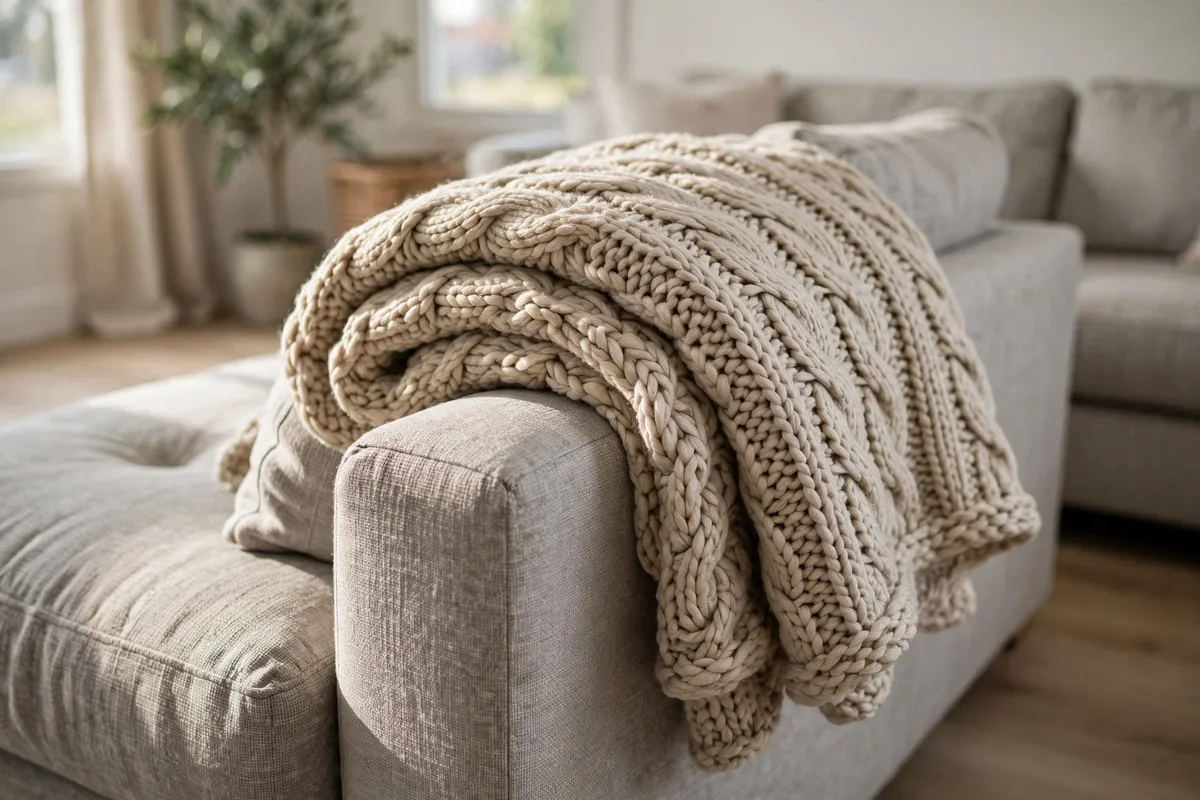
A throw draped artfully over a sectional at 9 a.m. is on the floor by dinner, especially on leather or smooth weaves. The drape is not the problem — the missing anchor is. Every throw that survives real life is secured at one point: tucked, weighted, or folded so its own mass holds it.
Start with the fold: fold the throw lengthwise into thirds, making a band roughly 12 to 15 inches wide. Then pick an anchor. Over the arm, tuck the inner end about six inches down between the arm and the seat cushion, so sitting down no longer drags it off. Over the back corner, hang the band where two sections meet and tuck the front tail behind the back cushion. On a seat, fold the band once more into a rectangle and lay it at the end of the seat, where feet cannot dislodge it. Heavy weaves — chunky knit, wool, quilted cotton — grip and stay; silky throws slide off anything, so fold those or keep them in a basket. Finally, adopt the two-throw rule: one throw for styling, one within reach for actual use, so movie night stops dismantling the arrangement.
Anti-slide checklist
- Fold lengthwise into thirds — never drape a fully opened throw.
- A backup throw in a basket keeps the styled one untouched.
3. Style the Chaise End Like Its Own Seat
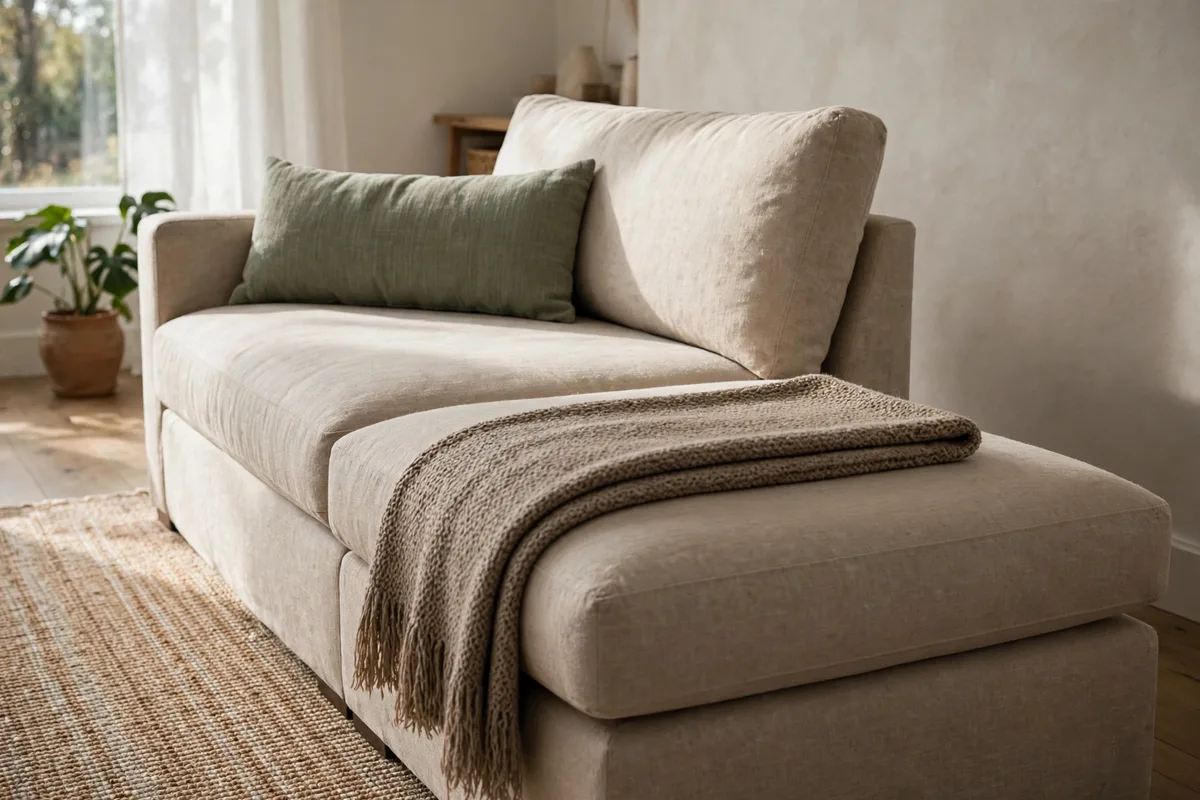
The chaise is the most-loved seat on the sectional and the worst-styled one. It collects the unfolded throw, spare pillows, and a laptop — and with no arm on its long side, nothing stays where you put it. Treat it as a separate daybed-style seat with its own small formula instead of an extension of the sofa run.
Keep the long surface almost clear; that uninterrupted stretch is the entire point of a chaise. Place one lumbar pillow at the head end, laid horizontally against the back cushion, where it supports a reclining reader’s lower back — a square pillow here just slides down all evening. Lay one folded throw across the foot end, perpendicular to the length, like a runner on a bed: it marks the foot zone and catches shoe wear. Everything between stays empty. Nothing lives on the chaise that is not fabric — books, remotes, and mugs belong on the table at its head (Tip 7), because hard objects get sat on, kicked off, or buried. Resetting two styling pieces takes twenty seconds.
The chaise formula
- One lumbar at the head end, horizontal — never a stack of squares.
- One folded throw across the foot end, perpendicular to the length.
- The middle stays completely clear for legs.
4. Bridge the Awkward Corner Cushion
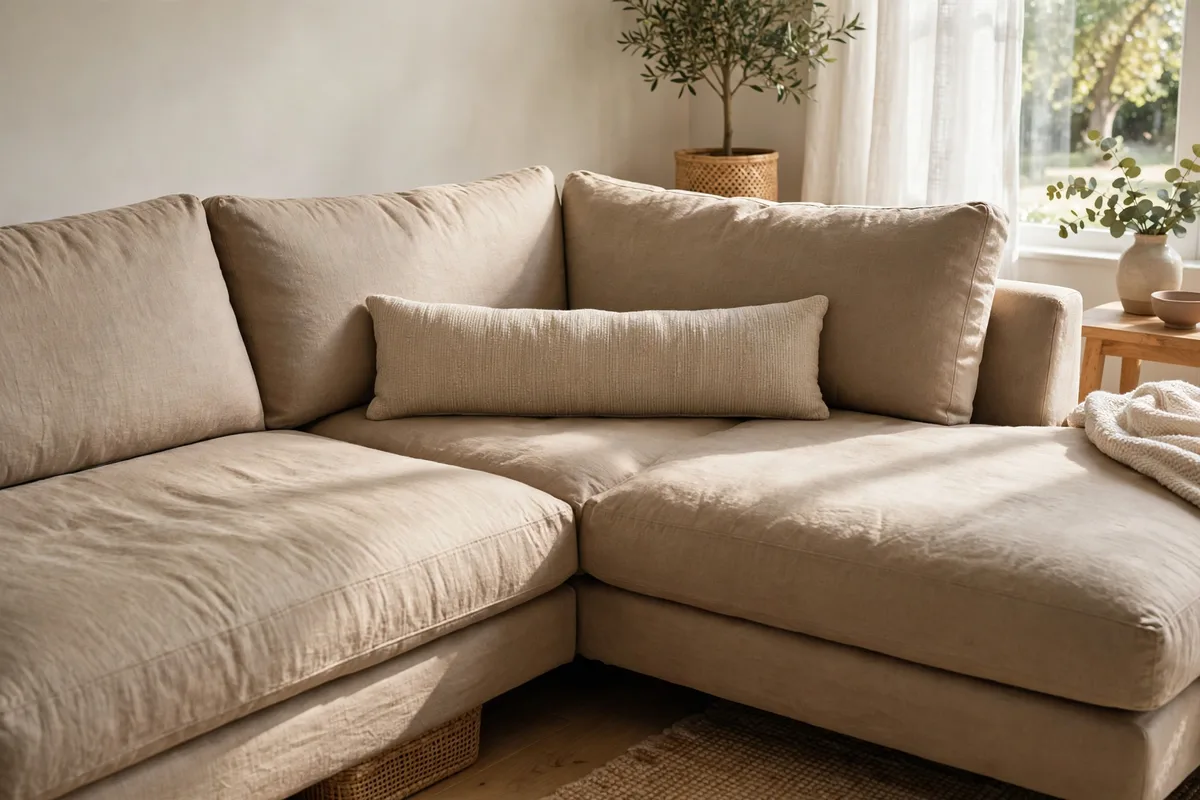
Every L and U sectional has the same dead spot: the corner seat. It is deeper than the other seats, has no arm on either side, and its back cushions meet at an angle that leaves a gap where a sitter’s back wants support. So nobody chooses it, and it becomes the pillow graveyard from Tip 1. The corner does not need more pillows — it needs one bridge.
The bridge is a single long lumbar, around 14 by 36 inches, or a bolster, laid horizontally across the angle where the back cushions meet. It covers the gap, gives the corner sitter real lumbar support, and visually connects the two runs of the sectional so the sofa reads as one piece. If your corner has the common wedge-shaped gap behind the seat cushion, slide a small firm cushion or a tightly rolled throw into the wedge first, then lay the lumbar over it so the bridge does not sink when someone sits. Angle it slightly, one end a touch higher, so it looks relaxed rather than installed.
Corner rescue steps
- Fill the wedge gap with a small firm cushion or rolled throw.
- Lay one long lumbar (about 14 × 36 in) across the back-cushion angle.
- Test-sit it: supported lower back means the corner is fixed.
5. Balance the Two Ends of an L or U Shape

Look at your sectional from across the room. On most sofas, one end is finished — lamp, side table, arranged pillows — and the other end just stops. That lopsidedness is the biggest reason a sectional looks “not quite done”: the eye reads the two ends as a pair and expects similar visual weight.
Balance is about weight, not matching: a table lamp at the left end can be balanced at the right by a tall plant in a basket, a floor lamp, or art books on a low stool. Rule of thumb: the tallest objects at the two ends should land within about six inches of each other in height, and each end needs one object that catches light or texture — metal, glass, foliage, or woven fiber. On a U-shape, style the two short ends as cousins, not twins: identical lamps look like a hotel, while a lamp on one side and an equally tall plant on the other looks like a home.
| If one end has… | Balance the other end with… |
|---|---|
| Table lamp on a side table | Floor lamp, or tall plant in a floor basket |
| Side table with books and a plant | Tray table with a sculptural object |
The balance test
- Photograph the sectional from the room’s entrance.
- Cover one end of the photo, then the other — both should feel equally furnished.
6. Fix the Rug With the Front-Legs Rule

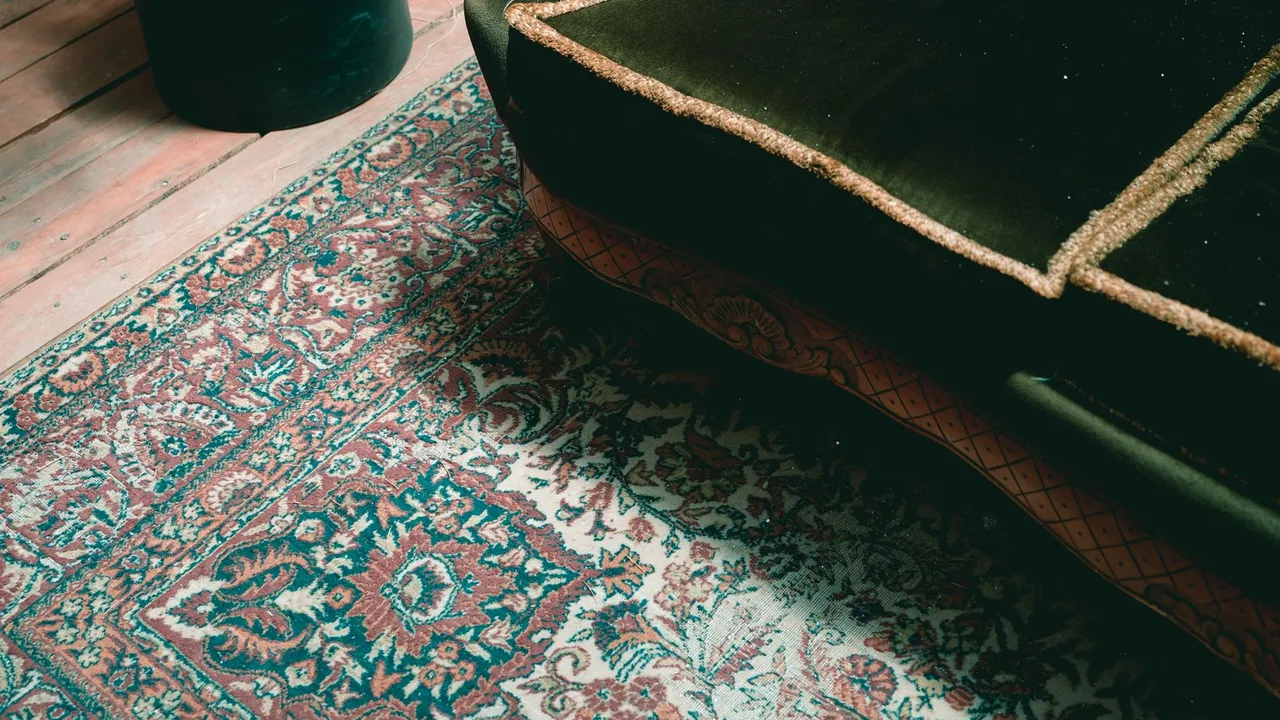
If the rug under your sectional looks wrong, it is almost certainly a placement problem, not a rug problem. The rule designers use is simple: the front legs of every section sit on the rug; the back legs may sit off it. That line of rug under the front of the whole sofa — chaise included — glues a multi-piece sectional into one arrangement. When only part of the sofa is on the rug, the setup looks unmoored.
If your rug is slightly too small, try three fixes before buying anything. Rotate it 90 degrees — the long dimension often fits the long run of an L better sideways. Pull it out from the wall, since many rugs hide inches behind the sofa while the front edge falls short. Or layer it over a larger flat-weave or jute base. The rug should extend at least six inches beyond each end of the sectional: usually 8 × 10 feet at minimum under a standard L, with 9 × 12 the comfortable choice. All-legs-on is the upgrade when the rug allows it; the accidental mix never works.
Rug troubleshooting
- Front legs of every section on the rug — chaise included.
- Rug extends roughly six inches past each end of the sofa.
7. Give the Open End a Side Table Landing Spot
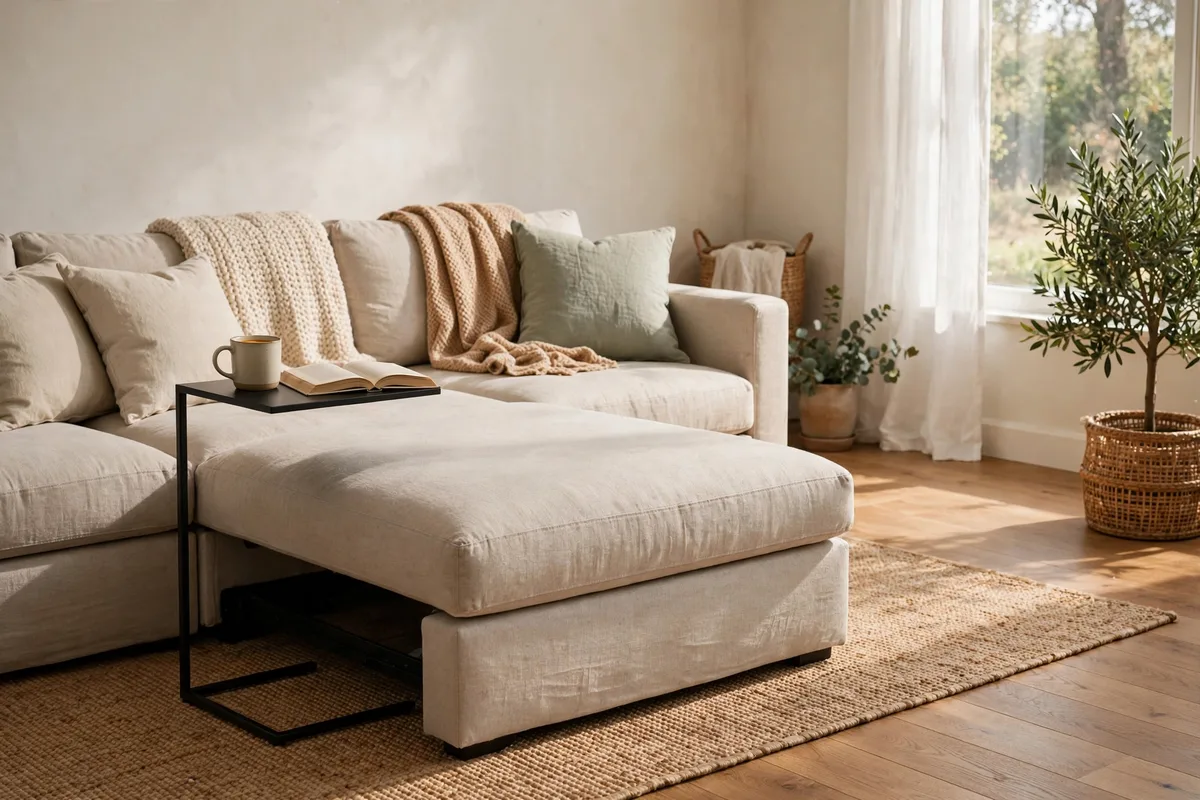
One end of your sectional has an arm, and arms collect drinks, phones, and remotes. The open end — the end of the chaise or the armless side of an L — has nothing, so everything lands on the cushions instead. A landing spot sized for that end changes daily life more than any decorative object will.
The most useful piece is a C-table: its base slides under the sectional so the top cantilevers over the seat edge or chaise, holding a mug and a book within reach in almost no floor space. Choose a heavy-based one so a drink at the edge cannot tip it. Where floor space allows, a round side table about 18 to 22 inches across works too — round, because the open end is a walkway and square corners bruise hips. Either way, the tabletop should sit within about two inches of the other end’s arm height, so reach feels equal from both sides. Keep the spot disciplined — things in use only, corralled on one small tray.
Choosing the landing spot
- C-table for tight spaces: base under the sofa, top over the seat.
- Round side table (18–22 in) where space allows; no corners on a walkway.
8. Light Both Ends So Neither Side Feels Forgotten

Sectionals are long, and one lamp cannot serve the whole thing. The classic setup — a single floor lamp behind one corner — leaves the far end in gloom, which is why everyone crowds the lit end and half your sofa goes unused after dark. The rule: every end of the sectional, plus the corner, should be within arm’s reach of a light source — a minimum of two lamps for an L, three for a large U.
Place them by seat, not symmetry. A table lamp on the side table covers the arm seat. An arc or pharmacy floor lamp behind the corner, its head hanging over the middle seats at about seated shoulder height, drops light on the page instead of in the eyes. The chaise end gets the third source: a small lamp on its landing table (Tip 7) or a floor lamp beside it. For table lamps, the shade bottom should sit around seated eye level, so you never stare at a bare bulb. Match the bulbs, not the lamps: mismatched color temperatures — one warm bulb, one daylight — make a room feel subtly wrong. Use one warm temperature across the seating zone, and put the main lamp on a dimmer.
Two-end lighting plan
- An arc or pharmacy lamp behind the corner serves the middle seats.
- Shade bottom near seated eye level; no bare bulbs from the sofa.
9. Keep the Back View Tidy in Open Rooms
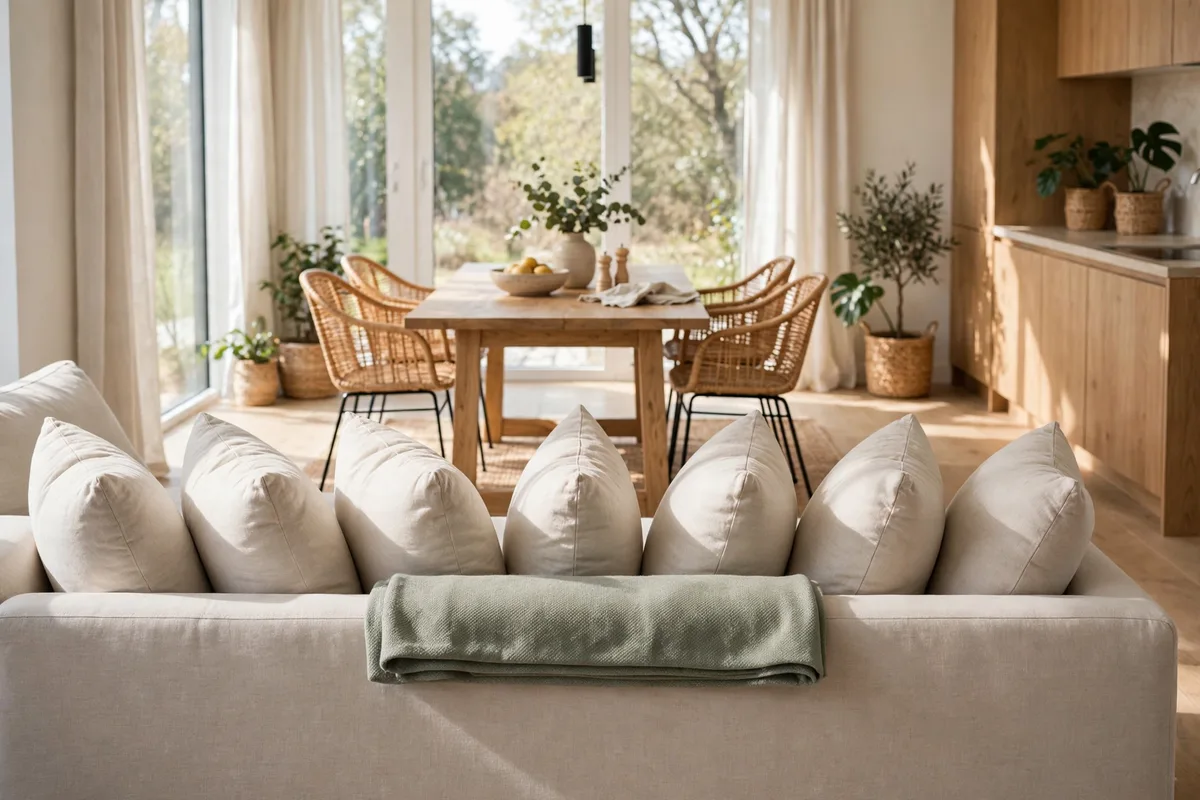
In an open-plan room, the back of your sectional is effectively a wall — one facing the kitchen, the dining table, or the front door. Layout advice covers what to put behind it, but the daily problem is different: from behind, most sectionals look scruffy. Pillow tops poke above the back rail, a throw hangs like laundry, zippers face the room, and the gap behind the sofa collects dust. A tidy back view is a habit, not a purchase.
Work it with three rules. The skyline rule: push pillows down to the line of the back cushions, and allow exactly one deliberate break — a folded throw laid band-style along the back at one end (Tip 2), never a drape hanging halfway down. The seam rule: turn every back cushion so seams and zippers face down or inward; visible zippers read as unfinished instantly. The floor rule: keep the strip behind the sofa clear and vacuumed — a clean shadow line makes the whole back look intentional. For the fuller treatment — console tables and lamps behind the sofa — our roundup of sectional sofa layout ideas covers those as layouts. But even with nothing behind it, a floated sectional with a clean skyline and hidden seams looks deliberate from the kitchen.
Back-view tidy rules
- Skyline: pillow tops at the back-cushion line; one throw, nothing dangling.
10. Run a 10-Minute Refresh: Rotate, Fluff, Reset

Sectionals age unevenly. The seat in front of the TV gets used daily; the far end barely gets touched. Within a year the favorite seat sags, its cover wrinkles, and the sofa looks tired on one side — though the frame and foam are fine. A weekly ten-minute routine prevents almost all of it, and doubles as the reset that keeps Tips 1 to 9 in place.
Minutes 1 to 3 — rotate: swap the most-sat seat cushion with the least-used one; if yours are shaped and cannot trade places, flip and rotate each 180 degrees where the design allows, plumping corners and faces as you go. This single habit stops the permanent dip. Minutes 4 to 6 — fluff and align: stand the back cushions up, chop the pillows back to their formula positions, refold the throw to its anchor, check the back skyline. Minutes 7 to 8 — surfaces: clear tables back to their trays and lint-roll the chaise, which collects the most crumbs and pet hair. Anchor the routine to an existing day — trash day works. Monthly, add a deeper job: vacuum between the cushions, wash the throw, and push the sections back together, because sectionals slowly creep apart.
The 10-minute routine at a glance
- Minutes 1–3: Rotate and flip seat cushions; plump corners and faces.
- Minutes 4–6: Fluff back cushions; reset pillows, throw, and skyline.
Frequently Asked Questions About Sectional Sofa Layouts
How many throw pillows should a sectional have?
About four on a compact L, six on a standard three-seat L, and seven to nine on a large L or U-shape, including one long lumbar bridging the corner. Never let pillows cover more than a quarter of the seat depth — if one keeps landing on the floor, the sofa has one too many.
Why do my pillows keep ending up in the corner?
Because the corner seat is the least comfortable — deep, armless, missing back support — people avoid it and pillows migrate into the empty space. Fix the seat, not the pillows: bridge the corner with a long lumbar (Tip 4) and anchor the arrangement at the arms and corner (Tip 1).
How do I keep a throw blanket from sliding off my sectional?
Fold it lengthwise into thirds to form a band, then anchor one end — tuck about six inches between the arm and seat cushion, or behind a back cushion. Heavy weaves like chunky knit and wool grip best; fold silky throws into a rectangle instead of draping them.
How should I style a chaise lounge end?
Keep it nearly bare: one lumbar pillow laid horizontally at the head end, one folded throw across the foot end, and the middle completely clear for legs. Books, mugs, and remotes belong on a C-table or side table at its head.
What can I do with the corner seat nobody wants to sit in?
Bridge it: slide a small firm cushion or rolled throw into the wedge gap behind the seat cushion, then lay one long lumbar — about 14 by 36 inches — across the angle where the back cushions meet. It covers the gap and adds real lower-back support, turning the most avoided seat into a reading spot.
Should all the legs of a sectional be on the rug?
Not necessarily. The minimum rule is front-legs-on: the front legs of every section, including the chaise, sit on the rug. All-legs-on looks even more settled if your rug is big enough.
How big should a rug be under a sectional?
Big enough to run under the front legs of the whole sectional and extend at least six inches beyond each end of the sofa. For a standard L that usually means an 8 × 10 foot rug at minimum, with 9 × 12 the comfortable choice. If yours falls short, try rotating it, pulling it from the wall, or layering it over a larger flat-weave base.
Where should lamps go with a sectional sofa?
At both ends, at minimum — one lamp per end, plus coverage for the corner seat on larger sofas. A table lamp serves the arm end, an arc or pharmacy floor lamp behind the corner serves the middle seats, and the chaise end gets a lamp on or beside its landing table. Match bulb color temperature across all of them.
How do I make the back of a floated sectional look good?
Keep it tidy rather than decorated: pillow tops at the line of the back cushions, one folded throw at most along the back, seams and zippers turned down or inward, and the floor strip behind the sofa vacuumed and clear. A clean skyline and swept floor line already make the back look intentional.
How often should I rotate sectional cushions?
Weekly is ideal — about three minutes inside a ten-minute refresh routine. Swap the most-used seat cushion with the least-used one, or flip and rotate each cushion 180 degrees if shaped sections cannot trade places. Regular rotation prevents the permanent sag and wrinkled cover that develop in a favorite seat.
Conclusion
A sectional that looks styled is not one arranged once, perfectly — it is one with systems that survive daily life. A pillow formula anchored at the arms and corner. A throw folded and tucked, not draped and doomed. A chaise kept clear, a corner bridged into a real seat, two ends carrying equal weight. A rug on the front-legs line, a landing table at the open end, a lamp within reach of every seat, a back view kept tidy, and ten minutes a week of resetting so none of it drifts.
None of it requires a new sofa or a decorator. Start with the two tips matching your biggest annoyance — for most owners, the pillow formula and the throw anchor — then add one more each week.