
The TV wall is the hardest-working wall in the living room. It hosts movie nights, anchors the furniture layout, and sits in your line of sight more than any other surface in the house. Yet most of us set it up by guesswork — the screen goes where the old one was, the cables pile up behind the console, and the decor around it never quite comes together.
These TV wall design tips take a different approach. Instead of asking which style to copy, they give you the practical rules designers use to make any TV wall look intentional: how high to mount the screen, how wide the console should be, where cables disappear, and how lighting changes everything. If you are choosing a look as well as getting it right, our companion guide to TV wall design ideas covers 14 styles to pair with these tips. For fully worked examples — measurements, mounting heights, and cable plans included — see our TV wall design examples guide.
1. Choose the Right Wall Before Anything Else
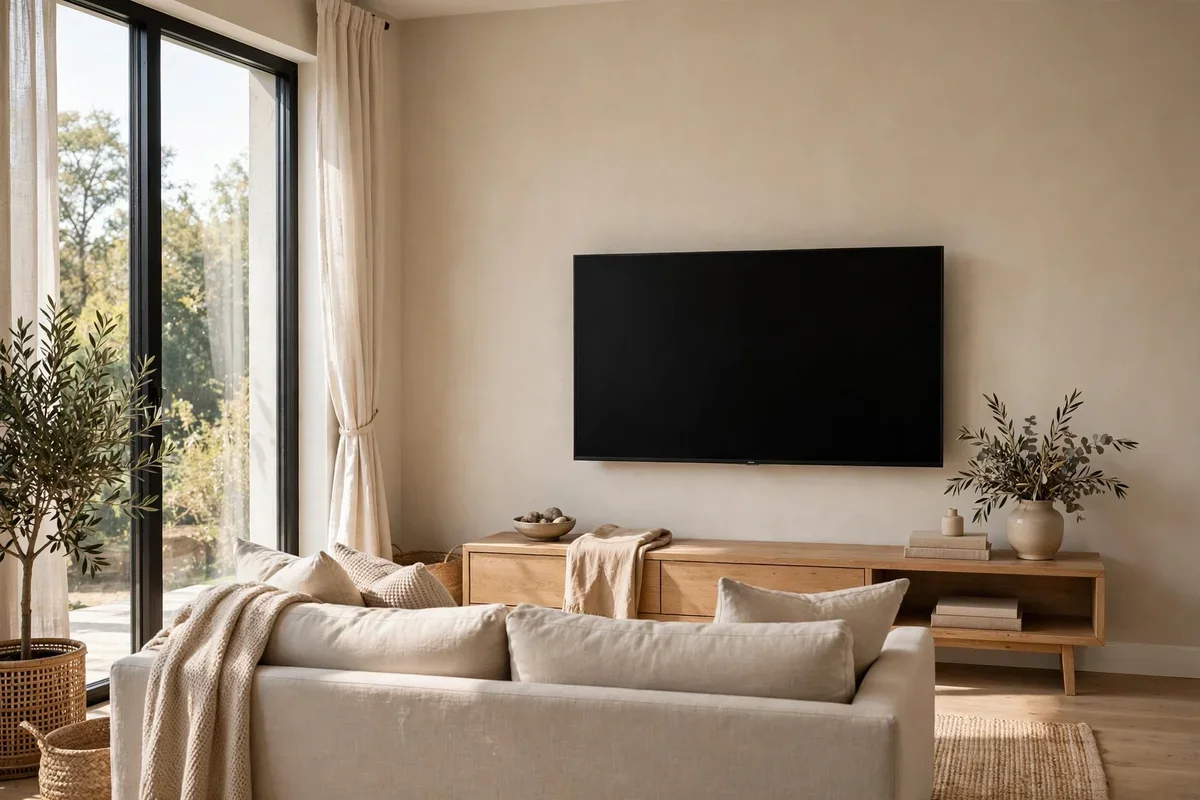
The single biggest decision happens before you buy a single frame or shelf. Walk into the room at different times of day and notice where sunlight lands — a wall that faces windows will throw glare onto the screen every afternoon, while a wall beside the windows usually stays viewable all day. The ideal TV wall faces your main seating directly and sits away from busy walkways, so nobody crosses in front of the screen on the way to the kitchen.
What to check on each candidate wall
- Glare: Stand where the TV would go and look toward the seating — any window behind the sofa will reflect in the screen.
- Width: The wall needs to be noticeably wider than the TV. A 55-inch screen is about 48 inches wide; it wants a wall at least 70-80 inches across to leave breathing room on each side.
- Traffic: Skip walls that sit on the main path between rooms. Foot traffic across the viewing zone is distracting and risky for cables.
In small or oddly shaped rooms, the right wall is not always obvious — and pairing a smart layout with the right seating ideas for small living rooms makes a compact space work twice as hard.
2. Mount the TV at Seated Eye Level
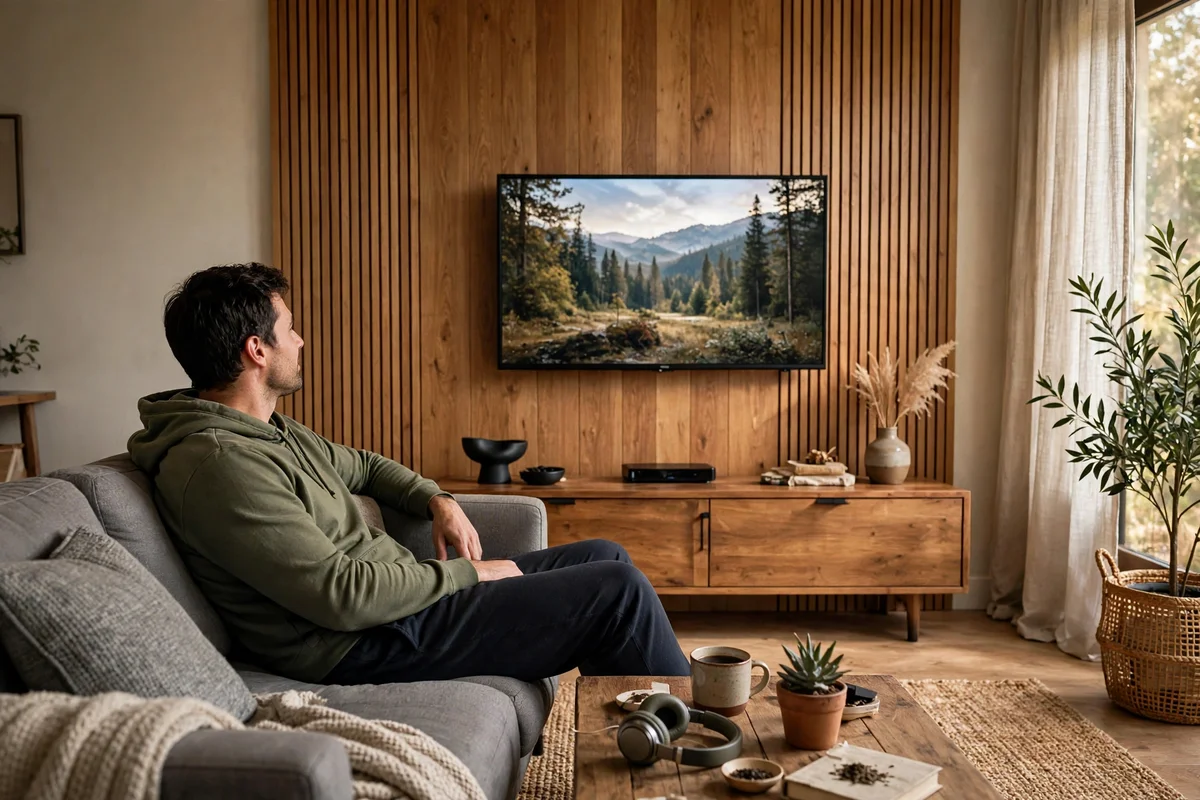
This is the most broken rule in home design, and fixing it costs nothing. When you sit on your sofa, the center of the screen should sit roughly at your eye level — for most sofas that means about 40 to 48 inches from the floor to the middle of the screen. A TV mounted too high forces your neck to tilt back, which gets uncomfortable fast on a two-hour movie.
Getting it right the first time
- Sit on your sofa and have someone measure from the floor to your eyes; that number is your target screen center.
- Lower, deeper sofas need the screen a few inches lower than the standard range.
- Tilting mounts can forgive a slightly high position, but they are a compromise — correct height is always better than a tilted neck-saver.
Mount makers like Vogel’s publish detailed height guides by screen size, which are worth checking before you drill. Once the height is set, everything else on the wall — shelves, art, consoles — aligns to it, and the whole composition suddenly looks planned.
3. Size the Screen to the Wall, Not the Room
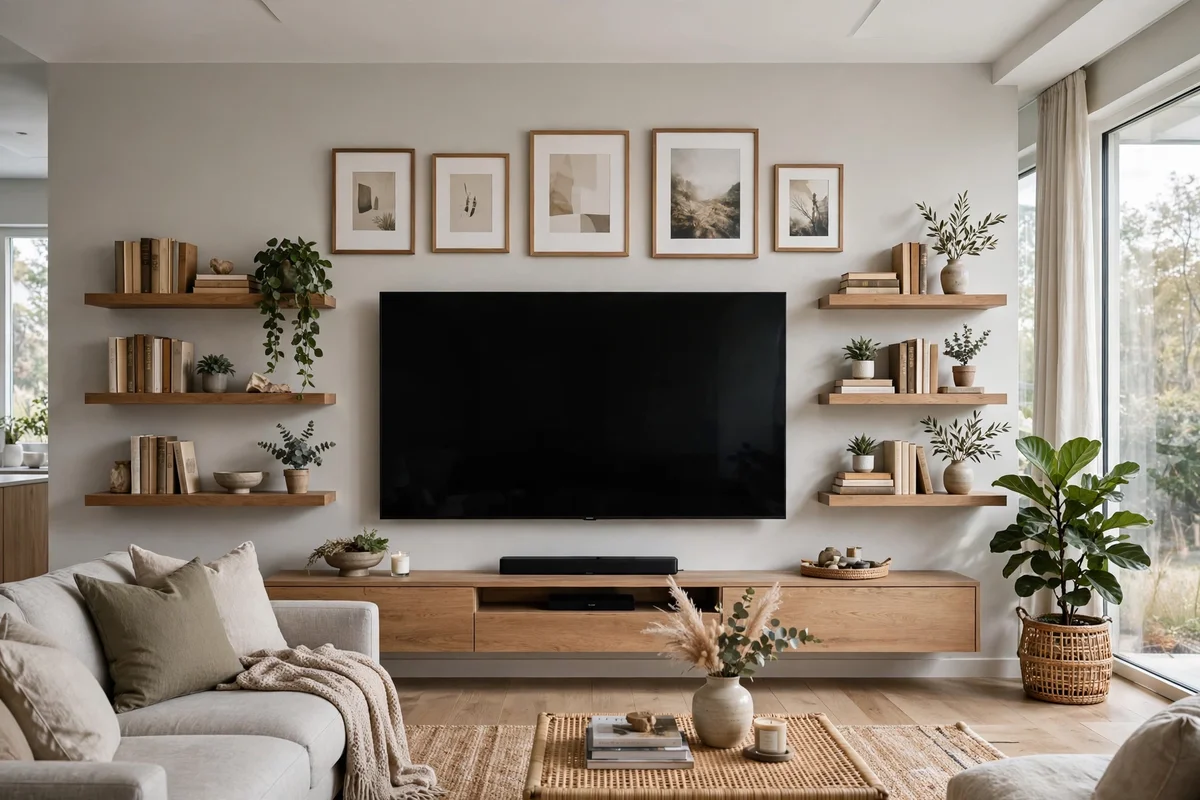
A TV that is too big for its wall dominates everything around it; one that is too small looks lost and pulls the eye toward the empty wall instead of the picture. The sweet spot is a screen whose width fills roughly half to two-thirds of the wall section it sits on. That leaves enough margin for framing elements — shelves, art, sconces — without crowding them against the screen’s edge.
| Screen diagonal | Approx. screen width | Wall section that suits it |
|---|---|---|
| 43-50 inches | 38-44 in | 60-80 in of wall |
| 55-65 inches | 48-57 in | 75-100 in of wall |
| 70-85 inches | 61-75 in | 95-130 in of wall |
Why wall width matters more than room size
People often size up because the room is large, then discover the TV wall itself is a modest 8-foot stretch between a doorway and a window. The screen relates to its immediate wall, not the square footage behind you. Measure the usable wall first, then pick the screen that fills about 55-65 percent of it. This one ratio prevents the two most common regrets: a screen that overwhelms a narrow wall, and a wall of emptiness around a screen that is too small.
4. Hide the Cables Three Ways
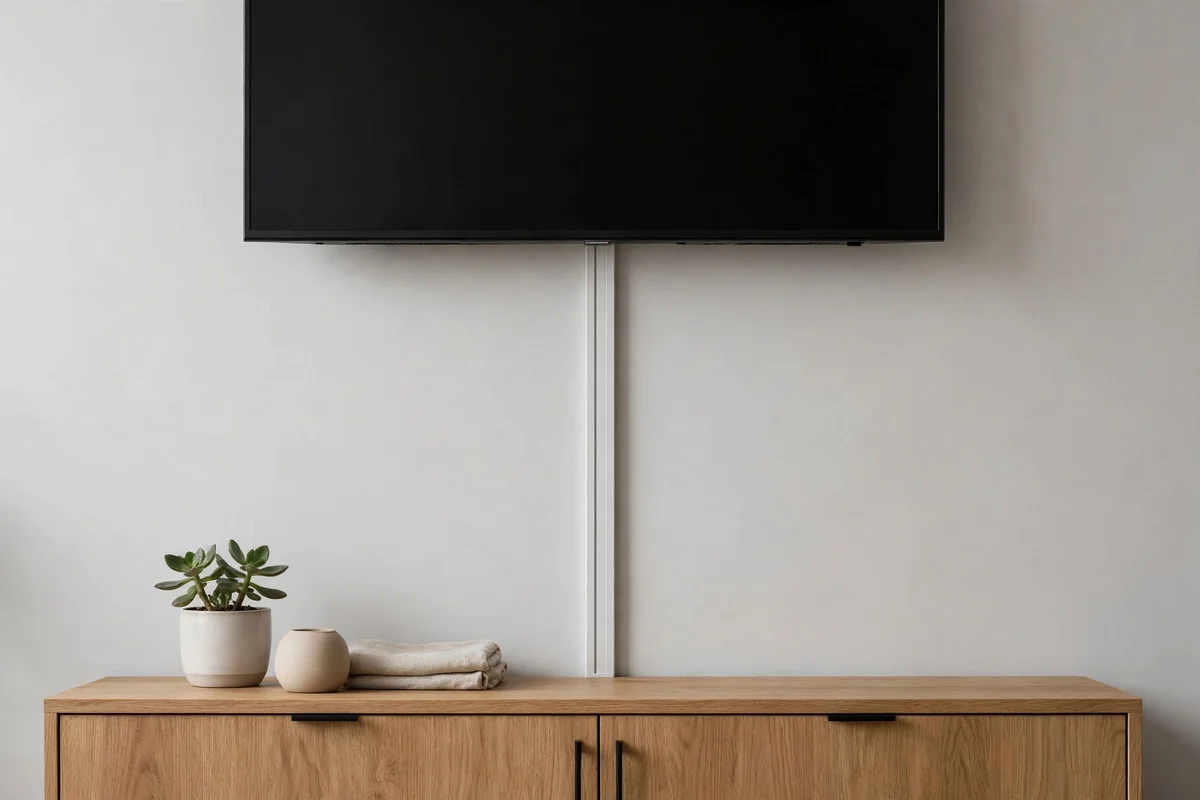
Nothing cheapens a well-designed TV wall faster than a tangle of black cords — it is one of the classic tacky small living room decor mistakes that makes an otherwise polished setup look unfinished. Every cable that runs to the TV — power, HDMI, ethernet, soundbar — needs a planned route before you style anything.
| Method | Effort | Look | Best for |
|---|---|---|---|
| In-wall cable kit | Medium (cut two holes, fish the cable) | Invisible | Homeowners, wall-mounted TVs |
| Paintable cord cover | Low (adhesive or screwed channel) | Near-invisible | Renters, anyone avoiding drywall cuts |
| Furniture routing | Low | Hidden behind console | TVs on stands, busy media setups |
A clean cable routine
Route everything behind the TV to a single power strip kept inside the console, so only one cord needs a path to the wall outlet. Choose a console with cable cutouts in the back panel, and bundle slack with velcro ties instead of letting it drape. If you are renting, a fabric or paintable cord channel run straight down behind the console reads as intentional trim rather than a workaround.
5. Give the Screen a Calm Backdrop

A turned-off TV is a large black rectangle. The wall behind it decides whether that rectangle disappears or glares at you all day. Darker tones — charcoal, deep navy, forest green — shrink the visual gap between the screen and the wall so the TV recedes when it is off. You do not need a dark room to pull this off: paint just the TV wall in a matte or eggshell finish and keep the rest of the room light.
Backdrop options by effort
- Paint (weekend, low cost): One dark accent wall in a flat or matte finish. Matte is non-negotiable — glossier paint bounces light onto the screen.
- Texture (medium): Wood slats, limewash, or panel molding add shadow depth so the wall has interest even where it is not dark.
- Material (bigger project): Stone, fluted panels, or book-matched veneer make the wall itself the decor — then restraint is the styling, and you add almost nothing else.
Natural materials like wood and stone are among the features designers return to again and again — they age gracefully, as our roundup of designer-approved timeless living room features shows. Whatever backdrop you choose, keep it simpler than you think; a busy wallpaper fighting a bright screen is visual noise.
6. Anchor the Wall with a Right-Sized Console
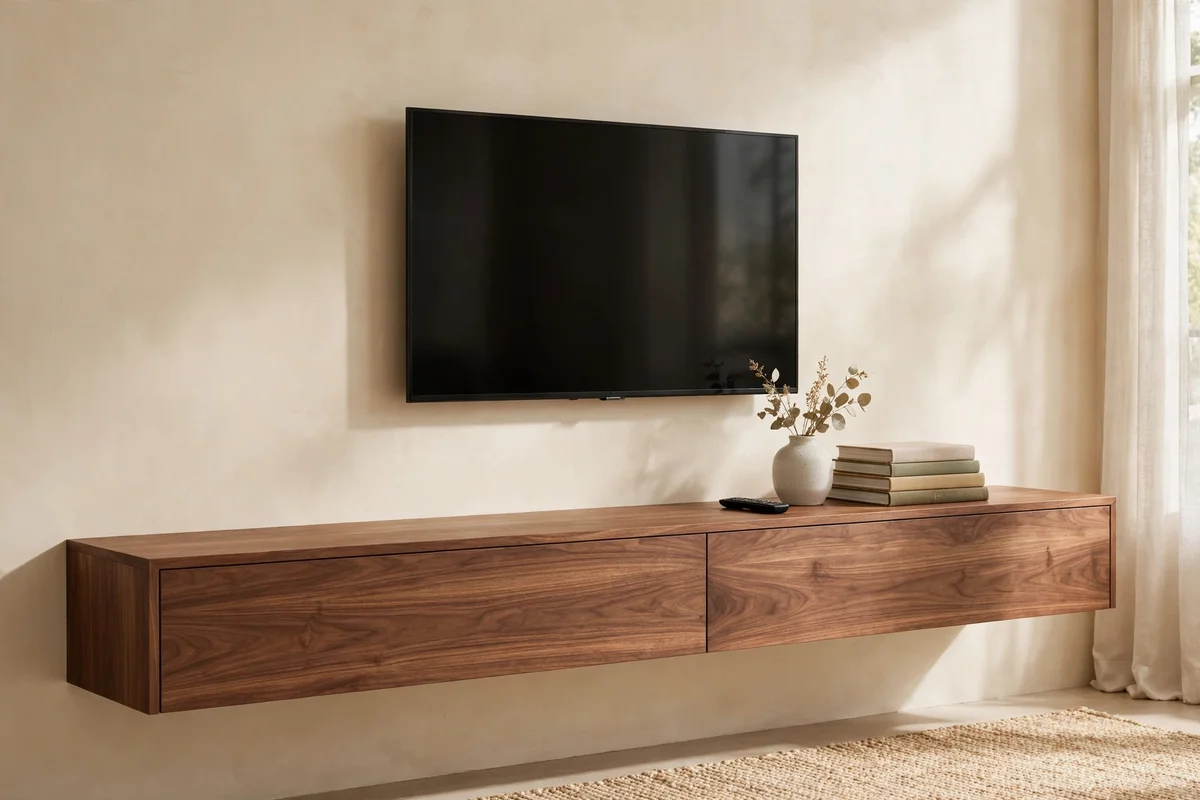
A wall-mounted TV with nothing beneath it looks like it is floating in space. The console underneath is the anchor that grounds the composition — but only if the proportions are right. Choose a unit that is wider than the TV, extending at least a few inches past the screen on each side. A console narrower than the screen looks top-heavy and unstable, even when it is perfectly sturdy.
Console rules that always work
- Width: TV width plus 6-12 inches total (3-6 inches per side) is the safe zone.
- Height: Low consoles (16-24 inches tall) keep sightlines clean and suit wall-mounted screens; leave 6-10 inches of clear gap between the console top and the TV’s bottom edge.
- Storage: Closed fronts with ventilation hide routers, game consoles, and streaming boxes. Open shelving on a media console collects dust and visual clutter in equal measure.
Floating consoles — wall-mounted with visible floor beneath — make small rooms feel larger and double the floating effect with an LED strip tucked underneath. Either way, the console and the TV should read as one stacked composition, not two unrelated objects.
7. Light the Wall, Not the Screen
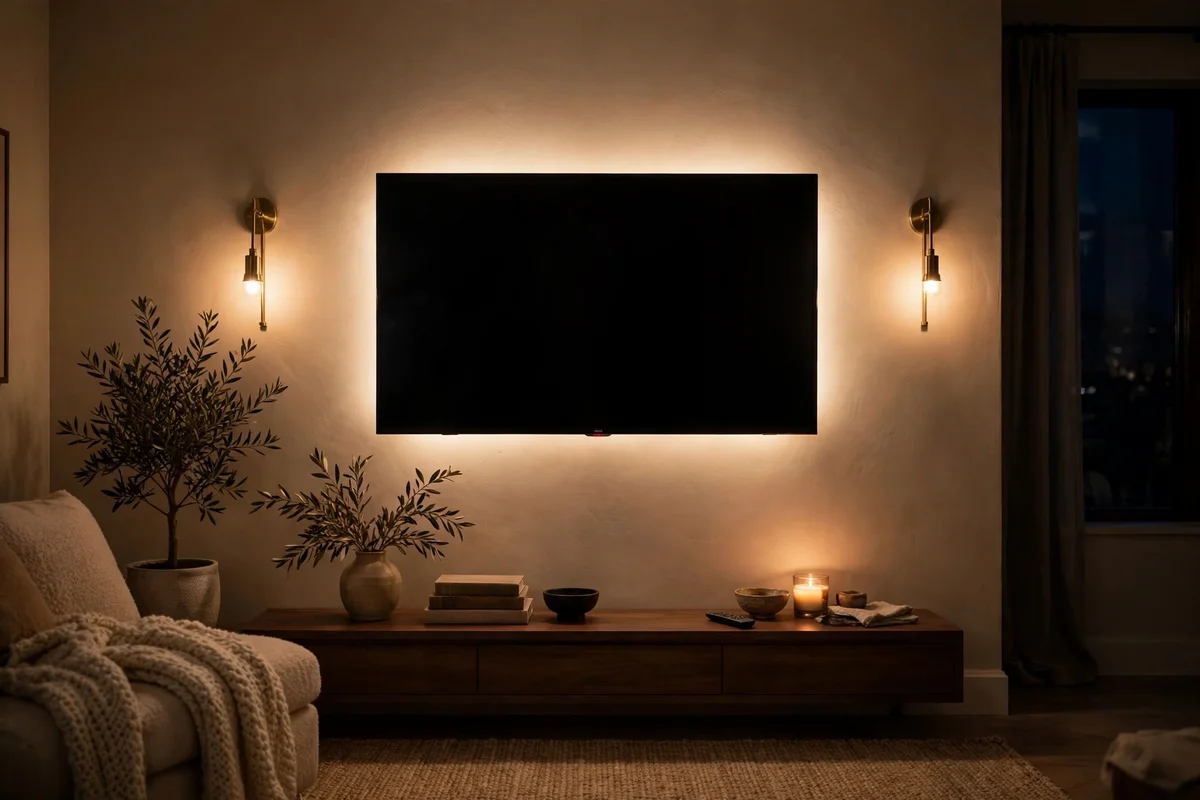
Overhead ceiling lights are the enemy of a good TV wall — they wash out the picture and throw reflections across the glass. The fix is layered, indirect light: a soft glow behind or beside the TV instead of a beam pointed at it.
A simple TV-wall lighting plan
- Bias light: A warm-white LED strip (around 2700-3000K) mounted just inside the TV’s back edges casts a gentle halo on the wall. It reduces the contrast between a bright screen and a dark room, which many viewers find easier on the eyes during evening watching. Keep it dimmable.
- Sconces: A pair of picture lights or slim sconces flanking the TV adds evening polish and draws the eye across the full width of the wall. Position them so no bulb reflects in the screen.
- Lamps: A table lamp on the console’s far end balances the composition and gives the room a non-screen light source for conversation.
Warm light flatters skin tones and wood finishes; cool white light feels clinical and increases perceived glare. Tie the bias strip to a smart plug and you can dim it for movie nights without adding another remote to the pile.
8. Style Shelves with Breathing Room
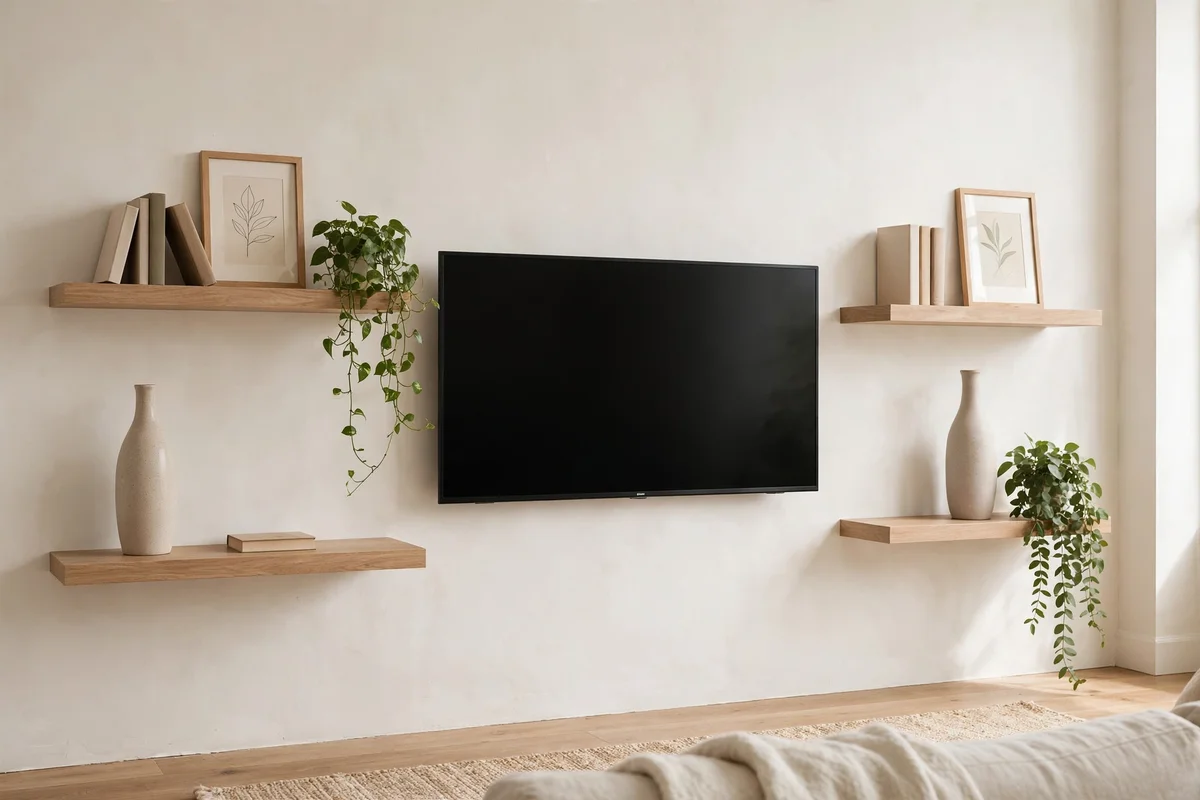
Shelves around the TV are where good walls go to die — one crowded shelf turns a media wall into a storage unit. The difference between styling and clutter is negative space. Aim to leave about a third of every shelf empty; breathing room is what makes the objects that remain look chosen rather than stored.
The styling formula
- Odd numbers: Group objects in threes or fives — odd groupings look natural to the eye.
- Vary height: A tall vase, a horizontal stack of books, a small framed photo. Height variation creates rhythm.
- Keep it low near the screen: Nothing tall or bright should sit at the TV’s edge height, where it competes with the picture for attention.
- Repeat the palette: Two or three colors echoed across the shelves tie them to the room instead of turning each shelf into its own display.
Style the top shelves with art and tall pieces that draw the eye upward, keep mid shelves for books and medium objects, and resist the urge to fill every inch. You can always add; subtracting from a crowded shelf is the hard part.
9. Balance the Composition Like a Designer
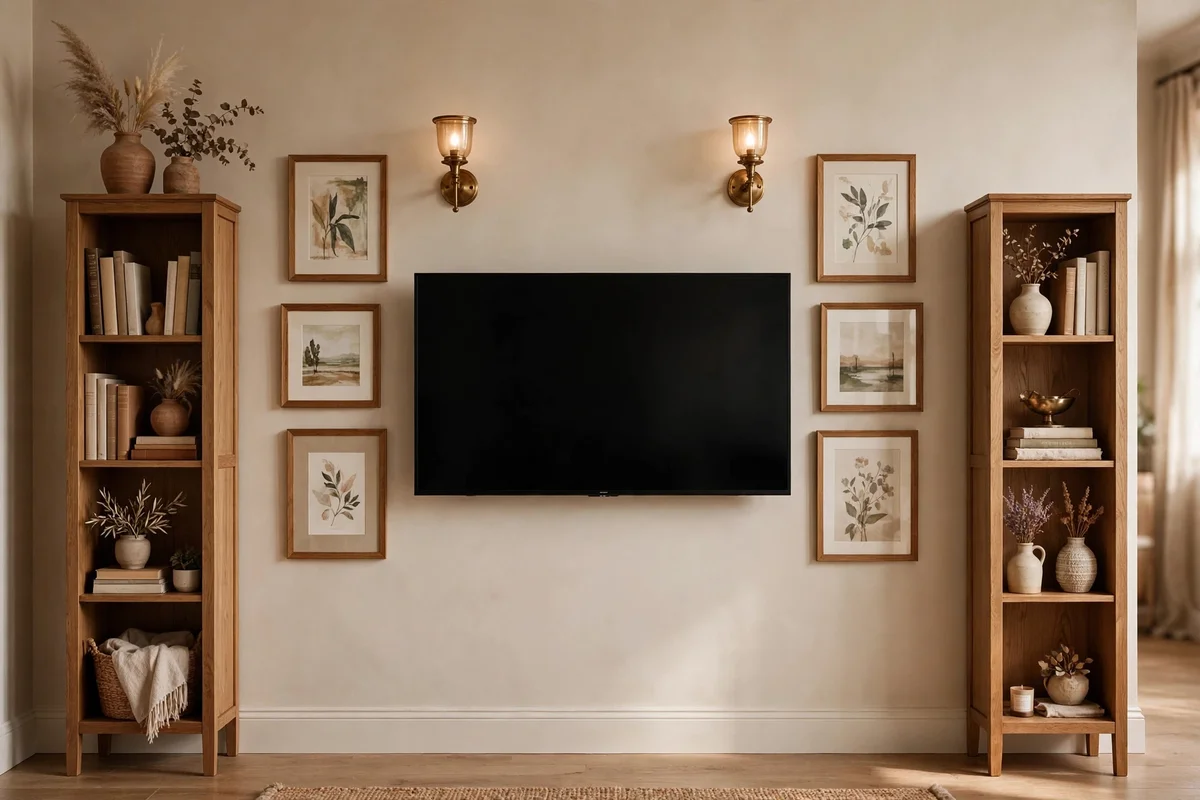
A TV wall is a composition problem: one big dark rectangle needs visual counterweights so the wall feels designed rather than dominated. You do not need perfect mirror symmetry — you need balance. A tall plant on one side can balance a stack of art frames on the other, as long as the visual weight feels even.
Three balancing moves
- Flank it: Matching elements on both sides — sconces, narrow bookcases, identical frames — is the fastest route to a wall that looks designed. The trick is matching, not mirroring: same furniture, styled differently.
- Frame it with art: Treat the screen as one large frame in a gallery arrangement. Keep frame spacing consistent (two to three inches) and align at least one edge of the arrangement for structure.
- Go intentionally off-center: On an awkward wall — a corner fireplace, a wide doorway — an asymmetrical arrangement that is honest about the room’s shape beats forced symmetry every time. Anchor the TV with a console, then build the decor on the side with more wall.
Step back to the sofa after every change and squint. If one side of the wall feels heavier, it is. Move one object and check again — balance is judged from the seat, not from two feet away.
10. Keep It Renter-Friendly and Budget-Smart
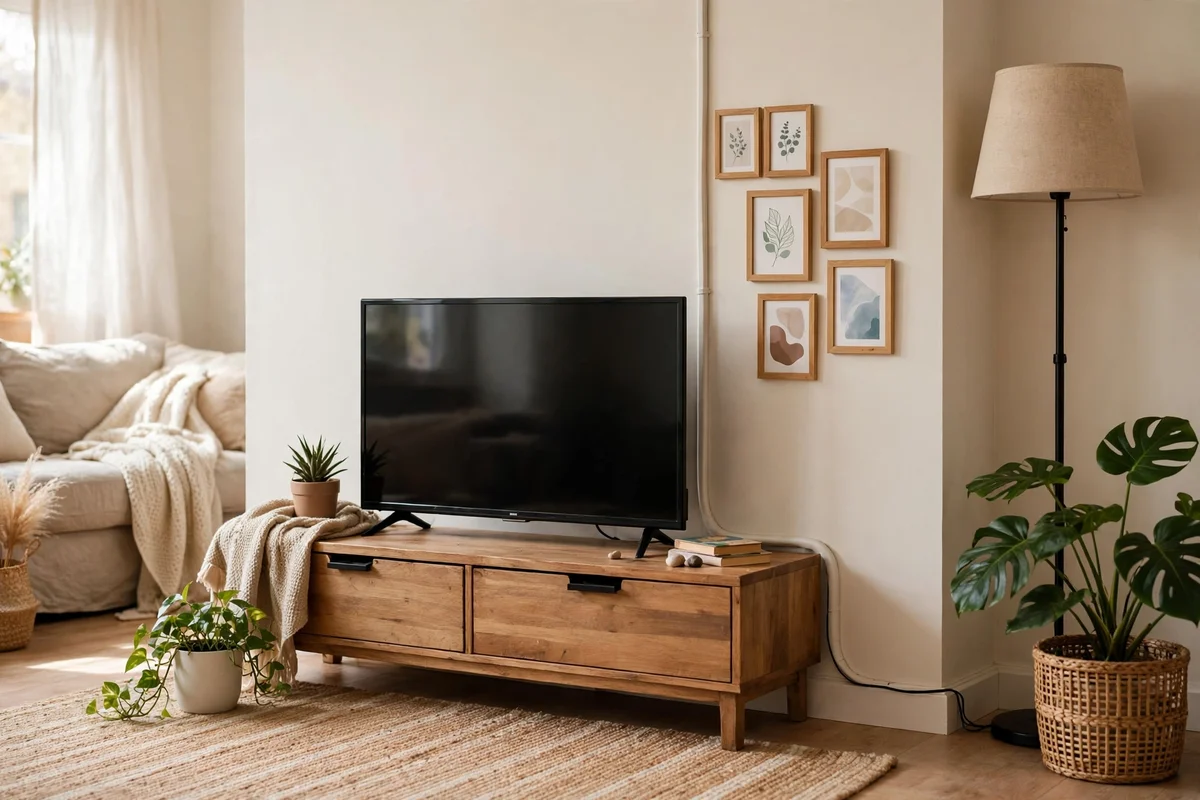
You do not need to own the walls or spend thousands to get a composed TV wall. The renter-friendly version skips drilling entirely: a low console the TV sits on instead of a wall mount, adhesive cord channels painted to match the wall, peel-and-stick frames or picture ledges for art, and a floor lamp instead of hardwired sconces. Everything is reversible on moving day.
| Budget tier | What it buys | The look it gets you |
|---|---|---|
| Under $150 | Paint (one wall), cord cover, thrifted frames, LED strip | Clean, intentional, glare-free |
| $150-600 | Low console or floating shelf, picture ledges, sconces or lamp, gallery frames | Layered, styled, magazine-adjacent |
| $600+ | Slat or panel accent wall, quality console, bias lighting, art-mode TV | Custom, architectural, built-in feel |
Spend where it shows
Put money into the backdrop and the console — they cover the most visual real estate. Save on decor by thrifting frames and printing your own art. And whatever the budget, the free moves matter most: correct mounting height, hidden cables, and breathing room on shelves cost nothing and do half the work.
Frequently Asked Questions About TV Wall Design
How high should I mount my TV on the wall?
Center the screen at your seated eye level — roughly 40 to 48 inches from the floor to the middle of the screen for most sofas. Mounting too high is the most common mistake and causes neck strain during long viewing sessions.
What size TV works best for my wall?
Choose a screen whose width fills about half to two-thirds of the wall section it sits on. Measure the usable wall first, then pick the screen size — the TV relates to its immediate wall, not the total room size.
How do I hide TV cables without opening the wall?
Use a paintable cord cover channel run from behind the TV down to the console or outlet — it reads as intentional trim. Keep a single power strip inside the console so only one cord needs routing.
Should the TV wall be darker than the rest of the room?
Slightly darker usually works best, since dark tones help a turned-off screen blend into the wall. Charcoal, navy, or deep green in a matte finish are safe choices that will not overwhelm the room.
How far should the sofa sit from the TV?
A comfortable starting point is a viewing distance of about 1.5 to 2.5 times the screen’s diagonal measurement. For a 65-inch TV that means roughly 8 to 13 feet — adjust closer for immersive movie watching.
Can I put a TV above a fireplace?
You can, but it usually mounts the screen too high for comfortable viewing, and heat plus soot can damage electronics over time. If you must, use a pull-down mount and check the mantel temperature during use.
What lighting is best around a TV?
Warm, indirect light: a dimmable bias LED strip behind the TV (around 2700-3000K) plus sconces or a lamp to the side. Avoid overhead lights aimed at the screen and any bulb that reflects in the glass.
How do I decorate around a TV without it looking cluttered?
Keep sightlines clear, leave about a third of every shelf empty, and stick to two or three colors across your decor. Style in odd-numbered groupings and keep tall or bright objects away from the screen’s edges.
Is a soundbar better mounted or on the console?
Either works — mount it just below the TV for the cleanest look, or set it on the console if you want zero drilling. Keep it centered under the screen and make sure nothing tall blocks its front.
What is the biggest TV wall mistake to avoid?
Mounting the TV too high. It causes neck strain, makes the wall look top-heavy, and throws off every other proportion on the wall. Get the height right first, and the rest of the design falls into place.
Conclusion
A great TV wall is not about an expensive look — it is about a series of small, correct decisions. Pick the wall with the least glare, mount the screen at seated eye level, size it to the wall it sits on, and hide every cable. Give the screen a calm backdrop, anchor it with a console that is wider than the TV, and light the wall with warm, indirect glow instead of overhead beams. Style the shelves with breathing room, balance the composition from your actual seat, and remember that the renter-friendly version of all of this exists.
None of these tips requires a renovation. Most of them cost little or nothing — a measuring tape, an afternoon, and the willingness to move the TV down six inches. Start with the free moves, add the backdrop and console when the budget allows, and your TV wall will stop being the black box you tolerate and start being the wall that makes the whole living room feel designed.