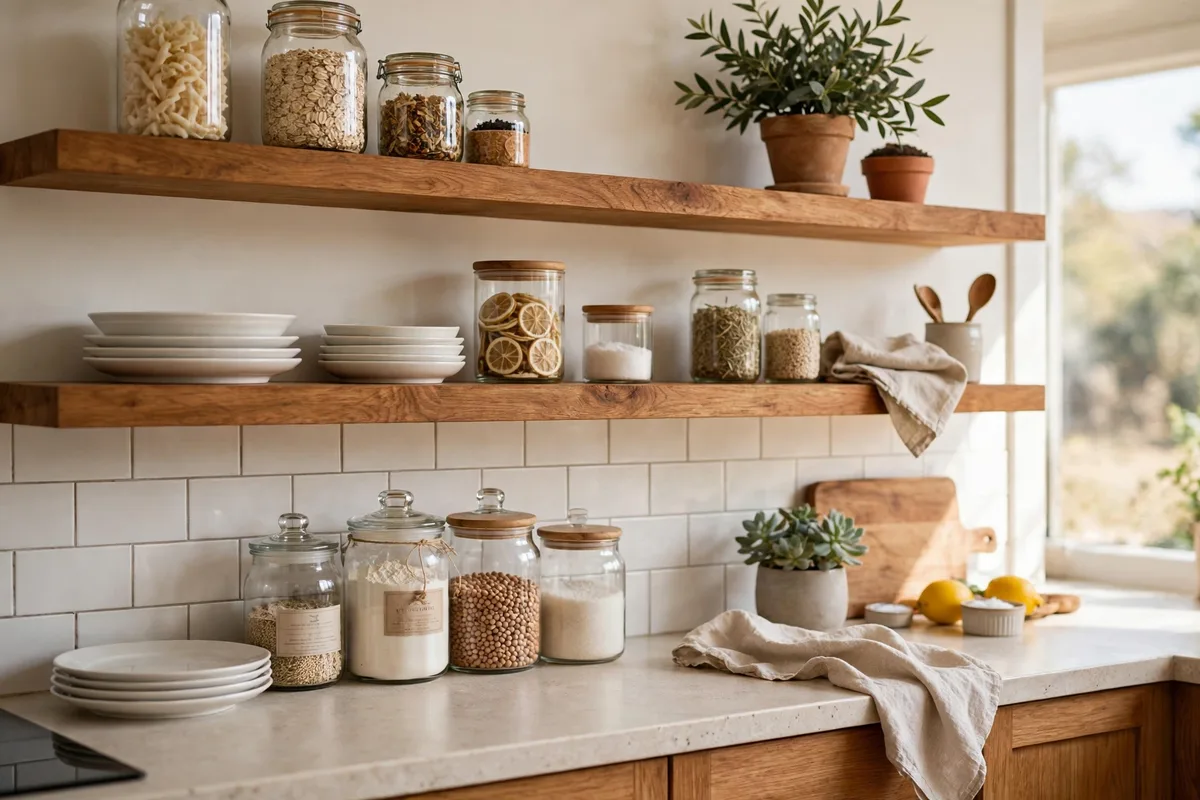
Open shelves are the kitchen’s promise and its trap. The promise: everything you use daily, visible and reachable, on a wall that looks like a café instead of a cupboard. The trap: everything you own, visible all the time, in the one room where grease flies and dust settles. Kitchen shelves succeed when they are planned as a working system first and a styling project second — what you reach for decides what lives where, the dimensions follow standard cabinet geometry, and the styling rules (tight palette, stacks, decanted jars) exist to keep a hard-working wall calm.
Ten ideas, workflow first: the measurements, the zones, then the styling discipline and the one honest section about grease.
The Open Shelf Numbers at a Glance
| Decision | Working number | Notes |
|---|---|---|
| First shelf height | ~18 in above the counter | Where an upper cabinet would start |
| Shelf spacing | 12–16 in apart | More for tall jars and pitchers |
| Shelf depth | 10–12 in | Dinner plates need ~11–12; mugs 6–8 |
| Palette | 2–3 colours + 1 material | White + wood + glass is the classic |
| Distance from range | 24 in or more, if possible | Or daily-use items only near the heat |
1. Start With What You Use Every Day
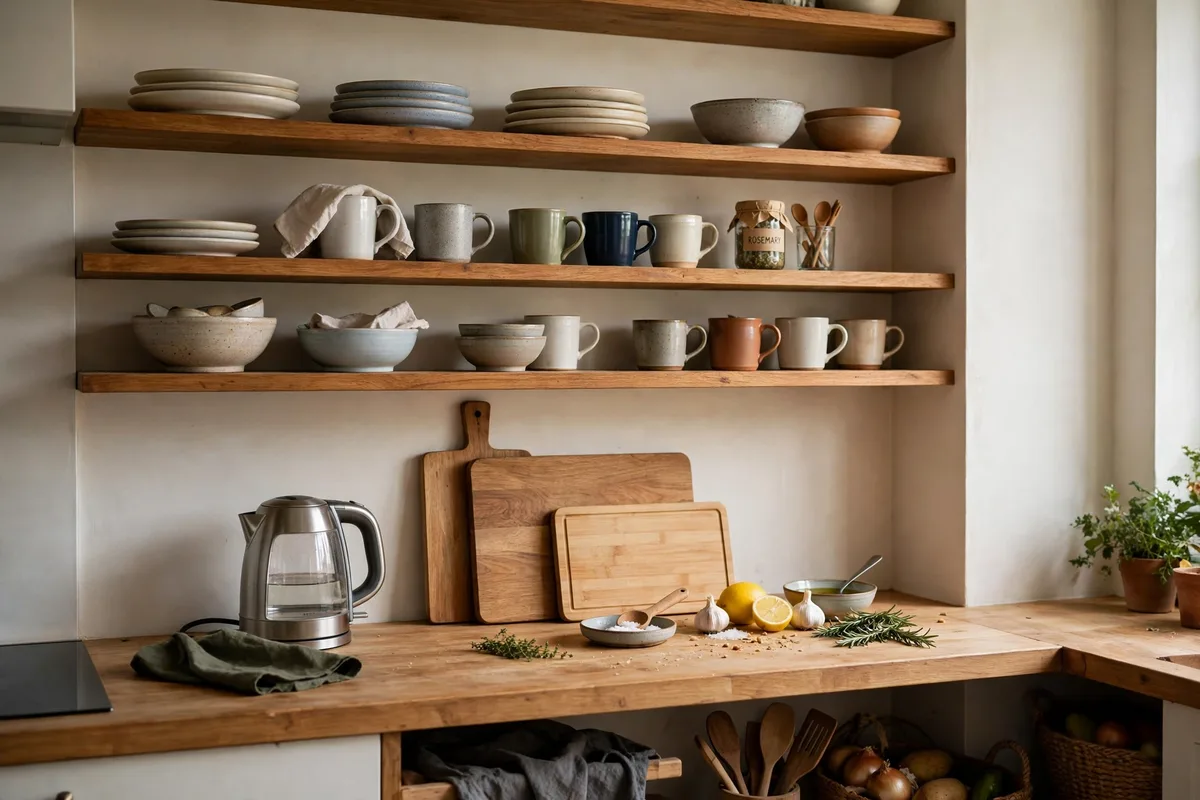
The first styling decision is an inventory, not a shopping trip. List what you touch daily — plates, bowls, mugs, glasses, the oil and salt that live by the stove — because open shelves are for rotation, not storage: items used and washed constantly never sit long enough to collect dust or grease, which is the entire maintenance argument solved by selection. Corner Renovation’s open-shelf planning guide starts here too: group by function, daily items at arm’s reach, display higher up.
What fails the daily test goes behind a door somewhere else — the good china, the holiday platter, the appliance used twice a year. Open shelving is a cast, not a company: every object on it should have a job it performs weekly at least.
2. The Dimensions: Cabinet Geometry, Minus the Doors
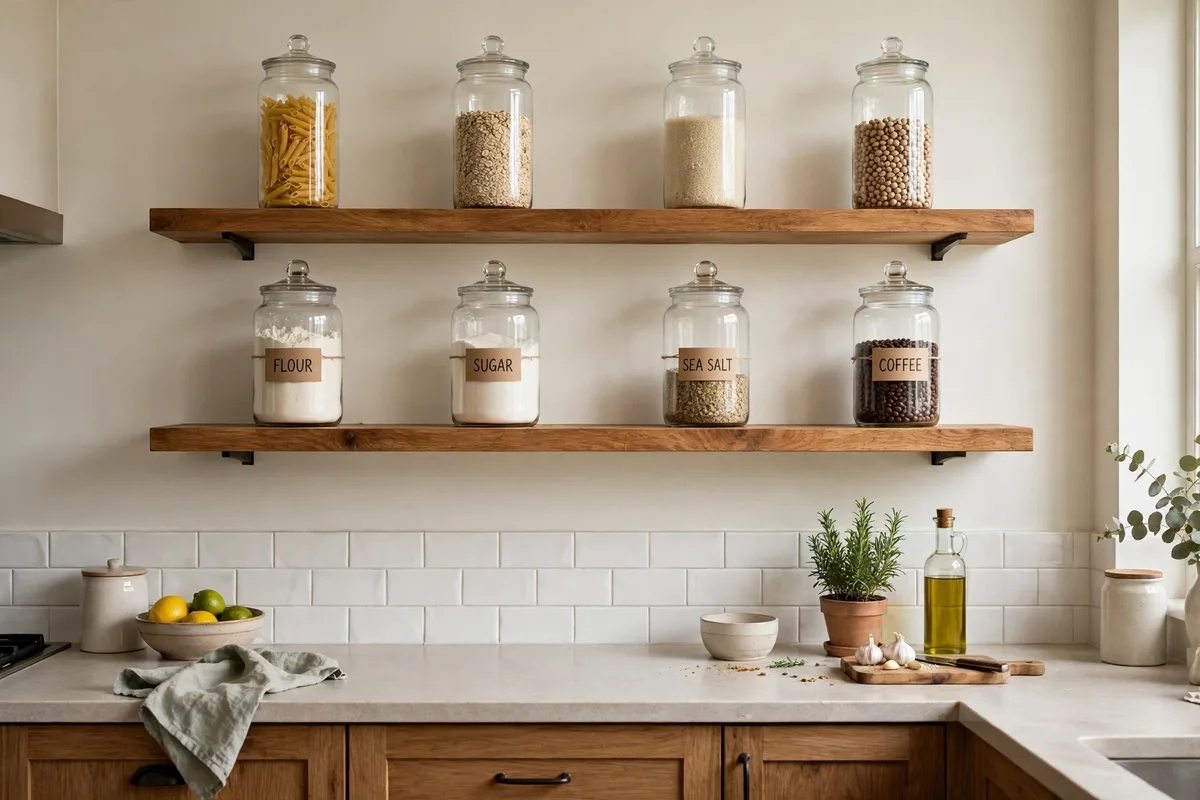
Shelves inherit the geometry of the uppers they replace. The first shelf starts about 18 inches above the counter — the standard underside height of an upper cabinet — leaving room for the coffee maker and stand mixer below. Spacing between shelves runs 12–16 inches (Corner Renovation’s range), wider where tall canisters live. Depth is the decision people get wrong: dinner plates need 11–12 inches, so daily-dish shelves are 10–12 inches deep; a shallower 6–8 inch shelf works for mugs, glasses and spices and reads lighter.
Support is part of the dimension decision: stacked stoneware is heavy, and a shelf that sags a quarter inch reads as failure forever. Brackets into studs every 32 inches or less, or a proper floating-shelf frame — the wall, not the wish, sets the load.
3. Shelves Change the Wall: Pair Them With Cabinets and Tile Deliberately
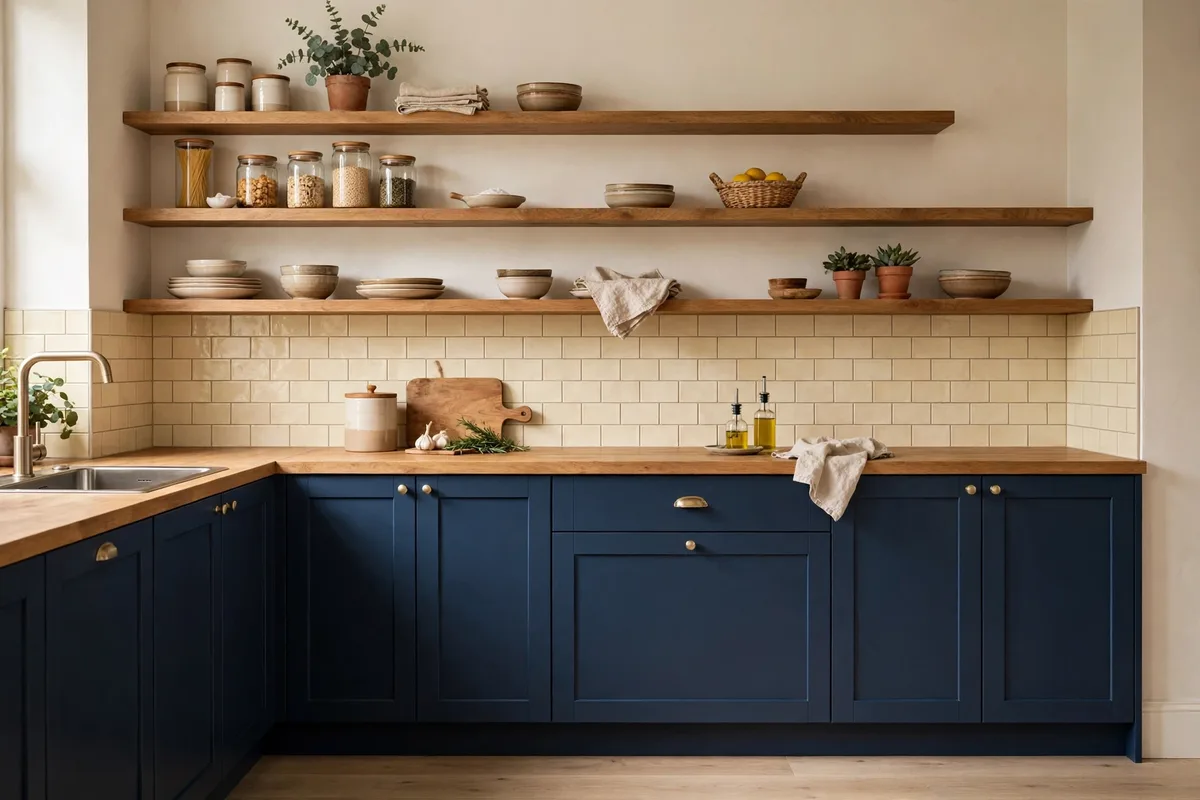
Few kitchens go all-shelf; most mix shelves with some closed uppers, and the pairing needs a decision. In a two-tone kitchen cabinets ideas scheme, shelves often take the “light above” role in wood — the warm natural note above darker lowers. The second relationship is the wall itself: with no cabinet doors, the surface behind the shelves is on display, which makes it the most visible stretch of kitchen backsplash colors ideas in the room. Choose that tile as the shelves’ backdrop — calm, warm, and cleanable — because it will be in every photograph the kitchen ever takes.
End the run on a line: a corner, a window edge, the range hood. A shelf run that stops mid-wall for no reason looks like the budget did.
4. Palette Discipline: Two or Three Colours, One Material Story
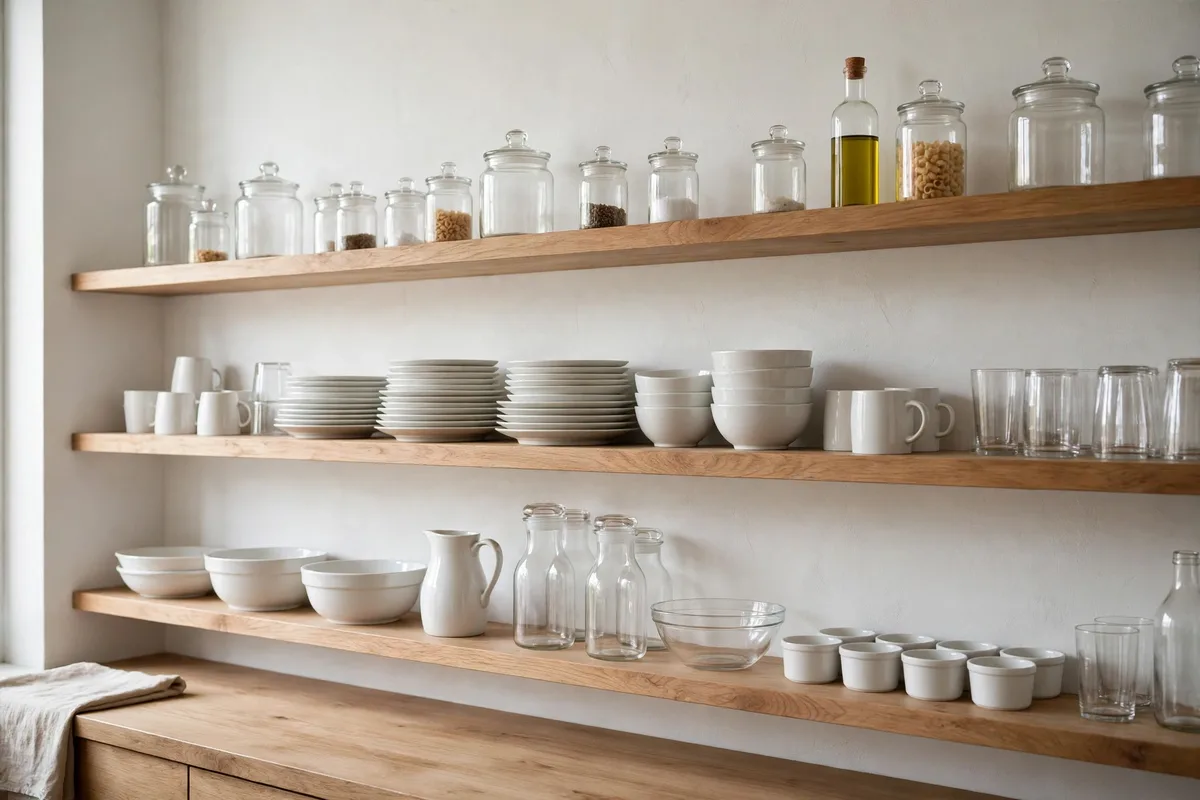
Corner Renovation’s first styling step is the one that separates styled shelves from storage: pick a palette — two or three colours plus one natural material — and let nothing live on the shelves outside it. White ceramics + wood + glass is the classic trio; stoneware + black metal + linen is another. The palette does the visual work that cabinet doors used to do: it makes thirty different objects read as one composition.
The misfit rule enforces it: a beloved coloured mug that breaks the palette goes in a drawer, not on the shelf “just this once”. Shelves show everything, so the palette is not a guideline — it is the whole design.
5. Stacks Are the Decor
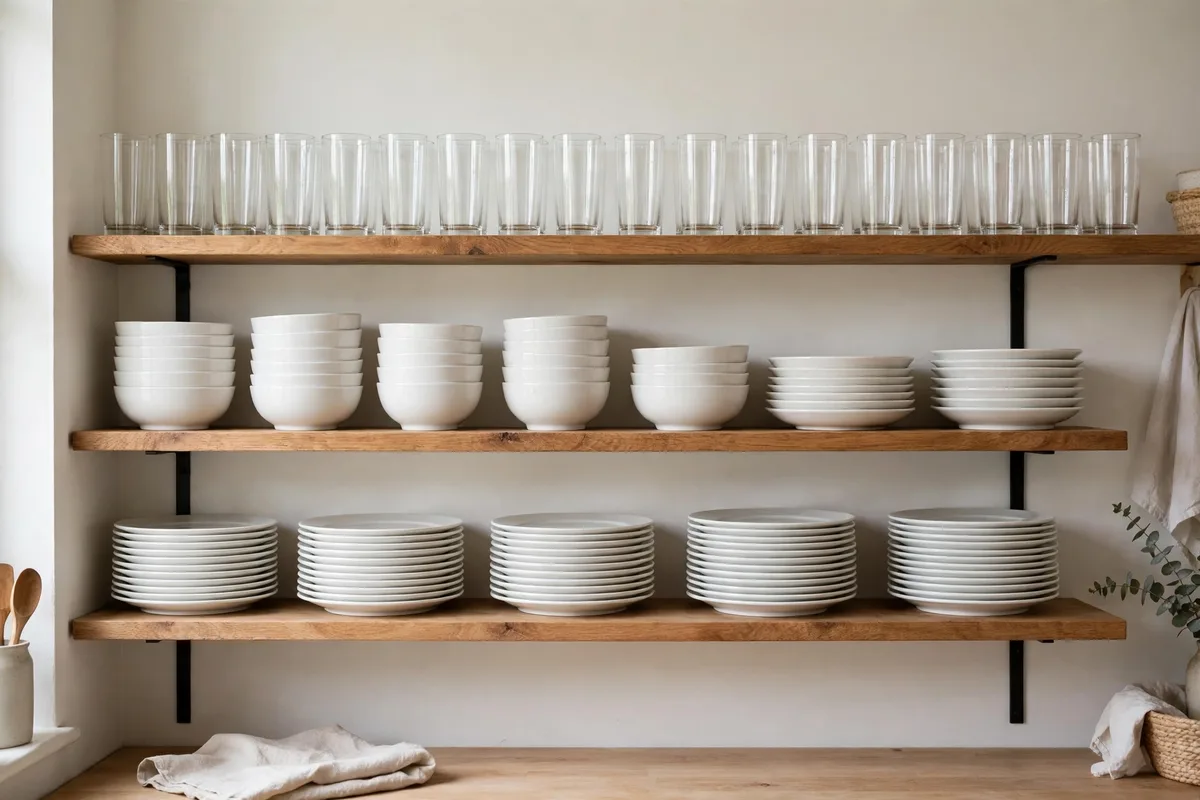
Kitchen shelves rarely need bought decor, because dishware itself — stacked and repeated — is the pattern. A stack of plates, a tower of bowls, a row of identical glasses: repetition reads as order at a glance, which is why matching sets look designed and inherited mismatches look like clutter. Stack heights should vary along the run (a tall stack, a low row, a gap) so the rhythm breathes; one unbroken skyline of equal stacks reads as warehouse.
Leave gaps deliberately — one empty stretch per shelf, the same bare-third discipline as the shelf system in our bathroom shelf styling ideas. On a working shelf the gap is also practical: it is where the thing in your hand goes while you reach for the thing behind it.
6. Decant the Staples, Match the Sets
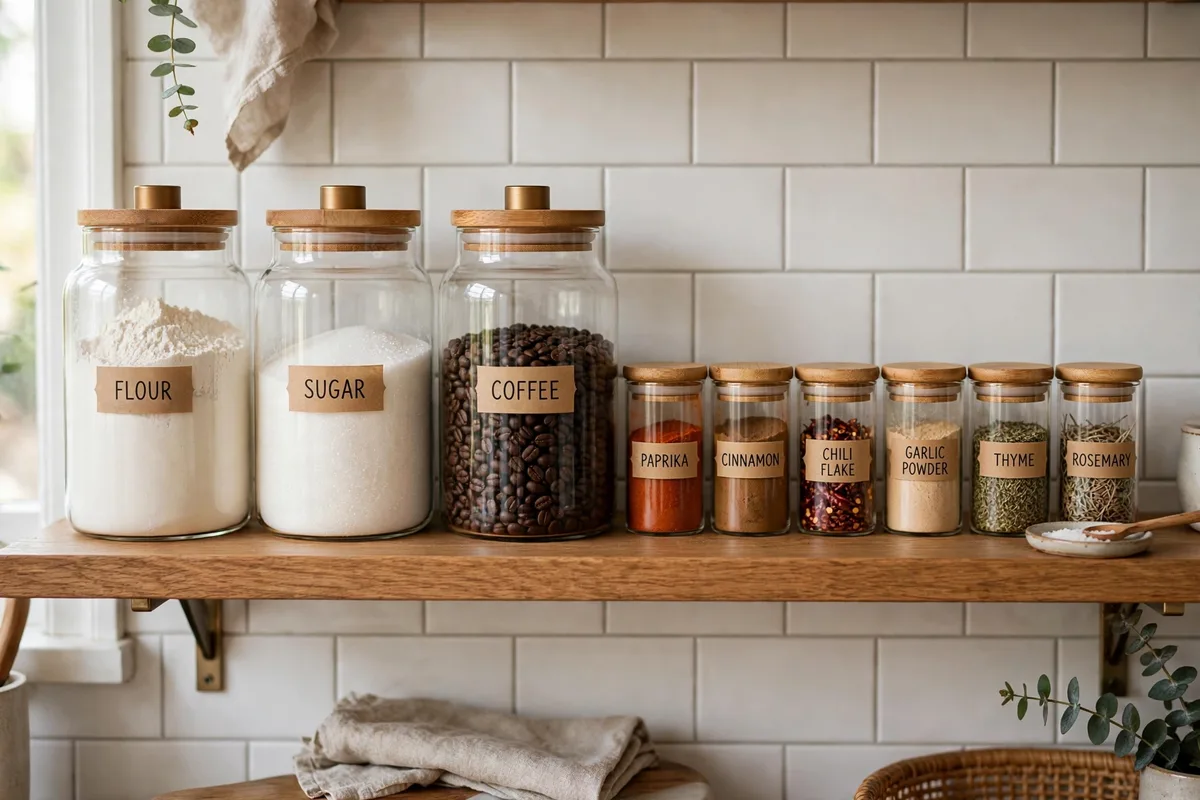
Pantry staples on open shelves follow one rule: out of the packaging, into vessels. Flour, sugar, coffee and pasta in clear canisters become colour and texture; the same goods in branded bags become visual noise and stale faster in the light besides. One vessel family per shelf run — glass with wood lids, or ceramic throughout — and the staples start reading as a still life that happens to be breakfast.
Dishware gets the same treatment: commit to matching sets on the shelves and exile the odd survivors to a closed cabinet. Repetition is the cheapest luxury in kitchen styling — six identical glasses look expensive; six different ones look accumulated.
7. Zone by Task: Coffee Here, Prep There
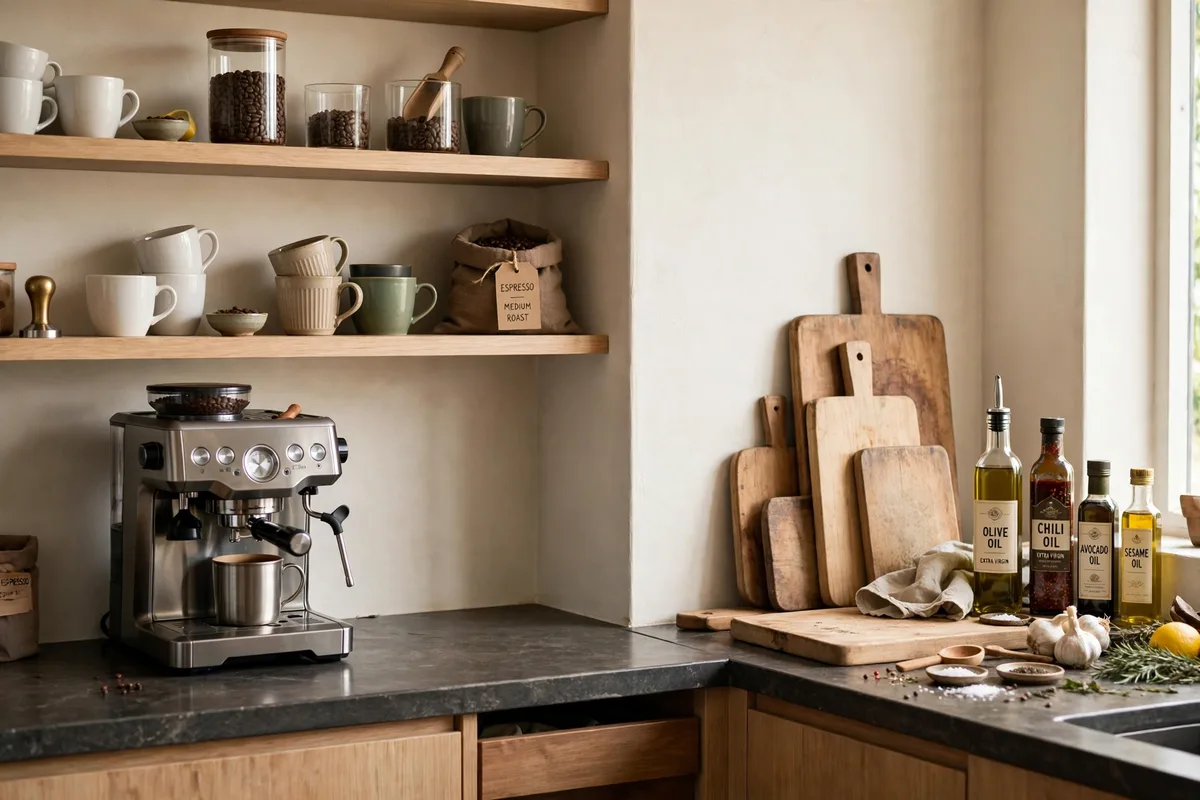
Arrange the shelves the way the kitchen works: a coffee zone above the coffee maker (mugs, beans, filters), a prep zone near the stove (oils, salt, the boards), dishes near the dishwasher or sink where they are unloaded. Zoning is invisible when it works — nobody admires it — and its absence is three extra steps every time you cook. It is also how shelves stay styled: items have a home zone, so putting them back correctly is the path of least resistance.
Frequency sets height inside each zone: the mug you use twice a day at front-and-centre height, the French press you use weekly a shelf up, the pretty teapot quarterly — that one is display, and display lives at the top (§8).
8. The Top Shelf Is Display — Treat It That Way
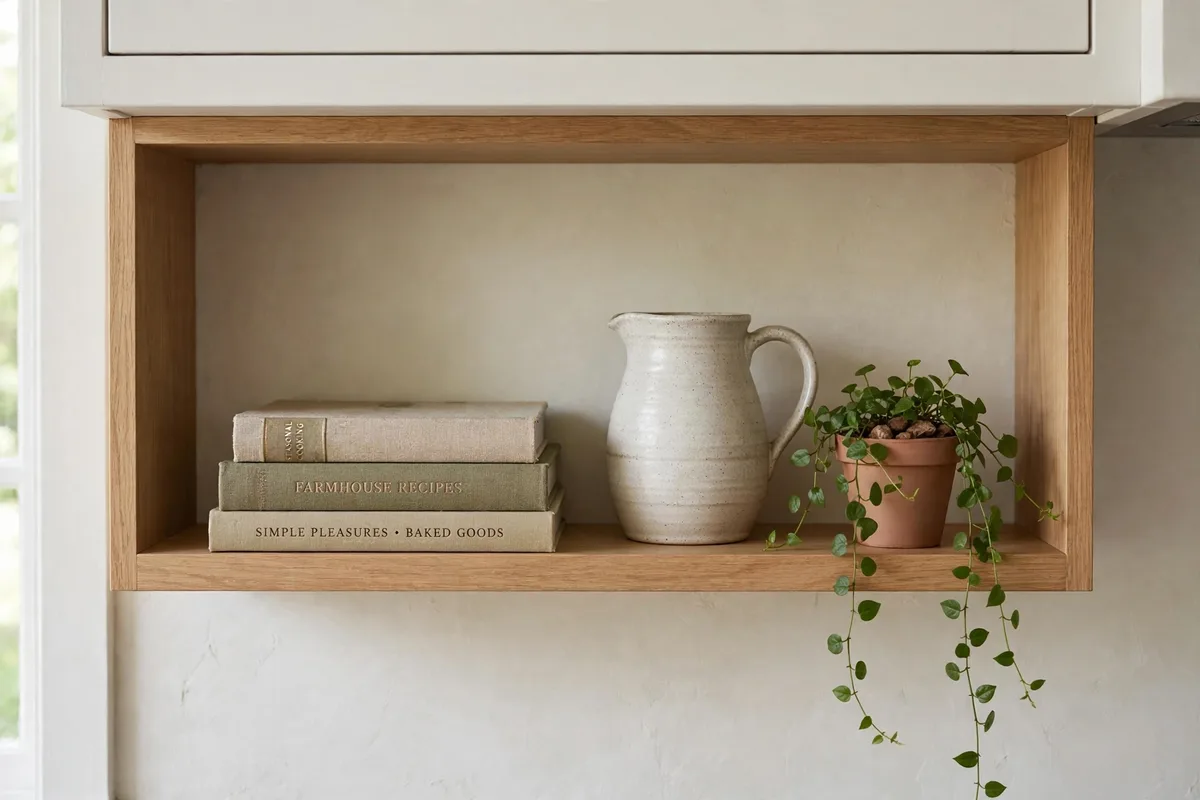
Every shelf run has a shelf nobody can reach without a stool, and honesty about it improves everything below. The top shelf is display: the ceramic pitcher, the cookbooks you love the look of, a trailing plant, serving pieces that come down for guests. Light, pretty, rarely touched — and dusted on the monthly edit, because display’s whole job is being looked at.
Naming it display also protects the working shelves: once there is a legitimate place for beautiful-but-useless, the reachable shelves stop accumulating it. The shelf system’s constitution in one line: reach equals rotation; height equals display.
9. Light Under the Shelf
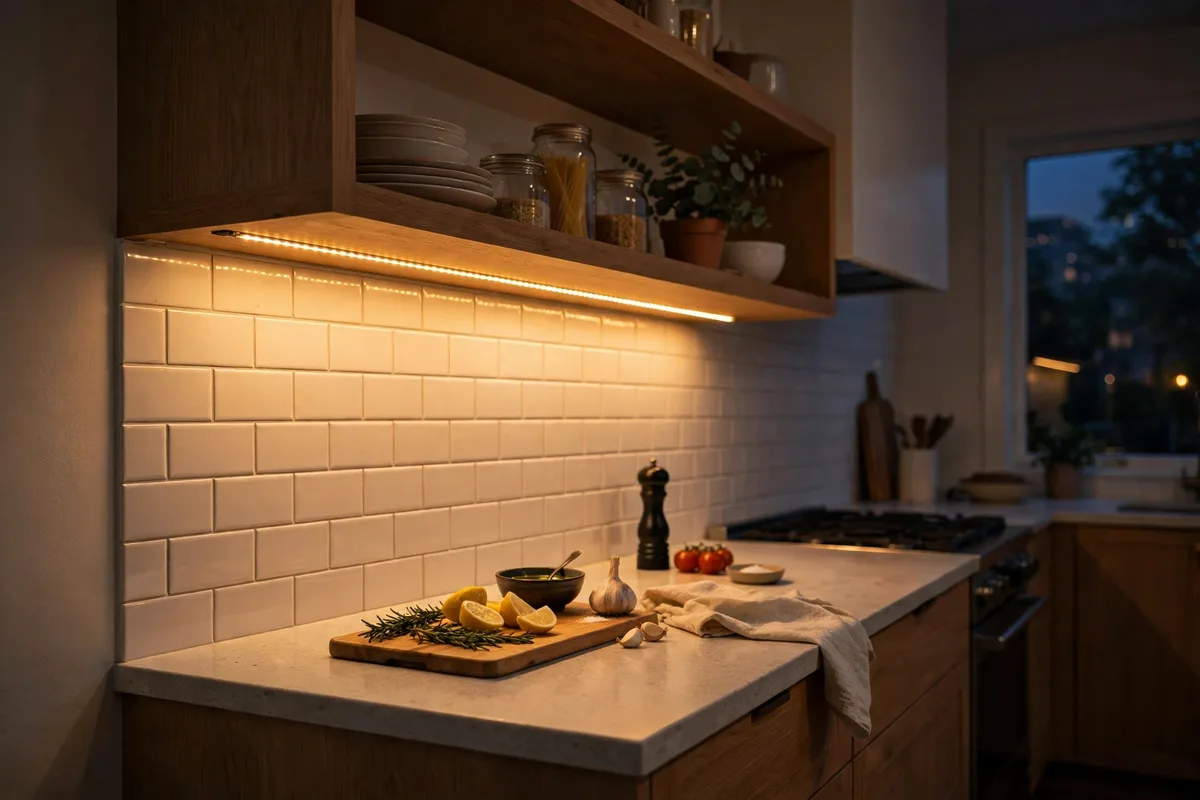
Upper cabinets traditionally hide the under-cabinet lights; shelves have no underside to hide them in, which turns out to be an opportunity. A slim LED strip under the lowest shelf washes the counter with task light, makes the backsplash glow, and gives the shelf run a finished, built-in look after dark. It is the kitchen application of the layering logic in our kitchen island lighting ideas: every work surface gets its own light layer, on its own switch, dimmable if possible.
Run the strip toward the front edge of the shelf so the light falls on the counter, not the wall, and match its Kelvin to the room’s other lights — a cool strip under warm pendants splits the kitchen into two colour zones at exactly the surface where food is judged.
10. The Grease Section: Placement, Materials, and the Wipe Habit
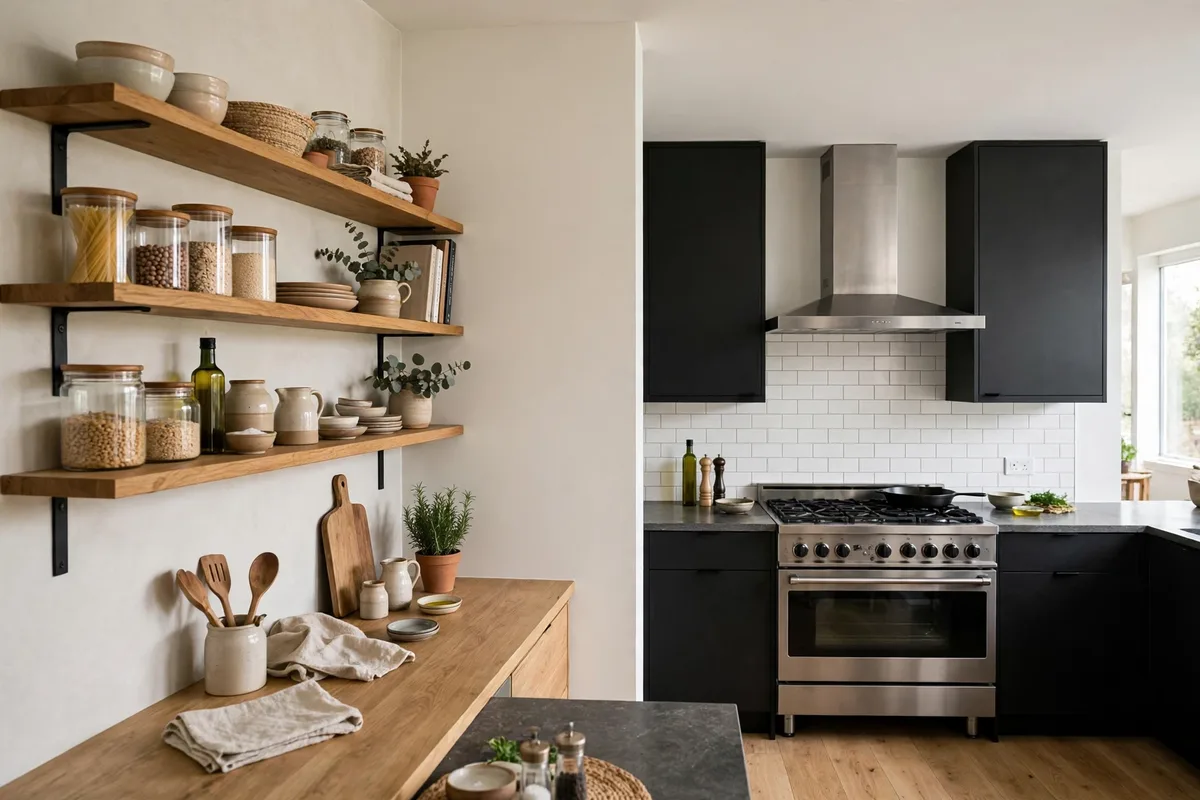
The honest objection to open shelves is airborne grease, and the honest answer is placement plus rotation. A Grateful Kitchen’s dust-and-grease investigation gives the working rules: shelves more than about two feet from the cooktop accumulate far less grease; near the range, limit shelves to daily-rotation items; sealed hardwood, glass and metal shelves wipe clean where unsealed wood and matte paint hold grease; and the range hood, run during cooking and five minutes after, removes most of the problem before it lands.
The maintenance that remains is genuinely small: a thirty-second dry wipe as part of the evening tidy, a monthly degrease of the top shelf (the one whose contents do not rotate). Households that fry daily and hate wiping should put their shelves on the sink wall, not the stove wall — the system works there unchanged.
Frequently Asked Questions About Open Shelving Styling
How high should the first open shelf be above the counter?
About 18 inches — the standard underside height of an upper cabinet — so counter appliances fit below and daily dishes sit at easy reach. Spacing between shelves is typically 12–16 inches, adjusted upward for tall jars and pitchers.
How deep should open kitchen shelves be?
10–12 inches for dinnerware (plates need roughly 11–12), 6–8 inches for mugs, glasses and spices. Shallower shelves read lighter and suit display; plates on a too-shallow shelf overhang and look — and are — unsafe.
What should actually live on open kitchen shelves?
Daily-rotation dishware and glasses, decanted staples in matched canisters, the coffee and prep items grouped by task zone, and — on the top shelf only — display: pitcher, cookbooks, plant. Rarely used and mismatched items belong behind doors.
Do open shelves get dirty and greasy?
Items near the range do, which is why placement and rotation are the system: shelves 24 inches or more from the cooktop, daily-use items near the heat (they are washed before grease builds), sealed materials, the hood run while cooking, and a weekly wipe. Shelves on the sink wall barely grease at all.
How do I keep open shelves from looking cluttered?
A tight palette (2–3 colours + one material), matching sets, stacks with deliberate gaps, decanted packaging, and zones with a home for everything. Clutter on open shelves is almost always a membership problem — too many things with no job — not an arrangement problem.
Can open shelves work in a small kitchen?
They are often the best choice: no doors swinging, no visual bulk, sightlines kept open. Keep the run shallow and the palette strict, and let one wall carry the shelves while closed storage elsewhere hides the overflow and the mismatches.
Open shelves or upper cabinets — which is better?
Neither universally. Shelves are cheaper, faster to use, and make daily dishware a design feature; cabinets hide everything, protect from grease, and store more (including the ugly and the rare). Most successful kitchens mix: shelves on one wall, cabinets on another.
What material is best for open kitchen shelves?
Sealed hardwood (oak, maple) for warmth that wipes clean; metal or glass for modern schemes. Avoid unsealed wood and matte painted surfaces near cooking zones — they absorb grease. Whatever the material, brackets must hit studs: stacked dishes are heavy.
How do I arrange items on open shelves?
Start with stacks and rows of the daily sets, vary heights along the run, group by task zone, add one texture note (a board, a basket, a plant) per shelf, and leave a gap. Then stand back and apply the palette test: anything outside the 2–3 colours moves.
How often do open kitchen shelves need cleaning?
A quick dry wipe weekly (thirty seconds, part of the evening tidy), a proper degrease monthly — mainly the top display shelf, whose contents do not rotate. Daily-use shelves effectively clean themselves through the dishwasher cycle of their contents.
Conclusion
Styled open shelves are a workflow wearing a palette: daily things low and reachable, dimensions borrowed from the cabinets they replaced, stacks and jars doing the decorative work, display exiled honestly to the top shelf, and the grease problem answered by placement rather than hope. Run that system and the most-photographed wall in the kitchen is also the one that works hardest — which is the only kind of styling a real kitchen can keep.