
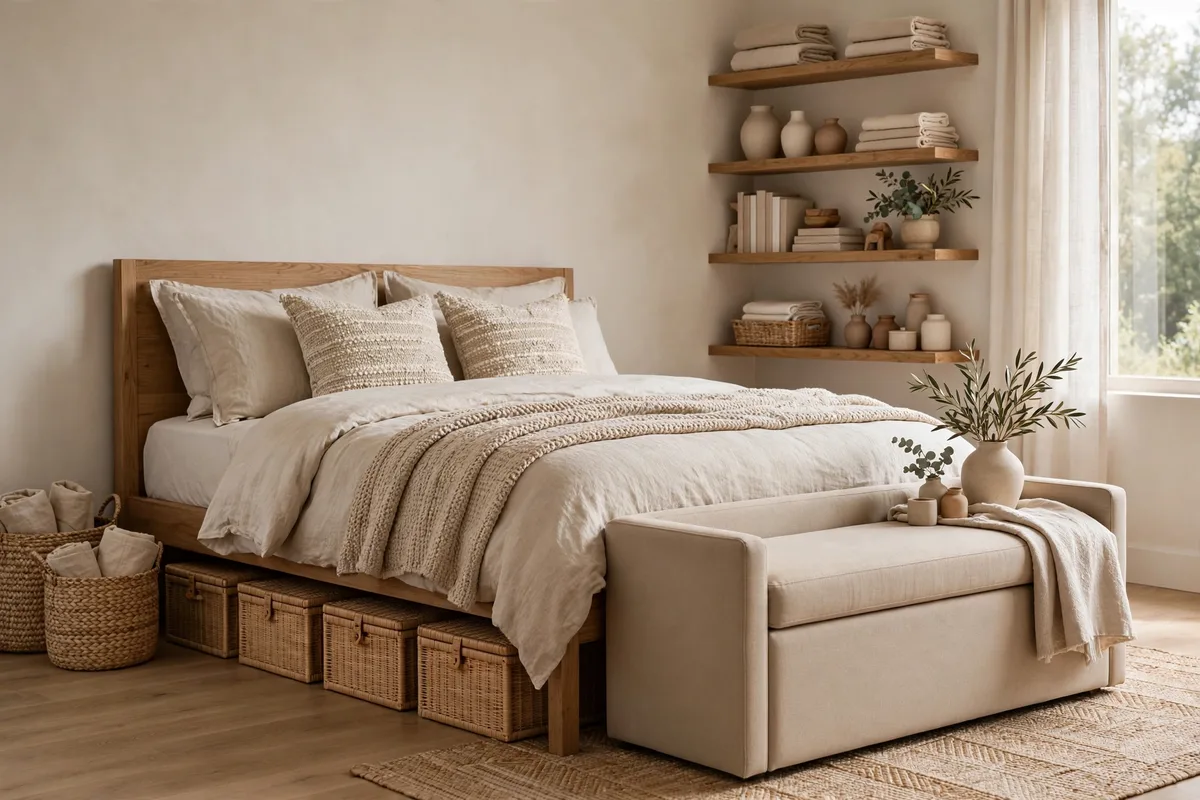
Most bedroom storage advice treats storage as something to hide: shut it in a wardrobe, slide it under the bed, and hope nobody looks too closely. But in a real bedroom — especially a small one — much of your storage will always be visible, and visible storage is either decor or clutter. There is no third option. The difference is never the amount of stuff; it is whether the pieces holding it were chosen, repeated and arranged on purpose.
This bedroom storage styling inspiration guide works through ten storage ideas that are styled rather than hidden, from matching under-bed boxes and a colour-ordered wardrobe rail to baskets that earn their place as decor and a full storage wall for small rooms. Every idea gets the same four-part treatment — what it holds, its styling rule, its best room size, and its watch-outs. The vertical thinking borrows from the same principles behind good small living room layout ideas: when the floor is full, the walls and furniture work harder — and a bedroom that stores well still leaves room for calm corners like the ones in these cozy reading corner ideas.
What follows are bedroom storage ideas built to be seen — each zone styled by a rule, not hidden behind a door.
The system at a glance: under-bed boxes matching and low for the seasonal archive; the open rail ordered by colour; bedside drawers for the mess with three items on top; baskets from one weave family; shelves styled in thirds; a storage bench at the foot of the bed; the vanity and desk kept as display; behind-door and corner pieces for the dead zones; seasonal pieces rotated out of sight; and, in a small room, the storage wall that assembles all of it — each zone’s piece and styling rule is tabled in the final section.
In this guide: Under-Bed Storage Styled With Matching Boxes · An Open Wardrobe Rail Styled by Colour · A Nightstand With Drawers and a Styled Top · Woven Baskets as Decor That Works · Vertical Shelving Styled in Thirds · Ottoman and Bench Storage at the Foot of the Bed · Vanity and Desk Storage That Doubles as Display · Behind-Door and Corner Storage, Finished Properly · Seasonal Rotation Storage That Stays Invisible · The Small-Bedroom Storage Wall: Every Zone on One Wall · Frequently Asked Questions About Bedroom Storage · Conclusion
1. Under-Bed Storage Styled With Matching Boxes
What it holds
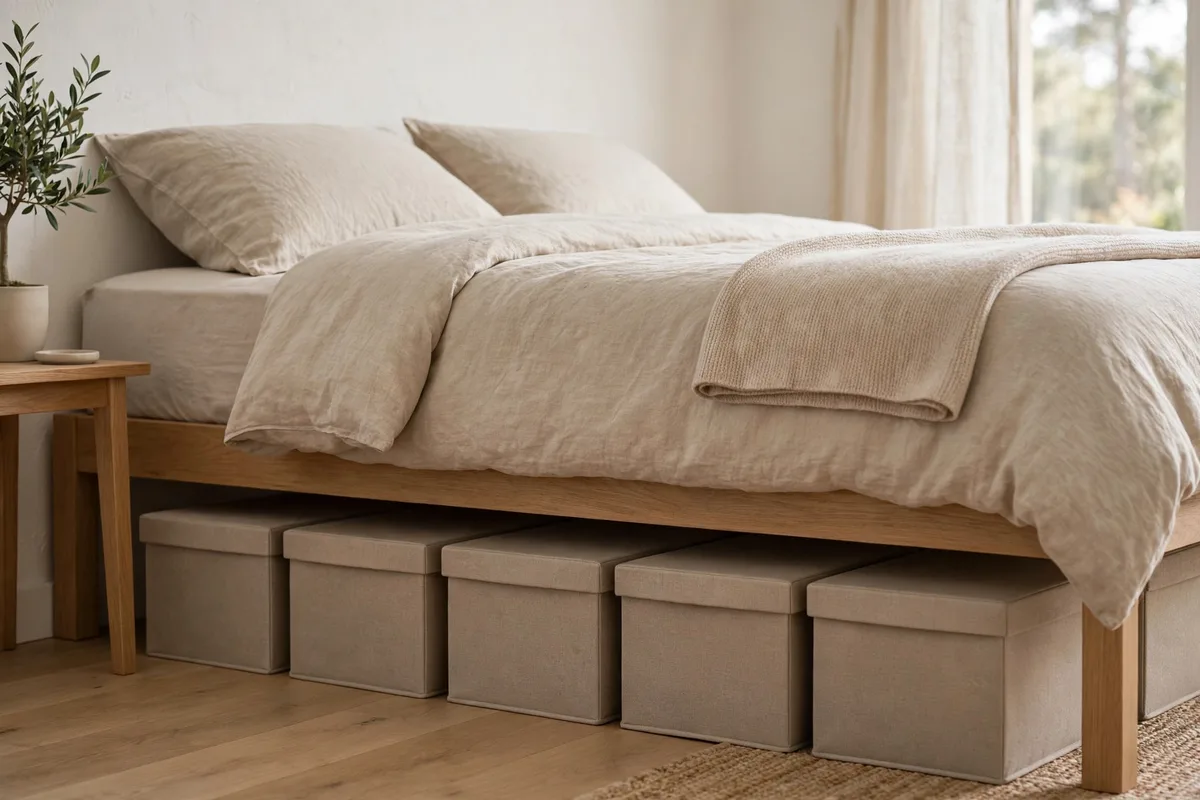
The under-bed zone is the bedroom’s archive: off-season clothing, spare bedding and duvet sets, extra pillows, and the shoes you wear twice a year. Store by category, one category per box; anything you need weekly belongs somewhere easier.
The styling rule
Under-bed storage only looks styled when it looks like one decision. Use a single style of box — same material, same colour, same lid — repeated across the full width of the bed, and keep every box fully closed with nothing peeking over the edge. A bed skirt that just clears the boxes hides the join; without one, the matching set itself is the finished edge.
Best room size and watch-outs
This works in every room size and matters most in small ones. Watch the clearance: measure the gap under your frame before buying, and keep boxes light enough to slide one-handed. The failure mode is the mixed row — three different bins, a loose shoe and a gift bag — which reads as overflow however tidy the rest of the room is.
2. An Open Wardrobe Rail Styled by Colour
What it holds
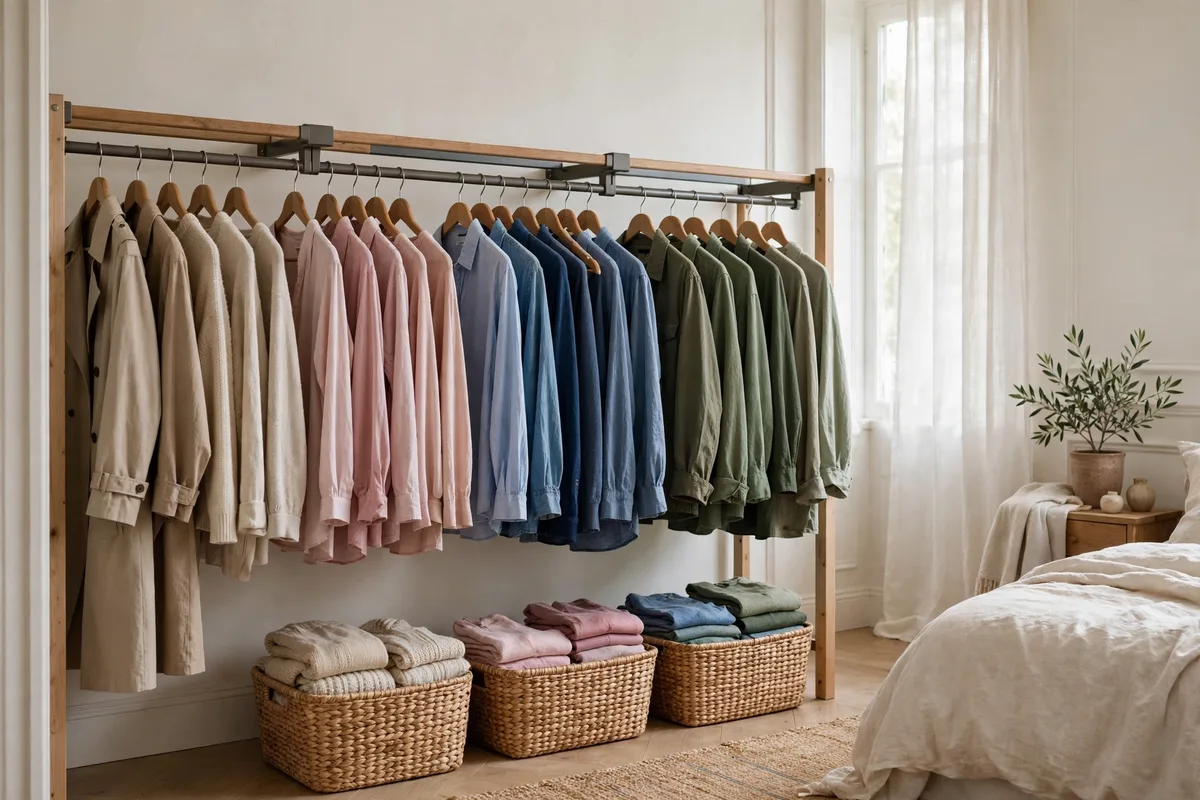
An open rail holds the current-season wardrobe you actually wear: shirts, dresses, jackets and the knitwear in weekly rotation, with baskets or a low drawer unit underneath for folded items and shoes. It replaces a wardrobe where there is no room for one, or relieves an overstuffed one.
The styling rule
Colour is the whole system. Hang everything in colour families — lights to darks, or grouped blocks of similar tones — on matching hangers, and the rail stops looking like storage and starts looking like a boutique display. Keep breathing room between garments; a rail at comfortable capacity looks styled, a crammed one looks like a stockroom. Baskets below should repeat one material so the base reads as a single plinth.
Best room size and watch-outs
Best in small and medium bedrooms, rentals, and dressing corners in larger rooms. The watch-outs are dust and discipline: open clothes gather dust faster, so this suits clothes in active rotation, not occasionwear stored for months. And the colour order needs a two-minute reset when laundry returns — the rule is a habit, not a purchase.
3. A Nightstand With Drawers and a Styled Top

What it holds
The nightstand is the highest-traffic storage in the room: chargers and cables, the current book, glasses, hand cream, medication, and everything else the evening routine generates. Drawers hold all of it; the top should hold almost none of it.
The styling rule
Divide the nightstand into a closed zone and a display zone, and never let them trade places. Inside the drawers, small dividers stop the jumble. On top, follow the three-item rule: a lamp, one functional piece (a tray or dish for glasses and jewellery), and one beautiful thing — a plant, a candle, a framed photo. Three items look styled; seven look like a landing strip. Matching the pair, or at least their lamps, doubles the effect.
Best room size and watch-outs
Every room size; in very small rooms a wall-mounted drawer unit gives the same closed storage with no floor footprint. Watch cable creep — route chargers into the drawer with a cable hole or a charging tray so cords never drape across the styled top. The other failure is scale: a nightstand much lower or higher than the mattress top always looks accidental. That nightstand at full styling depth — twelve styled tops and its own formula table — is our bedside table styling guide.
4. Woven Baskets as Decor That Works
What it holds
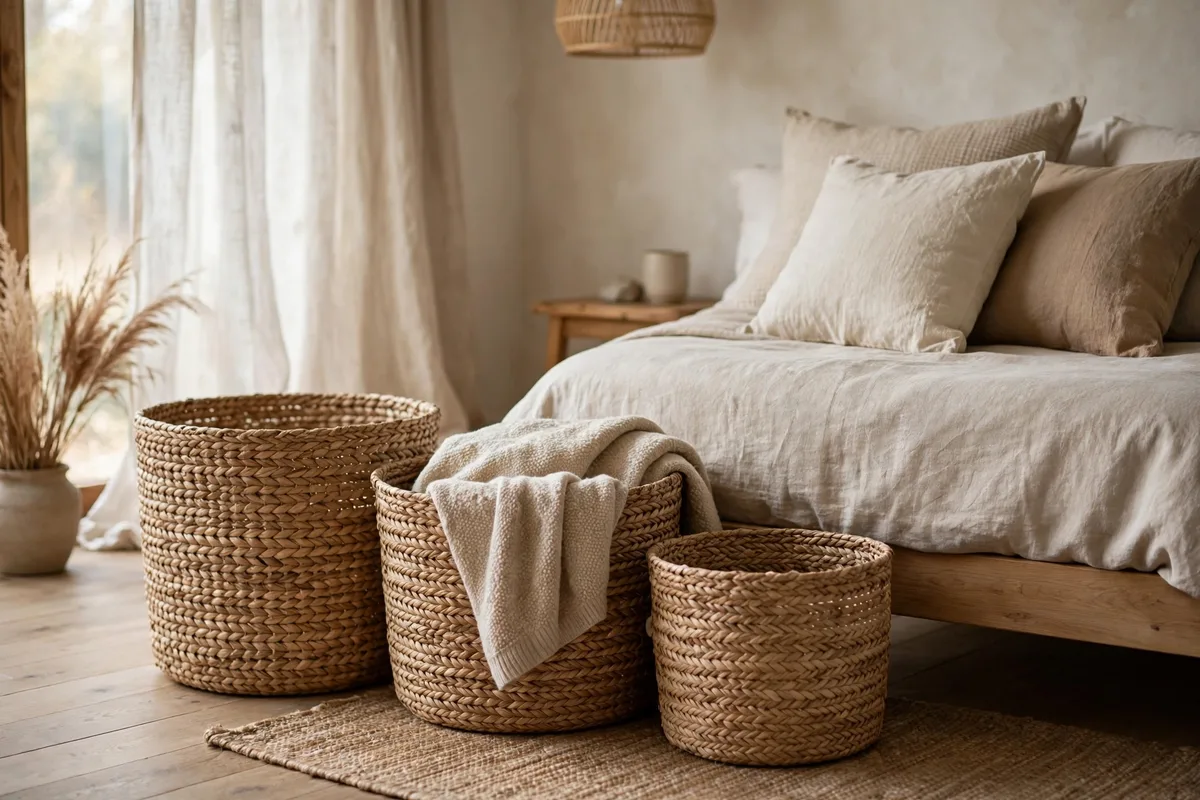
Baskets are the bedroom’s flexible storage: spare throws and blankets beside the bed, the reading pile, laundry in transit, spare cushions, and the miscellaneous category every room invents for itself. Lidded baskets take the visually noisy loads; open baskets take textiles, which look good even when full.
The styling rule
Baskets style a room through texture and repetition. Keep to one weave family — seagrass, rattan, water hyacinth, woven cotton — and vary the sizes instead of the materials, so a group reads as a set rather than a collection of accidents. Place them where their contents are used, never scattered one per wall. Odd numbers group best, and a basket should look comfortably full or properly empty, never overflowing.
Best room size and watch-outs
All sizes, and the fastest styling win in a rental because nothing is fixed. Watch quality: thin, collapsing baskets sag into untidiness within months, so choose structured weaves with firm rims. Unlined baskets can snag delicate knitwear — line them or reserve them for sturdier textiles. And resist the basket-per-problem habit; five baskets in one room is a storage system, ten is a basket shop.
5. Vertical Shelving Styled in Thirds
What it holds
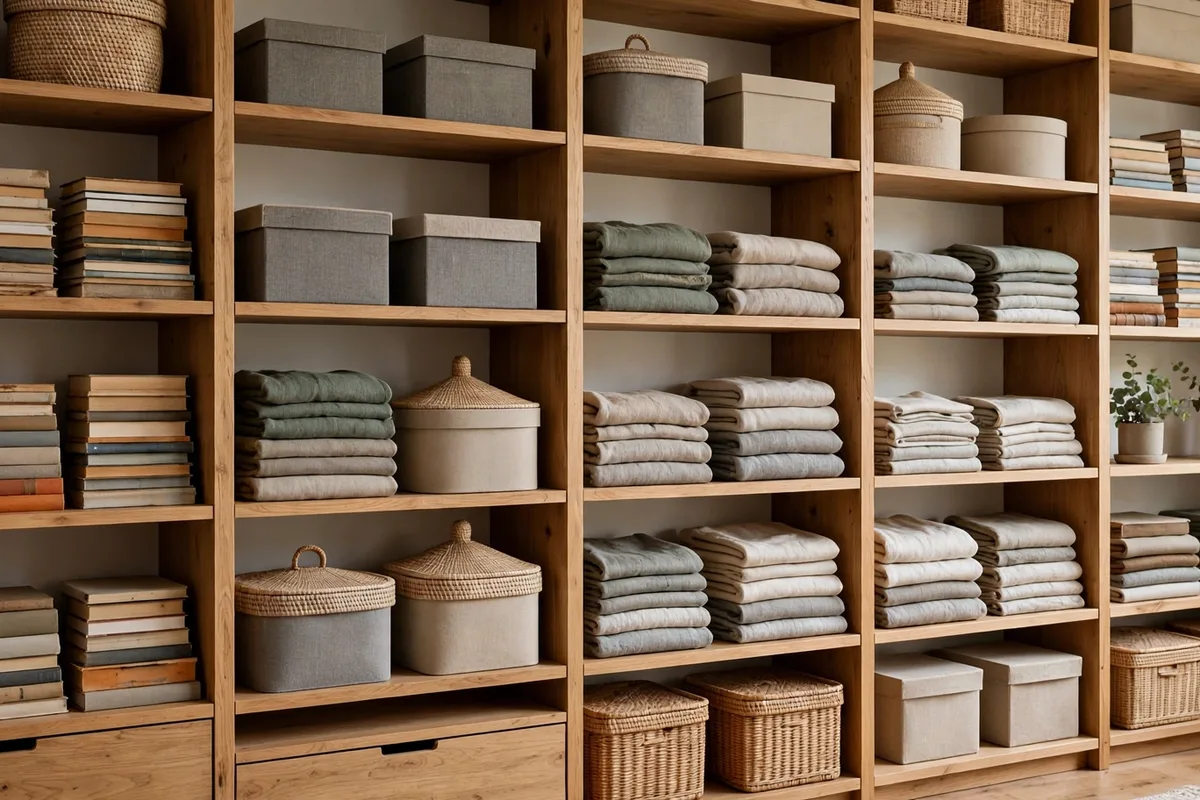
Wall shelving above a dresser, beside the bed or over a desk holds the bedroom’s mid-frequency things: books, folded knitwear in open stacks, storage boxes for accessories, and the display pieces — plants, ceramics, framed prints — that make the room personal.
The styling rule
Divide every shelf run into thirds: one third closed storage (lidded boxes or baskets), one third stacked storage (books horizontal, folded textiles), and one third display with empty space around it. The empty third is what stops the shelves reading as warehousing. Repeat the same box across the run and leave the ends of each shelf clear so the arrangement has edges.
Best room size and watch-outs
Essential in small bedrooms, where the wall is the only unclaimed territory, and equally good as a dressing-zone feature in large ones. Watch weight and anchoring: shelves holding books and boxes must be fixed into studs or proper wall anchors. The styling failure is the full-length row of identical upright books plus clutter in the gaps — break the rhythm with the thirds rule and it resolves.
6. Ottoman and Bench Storage at the Foot of the Bed
What it holds
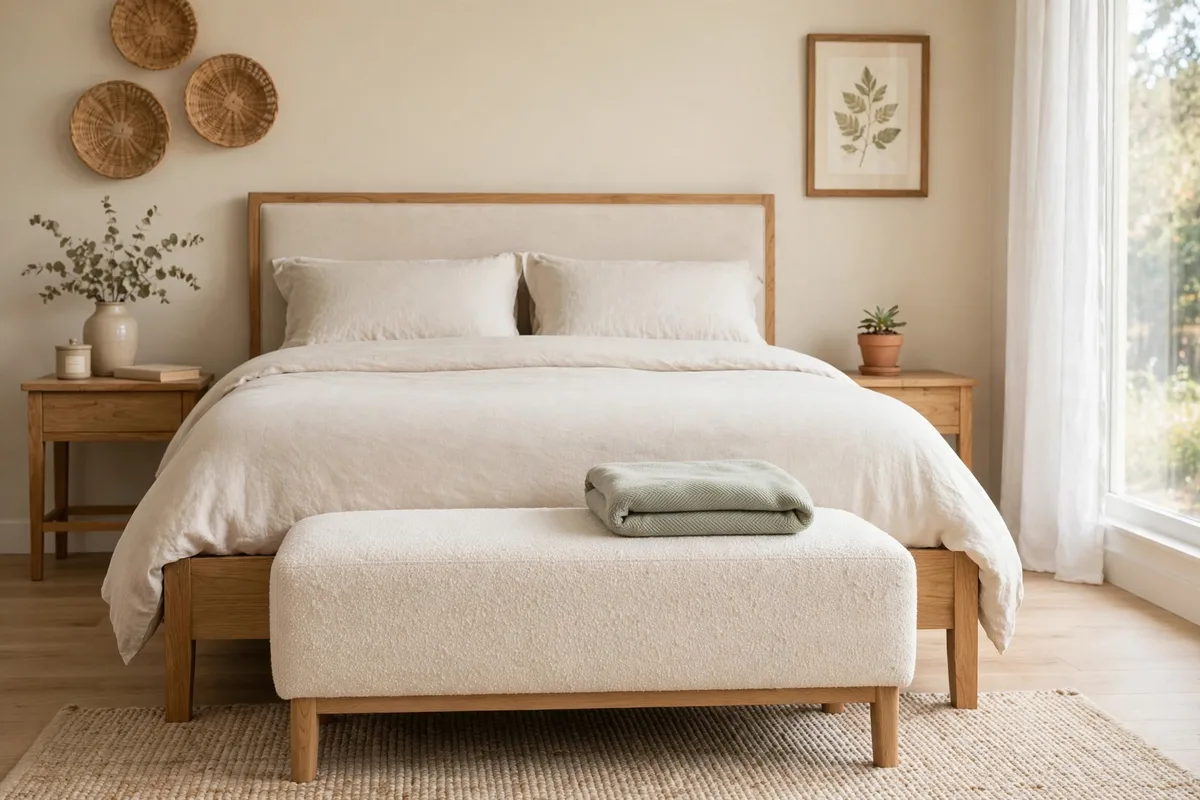
A storage bench or ottoman at the foot of the bed holds the bedding overflow — spare throws, the extra pillow set, winter blankets — plus the clothes-in-limbo that otherwise colonise a chair: tomorrow’s outfit, the cardigan worn for an hour. It is also the room’s most useful seat, for shoes, socks and morning dressing.
The styling rule
The bench is a visual bridge between the bed and the room, so its upholstery should echo one bedding colour or texture rather than matching the bed exactly. Keep the top clear or hold it to a single folded throw placed off-centre; the moment the top becomes a shelf, the styling is gone. Choose a width a little narrower than the bed and a height a little lower than the mattress.
Best room size and watch-outs
Best in medium and large bedrooms with clear floor at the foot of the bed; in a small room, only if the walkway past it stays comfortable — measure before you fall in love. Watch lid mechanics: a hinged top that cannot open fully because it hits the bed is a daily irritation, and soft-close or lift-off lids matter if the bench will be opened every day.
7. Vanity and Desk Storage That Doubles as Display
What it holds
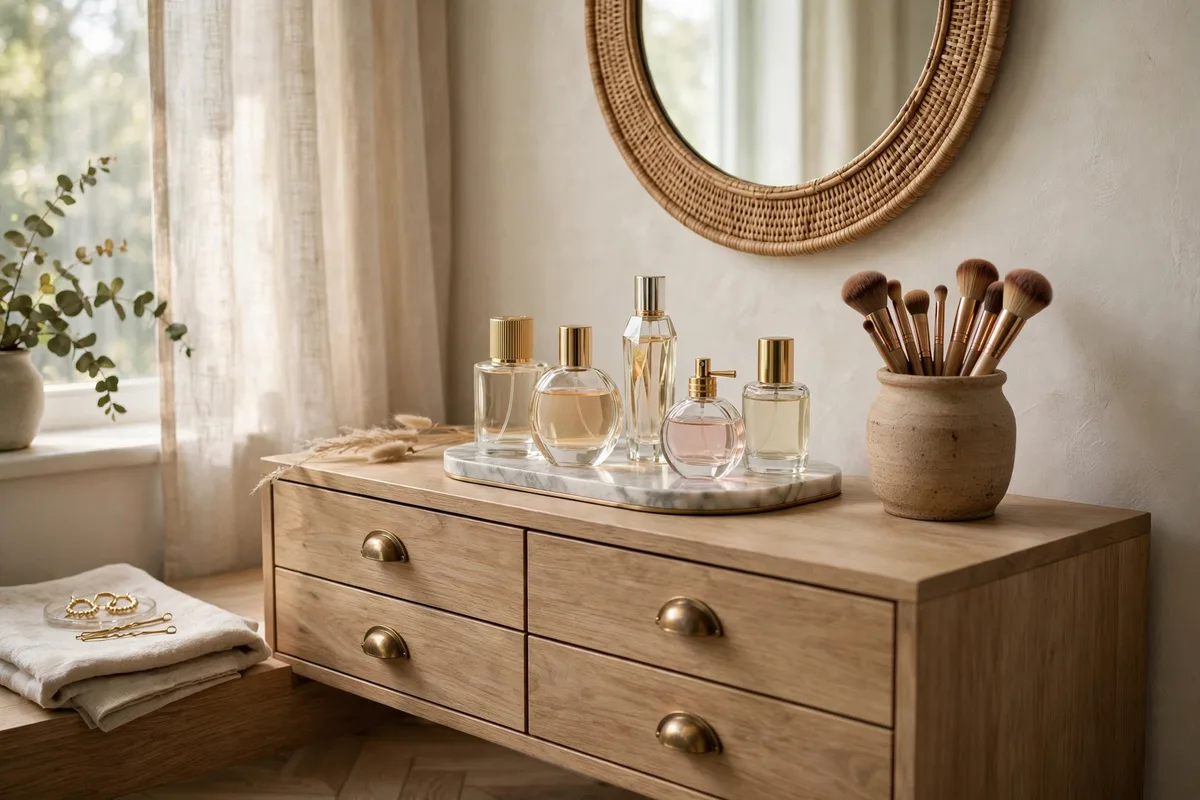
The vanity or desk zone holds the small, many-piece categories: makeup and skincare, brushes, jewellery, hair tools, or — in the work-from-bedroom version — notebooks, chargers and stationery. These are the items most likely to spread, because each one is small and used daily.
The styling rule
Closed storage below, display above, with a tray as the border between them. Drawers with dividers hold the working collection; the surface holds only what is beautiful enough to show — perfume bottles, a jewellery stand, brushes in a ceramic pot — gathered on a single tray. Anything that does not earn display status graduates down into a drawer. A mirror above anchors the zone.
Best room size and watch-outs
Suits any room with a spare metre of wall; in small bedrooms a slim console with two drawers does the whole job. Watch lighting: a vanity styled beautifully but lit by one ceiling light still fails at its actual task, so plan a lamp or sconce into the zone. And watch product creep — the tray rule only works if the tray has a fixed size and full means full.
8. Behind-Door and Corner Storage, Finished Properly
What it holds
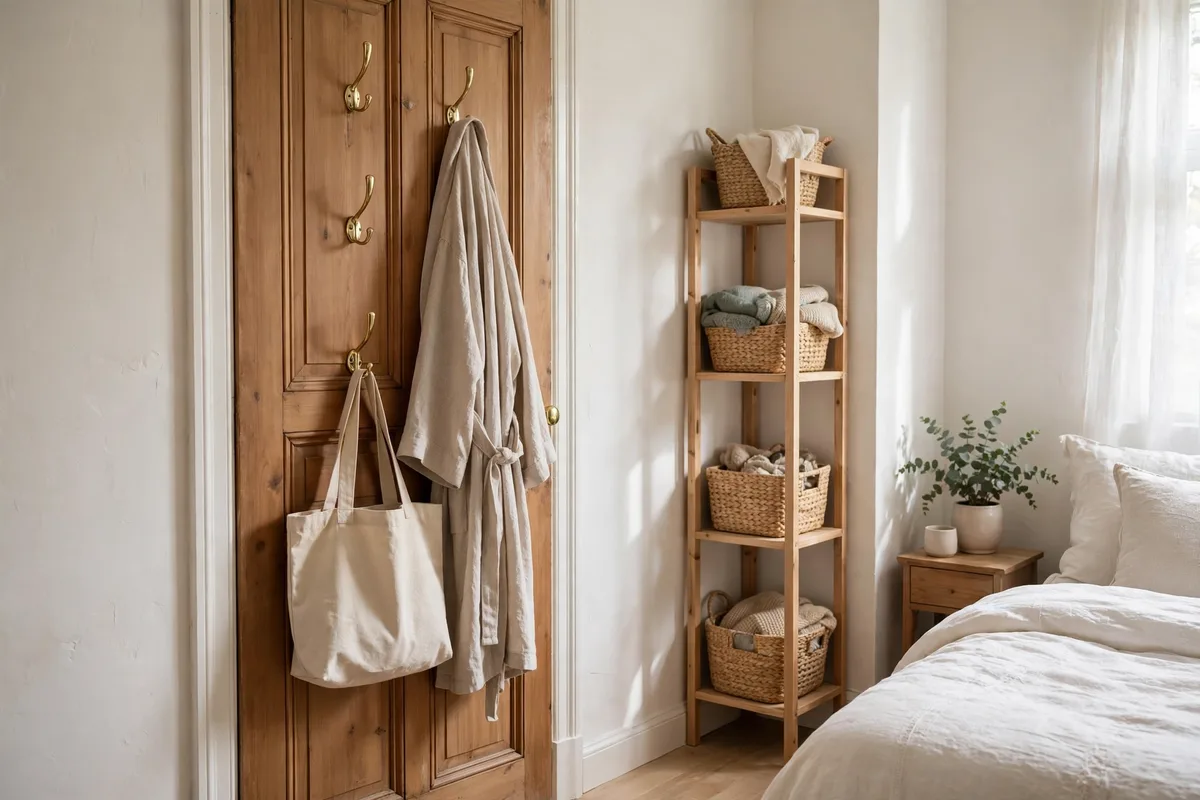
The door back and the room’s corners hold the awkward categories: robes and tomorrow’s outfit on hooks, bags and hats, the laundry basket in the dead corner, spare hangers, and accessories on a slim corner shelf. These are the zones that keep the main furniture free of draped and leaning things.
The styling rule
Finish is everything here, because this storage is improvised by nature. Choose hooks in one deliberate finish — brushed brass, matte black, warm wood — and repeat it wherever hardware shows, so the door rack reads as part of the design. Over-door organisers in fabric tones that match the room beat clear plastic, which advertises its contents. In corners, a ladder shelf or stacked corner shelves in the room’s wood tone turns a dead angle into a deliberate vignette.
Best room size and watch-outs
Most valuable in small bedrooms and rentals, where these are found metres. Watch door clearance and swing: an over-door rack that stops the door closing properly will annoy you daily, and heavy loads on a hollow door strain its hinges. Corner watch-out: a corner used for storage must still be one zone with one job — the corner that holds the laundry basket, a plant and three bags is a mess with good PR.
9. Seasonal Rotation Storage That Stays Invisible
What it holds
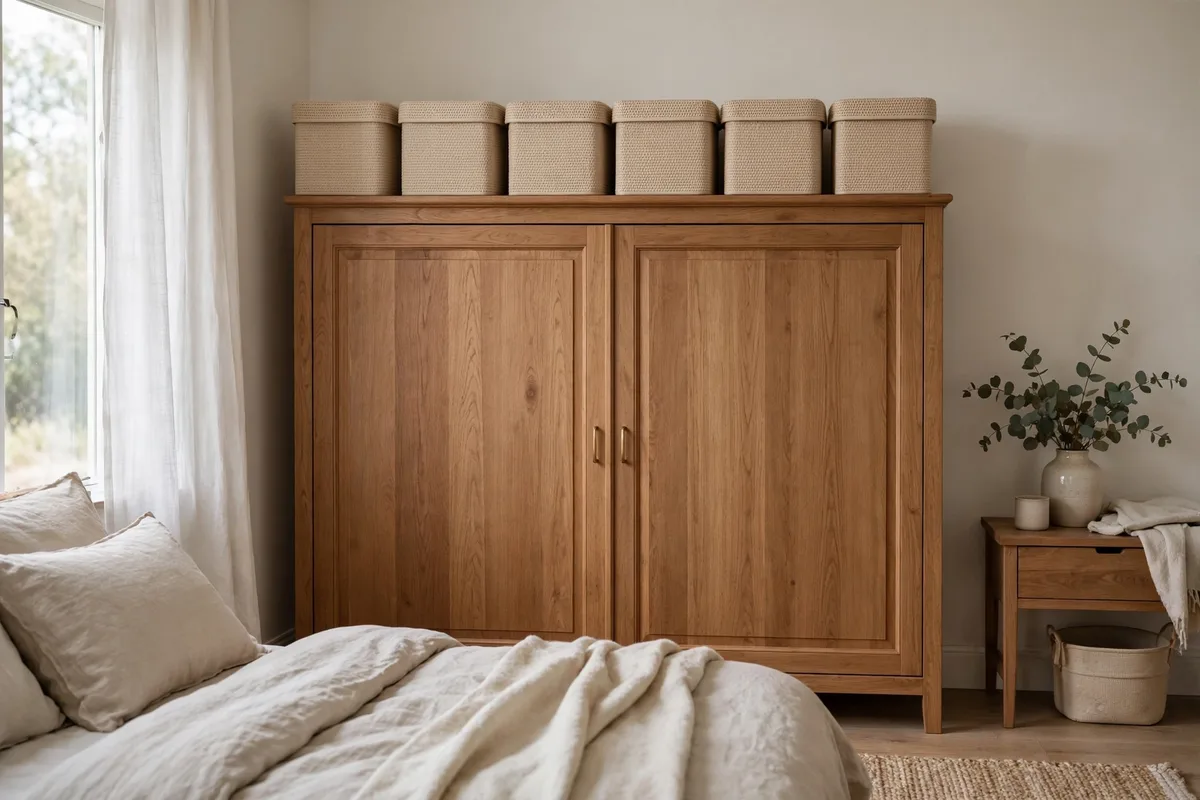
Every bedroom owns a twice-a-year category: winter duvets and heavy throws, summer linens, off-season clothing, holiday items and keepsakes. Rotation storage holds all of it — on the wardrobe top, in the highest shelves, in the deepest under-bed boxes — so the everyday zones only ever hold the current season.
The styling rule
Invisible is the style. Identical lidded boxes, labelled on the short end that faces out, in a colour that disappears against the wall or wardrobe — a row so uniform the eye slides off it. Vacuum bags belong inside boxes, never loose, because a lumpy bag reads as clutter at any height. Keep a contents list taped inside one lid; a system you cannot inventory becomes one you rebuy instead of reuse.
Best room size and watch-outs
All room sizes; the smaller the room, the more the everyday zones depend on it. Watch the twice-a-year discipline: rotation only works if it actually rotates, so tie it to fixed moments — the first warm weekend, the first cold one. And store textiles clean and fully dry, because a sealed box preserves whatever state its contents went in.
10. The Small-Bedroom Storage Wall: Every Zone on One Wall
What it holds
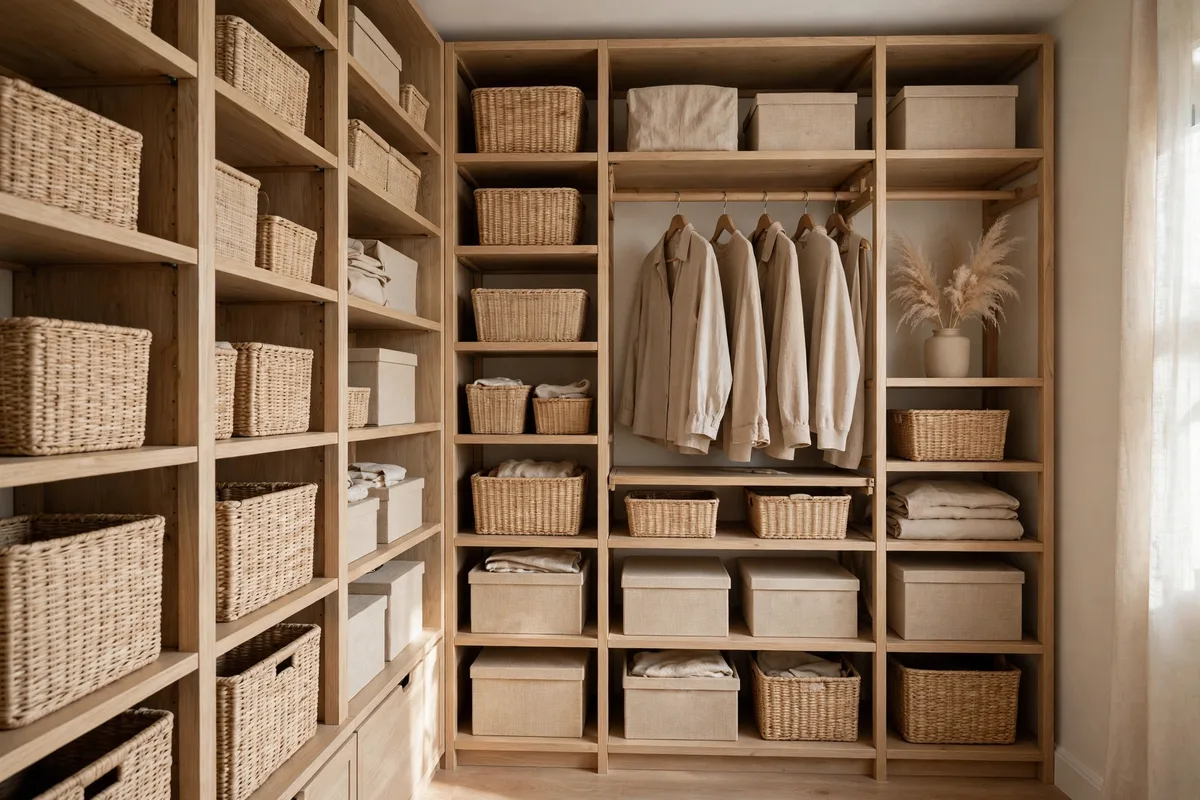
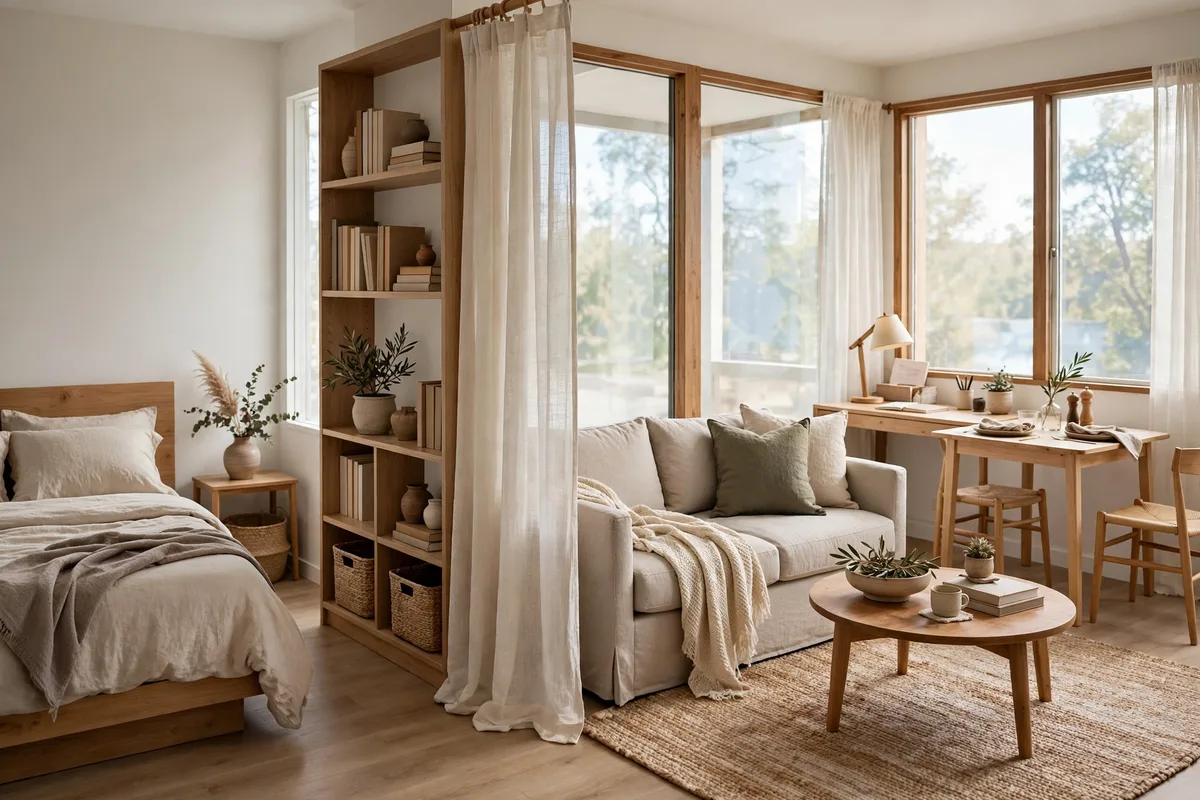
The storage wall is the synthesis: one wall — the one the bed faces or flanks — built in layers to do every storage job in the room. Boxes and drawers run along its base, shelving styled in thirds fills the middle, a rail or baskets take the remaining width, and seasonal boxes close the top. Everything from the previous nine sections finds its place here, in one visual language.
The storage-by-zone table
Use this table as the blueprint, for the wall and the room as a whole. Each zone gets one main job, one piece, and one styling rule — the discipline that keeps the system looking designed rather than accumulated.
| Zone | Storage piece | What it holds | Styling rule |
|---|---|---|---|
| Under the bed | Matching lidded boxes or drawers | Off-season clothes, spare bedding | One box style, one colour, nothing peeking out |
| Wardrobe wall | Open rail with baskets below | Current-season clothes, shoes | Hang by colour family; baskets hide the small things |
| Bedside | Nightstand with drawers | Chargers, books, glasses, night essentials | Drawer for the mess, three items maximum on top |
| Foot of the bed | Storage bench or ottoman | Throws, extra pillows, morning clothes | Upholstery echoes the bedding palette |
| Walls | Vertical shelving | Books, folded knits, display pieces | Style in thirds: stored, stacked, shown |
| Corners and floor edges | Woven baskets | Blankets, laundry, reading pile | Same weave family, varied sizes |
| Vanity or desk | Drawer unit with trays and jars | Makeup, jewellery, work supplies | Closed storage below, display only on top |
| Door and corners | Over-door rack, corner shelves | Robes, bags, accessories | One finish for hooks; one job per corner |
| High and deep storage | Lidded seasonal boxes | Winter duvets, holiday items, keepsakes | Labelled, identical boxes, rotated twice a year |
The styling rule and watch-outs
One palette is the rule that makes a wall of storage read as furniture rather than warehousing: the same box colour from base to top, one basket weave, one hardware finish, and the thirds rule on every open shelf. Build it in the order you can afford — base boxes and shelving first, rail and baskets later. It suits small bedrooms best, and rented ones only in freestanding form (tall bookcases, leaning shelves). The watch-out is overreach: a storage wall that also tries to be a gallery, desk and dressing table collapses back into clutter — let storage be its one job, done completely. That wall as a floor-plan layout — where it goes, not only how it looks — is in our small bedroom layout guide.
Frequently Asked Questions About Bedroom Storage
How do I make open storage look tidy instead of messy?
Give it one rule and keep the rule visible: colour order on a rail, identical boxes on a shelf, one weave family for baskets. Open storage looks messy when it follows several systems at once, or none. Editing matters too — a shelf or rail at comfortable capacity reads styled, while the same one crammed reads chaotic, however neatly arranged.
What should I store under the bed, and what should I avoid?
Store the archive: off-season clothes, spare bedding, extra pillows and rarely worn shoes, each category in its own matching lidded box. Avoid anything you need weekly, anything that should breathe and be seen to be remembered, and loose items without a box — unboxed under-bed storage migrates, gathers dust and becomes the room’s forgotten layer.
How many storage colours should a bedroom use?
Fewer than instinct suggests. One material or colour for boxes, one weave family for baskets, and hardware in a single finish is enough for the whole room. Storage pieces are background; they should repeat the room’s existing palette — bedding tones, wood tones, wall colour — rather than introduce new colours of their own.
What is the best storage for a very small bedroom?
Start where the floor is already spent: under-bed boxes, a drawer nightstand and one vertical shelf run styled in thirds usually outperform any new freestanding furniture. Then add the found zones — the door back and one corner. If the room can give up one wall, the storage wall in Section 10 combines all of these into a single run and frees the rest of the floor completely.
How do I style shelves so they do not look like a stockroom?
Use the thirds rule: one third closed boxes, one third stacked items like books and folded textiles, one third display with genuine empty space around it. Repeat the same box, keep colours inside the room’s palette, and clear the ends of each shelf. Stockrooms fill every inch evenly; styled shelves deliberately do not.
Are matching storage boxes really worth it?
Yes, and they are usually the cheapest styling upgrade in the room. Identical boxes turn storage into a repeated pattern, which the eye reads as design; mismatched boxes read as accumulation, even when the contents are equally organised. If a full set is too much at once, start with the most visible run — the under-bed row or the wardrobe top.
How do I keep a nightstand top from becoming a clutter magnet?
Cap it at three items — lamp, one tray or dish, one beautiful thing — and make the drawers do the rest with small dividers inside. Route charging into the drawer so cables never cross the top. Clutter magnets form where there is no rule; a visible limit, kept for a week, quickly becomes a habit.
What storage works best in a rented bedroom?
Everything freestanding or door-hung: matching under-bed boxes, baskets, a storage bench, a colour-ordered open rail, and over-door hooks that need no drilling. Ladder shelves lean rather than fix, and even the storage wall works in freestanding form with tall bookcases. Save fixed shelving and built-in units for a home you own.
How do I stop baskets and open shelves gathering dust?
Accept a light rhythm rather than a deep-clean event: lidded baskets and boxes for anything stored longer than a month, open baskets reserved for textiles in active use, and shelves dusted when you rotate or restyle them — which the thirds system makes quick.
Where should seasonal items live if I have no wardrobe top or attic?
The deepest under-bed boxes and the highest shelf are the usual answer, in identical labelled boxes so the row stays invisible. If those are full too, the honest next step is editing rather than more storage.
Conclusion
Styled bedroom storage is not a shopping list; it is a small set of decisions repeated until the room looks inevitable. Zones give every category a territory, matching boxes and one weave family turn visible storage into pattern, and a styling rule per piece — colour order on the rail, thirds on the shelves, three items on the nightstand — keeps the system honest between tidy-ups. Start with the most visible run in your room, fix that first, and let each idea earn its place by holding something real.
Finish with the test that matters: from the doorway, the room should read as a bedroom first and a storage system second — calm surfaces, repeated materials, nothing visible that does not look chosen. Storage that passes that test has stopped being hidden, and started being styled.



Pingback: Small Bedroom Layout Ideas Guide — 12 Layouts That Work