Disclosure: As an Amazon Associate I earn from qualifying purchases. This article contains affiliate links. If you purchase through these links, we may earn a commission at no additional cost to you.
The best mandoline slicer for vegetables with safety guard does one job better than any knife in most home kitchens: it turns cucumbers, potatoes, onions, and zucchini into slices of exactly the same thickness, in a fraction of the time. Even thickness is not a vanity detail — it is why gratins cook evenly, why pickles cure at the same rate, and why a cucumber salad looks like a deli made it. The safety guard, a food holder with prongs that keeps fingers away from the blade, is what makes that speed safe enough for everyday use.
This guide compares the mandoline honestly against the box slicer’s slicing side and against plain knife skills, then walks through the listing checks that matter: blade style (straight, V-blade, or Japanese-style), thickness adjustment range, guard design, non-slip stability, and how the parts wash. If you meal-prep salads, scalloped potatoes, onion toppings, or homemade chips, this is the comparison to read before you choose.
Quick Verdict
Choose a mandoline with a sharp, replaceable or well-protected blade, thickness settings from paper-thin (about 1 mm) to roughly 6–9 mm, a wide food holder that grips small and large produce, and a body that folds flat or stands stably on non-slip feet. The guard is not an accessory to leave in the box; the right model makes using it feel natural, because the holder’s handle and prongs are shaped for real pushing, not just for the product photo.
Skip the mandoline if you slice one tomato a week — a sharp chef’s knife wins on setup and washing. Skip it, too, if you will not use the guard: this tool’s whole reputation problem comes from bare fingers meeting a very efficient blade. Used with the holder, and with the blade guard replaced before storage, it is faster and more consistent than either a box slicer or freehand knife work for any batch bigger than a single vegetable.
Important: Always use the food holder guard, and stop slicing when the produce gets short. The last inch belongs to a knife or the compost, not to your fingertips. Many experienced cooks also wear a cut-resistant glove on the pushing hand for extra margin.
What to Look For Before You Buy
The safety guard itself
Look for a holder with metal or sturdy plastic prongs that pierce and grip the food, a wide palm rest, and a plunger or sliding design that keeps your hand moving parallel to the deck — never angled toward the blade. The holder should grip a halved onion or a short carrot stub securely. If the guard in listing photos looks like a small round cap, it will frustrate you with anything bigger than a radish, and frustration is what makes people put the guard back in the drawer.
Blade style and sharpness
Straight blades are simple and sharpen or replace easily. V-shaped blades start cuts with less pushing force — helpful for firm potatoes and sweet potatoes — because the edge meets the food at an angle. Japanese-style blades are prized for very clean cuts on soft produce like tomatoes. What matters most is that the blade is stainless steel, arrives genuinely sharp, and either can be replaced or is protected by a storage cover so it does not dull rattling in a drawer.
Thickness adjustment
An adjustable thickness slicer earns its keep across recipes: about 1–1.5 mm for chips and garlic, 2–3 mm for cucumber salad and pickles, 4–6 mm for gratins and roasted vegetable trays. Prefer a dial or lever with marked settings over “slide and guess” plates. Marked settings let you return to the exact cut that worked last time, which is the whole point of the tool.
Extra blades: julienne and waffle
Many models add a julienne blade for matchsticks and a wavy blade for crinkle cuts. These are genuinely useful for slaws, carrot sticks, and waffle fries, but only if the inserts lock in firmly and store in a case; loose blades in a utensil drawer are a cut waiting to happen. If you will never julienne, a simpler slicer with a better guard beats a ten-piece set with a mediocre one.
Stability and cleaning
Non-slip feet or a fold-out stand should hold the deck steady over a bowl or board, and the runway should be wide enough for a halved cabbage or a big onion. Most mandolines are technically dishwasher safe, but hand washing protects the blade edge — and any dishwasher claim should specify top rack. A cleaning brush included in the box is a small, telling sign the maker thought about ownership.
Mandoline vs Box Slicer vs Knife: Which Suits Your Kitchen?
| Method | Slice Consistency | Speed for a Batch | Safety Picture | Best Job |
|---|---|---|---|---|
| Mandoline with guard | Excellent — set thickness, repeat | Fastest for 3+ vegetables | Good with guard, poor without | Gratins, salads, chips, pickles |
| Box grater / box slicer side | Fair — pressure changes thickness | Slow, awkward angle | Moderate; knuckles near the plane | The odd cucumber when nothing else is clean |
| Chef’s knife skills | Depends entirely on the cook | Fine for one item, slow for ten | Good with trained grip and sharp blade | Single vegetables, irregular cuts, trimming |
The mandoline’s case
Consistency and repeatability. When a recipe says “slice 1/8 inch,” the mandoline simply does it, fifty times in a row, while the cook’s attention stays on seasoning and timing. Meal-prep households feel this most: a week of cucumber salad slicer work, onion for sandwiches, and zucchini for a bake takes minutes, and every piece cooks or cures at the same speed because every piece is the same thickness.
The box slicer’s case
The slicing side of a box grater costs nothing extra and lives in almost every kitchen already. For one cucumber, it is honestly fine. Its limits show up fast, though: no thickness adjustment, a narrow plane that forces small pieces, downward pressure that varies every stroke, and no real guard beyond your own grip. It is a backup singer, not the lead.
The knife’s case
Mandoline vs knife skills is the fairest fight. A sharp 8-inch chef’s knife in practiced hands is flexible, needs no assembly, and washes in seconds — and it handles the odd shapes, ends, and trimming jobs no slicer can. What it cannot do, outside of professional hands, is hold 2 mm across three pounds of potatoes. The mature setup is both: knife for singles and ends, mandoline for batches. That pairing starts with sharp steel, which is why our guide to the best knife sharpener for dull kitchen knives beginners can use sits naturally beside this one.
Pros and Cons
Pros
- Perfectly even slices that cook, pickle, and bake uniformly
- Far faster than knife work for batches and meal prep
- Repeatable thickness settings for chips, salads, and gratins
- Julienne and crinkle inserts widen the recipe range
- Flat or folding storage takes little drawer or cabinet space
Cons
- Demands the guard every time — no exceptions for “just one quick slice”
- More washing and careful drying than a knife and board
- End pieces and very soft, ripe produce are still knife work
- Cheap blades dull quickly and cannot always be replaced
Who Should Buy It — and Who Should Skip It
Buy a guarded mandoline if you regularly make scalloped potatoes, French onion soup toppings, pickles, big salads, homemade chips, or vegetable bakes — anywhere evenness changes the result. It also suits cooks whose knife skills are still developing but whose standards are not: the tool supplies the consistency while your technique catches up. Pair it with the prep speed of the best vegetable chopper for onions without crying fast and most weeknight vegetable work is covered between the two tools.
Skip it if your slicing is genuinely occasional, if your kitchen storage is already overflowing (check the crock-and-drawer situation in our best large kitchen utensil holder countertop crock ceramic guide first), or if you know the guard will stay in the box. An unused-guard mandoline is worse than no mandoline. More kitchen tool guides are collected on the Ideas Home Accessories homepage.
Helpful Tips for Daily Use
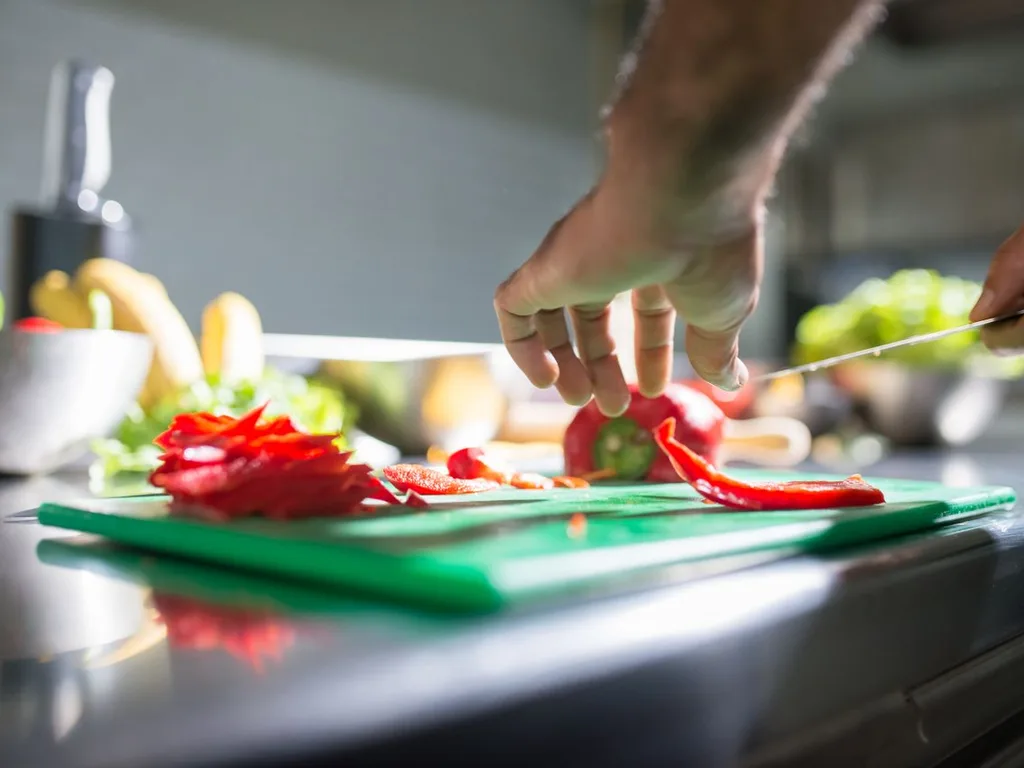
Create a flat side first. Halve round produce — onions, potatoes, lemons — and set the cut side down into the holder’s prongs. A flat base stops rolling, and rolling is the moment guards get bypassed and cuts happen. Firm, cold vegetables also slice cleaner than room-temperature soft ones; ten minutes in the fridge helps tomatoes behave.
Let sharpness do the work. Use long, light strokes and let the blade’s edge slice rather than forcing produce through with pressure. If you find yourself pushing hard, the blade is dull, the item is too firm for the angle (switch to a V-blade technique of lighter, quicker passes), or the piece is too wide and should be halved.
Wash and store like it matters — it does. Rinse right after use so starch and onion do not dry onto the blade, wash by hand with a brush moving away from the edge, dry fully, and replace the blade cover before the tool goes in the drawer. Storing the guard clipped to the body keeps the whole system together, so the safe way is also the easy way next time.
Frequently Asked Questions
Is a mandoline slicer safe to use at home?
Yes, when the safety guard is used every time and slicing stops before the produce gets short. The food holder keeps fingers inches from the blade, a cut-resistant glove adds margin, and a stable, non-slip deck removes the wobble that causes most accidents. Nearly all mandoline injuries share one cause: slicing freehand without the holder for the last few pieces.
Mandoline or box slicer — which gives better slices?
A mandoline, clearly. It offers set, repeatable thickness from about 1 mm to 9 mm, a wide runway, and a guard; the slicing side of a box grater has a fixed, unmarked thickness, a narrow plane, and no guard, so slices vary with every stroke. The box slicer is an acceptable backup for a single cucumber, not a batch tool.
What thickness should I use for common vegetables?
Use about 1 to 1.5 mm for potato chips and garlic, 2 to 3 mm for cucumber salad, pickles, and onion toppings, and 4 to 6 mm for gratins, scalloped potatoes, and roasted vegetable trays. Thinner slices cook and cure faster and more evenly together, which is exactly why a marked thickness dial is worth having.
Can a mandoline slice tomatoes and other soft produce?
Yes, with a genuinely sharp blade and light, quick strokes — a dull blade crushes soft produce instead of slicing it. Chill tomatoes briefly to firm them, use the holder from the first cut, and choose a slightly thicker setting, around 3 to 4 mm. Very ripe, collapsing tomatoes are still better with a serrated knife.
How do I clean a mandoline without cutting myself?
Rinse immediately, then wash by hand with a brush, always wiping from the spine of the blade toward the edge — never along or against the edge with a sponge in your palm. Use tongs or the brush to clear stuck pieces. Dry fully and fit the blade cover before storage; most blades stay sharper longer with hand washing than in the dishwasher.
Do I still need good knife skills if I own a mandoline?
Yes. The knife handles ends, halves, trimming, and single items where setting up the mandoline is not worth it, and it finishes the last inch of anything the guard is holding. The mandoline replaces repetitive slicing, not the knife. Most well-run home kitchens end up using both several times a week.
Final Thought
The right mandoline is a guarded, adjustable, stable one — sharp V-blade or straight blade, honest thickness marks, a food holder you will genuinely use — and it will make your gratins, salads, and pickles visibly more even from the first session. Check the guard design and blade replacement options on the listing before anything else; those two details decide whether this becomes a daily tool or a drawer warning.
Disclosure: As an Amazon Associate I earn from qualifying purchases.