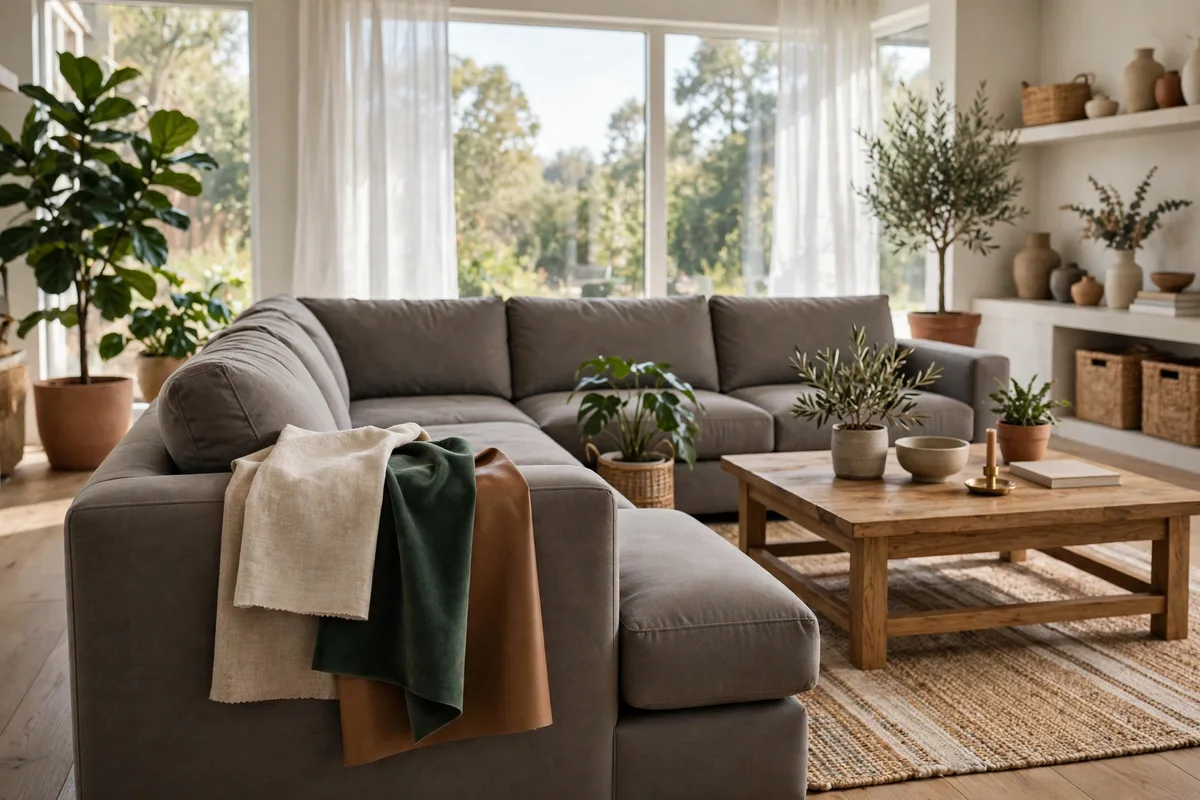
Two sectionals can look identical in a photograph and live completely different lives at home. The difference is rarely the shape. It is the material over the cushions: how it handles spilled coffee, a dog that insists on the corner seat, afternoon sun, and the daily slide of people sitting down and getting up. Choose well and a sectional stays welcoming for years; choose for colour alone and you can be fighting stains, snags, and fading within a season.
This guide compares the materials you will actually meet in stores: performance fabric, microfiber and polyester blends, linen, cotton and canvas, velvet, leather in its different grades, faux leather, and textured weaves such as boucle, chenille, and wool blends. For each one: how it feels, cleans, handles pets and children, behaves in sunlight, and what it tends to cost. Once you know your material, pair it with a layout that fits your room using our sectional sofa layout inspiration guide.
Sectional sofa materials by household — the shortlist: toddlers → performance fabric; dogs → performance fabric or top-grain leather; scratching cats → microfiber, boucle avoided; allergy → leather; a sunny room → solution-dyed; a humid climate → linen blends; calm adults → velvet, linen or boucle; a rental → faux leather or blends. Each material gets its five-axis verdict below; the final section turns this into the full match table.
In this guide: Start With How You Actually Live: Weave, Wear and Cleaning Codes · Performance Fabric: The Hard-Wearing Choice for Busy Homes · Microfiber and Polyester Blends: Soft, Practical and Easy on the Budget · Linen and Linen Blends: Cool, Breathable and Beautifully Relaxed · Cotton, Twill and Canvas: Familiar Comfort With Honest Trade-Offs · Velvet and Performance Velvet: Rich Colour and a Plush Feel · Leather: Full-Grain, Top-Grain and the Labels That Matter · Faux Leather and Vegan Alternatives: The Leather Look for Less · Boucle, Chenille and Wool Blends: Texture With a Few Warnings · Match the Material to Your Household and Keep It Looking Good · Frequently Asked Questions About Sectional Sofa Materials · Conclusion
1. Start With How You Actually Live: Weave, Wear and Cleaning Codes
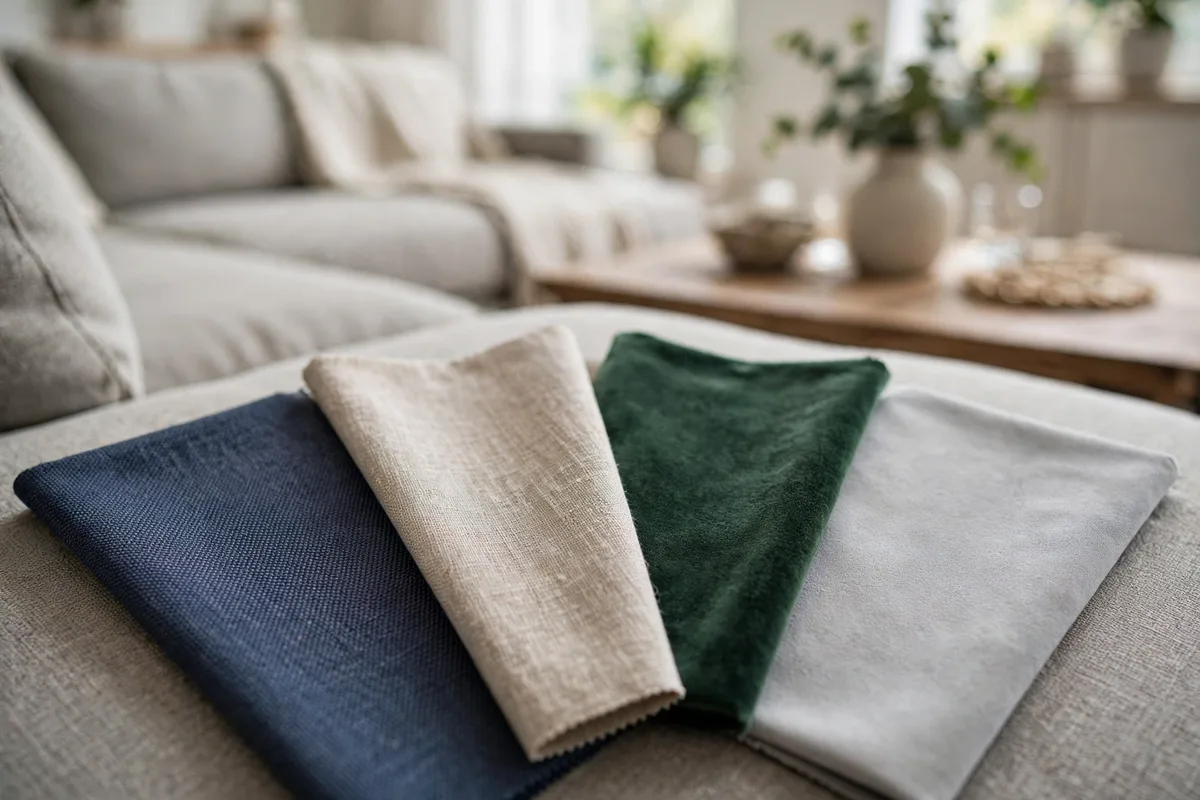
Before falling for any fabric, answer three honest questions. Who sits here daily, and what do they bring: snacks, paws, homework, or just a book? How much cleaning will you genuinely do each week? And how much direct sun lands where the sectional will live? Your answers narrow the field faster than any colour chart, because materials differ most in abrasion resistance, stain behaviour, and lightfastness.
Three checks that predict how a fabric ages
- Weave tightness: A tight, flat weave gives claws and zips little to catch on, and releases hair easily. Loose, loopy weaves look wonderful and trap almost everything.
- Wear rating: Many fabrics carry an abrasion rating, often described in rub counts. As general guidance, higher numbers suit heavier daily use; delicate low-rated fabrics belong on occasional seating. Ask the retailer rather than guessing from thickness.
- Cleaning code: Labels use simple codes for what cleaning the fabric tolerates. Learning them prevents the classic disaster of soaking a solvent-only fabric with water.
| Code | Meaning | What it means for you |
|---|---|---|
| W | Water-based cleaners only | The easiest home care: most spots respond to water-based upholstery shampoo |
| S | Solvent-based cleaners only | Dry-clean style solvents; water can leave rings or shrink the fabric |
| WS | Water or solvent | Flexible: either type of cleaner is acceptable |
| X | Vacuum only | No liquid cleaning at all; the most delicate option for a main sofa |
Test swatches like you mean it
Order large swatches and live with them for a few days. Drape one over your sofa arm: set a mug on it, let the dog step on it, vacuum it, and check it in morning and evening light. Scratch it, spill coffee on it and blot, and press dark denim against it for dye transfer. A swatch that survives your weekend will usually survive your sectional.
2. Performance Fabric: The Hard-Wearing Choice for Busy Homes
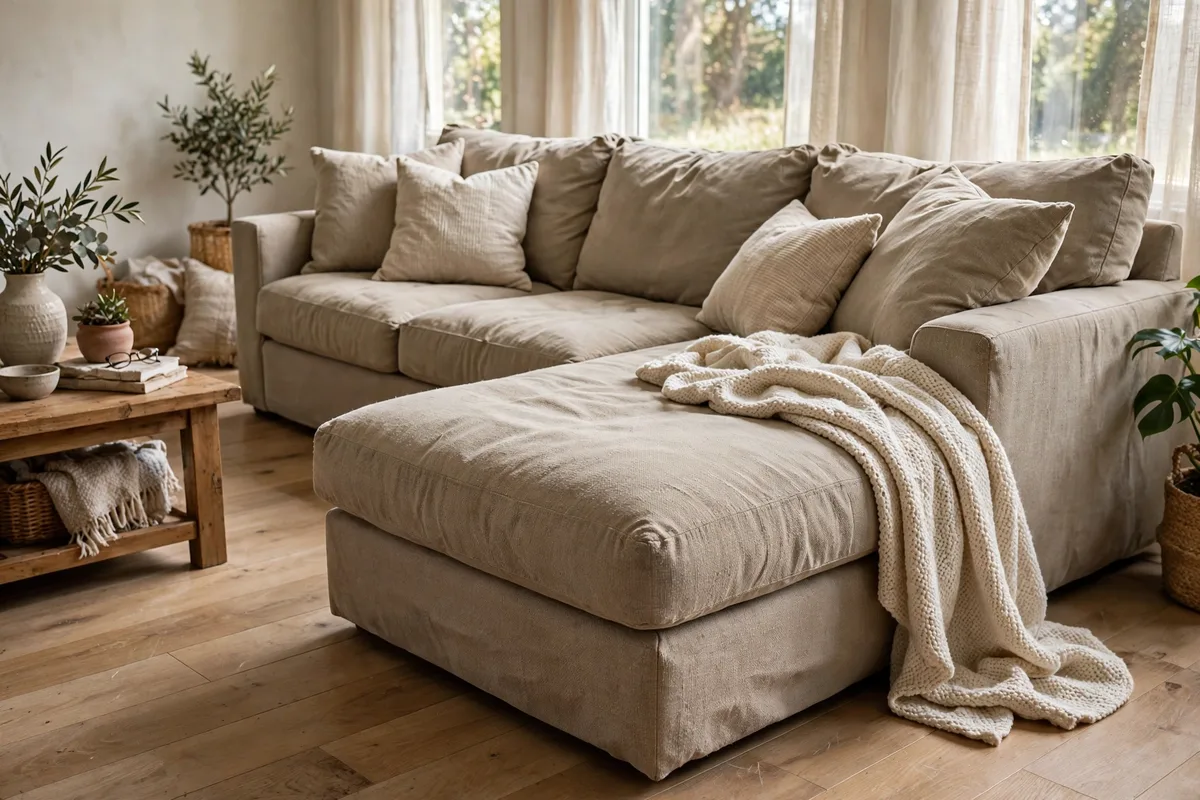
Performance fabric is not one fibre but a category of engineered upholstery, often polyester, olefin, or acrylic based, designed so spills sit on the surface longer, stains release more easily, and colours resist fading. Solution-dyed fibres carry colour through each strand, which is why they shrug off sun and scrubbing so well. For a sectional hosting movie nights, grandchildren, and a pet with strong opinions about the chaise, this is the default recommendation.
Living with performance fabric
- Durability: Usually excellent. Tight performance weaves resist pilling and sagging better than most natural fibres.
- Cleaning: The easiest of the fabric families. Most spills blot up; many covers spot clean with a water-based cleaner, and some lines offer removable washable covers.
- Pets and kids: The strongest all-round choice. Hair sits on the tight weave instead of embedding, and claws find little to snag.
- Sunlight: Solution-dyed versions are among the most fade-resistant upholsteries available.
- Cost feel: Mid-range to premium — more than basic polyester, repaid in years of lower-stress ownership.
The honest trade-off is feel. Some performance fabrics have a slightly synthetic hand and a flatter look than linen or velvet, although the best modern versions are convincingly soft. If your household is busy, start here and only move on if something else wins both your heart and your swatch test.
3. Microfiber and Polyester Blends: Soft, Practical and Easy on the Budget
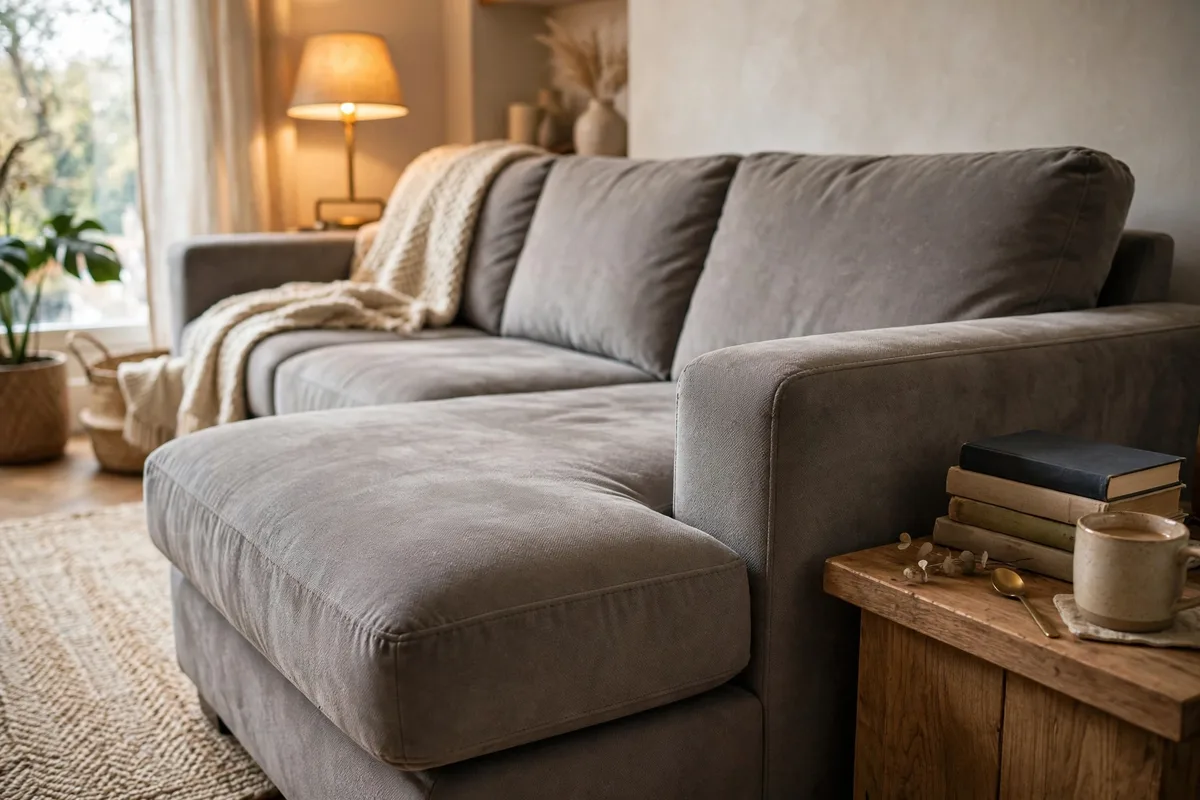
Microfiber is made from extremely fine synthetic fibres pressed into a dense, suede-like surface, and polyester blends pair polyester with other fibres to balance softness, strength, and price. Together they cover a huge share of family sectionals, and they have earned that place: the dense surface gives spills little room to soak in, the fabric feels warm in every season, and the price leaves budget room for a better frame and cushions.
Where microfiber and blends shine
- Durability: High for the price. The tight surface resists snags, although lower-quality blends can pill in high-friction spots such as the front edge of the chaise.
- Cleaning: Simple. Most marks respond to a vacuum, a lint roller, and prompt spot cleaning following the label code.
- Pets and kids: Very good. Hair does not embed deeply, and the smooth surface gives claws little purchase.
- Sunlight and colour: Polyester holds colour well and wrinkles little, so cushions keep a tidy look with minimal effort.
- Cost feel: Budget to mid-range, often the best value per year of use on this list.
Watch for two things. Microfiber can build static in dry winters, and its nap shades differently by angle, which some people read as marks. Blends vary enormously, so check the actual mix.
4. Linen and Linen Blends: Cool, Breathable and Beautifully Relaxed
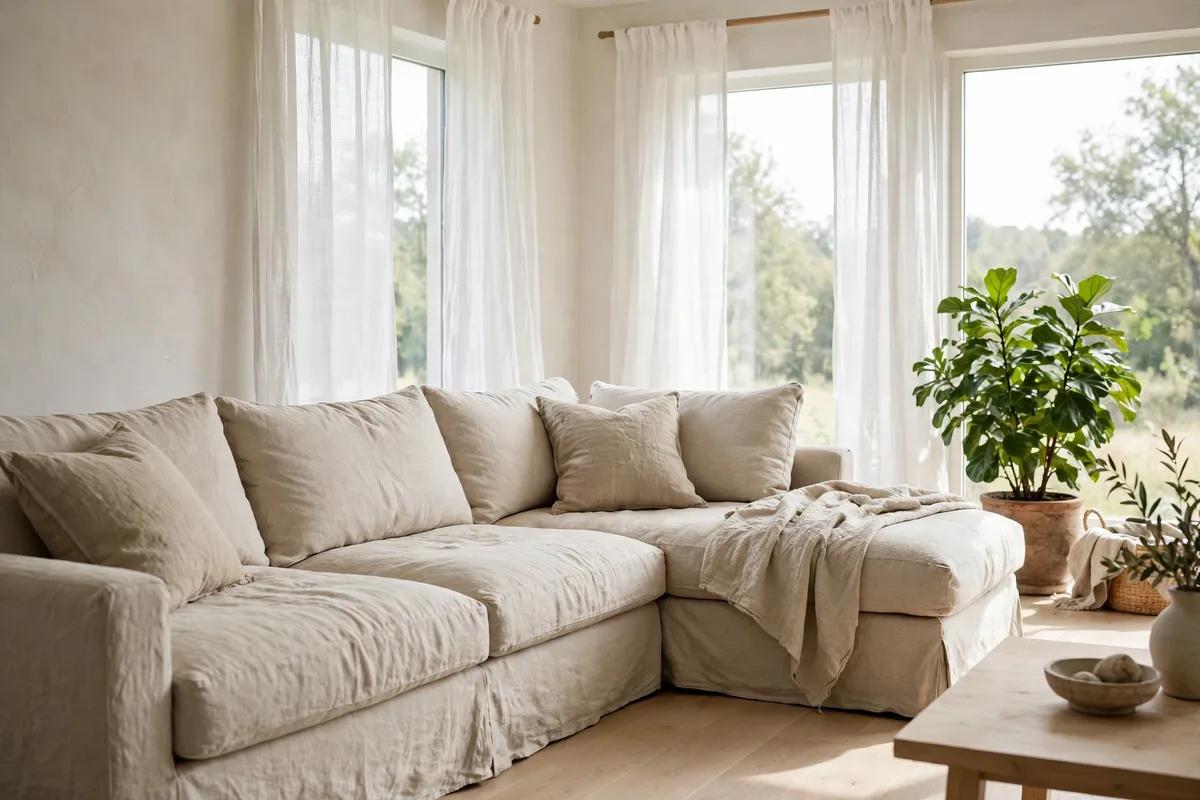
Linen is woven from flax, and its appeal is sensory: cool, breathable, and textured in a way no synthetic quite reproduces. A linen sectional instantly relaxes a room, pairing with light wood, woven rugs, and a coastal or Scandinavian mood. Pure linen is also the diva of this list: it wrinkles, absorbs spills quickly, and asks to be lived with gently. Linen blends add polyester or cotton, keep much of the look, and behave noticeably better.
The realistic linen briefing
- Durability: Moderate. The fibres are strong, but the weave is often looser and can show wear and creasing at cushion edges sooner than tight synthetics.
- Cleaning: The fussiest everyday fabric. Many linens carry a solvent-based code, and spills need fast blotting. Removable washable covers change the equation, so ask before you buy.
- Pets and kids: Best in calmer households; claws can catch the weave and sticky fingers show. A washable slipcover is the family-friendly exception.
- Sunlight and climate: Superb in hot rooms because it breathes. It can fade unevenly in harsh sun, so rotate cushions.
- Cost feel: Mid-range to premium, pure linens at the top.
Choose linen for mainly-adult rooms and long cool evenings, and only if you genuinely like the softly rumpled look.
5. Cotton, Twill and Canvas: Familiar Comfort With Honest Trade-Offs
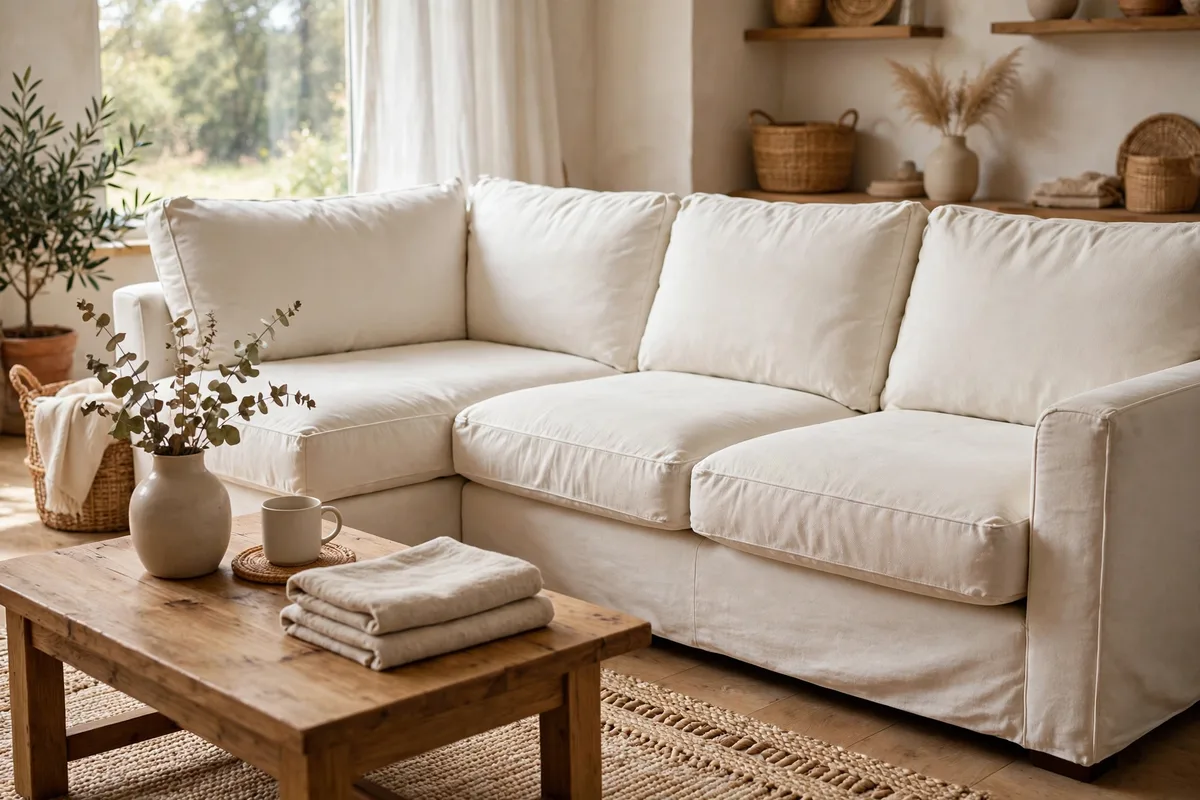
Cotton upholstery, especially in a sturdy twill or canvas weave, feels like a favourite shirt: soft, matte, breathable, and unpretentious. It takes dye beautifully, and a tight twill adds real toughness. Cotton duck and canvas are also the classic slipcover fabrics, which is their secret superpower: when the cover goes in the wash, cotton’s main weakness matters far less.
What to expect from cotton family fabrics
- Durability: Moderate to good in twill and canvas, lower in loose weaves. Cotton can fade and show wear over years of heavy use.
- Cleaning: Untreated cotton absorbs spills fast, so blot immediately and follow the code. Treated performance-cotton versions resist stains far better.
- Pets and kids: Workable with washable covers, risky without them; muddy paws on fixed pale cotton are a recurring chore.
- Sunlight and climate: Comfortable in every season and never sticky, a real advantage over leather in warm rooms. Colours can soften in strong sun.
- Cost feel: Budget to mid-range; washable slipcover sectionals repay their mid-range price in convenience.
The buying rule is simple: cotton makes the most sense when the covers come off. Fixed cotton with toddlers or a shedding dog means professional cleaning; a washable slipcover is far more relaxed.
6. Velvet and Performance Velvet: Rich Colour and a Plush Feel
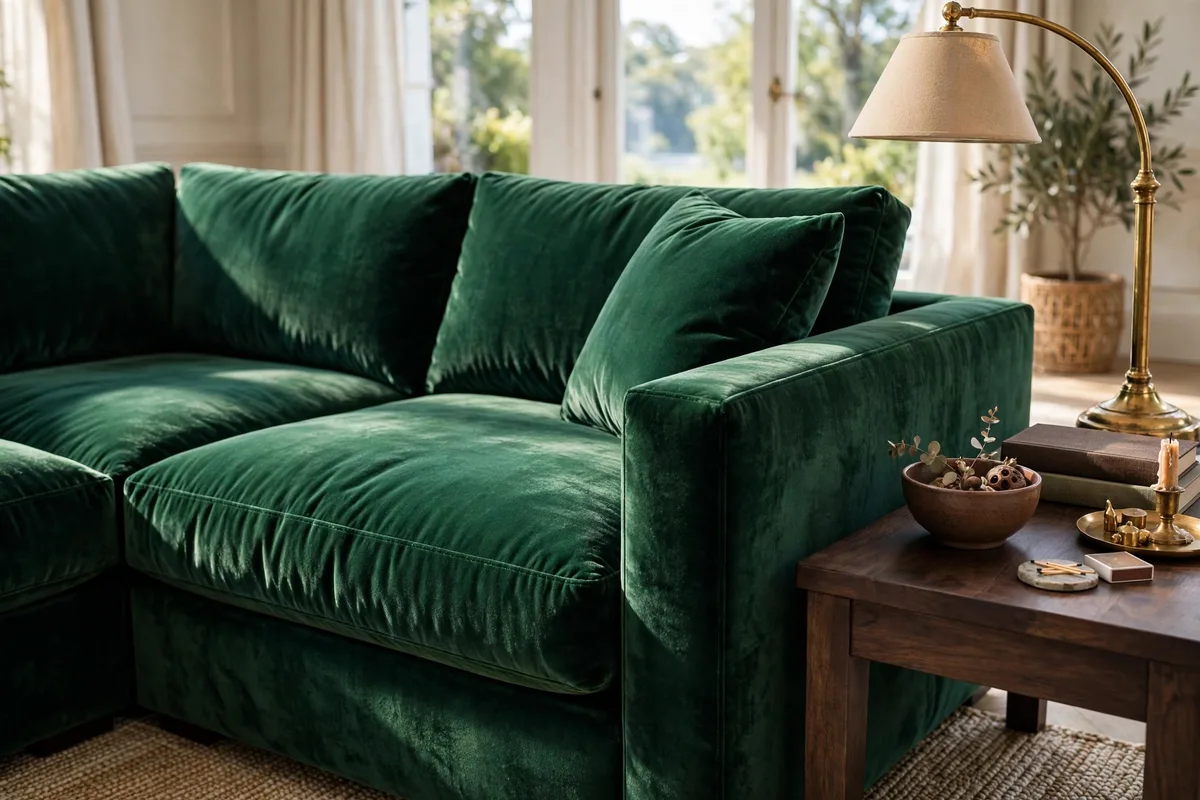
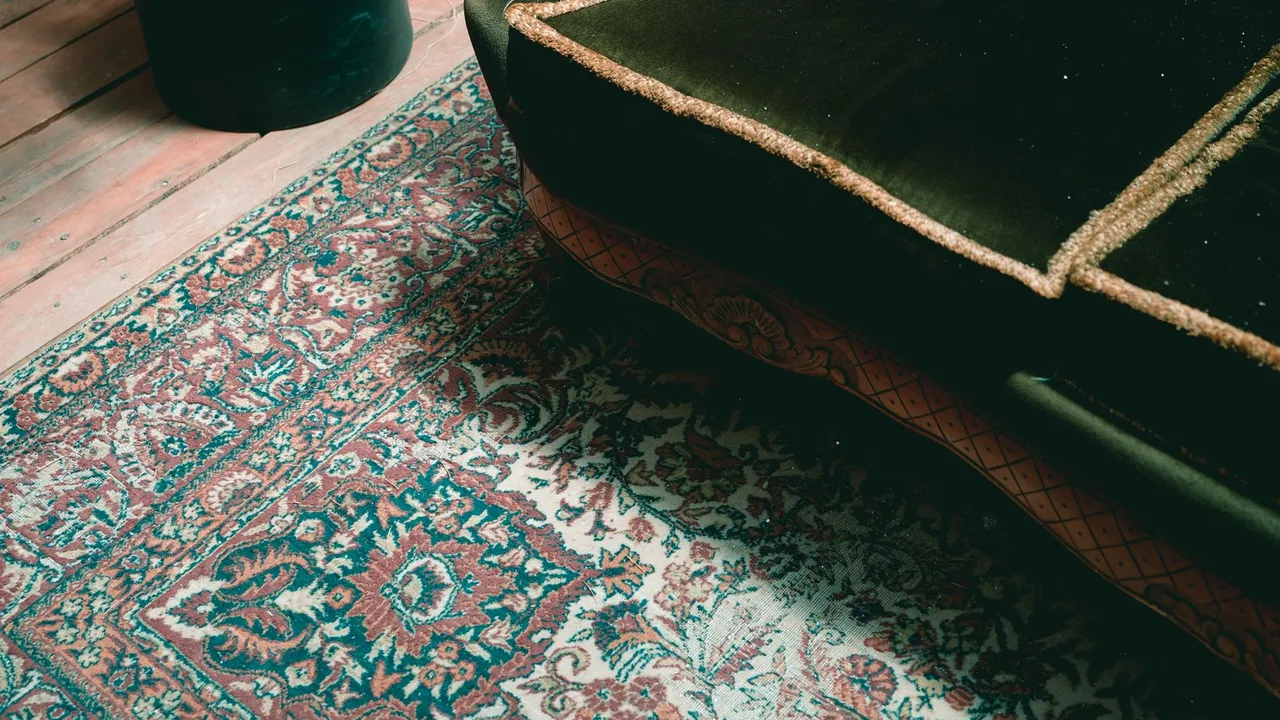
Velvet is defined by its pile: short, dense fibres standing upright, which is why it returns the deepest, most saturated colours of any upholstery. A velvet sectional in emerald, navy, rust, or ochre needs little styling around it; the material is the statement. Traditional cotton velvet is beautiful but delicate. Most family-practical velvet today is polyester performance velvet, which keeps the glow while adding serious stain resistance, and it has quietly become a legitimate everyday option.
Velvet, honestly assessed
- Durability: Performance velvet rates surprisingly high; cotton velvet sits lower and can crush or shine in the favourite seat. Expect pile shading — darker brushed one way, lighter the other. That is velvet being velvet, not damage.
- Cleaning: Dust and hair settle into the pile, so velvet asks for a weekly brush or vacuum pass. Spills on performance velvet usually blot away; traditional velvet often needs solvent care.
- Pets and kids: Better than its reputation. Hair shows but does not embed as it does in loose weaves, and claws tend to slide on short pile rather than snag.
- Sunlight: Dark velvets can fade at the edges in strong sun; rotate cushions to even it out.
- Cost feel: Mid-range to premium for performance velvet; high for cotton and silk blends, which belong in low-traffic rooms.
Pick velvet when you want the sectional to carry the room’s colour story and accept a quick weekly brush-down.
7. Leather: Full-Grain, Top-Grain and the Labels That Matter
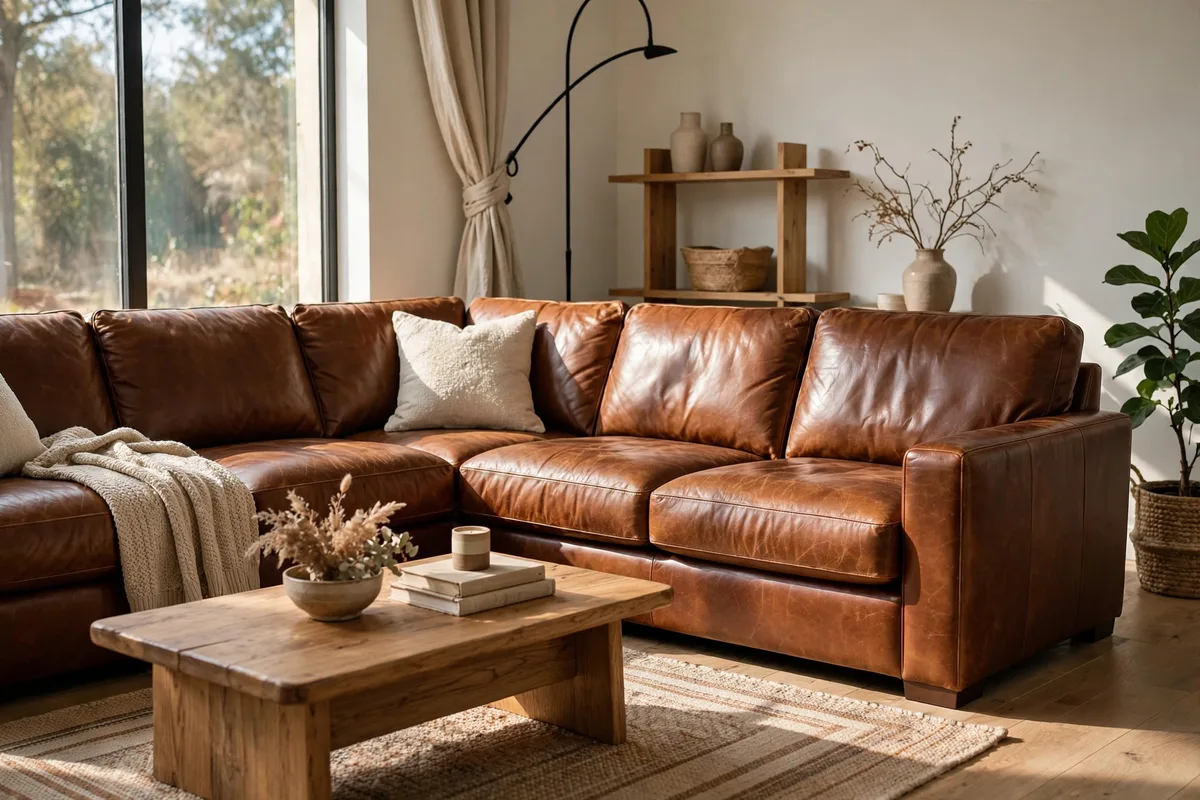
Leather is the investment material: a hide surface that wipes clean in seconds, resists odours, does not harbour dust and hair like woven fabric, and develops a patina many owners love more at year ten than on delivery day. It also has the most confusing labels, and the differences are real money, so understand the grades before you shop.
| Leather type | What it is | Durability and feel | Cost feel |
|---|---|---|---|
| Full-grain | The top layer of the hide with its natural surface kept | The strongest and most characterful; softens and develops patina | Premium to investment |
| Top-grain | The top layer, lightly sanded and finished for uniformity | Very durable, more stain resistant, slightly less natural texture | Premium |
| Corrected-grain | Surface embossed and heavily finished to even out marks | Consistent look, easier care, less breathable feel | Mid to premium |
| Split and bonded | Lower layers of the hide, or fibres bonded under a coating | Much weaker; bonded surfaces can peel over time | Budget, best avoided on a main sectional |
Living with real leather
- Cleaning: A wipe with a dry or slightly damp cloth handles almost everything; hair and dust sit on the surface. Condition periodically with an upholstery leather product, and keep harsh cleaners away.
- Pets and kids: Spills and hair are effortless, which is why many pet owners swear by leather. The trade-off is scratches: claws and sharp toys can mark it, though marks on full-grain often blend into the patina.
- Sunlight and climate: Leather can dry or crack if baked by constant direct sun or heat, so positioning matters. It feels cool in winter and can feel sticky in humid heat.
- Cost feel: The highest on this list, but over a long life its cost per year often rivals mid-range fabric.
Buy the best grade you can afford, favour top-grain or full-grain for seats and arms, and be cautious of any large sectional wearing a vague “genuine leather” label at a bonded-leather price.
8. Faux Leather and Vegan Alternatives: The Leather Look for Less
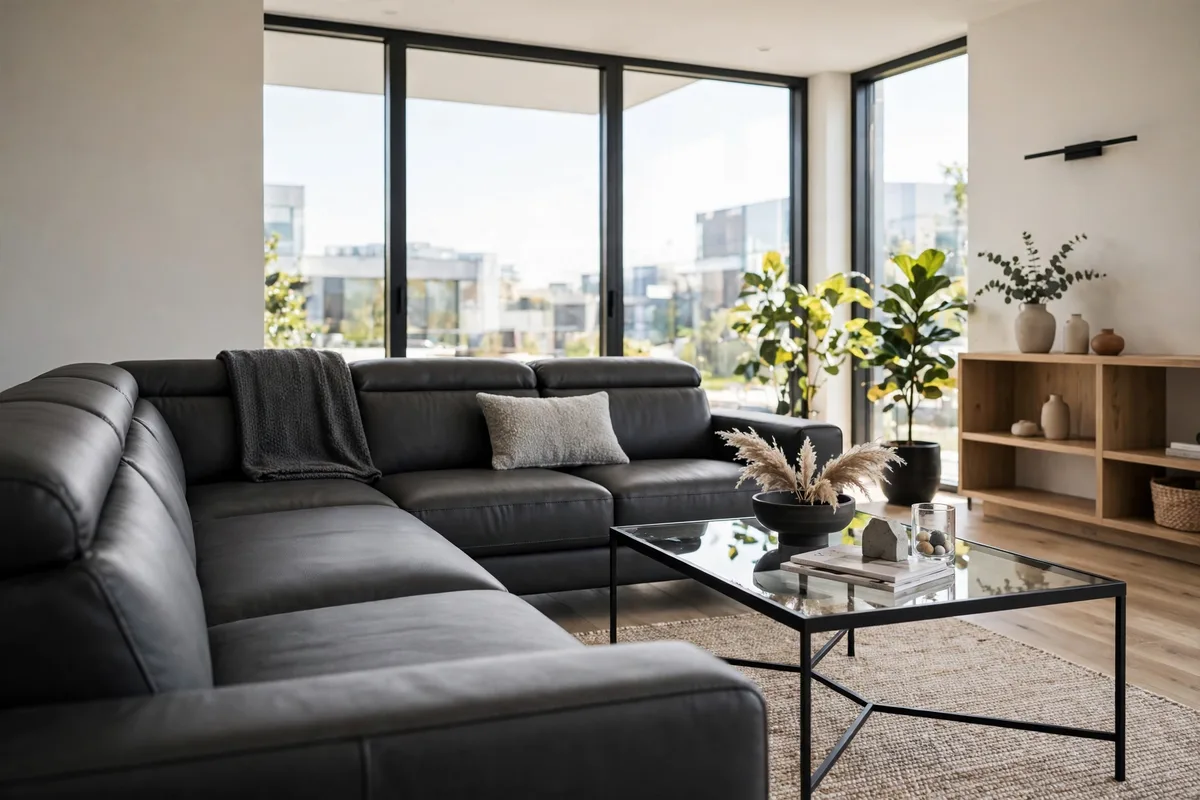
Faux leather, usually polyurethane or vinyl over a fabric backing, copies leather’s smooth, wipeable surface at a fraction of the price, and newer microfiber-based vegan alternatives feel softer than the stiff vinyl many people remember. For rentals, first apartments, media rooms, or households avoiding animal products, it delivers the tailored look and the easiest wipe-down routine here.
Where faux leather earns its place, and where it does not
- Durability: Good against stains and scuffs in the short to medium term. Its weakness is time: lower-quality coatings can crack or peel at seat edges and the front of the chaise, and it does not improve with age.
- Cleaning: The simplest on this list. Spills and hair wipe off with a damp cloth and mild soap. Avoid harsh solvents, which damage the coating.
- Pets and kids: Excellent for spills and hair; mixed for claws, since a puncture in the coating cannot be buffed out.
- Sunlight and climate: Prolonged sun and heat dry the coating and speed cracking, and humid rooms can make it feel sticky. Newer breathable-backed versions improve this.
- Cost feel: Budget to mid-range, often dramatically cheaper than real leather in the same silhouette.
Judge faux leather by thickness, backing quality, and warranty, and plan on a shorter service life than real leather. Within those terms it is a smart choice where wipe-clean convenience outranks heirloom ambitions.
9. Boucle, Chenille and Wool Blends: Texture With a Few Warnings
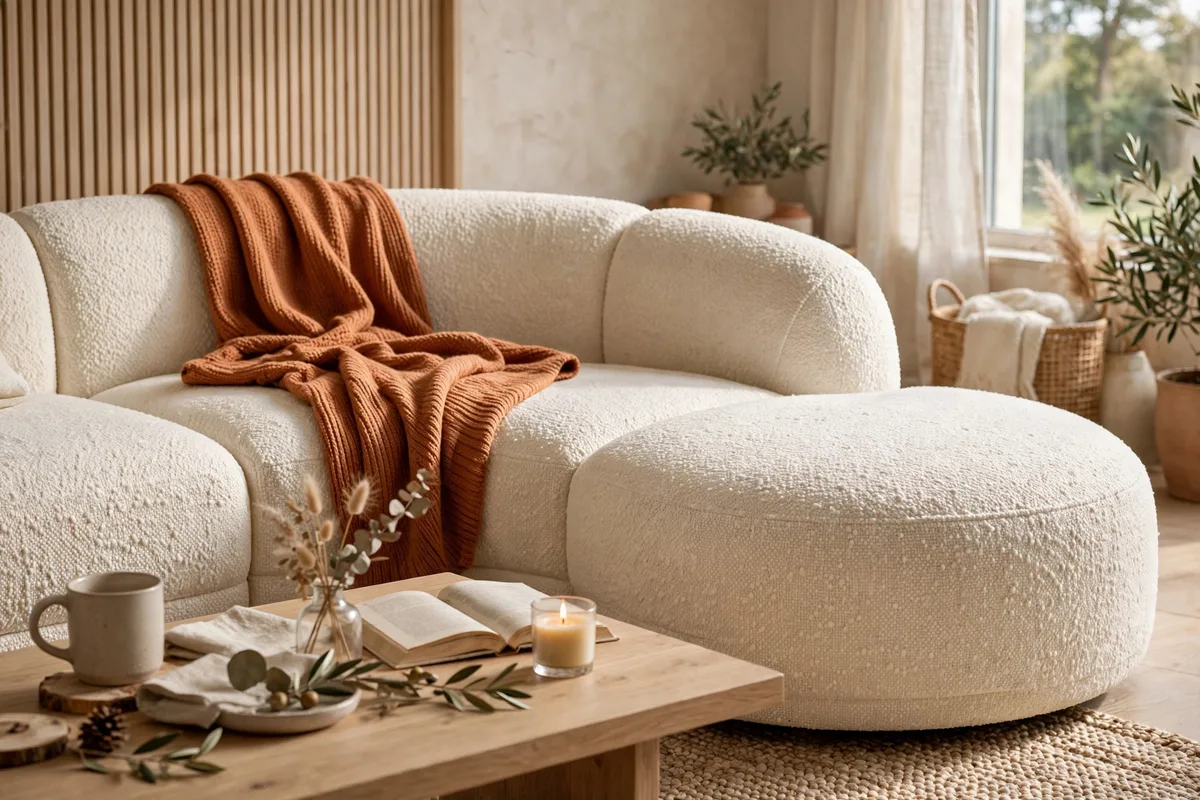
Textured weaves are how a neutral sectional stops being boring. Boucle uses looped yarns for its soft, nubby surface; chenille uses fuzzy yarns for a velvety ribbed softness; wool blends bring natural resilience and a tailored matte finish. All three add depth flat weaves cannot, and all three reward the right household while punishing the wrong one quickly.
Texture, material by material
- Boucle: The most fashionable and the most fragile of the three. Its loops are exactly what cat claws dream about, a pulled loop can run, and crumbs work down between the loops where the vacuum struggles. In a calm, adult, low-traffic room it is a sculptural joy; in a house with scratching cats, save boucle for an accent chair and let the sectional wear something tougher.
- Chenille: Soft, inviting, and more forgiving than boucle. Its pile can flatten in the favourite corner seat and loose versions can snag, so favour dense weaves and rotate cushions.
- Wool and wool blends: The quiet achiever. Wool fibres are naturally elastic, so cushions resist crushing, and the surface sheds dry dirt rather than absorbing it instantly. Polyester blends add strength and lower the price.
For any textured weave, the swatch test matters double: scratch it, spill on it, and vacuum hair out of it.
10. Match the Material to Your Household and Keep It Looking Good
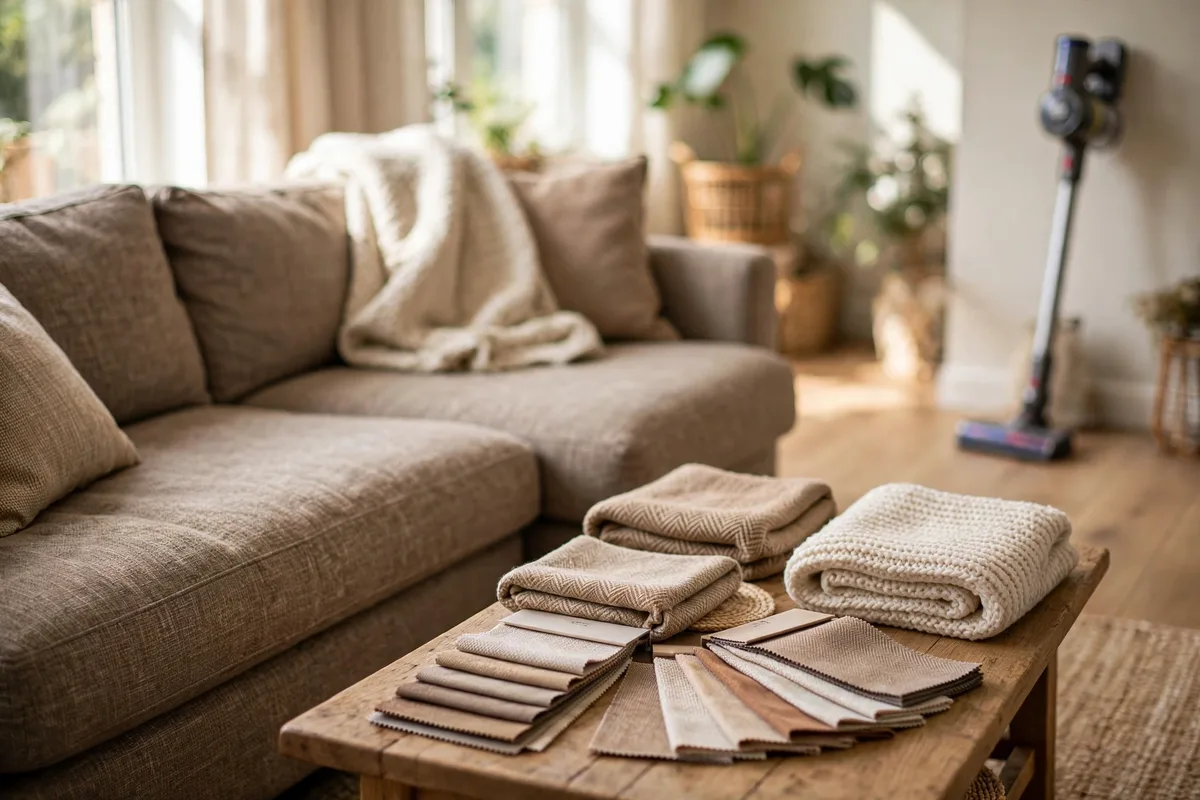
There is no single best material, only the best match between a fabric’s behaviour and your household’s habits. Use the table below as a shortlist, then confirm your winner with a swatch test and a cleaning-code check. Readers still deciding on arrangement can browse these sectional sofa layout ideas once the material question is settled.
| Your household | First material to try | Strong alternative | Best avoided |
|---|---|---|---|
| Toddlers, snacks, daily chaos | Performance fabric | Microfiber with washable covers | Pure linen, boucle |
| Dogs that own the chaise | Performance fabric | Top-grain leather | Loose weaves, boucle |
| Cats that scratch | Microfiber or tight performance weave | Smooth leather, accepting marks | Boucle, loose chenille, linen |
| Allergy-sensitive home | Leather or faux leather | Tight-woven performance fabric | Deep textures that trap dust |
| Sunny, south-facing room | Solution-dyed performance fabric | Polyester blends | Untreated cotton, delicate velvet |
| Hot, humid climate | Linen blends, breathable cotton | Performance fabric in a light weave | Faux leather, sticky vinyl |
| Calm adult household, style first | Velvet, linen, boucle | Wool blends | Nothing off limits if care suits you |
| Rental or first apartment | Faux leather, polyester blends | Slipcovered cotton twill | Investment full-grain leather |
A care routine that suits every material
- Weekly: Vacuum with an upholstery attachment, working creases and the corner seat where debris collects. Brush velvet and chenille in one direction.
- Monthly: Rotate and flip cushions the maker allows, so the chaise and corner wear at the same pace as the rest.
- Immediately: Blot every spill, never rub, working from the edge inward. Follow the label’s cleaning code, and test any cleaner on a hidden patch first.
- Seasonally: Condition real leather, wash removable covers if the label allows, and check the sun side for fading.
Small habits like these are worth more than any premium label.
Frequently Asked Questions About Sectional Sofa Materials
What is the most durable material for a sectional sofa?
Performance fabrics and top-grain or full-grain leather are the most durable choices. Performance weaves resist abrasion, stains, and fading as a system, while good leather wipes clean and softens rather than wearing thin.
Which sectional material is best for dogs?
Choose a tight weave that hair cannot embed in and claws cannot snag: performance fabric and microfiber are the usual winners. Leather also sheds hair and wipes clean, but claws can leave marks. Keep a washable throw on your dog’s favourite seat.
Which sectional material is best for cats that scratch?
Favour smooth, tight surfaces with no loops to catch: microfiber, tight performance weaves, and smooth velvet pile deny claws a grip. Avoid boucle and loose weaves, which can be pulled loop by loop. A scratching post beside the sectional helps more than fabric choice alone.
Is linen a good material for a family sectional?
Pure linen is risky for young families: it wrinkles, absorbs spills quickly, and often needs solvent cleaning. A linen blend, or better still a washable linen-look slipcover, keeps the breezy style with far more forgiveness.
Is leather or fabric better for a sectional?
Leather wins on wipe-clean ease, odour resistance, and allergy-friendliness, ageing with patina rather than pilling. Fabric wins on warmth, colour variety, a softer sit in hot or cold rooms, and lower upfront cost. Heavy spill traffic favours leather’s surface; cosiness-first households usually prefer performance fabric.
What does a sofa cleaning code mean?
The label code tells you which cleaners the fabric tolerates: W is water-based, S is solvent-based only, WS is either, and X is vacuum only. The wrong type can set a stain or ring the fabric, so check before treating any mark.
Does velvet work on an everyday family sectional?
Performance velvet does. Its dense synthetic pile resists stains and wear, releases hair with a brush, and keeps the rich colour. Traditional cotton velvet is more delicate and suits quieter rooms. Either way, plan a quick weekly brush-down.
How long should a sectional sofa material last?
With regular care, quality performance fabric and microfiber serve a busy household for many years, and top-grain leather typically lasts longest of all, often outliving fabric sectionals. Faux leather generally has the shortest service life because its coating can crack or peel with age.
Can you mix materials on one sectional?
Yes, most successfully through cushions and throws rather than the frame upholstery itself. If a sectional offers contrast options, keep the hardest-wearing material on the seats and chaise and save delicate textures for back cushions or an accompanying chair, where wear is lighter.
What material should you choose for a sectional in a sunny room?
Solution-dyed performance fabrics resist fading best because the colour runs through each fibre, and polyester blends also hold colour well. Untreated cotton, linen, and dark velvets fade fastest, so rotate cushions, use window coverings at peak hours, and cover the sunniest seat. Material decides how fast a fabric fades; placement decides how much sun lands on it at all — the placement fixes live in our sectional sofa layout mistakes guide.
Conclusion
The right sectional material matches the life the sofa will actually live. Start with your household, not the colour chart: your traffic, pets, sunlight, and appetite for cleaning, then test the shortlist with a swatch weekend. Busy families rarely regret performance fabric or microfiber; leather rewards wipe-clean longevity; linen, velvet, and boucle reward calmer homes with unmatched texture and colour; cotton slipcovers and faux leather quietly solve the washable and budget briefs. Choose with your eyes open, care for the winner in small weekly habits, and your sectional will stay the most welcoming seat in the house for years.