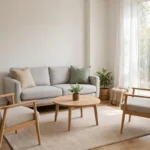
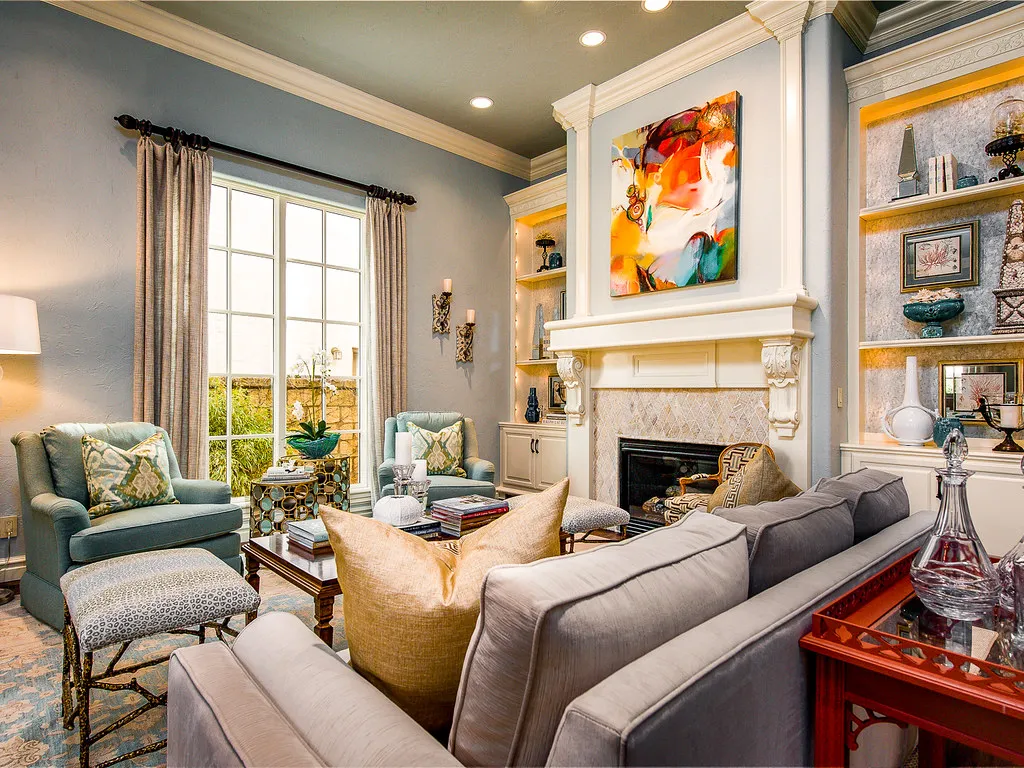
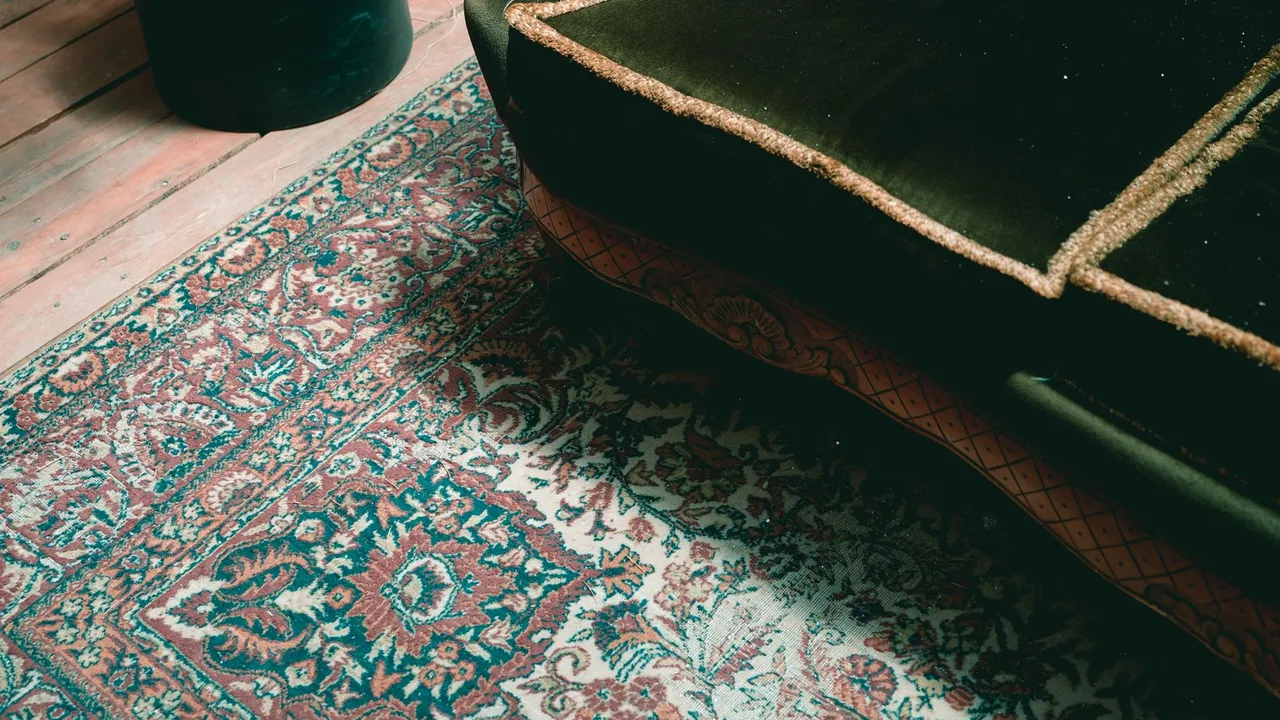
A neutral sofa is the easiest piece of furniture to buy and one of the hardest to style well. Beige, cream, gray, ivory, taupe — these tones go with everything, which is exactly why so many living rooms built around them end up looking washed out, flat, or like the decorating simply stopped halfway. The sofa itself is never the problem. The problem is almost always a missing technique: pillows matched instead of layered, a rug that is too small, lighting that flattens every texture, or an accent color that appears exactly once and looks like an accident.
The good news is that neutral sofa styling is a learnable skill, not a talent. Professional stylists rely on a small set of repeatable moves — reading undertones, following pillow formulas, sizing rugs correctly, repeating accent colors, and lighting textures so they show up after dark. The twelve tips below walk through each one in the order you would actually use them, from the undertone check that should happen before you buy a single cushion to the renter-friendly tricks that cost almost nothing. If you would rather see one room styled from start to finish, our neutral sofa styling guide puts all of these moves together in a single worked example.
1. Read Your Sofa’s Undertone Before Buying Anything

Neutral is not one color. A cream sofa can lean yellow, pink, or chalky white; a gray sofa can run blue, green, or warm greige. This undertone decides which accessories will look harmonious and which will look slightly wrong in a way you cannot quite name, so identifying it is the first step — before you spend a dollar on pillows or throws.
The test is simple. In daylight, hold a pure white sheet of paper against the sofa and compare. If the sofa looks yellow or peachy next to the paper, it is warm. If it looks blue or steely, it is cool. If it just looks softer and darker than the paper, it is a true neutral.
Match accessories to the temperature
- Warm neutrals (cream, beige, oatmeal, camel): pair with sage, dusty terracotta, warm mustard, blush, camel, and honey woods. Avoid icy grays and stark white accessories, which flatten the warmth.
- Cool neutrals (blue-gray, charcoal, greige): pair with rust, terracotta, burnt orange, deep mustard, navy, and forest green to add warmth back in. Avoid beige pillows, which can look dingy against cool gray.
- True neutrals (ivory, stone, mushroom): the most flexible — they take both warm and cool accents, so choose based on the mood you want rather than the sofa.
Ten minutes with a white sheet of paper saves more styling headaches than any other single step.
2. Follow the Odd-Number Pillow Formula
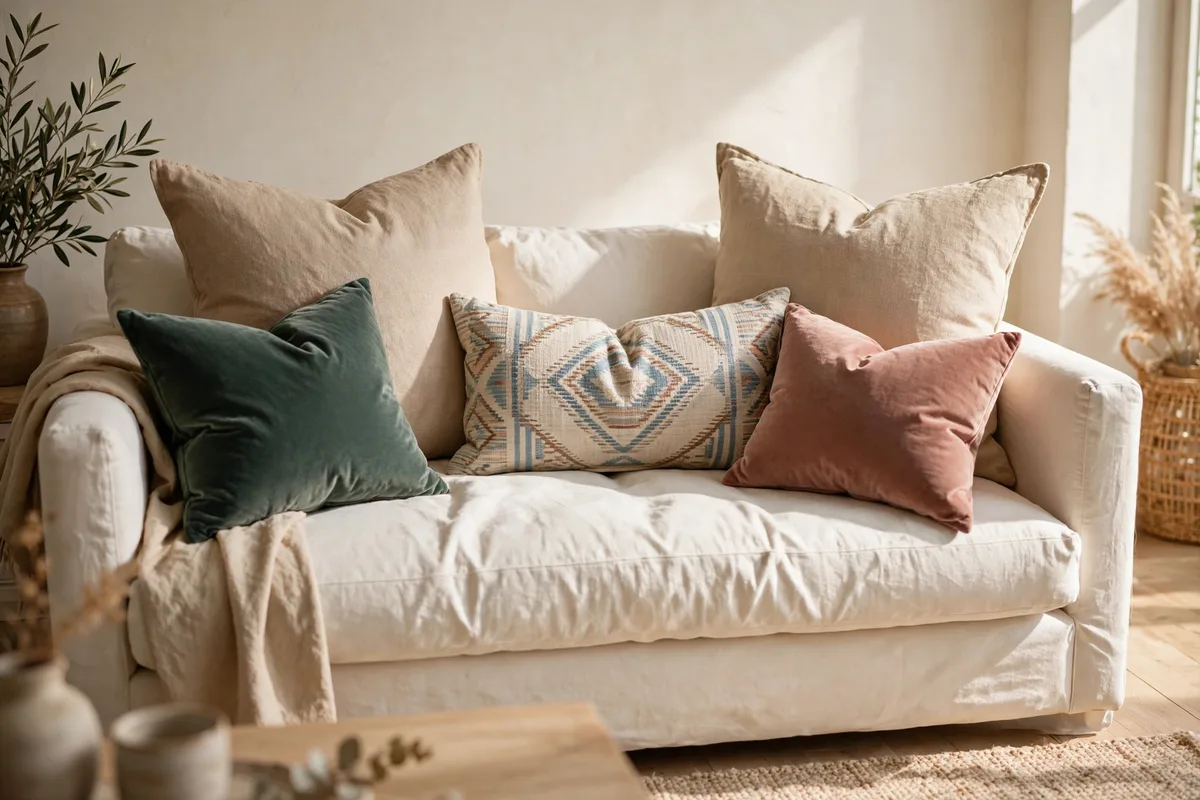
Professionals use odd numbers of pillows because they read as natural and effortless; even numbers read as formal. For a standard three-seater, three to five pillows is the sweet spot; a loveseat takes two or three.
The classic arrangement is the 2-2-1: two larger matching squares (around 20 inches) at the back corners, two slightly smaller cushions (18 inches) in a complementary tone or pattern in front, and one statement piece — a lumbar cushion, a botanical print, or a richly textured fabric — centered at the front. Varying the sizes keeps the eye moving instead of landing on one flat horizontal line.
Build your pillow mix with the three-color rule
Pick three colors pulled from around the room — your rug, curtains, wall art, or the sofa itself. Two should be quiet neutrals in different textures, and one should be your accent. Then choose one patterned pillow to lead: a stripe, a small-scale floral, or an abstract print that contains at least two of your three colors. All the other pillows are chosen to echo that leader. Finally, give each pillow the “karate chop” — a firm vertical press down the center that creates a soft crease — for that lived-in, catalog look.
3. Drape Throws With Intention
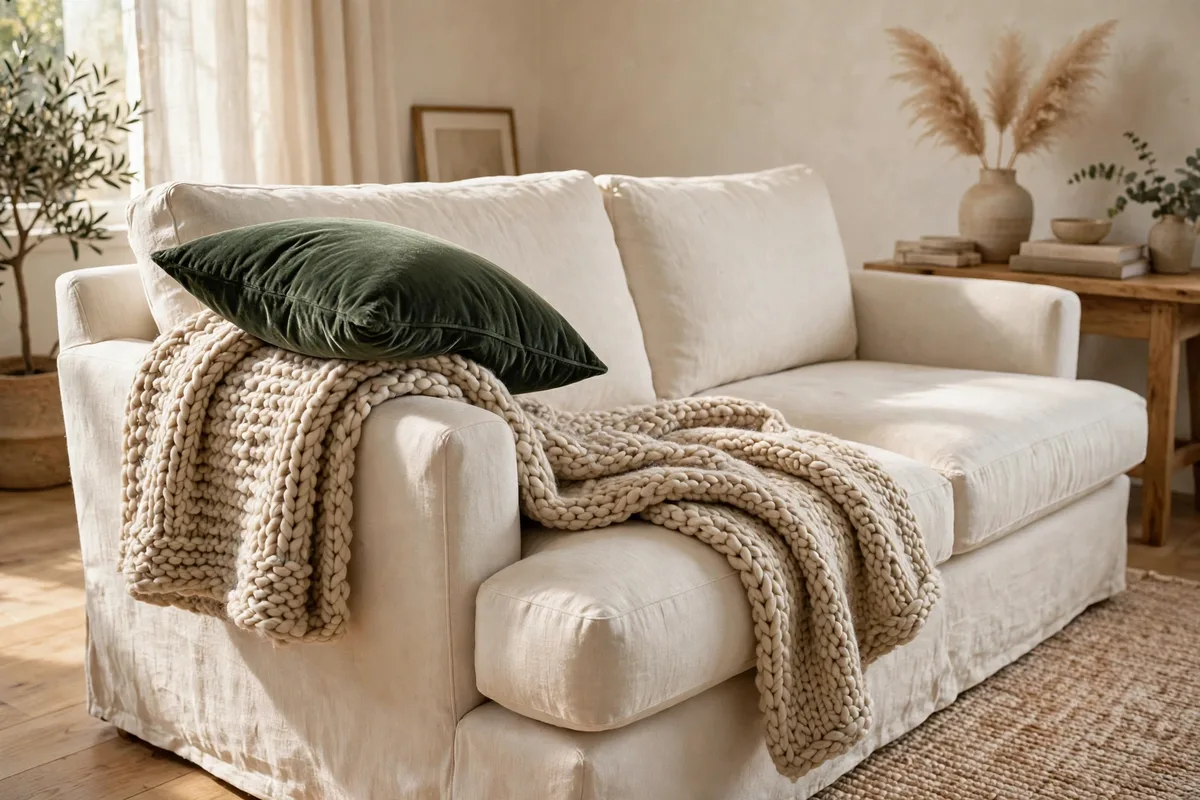
A throw on a neutral sofa should look casually placed, never abandoned, and the difference between the two is about ten seconds of intention. More importantly, the throw should add a texture the sofa does not already have: a chunky knit on smooth linen, a lightweight woven throw on velvet, a soft wool on boucle. The contrast makes both fabrics look better.
There are three reliable drape methods worth learning:
- The arm cascade: fold the throw into a loose rectangle, drape it over one arm, and let one end fall onto the seat cushion. Tuck a pillow partially over the fold to anchor it so it stays put.
- The back fold: fold the throw lengthwise into thirds and lay it along the sofa back for a clean horizontal line. This works especially well on three-seaters and reads as polished rather than casual.
- The corner toss: drape the throw diagonally across one corner and let it fall naturally. Best with lighter fabrics that fold softly — heavy throws look lumpy in this position.
Change your throw with the seasons: a heavyweight wool in winter, a lighter cotton or linen version in spring. The sofa stays; only the feel of the room changes.
4. Anchor the Sofa With a Correctly Sized Rug
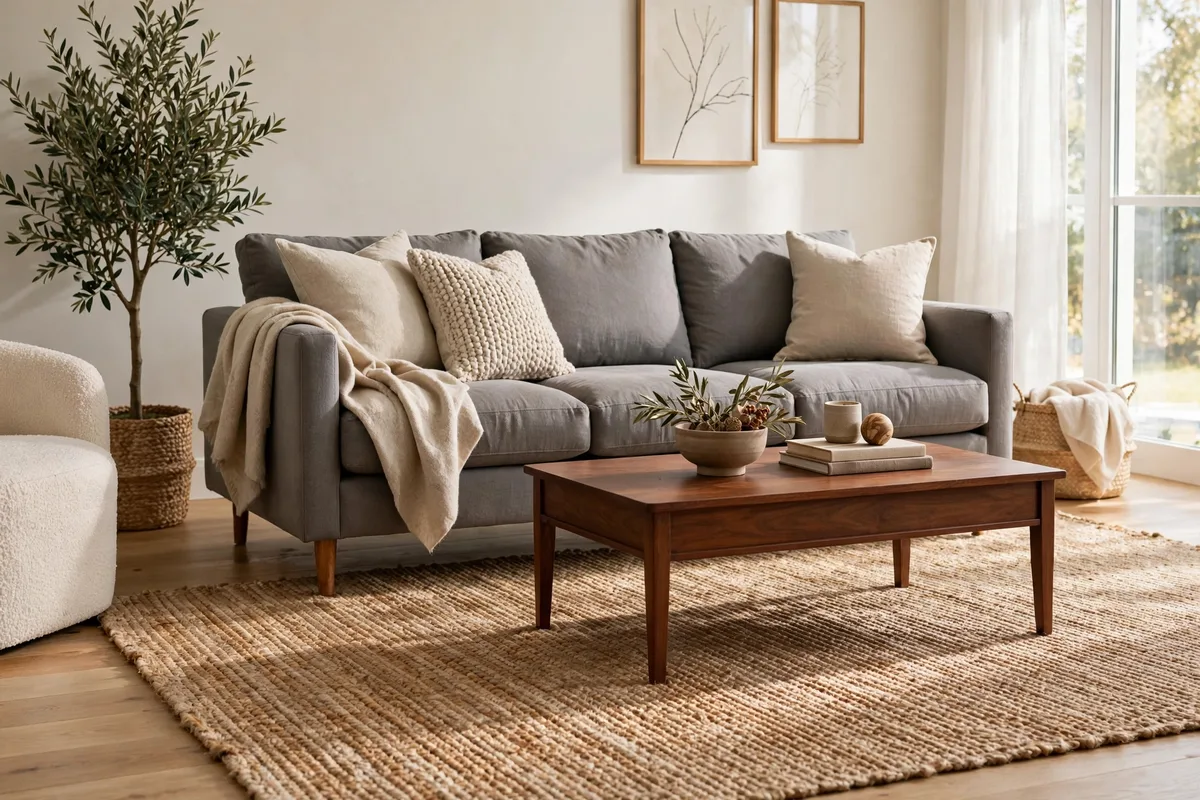
Without a rug, even a beautifully styled neutral sofa looks like it is floating in the room. The rug defines the seating zone and gives the whole arrangement a finished, grounded feel — but only if it is large enough. A rug that is too small makes the seating area feel cramped and disconnected, and the room actually reads as smaller.
The golden rule is that at least the front legs of the sofa should rest on the rug. In larger rooms, placing all four legs on the rug looks even more considered. Leave roughly 18 inches of bare floor around the rug so the room can breathe, and make sure the rug extends under the coffee table so the pieces read as one group.
Rug sizing quick guide
| Sofa size | Minimum rug size | Best placement |
|---|---|---|
| Loveseat / apartment sofa | 5 x 8 ft | Front legs on the rug |
| Standard 3-seater | 8 x 10 ft | Front legs on the rug |
| Large 3-seater + accent chair | 9 x 12 ft | All front legs on the rug |
| Sectional | 9 x 12 ft or larger | All sofa legs on the rug |
For the rug itself, this is your best chance to introduce pattern or a deeper tone without buying statement furniture: a deep-toned jute, a geometric wool flat-weave, or a soft abstract print. Match the rug’s texture to the sofa fabric — jute or flat-weave for cotton and linen, thick wool or deep pile for velvet and boucle.
5. Ground the Scheme With One Dark Contrast Piece

An all-neutral room without a single dark element has a specific failure mode: it looks washed out, like the color was turned down on the whole space. The fix is one deliberate piece of contrast — a dark anchor that gives the eye somewhere to land and makes all the pale tones around it look brighter by comparison.
This does not mean painting a wall black. Think smaller: a black metal floor lamp arcing behind one end of the sofa, a dark walnut side table, a charcoal lumbar cushion, a deep espresso picture frame, or a black-and-white photograph in a thin dark frame above the sofa. One dark piece is enough; two or three start to change the mood of the room entirely, which is a different scheme.
The contrast piece works hardest when it is echoed in a small way — a black lamp base picked up by a thin black picture frame, for example — so it reads as intentional rather than random. If your neutral sofa sits in a room that feels flat no matter how many cream pillows you add, a single dark anchor is usually the missing ingredient.
6. Pair It With an Accent Chair That Echoes Your Palette
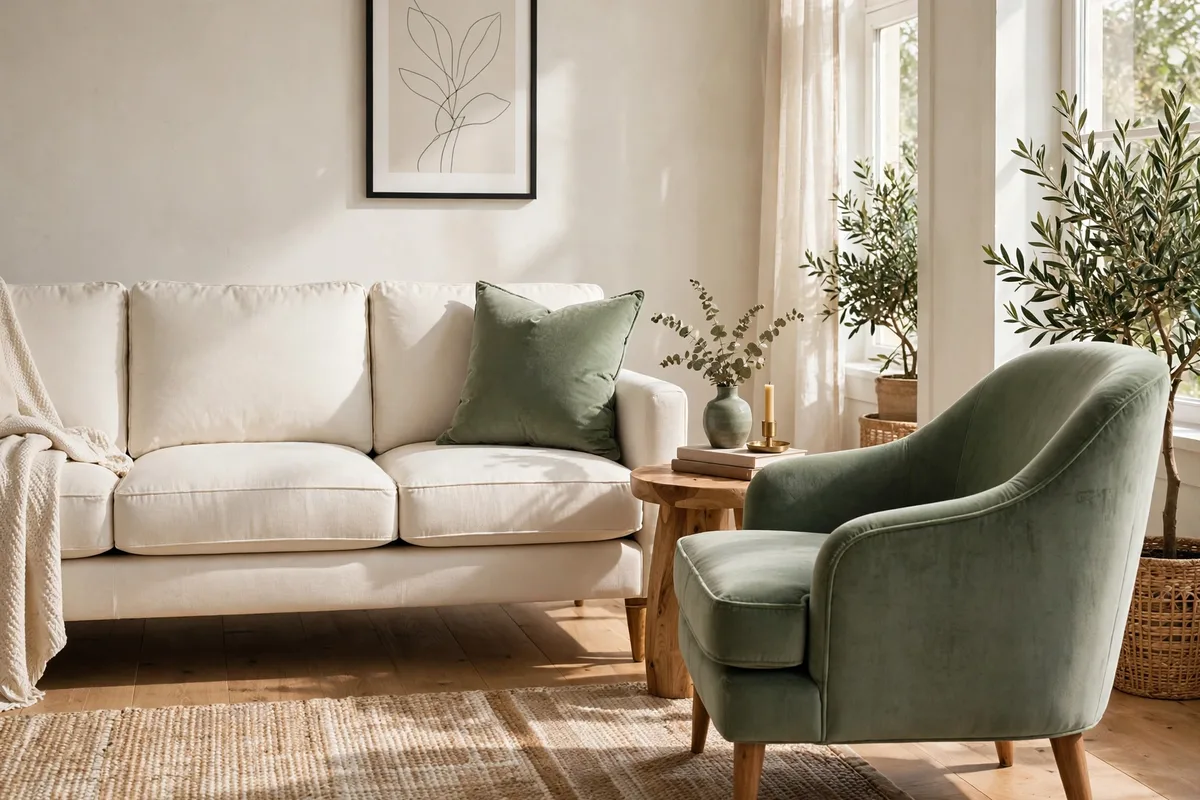
A neutral sofa paired with a more expressive armchair is one of the most effective living room moves available. The sofa supplies the calm, grounded base; the chair supplies the color or pattern the sofa deliberately avoids. Together they read as a deliberate pair instead of furniture that arrived separately.
The chair does not need to shout. A sage velvet armchair beside an oatmeal sofa, a warm terracotta linen chair next to a cream three-seater, or a deep teal accent chair against warm beige — each pairing works because the tones relate. The professional trick for maximum flexibility is to choose a chair in a color that already appears in your cushions. That single echo creates a visual connection across the room and makes the scheme feel considered rather than assembled.
Angle the chair toward the sofa to form a conversation area, leaving room for a side table between them. In tighter rooms, a slim-profile chair with raised legs keeps the footprint light — there are plenty of seating ideas for small living rooms that prove a compact space can still carry contrast.
7. Style the Wall Behind the Sofa
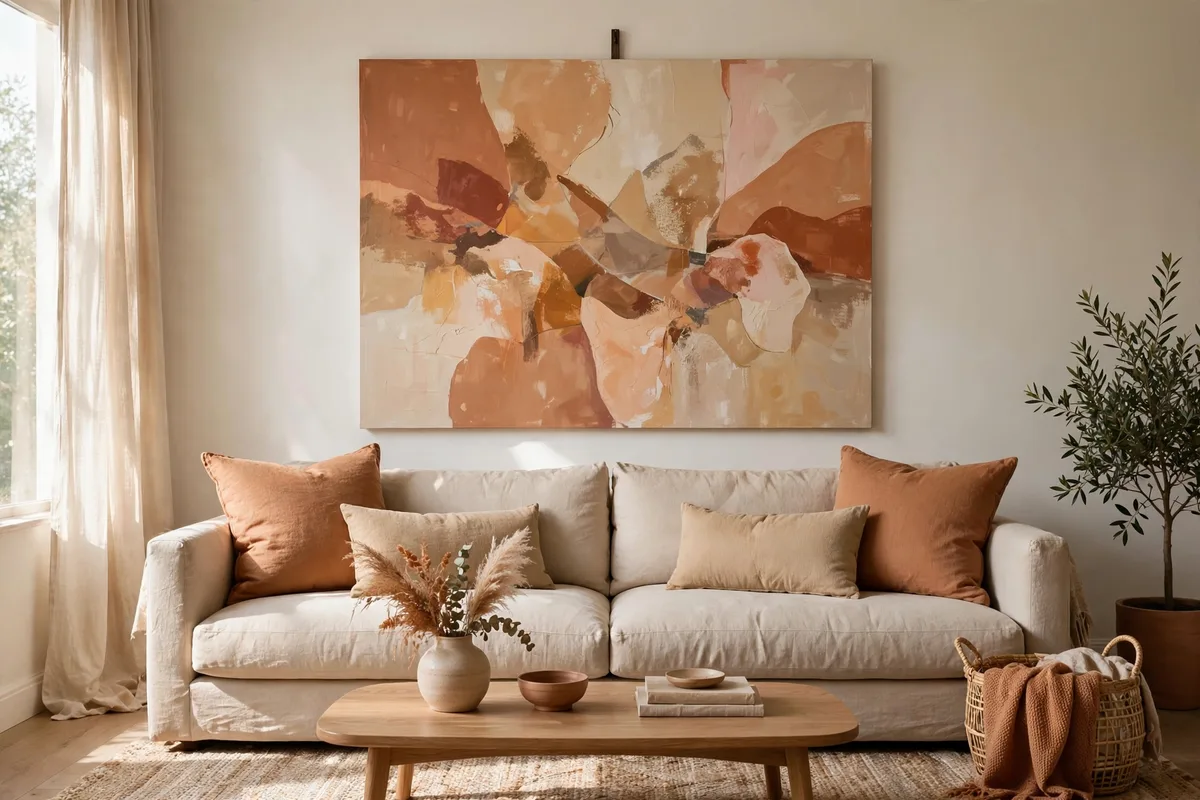
The wall behind a neutral sofa is prime decorating real estate, and leaving it blank is the fastest way to make the sofa look stranded. One well-scaled piece of art instantly turns the sofa into a focal point — and it gives your accent colors somewhere to live beyond the cushions.
Scale is the rule that matters most: aim for artwork roughly two-thirds the width of the sofa. A single oversized abstract print works beautifully in minimal rooms, while a gallery wall of complementary prints adds personality. Hang the center of the arrangement at eye level — about 57 inches from the floor — rather than floating it near the ceiling.
Mirrors are a strong alternative, especially in smaller or darker rooms, because they bounce light back into the space and make the seating area feel larger. Whatever you choose, echo one accent color from your cushions in the artwork so the wall feels styled with the sofa in mind rather than as an afterthought. For the bigger picture, see these designer-approved features of a timeless living room.
8. Layer Warm Lighting Around the Sofa
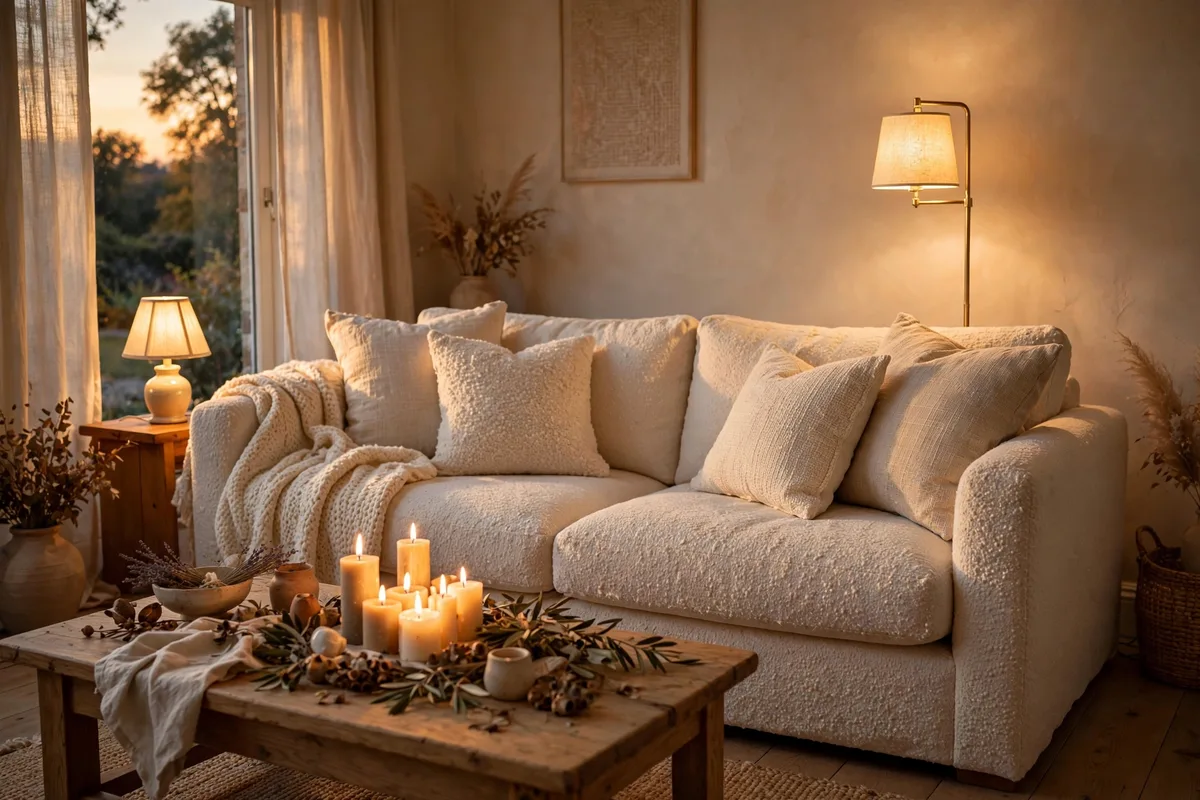
A neutral sofa styled in flat overhead light will always look a little lifeless, because neutrals need warm light to show their depth. Layered lighting — ambient, task, and accent working together — is what makes the textures you have built actually visible in the evening.
Build three layers
- Ambient: the room’s base layer, from a ceiling fixture or recessed lights on a dimmer. Keep it warm (around 2700K) so neutral fabrics read as cozy rather than clinical.
- Task: a slim floor lamp behind one end of the sofa creates a reading corner and adds vertical height. A table lamp on the side table gives a softer, more intimate pool of light.
- Accent: a small picture light over the artwork behind the sofa, or a candle cluster on the coffee table, adds the final glow that makes the arrangement feel finished after dark.
Place lighting asymmetrically — a floor lamp on one side, a plant on the other — for a relaxed, lived-in balance. One practical check: stand across the room at night and look at the sofa. If the pillows and throw look flat and gray under your bulbs, the bulbs are too cool; warm-white bulbs are a five-minute fix.
9. Repeat Your Accent Color Three Times
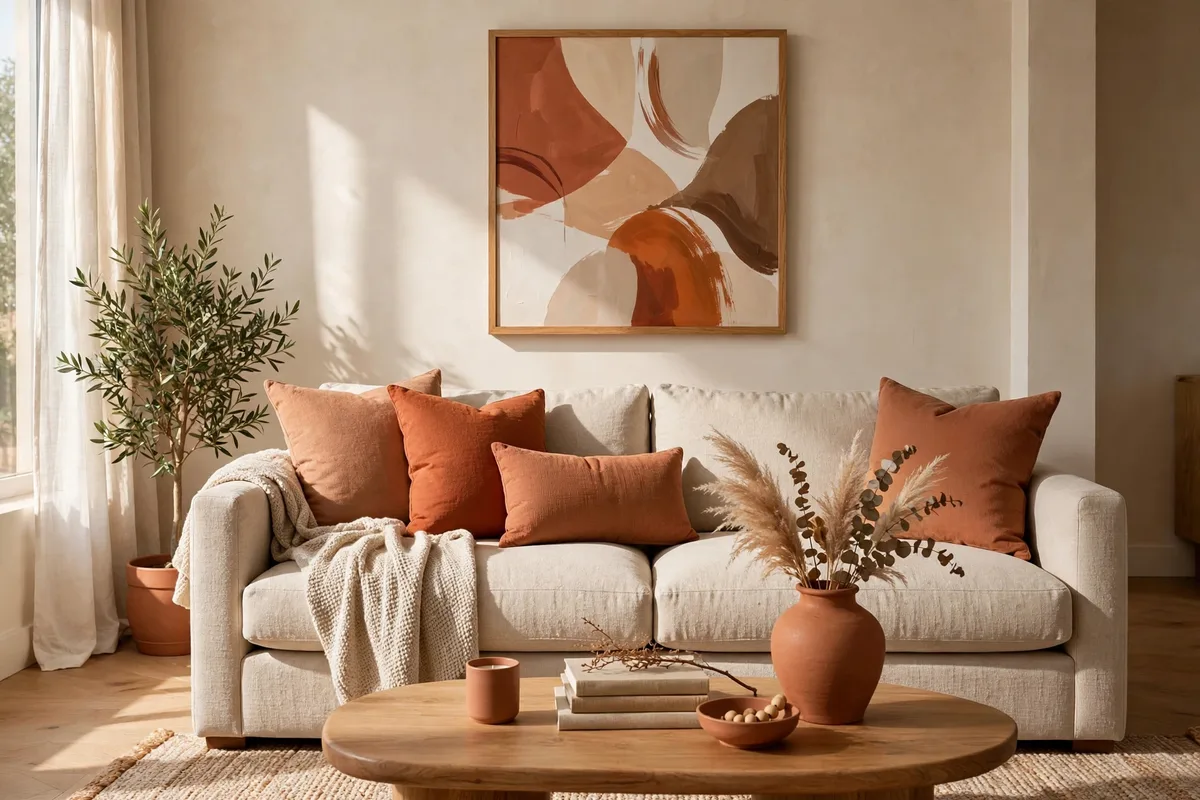
Here is the rule that separates styled rooms from decorated ones: an accent color that appears exactly once looks like an accident, but the same color repeated in three places looks like a scheme. This “rule of three” is the simplest color discipline in interior styling, and it matters most on a neutral sofa, where a single bold cushion can otherwise look stranded.
The sofa itself is repetition zero — your accent should appear in the cushions, then show up at least twice more in the room: in the artwork behind the sofa, in a vase on the coffee table, in the rug pattern, in a throw folded over the arm, or in a book spine on the side table. The repetitions do not need to match exactly; terracotta, rust, and clay read as one family. What matters is that the eye finds the color in more than one place and concludes the room was planned.
A useful exercise: photograph your seating area, then count how many times your accent color appears. If the answer is one, you have found your next styling move. This single habit fixes more “something feels off” neutral rooms than any new purchase.
10. Refresh Seasonally Without Redecorating

One of the strongest arguments for a neutral sofa is that it costs almost nothing to update across the year. The sofa stays; only the accessories change. A pair of cushion covers and a seasonal throw is genuinely all it takes to shift a living room from one season to the next — no new furniture required.
Seasonal palette guide for a neutral sofa
| Season | Accent colors | Throw texture | Small swap |
|---|---|---|---|
| Spring | Sage, dusty terracotta, pale blue | Light cotton or linen | Botanical-print cushion |
| Summer | Brighter accents, sky blue, coral | Breathable linen | Fresh-cut flowers in a simple vase |
| Autumn | Rust, amber, deep brown | Chunky knit wool | Heavier rug layer or woven basket |
| Winter | Deep teal, indigo, burgundy | Heavyweight wool | Candle cluster and warm lamp glow |
Keep off-season cushion covers folded in a single storage box so the swap takes twenty minutes, not an afternoon. While you are swapping, take the opportunity to vacuum the upholstery and rotate the cushions so wear distributes evenly — a neutral sofa shows its age in flattened cushions long before the fabric gives out.
11. Keep It Looking New: Upkeep for Pets, Kids, and Real Life
A neutral sofa only stays beautiful if it stays clean, and light upholstery shows everything — which is why the styling conversation has to include maintenance. The good news: most of it is habit, not effort.
Vacuum the sofa weekly with an upholstery attachment, getting into the crevices where crumbs and pet hair collect. Rotate and flip the seat and back cushions monthly so they wear evenly; plump them by hand each evening — thirty seconds of fluffing keeps a neutral sofa from developing that sad, deflated look. For stains, blot (never rub) immediately with a clean cloth, and always spot-test any cleaner on a hidden area first. Apartment Therapy’s sofa refresh routine covers this deep-clean sequence well: remove everything, vacuum every crevice, treat stains, air dry, then restyle.
If you are buying new, consider performance fabrics — tightly woven, stain-resistant weaves made for households with pets and children. A washable slipcover is the ultimate insurance policy for a white or cream sofa: the light look with a reset button.
12. Style It Renter-Friendly With No-Commitment Moves
Renters often assume a neutral sofa in a rental means living with beige walls and zero personality until they move. In fact, a neutral sofa is the ideal renter’s piece, because every styling move that matters is removable.
Start with what touches the sofa, not the walls: cushion covers instead of new pillows (a fraction of the price, stored flat between seasons), a throw, and a large rug — which, conveniently, also protects the flooring and comes with you when you leave. For the wall behind the sofa, lean a large framed print on top of a console or use damage-free hanging strips rated for the frame’s weight rather than drilling. A tall plant in a floor basket adds height and life with zero holes. Peel-and-stick wallpaper on a single accent wall or even on the back of a bookshelf adds color that removes cleanly.
The principle: invest in pieces that move with you (rug, art, lamps, plants) and keep everything attached to the apartment itself temporary. When the lease ends, the styling comes along — and the neutral sofa, styled this way, will look just as good in the next place.
Frequently Asked Questions About Neutral Sofa Styling
What colors go best with a beige sofa?
Beige is the most forgiving neutral base. It pairs beautifully with warm whites, camel, and taupe for a tone-on-tone look, and with deeper accents like forest green, navy, terracotta, and rust when you want contrast. Brushed brass and warm wood tones also warm it up nicely without adding color.
How many throw pillows should I put on a neutral sofa?
For a standard three-seater, three to five pillows is the sweet spot; two to three works for a loveseat. Use odd numbers and vary the sizes — larger squares at the back, smaller ones in front, and one lumbar pillow centered. Fewer, well-chosen pillows always look better than a crowded row.
How do I stop a neutral sofa from looking boring?
Layer contrasting textures — velvet against linen, boucle beside cotton — because texture creates depth without color. Add one accent color repeated in at least three places, ground the sofa with a correctly sized rug, and style the wall behind it. A flat neutral sofa usually needs more layers, not louder colors.
What size rug should go under a neutral sofa?
At least the front legs of the sofa should rest on the rug. For a standard three-seater, an 8 x 10 ft rug is the minimum; sectionals and larger seating areas need 9 x 12 ft. A rug that is too small makes the room feel smaller, so when in doubt, size up.
Can I mix warm and cool tones around a neutral sofa?
Yes, but let the sofa’s undertone lead. A warm beige sofa can take a cool accent like powder blue or sage for contrast, and a cool gray sofa benefits from warm counterpoints like rust or terracotta. Keep roughly two-thirds of the palette in the sofa’s temperature family so the mix looks deliberate.
How do I style a neutral sofa for each season?
Swap cushion covers and the throw — that is genuinely all it takes. Spring: sage and botanical prints; summer: lighter linen and brighter accents; autumn: rust, amber, and chunky knits; winter: deep teal or indigo with heavyweight wool. Store off-season covers in one box for a twenty-minute changeover.
What is the 60-30-10 rule for a neutral living room?
Sixty percent of the room’s color comes from large surfaces (walls, flooring, the sofa), thirty percent from mid-size pieces (rug, curtains, accent furniture), and ten percent from accents (cushions, throws, vases, art). On a neutral sofa, that ten percent does most of the emotional work, so repeat it in at least three places.
How do I keep a light-colored sofa clean with pets or kids?
Vacuum weekly with an upholstery attachment, rotate and fluff cushions monthly, and blot spills immediately instead of rubbing. Consider performance fabrics when buying new, and use a washable throw over the most-used seat plus a washable slipcover for the ultimate reset button on white or cream sofas.
Should the throw pillows match the curtains?
They do not need to match exactly, and matching sets can look flat. Instead, pull one shared color or pattern family through both — for example, a rust pillow echoed in a rust stripe on the curtains. Coordination beats matching every time.
Is a neutral sofa a good choice for a small living room?
Yes — light neutrals reflect light and make boundaries seem to disappear, which helps a compact room feel larger. Keep the palette light, use a correctly sized rug to define the zone, add one contrasting accent chair with raised legs to keep the footprint airy, and avoid overcrowding the sofa with too many pillows.
Conclusion
A neutral sofa is the most forgiving starting point a living room can have, and these twelve tips share one principle: intention beats inventory. Reading the undertone before you shop, following a pillow formula, sizing the rug correctly, and repeating your accent color three times will do more than doubling the budget ever could.
Start with the free moves: rearrange the pillows into an odd-number formula, karate-chop them, refold the throw, and count your accent-color repetitions in a photograph. Then make one considered addition — the right rug size, a dark contrast piece, or art scaled to two-thirds of the sofa. Because the sofa itself never changes, every improvement compounds, season after season. That is the real payoff of a neutral sofa: style it with technique once, and it keeps paying you back every time you walk into the room.