
Windows are where winter gets in — and where a room either glows or glares in the year’s thinnest light. The fix is not thicker curtains alone; it is a stack: seal the frame, layer the fabrics, stop the sill gap, then add the glow. Done in that order, the same window that leaked heat becomes the seat everyone fights for, lit like a lantern from the street. These are the winter window styling ideas that earn their keep — insulation first, decoration built on top of it, nothing that costs daylight.
Ten layers and touches, in the order to apply them: seal, insulate, then style.
In this guide: The Winter Window Stack at a Glance · 1. Windows Are Winter’s Weak Point — Treat Them That Way · 2. Build the Layered Curtain Stack · 3. Seal the Drafts Before You Style Anything · 4. The Draft Stopper, Styled Instead of Hidden · 5. Give the Sill a Glow: LED Candles and Lanterns · 6. Frost the Corners, Keep the View · 7. Make the Deep Sill a Seat, Not a Shelf · 8. Greenery That Survives Winter Light · 9. Hang the Winter Wreath Inside the Glass · 10. Run the Daily Open-Close Routine · Frequently Asked Questions About Winter Window Styling · Conclusion
Two passes: This page runs in the order winter demands: the cold first (Sections 1–4), then the look (Sections 5–9), then the habit that operates both (Section 10). If you came for the look, start at Section 5 and work down. If you came for the cold, start at Section 1 — the styling will still be there when the drafts are dead.
The Winter Window Stack at a Glance
| Layer | Its job | Skip it and… |
|---|---|---|
| Sealed frame (weatherstrip/caulk) | Stops the draft at source | Every other layer works twice as hard |
| Heavy / thermal curtain | The insulation blanket | Glass radiates cold into the room all evening |
| Sheer layer | Daytime privacy + softened light | Bare glass glare, neighbours’ view in |
| Draft stopper on the sill | Seals the bottom gap | A cold stripe at ankle height |
| Sill styling (LED glow, greenery) | The welcome, in and out | The window reads as a black mirror after 4 pm |
| Frosted corners | Decoration that costs no daylight | No real loss — a full frost spends the light |
| Deep sill seat | The sealed window becomes the warm seat | An unsealed nook is a draft with cushions |
| Winter greenery | The living layer | Summer plants sulk in winter light |
| Wreath inside the glass | January’s green, out of the weather | December’s wreath weathers outside |
| Daily open-close routine | The stack, operated | Layers left shut spend daylight, left open spend heat |
1. Windows Are Winter’s Weak Point — Treat Them That Way

Winter decorating guidance is blunt about it: windows play a critical role in insulating the home, because glass is the thinnest, coldest surface in any room. Stand beside a window on a January evening and you feel it — the chill is not imagination, it is cold air sliding off the pane and pooling at your ankles. That is why winter window styling is a performance subject before it is a decorative one: every choice that follows either adds a layer between you and the glass or it is tinsel on a leak.
Budget follows the physics: spend first on the sealing and the heaviest layer. Decorative touches reuse what the house owns — candles, greenery, paper — while the money goes where the heat escapes.
2. Build the Layered Curtain Stack

The proven winter window treatment is a pair, not a panel: sheer curtains for daytime privacy and diffused light, heavy drapes over them for the night. Velvet, wool and heavy lined cotton are the insulating fabrics; thermal or blackout lining upgrades any of them. By day the heavies stack back to the wall and the sheers keep the room bright and unobserved; at dusk the heavy layer closes and the window becomes a wall of fabric warmer than glass could ever be.
Hang the heavy layer high and wide, floor-length: a curtain that stops at the sill lets cold air spill over the top and out the bottom. Add a pelmet or valance over the rod if drafts curl over — it caps the chimney. The full fabric system pairs with the textiles in our winter cozy textiles ideas — throws and cushions in the same weight class.
3. Seal the Drafts Before You Style Anything
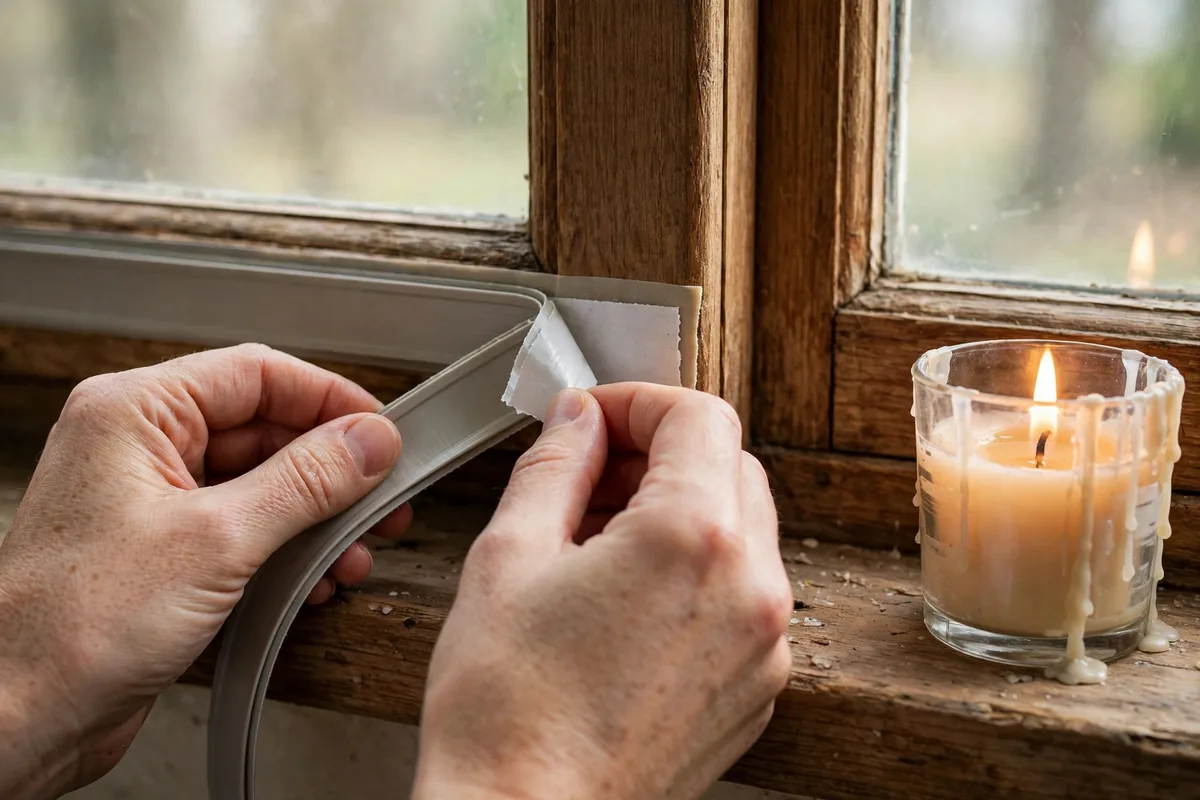
Find the leaks first with the classic test from window insulation guidance: hold a lit candle or incense stick near the frame on a windy day and watch the flame — where it flickers, air is moving. Seal moving joints with self-adhesive weatherstripping (foam or V-strip), fixed joints and cracked putty with caulk, and tired sash windows with removable sealant or secondary film. Work window by window on the rooms you actually heat.
It is the least photogenic step and the one that changes the room’s temperature most. Thirty minutes with a foam strip outperforms a new throw bought for the window seat every single time.
The Missing Layer: Shades at the Glass
Between the sealed frame and the heavy curtain sits the layer this stack has been missing: cellular (honeycomb) shades. Their pockets trap still air at the glass itself, so they insulate during the hours the curtains stand open — the gap in the routine of Section 10 — and paired under the heavy curtain they form the warmest common combination, as widely used guidance has it. Top-down, bottom-up versions keep privacy while admitting light from the top. And one step cheaper: removable insulation film — the shrink-film kit — is the lowest-cost full-pane layer for rented or tired windows, near-invisible when applied tight, and it comes off in spring without a trace. No layer here replaces sealing; all of them assume it.
4. The Draft Stopper, Styled Instead of Hidden

The draft stopper — a fabric tube filled with sand or dried rice, laid along the sill — is the insulation layer you can sew, buy in herringbone wool or tweed, and treat as part of the styling rather than an apology. Match it to the curtain fabric or the room’s throws and it reads as a bolster; in a contrast colour it becomes the sill’s deliberate accent line. On doors the same idea guards the bigger gap, but windows are where it earns its keep nightly.
Size it exactly to the window’s width, ends tucked to the frame. A gap at either end is a chimney, and the cold will find it with an accuracy that feels personal.
5. Give the Sill a Glow: LED Candles and Lanterns

A candle in the window is an old symbol of warmth and welcome — and an open flame beside curtains is exactly the risk modern LED pillars exist to remove. Cluster three flameless candles of different heights on the sill among pine sprigs and cones, or set a lantern at the window’s corner, and from outside the house glows; from inside, the black January pane becomes a lit scene instead of a mirror. The principle is the same one behind our holiday window display ideas, kept quieter for the long months after the decorations come down.
Put them on a timer (on at dusk, off at bedtime) and the glow keeps itself. Real flame stays on the table, in a holder, away from fabric — winter styling should never trade warmth for worry.
6. Frost the Corners, Keep the View
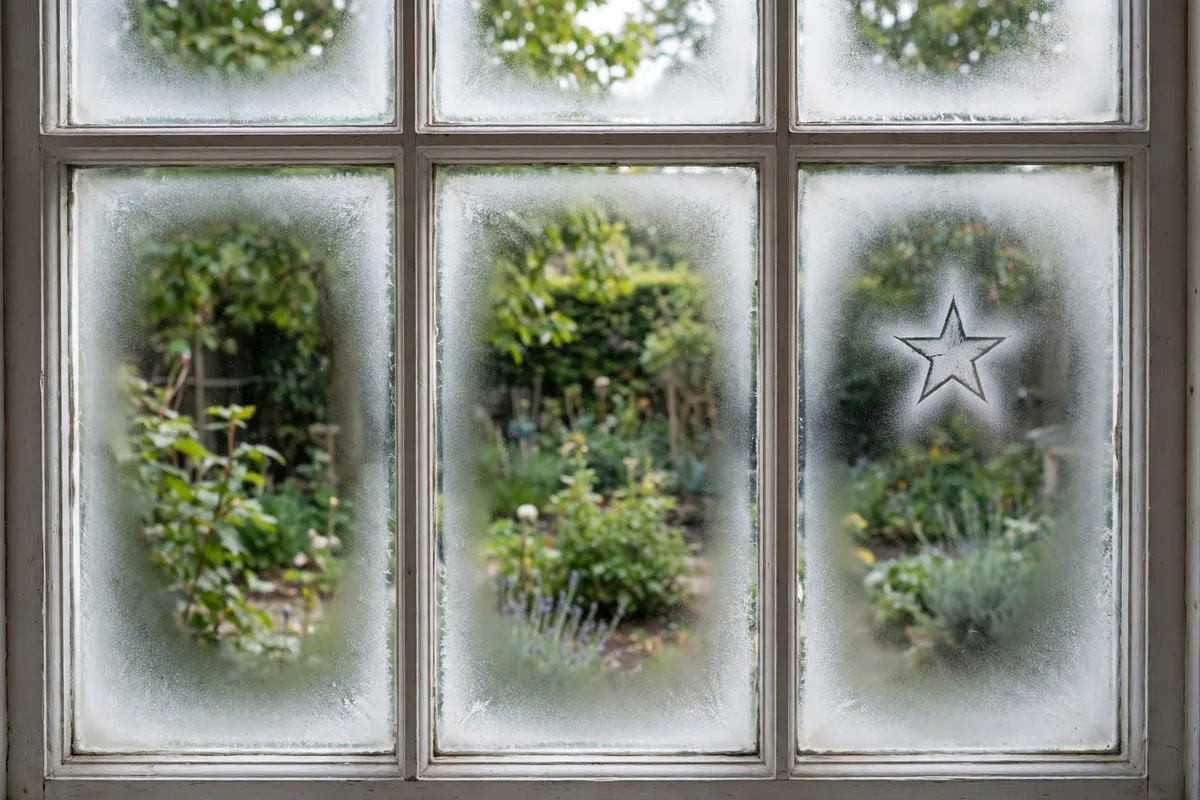
A whisper of winter on the glass itself: removable faux-snow spray frosting the corners of each pane, a paper snowflake or two, a stencilled star — kept to the edges so the centre stays clear for light and view. The corners are where real frost gathers first, so the decoration reads as weather, not wallpaper. It wipes off with a damp cloth when the season turns, which makes it the renter-friendliest layer in the whole stack.
Heavy frost film has a daylight cost — in mid-winter, light is too precious to filter. Corners and edges only: the frame of frost, the middle left to the sky.
7. Make the Deep Sill a Seat, Not a Shelf

If any window has a deep sill or a low radiator cover, winter wants it sat on: a cushion pad, two pillows against the frame, a folded throw, and the weakest winter sun becomes an appointment. It is the coldest seat in the house made deliberate — which only works because the sealing and the stopper (§§3–4) already killed the draft that would have made it a punishment. A small side table or the sill’s end holds the mug and the book.
Seal the window first (§3) or the nook is a draft with cushions. For the full treatment, it pairs with our cozy reading corner ideas — same chair-side logic, better light.
8. Greenery That Survives Winter Light

The sill garden shrinks honestly in winter: light levels drop, and the sun-worshippers from the summer sill sulk or die. Choose for the light you have — small potted evergreens, ivy, snake plants and ZZ plants tolerate the dim months, and forced bulbs (paperwhites, hyacinths, amaryllis) are winter’s own flowers, timed for exactly this windowsill. A row of green against the frost is also the view from the street at its most alive.
Keep pots off cold glass contact on freezing nights, and water less than summer habit suggests — winter roots rot in kindness. Grouping helps humidity and looks like a garden rather than a queue.
9. Hang the Winter Wreath Inside the Glass

December’s wreath faced the street; January’s faces you. A small eucalyptus or pine wreath hung inside the window on a ribbon — from the latch or a suction hook — lasts longer out of the weather, silhouettes against the morning light, and carries the season past the twelfth night without a bauble in sight. Paper snowflakes on the neighbouring pane keep it company at zero cost, cut from yesterday’s paper.
Keep both clear of the candle cluster (§5) and out of the curtain’s swing. Mist a fresh wreath every few days and it will see out the frost season in green. The hanging paper star belongs to this same quiet tradition — the Scandinavian winter custom of a lit star in the window through the dark months; here it hangs inside, with the wreath, facing the room.
10. Run the Daily Open-Close Routine

Styled windows have a daily rhythm worth automating by habit: sheers and heavies open on waking (daylight and solar gain are free heating), heavies closed at dusk the moment the glass goes cold, sill candles on their timer, and a ten-second wipe of condensation from the corners on frosty mornings before it feeds mould. South-facing windows earn the most from the open hours; north-facing ones can stay layered longer without losing anything.
When spring returns, the stack reverses to the summer window logic of our summer living room refresh ideas — sheers forward, heavies rested, glass bare to the light again. Motorised versions of this routine exist — shades that close themselves at sunset — but the honest equivalent is the one in this section: a habit, kept daily, costing nothing.
Frequently Asked Questions About Winter Window Styling
What curtains insulate best in winter?
Heavy, lined or thermal curtains in velvet, wool or heavy cotton, hung high, wide and floor-length so cold air cannot spill beneath them. A sheer underneath keeps daytime privacy — the combination outperforms either layer alone.
How do I find where my window drafts?
The candle or incense test: move a flame slowly around the frame on a windy day and watch for flickers — each flicker marks a leak. Seal moving joints with weatherstripping and fixed joints with caulk.
Are LED candles in windows safe?
Yes — they are the recommended replacement for the traditional real candle in the window, giving the same welcome glow with no flame near curtains or wooden sills. Choose realistic flicker models and set them on timers.
Will thermal curtains make my room too dark?
Only if they are your only layer. Pair them with sheers: heavies open by day (stacked to the sides), sheers filtering light, heavies closed at dusk. The room keeps its daylight and gains its evenings.
What is a pelmet and do I need one?
A pelmet is a cover box above the curtain rod that traps the cold air falling behind curtains so it cannot spill into the room. It is the insulation guides’ finishing touch for floor-to-ceiling drapes — worthwhile on large, cold windows, optional elsewhere.
How do I stop window condensation in winter?
Open curtains by day so air circulates at the glass, wipe corners each cold morning, keep sill plants from touching the pane, and avoid drying laundry beside cold windows. Persistent heavy condensation is a ventilation issue beyond styling’s reach.
Can renters do winter window styling?
Almost all of it: layered curtains on tension or existing rods, adhesive weatherstripping (removable), draft stoppers, LED sills, removable frost spray and paper snowflakes all leave no trace. Only caulking fixed joints needs a landlord’s nod.
Which plants survive a winter windowsill?
Low-light tolerant plants: small evergreens, ivy, snake plants and ZZ plants, plus forced bulbs like paperwhites and hyacinths for winter flowers. Group them where the day’s light actually reaches and water sparingly.
How is winter window styling different from holiday window displays?
Direction and duration. Holiday displays face the street for December; winter styling faces the room for January and February, and its budget goes first to insulation — sealing and layers — with decoration built on top of a warm window.
When should winter window layers come down?
As nights soften — typically March: heavies wash and store, sheers move forward, the seal and stopper stay (they work against summer heat and noise too, in smaller measure).
Are cellular shades worth it for winter?
They are the one layer that works while your curtains are open: the honeycomb pockets hold still air at the glass through the daylight hours, when the heavy stack is stacked back. Paired under lined curtains for the night, they complete the warmest common combination. Renters and tired windows can take the cheaper route first — shrink-film — and judge the difference before spending on shades.
Conclusion
A winter window earns its styling: seal the frame, stack the layers, stop the sill gap, then add the glow, the green and the wreath that make the cold side of the house feel like the warmest seat in it. Do the invisible work first and the visible work will look — and feel — twice as good.