
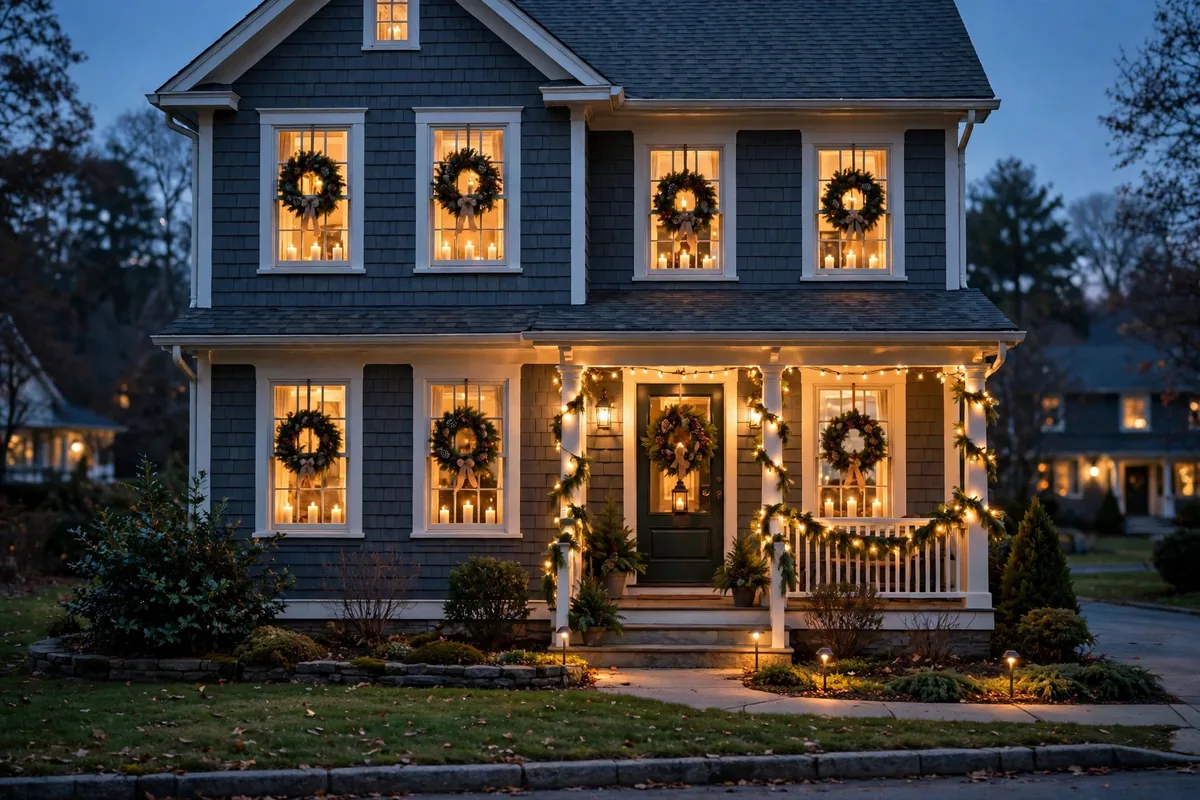
A holiday window has two audiences, and most displays only serve one of them. From the street it should read as a warm signal — this house is celebrating. From inside, the same window frames your own evenings, so it cannot be a tangle of cords, suction cups and plastic that you stare at for six weeks. The displays below are built to work from both sides: simple shapes, warm light, and everything secured, timed and safe.
Work window by window rather than room by room. Two or three front windows dressed identically will always look more expensive than six windows dressed six different ways.
In this guide: Start With the View From the Street · Frame the Window With Garland or a Wreath · Line the Sill With Candles and Lanterns · Hang Ornaments and Stars in the Glass · Build a Snowy Scene on the Sill · Put a Small Tree in the Window · Choose Lights That Read From Outside · Switch the Same Windows for Autumn and Halloween · Work With Curtains, Blinds and Privacy · Keep It Safe: Heat, Moisture and Cords
The starter kit: Almost every display below runs on the same small kit: clear removable hooks and suction cups rated for glass, near-invisible fishing line or fine thread, battery fairy lights and flameless candles on timers, white felt or batting for snow scenes, and black card for silhouettes. Buy the kit once and the only per-display cost is the decorations themselves.
Window Treatments at a Glance
| Window | Best Treatment | Why It Works |
|---|---|---|
| Large picture window | Hanging stars/ornaments + sill scene | Uses the full glass area without blocking light |
| Pair of matching windows | Identical wreath in each | Symmetry reads as architecture, not decoration |
| Bay window | Small tree or village on the sill platform | The deep sill is a ready-made stage |
| Narrow hallway window | Single flameless candle | The classic one-candle welcome, zero clutter |
| Kitchen window | Herb pots + mini wreath on the latch | Survives steam and daily use |
1. Start With the View From the Street
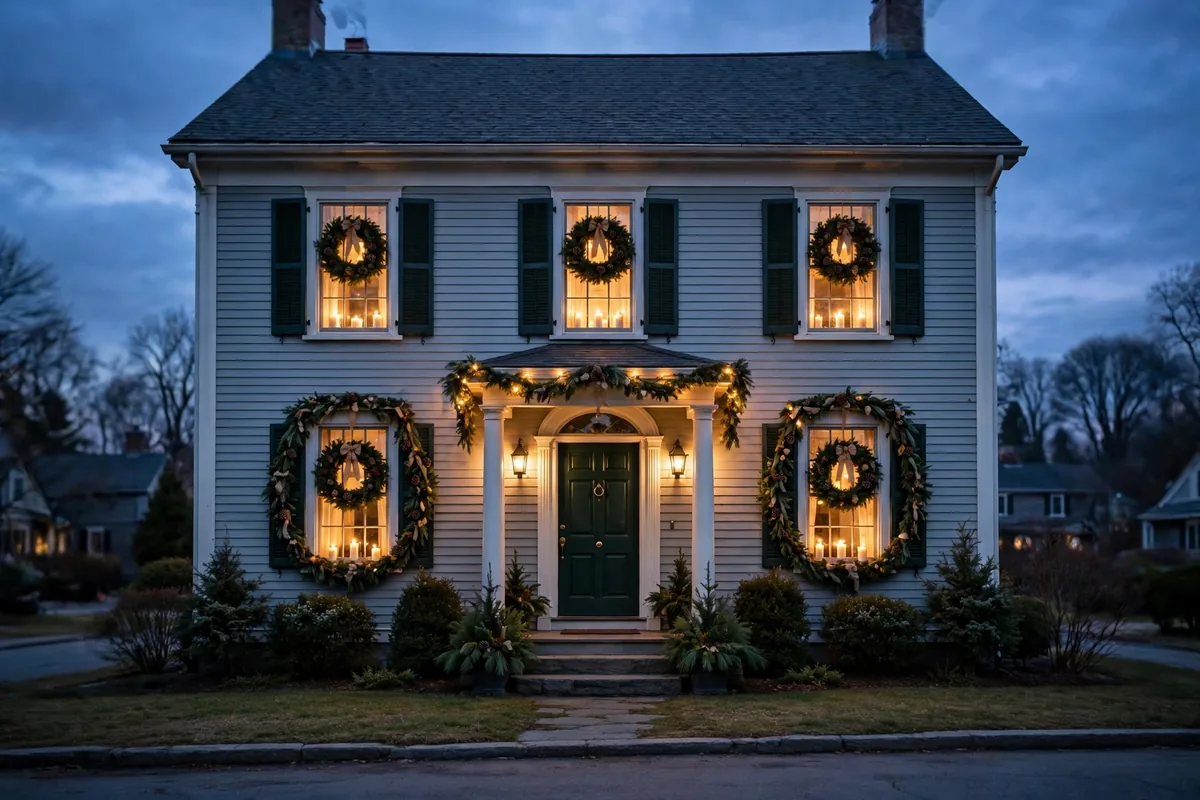
Before you hang anything, walk across the street at dusk and look back. That is the view you are designing. From twenty metres away, detail disappears — what reads is shape and light: a wreath’s circle, a candle’s point of glow, a tree’s triangle, symmetry between windows. Choose one strong shape per window and repeat it.
Take a phone photo from the street when you think you are finished. The camera is ruthless about the things the eye forgives — the drooping garland end, the one candle that is out, the display that only works from inside.
2. Frame the Window With Garland or a Wreath
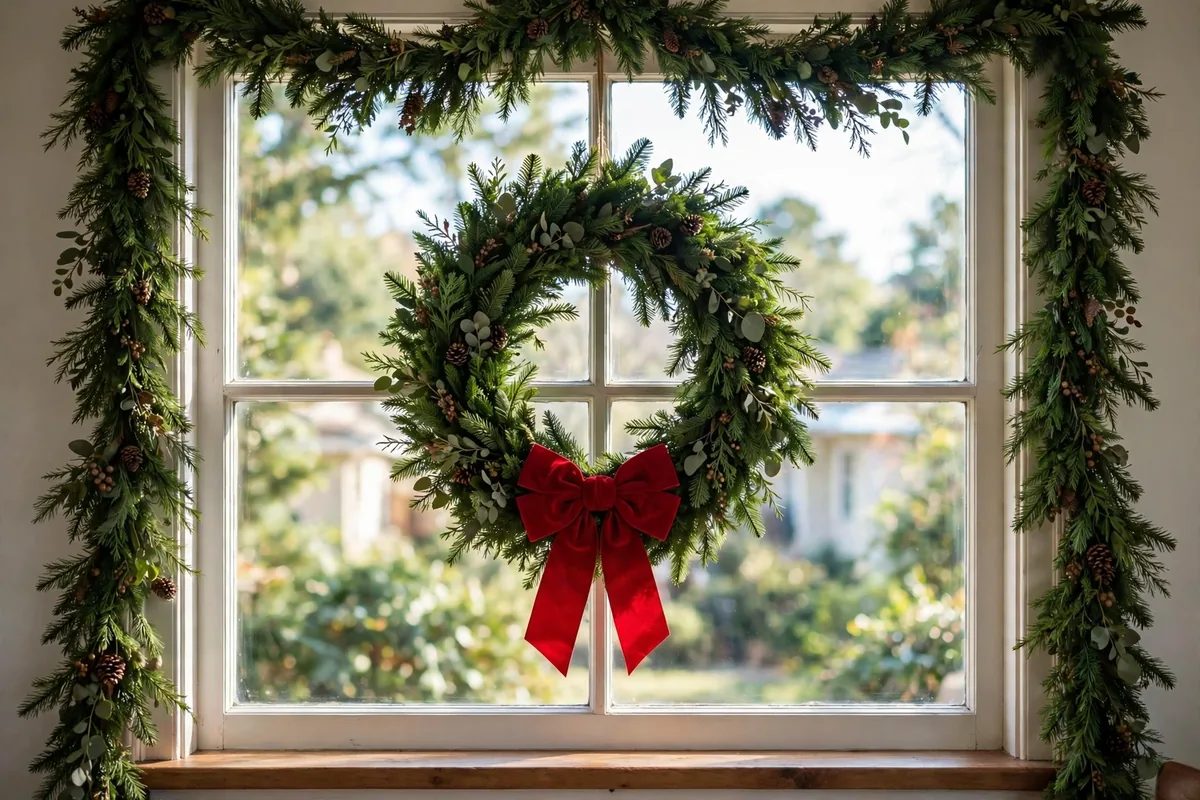
The two classic frames: a wreath centred in the glass, or a garland run around the inside of the frame. A wreath hangs from a suction hook on the glass or a ribbon looped over the top of the sash — never a nail in the frame. Identical wreaths in every front window is the single most polished look in this whole guide, and the easiest: buy them in one trip, hang them in twenty minutes.
Window specialists give the same advice: the Window Genie holiday decorating FAQ recommends hanging wreaths directly on the glass or framing the window with garland and lights — and battery candles on the sill, which is where this guide goes next.
3. Line the Sill With Candles and Lanterns
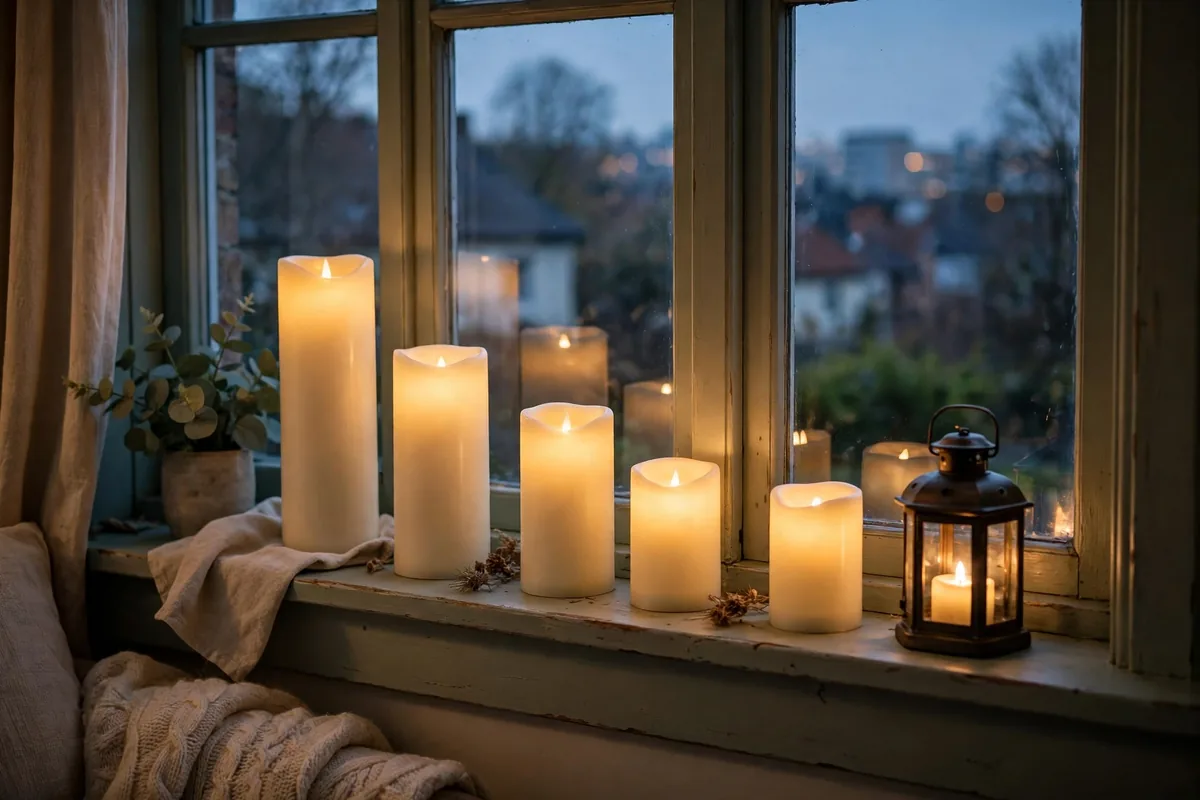
The one-candle-in-each-window tradition survives because it works: a single point of warm light, centred, says welcome in every language. Modernise it with flameless candles on timers — same glow, no flame anywhere near curtains — or group three candles of different heights at one side of a wide sill, with a small lantern as the anchor.
Keep spacing deliberate: either dead centre or a clear asymmetric group. A candle placed “somewhere along” the sill reads as forgotten, not styled. Set timers once and the whole house lights itself at dusk, which is also when the street view matters most.
4. Hang Ornaments and Stars in the Glass
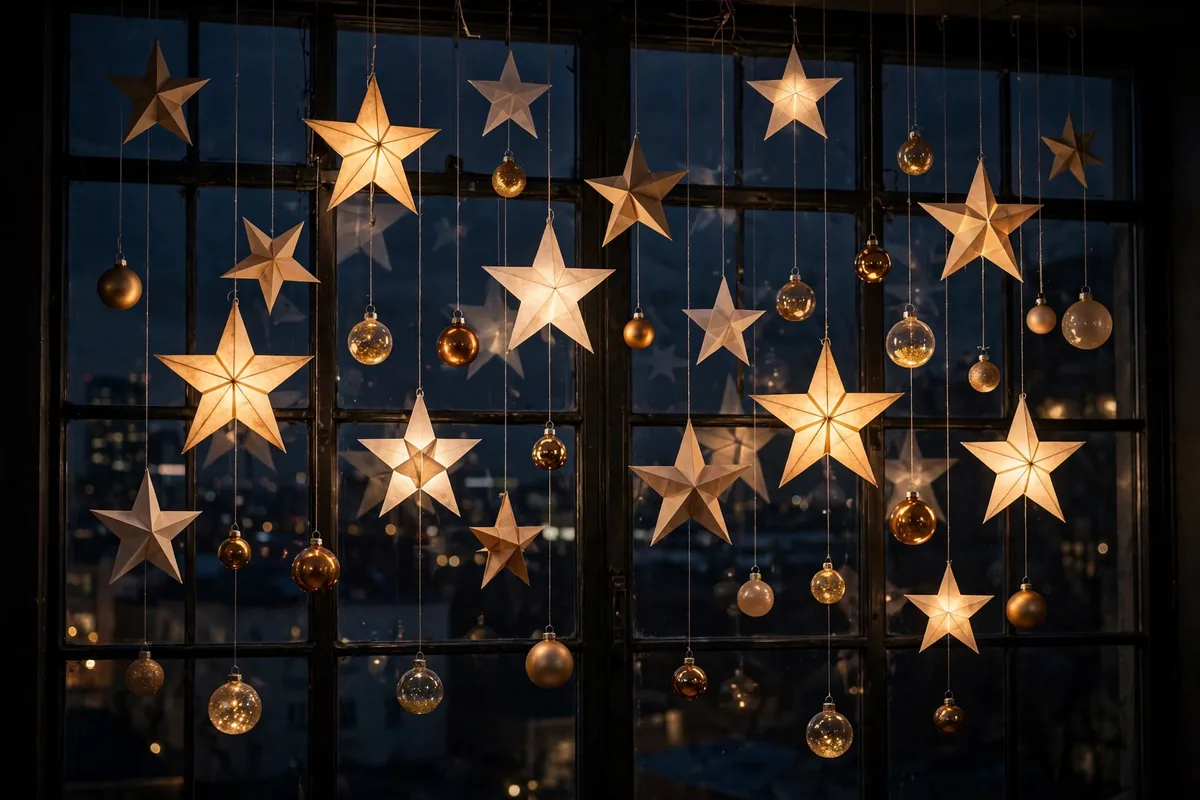
A big picture window earns a hanging display: paper or metal stars, baubles on near-invisible thread, or snowflakes, hung at staggered heights in the top two-thirds of the glass. Backlit by the room at night, they float; by day they cast the decoration into the room instead. Vary heights in a rhythm — high, low, mid — rather than a straight row.
Hang from the top of the frame with removable hooks or a slim tension rod inside the reveal, so nothing sticks to the glass itself. Keep the lowest hanging piece above head height for anyone opening the window, and above pet-leaping height too.
Hanging the Cascade, Step by Step
Step 1 — Fix the line. Run a slim tension rod inside the window reveal, or place clear removable hooks along the top of the frame, roughly 20 cm apart.
Step 2 — Vary the drops. Tie stars or baubles on fishing line at clearly different lengths — short, mid and long drops roughly 20, 40 and 60 cm — so the display has a rhythm instead of a straight row.
Step 3 — Keep the bottom clear. The lowest piece should stay above head height for anyone opening the window, and out of pet-leaping range.
Step 4 — Check it twice. Look from the sofa for tangles, then from the street at dusk for silhouette — the cascade should read as floating points, not a curtain.
5. Build a Snowy Scene on the Sill
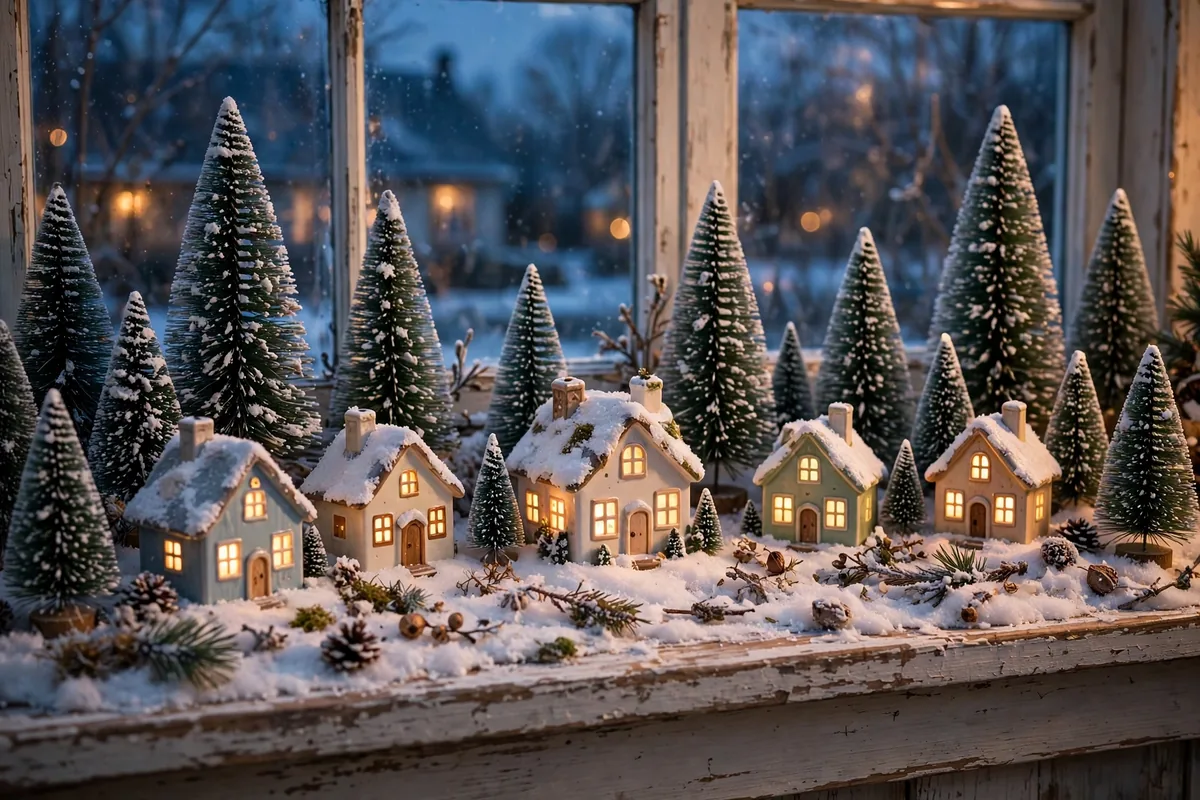
A deep sill is a stage. Lay a strip of white felt or batting as snow, then build the scene in threes: tiny houses or a church, bottle-brush trees, a figure or two, and one light source — a flameless tealight or the houses’ own battery windows. From the street it reads as a lit village; from inside, it is the detail children and guests lean in to see.
This is also the renter-friendly display: nothing attached, nothing permanent, the whole scene lifts off in one box in January. Keep the snow strip narrower than the sill so the scene has a visible front edge, like a theatre stage.
6. Put a Small Tree in the Window
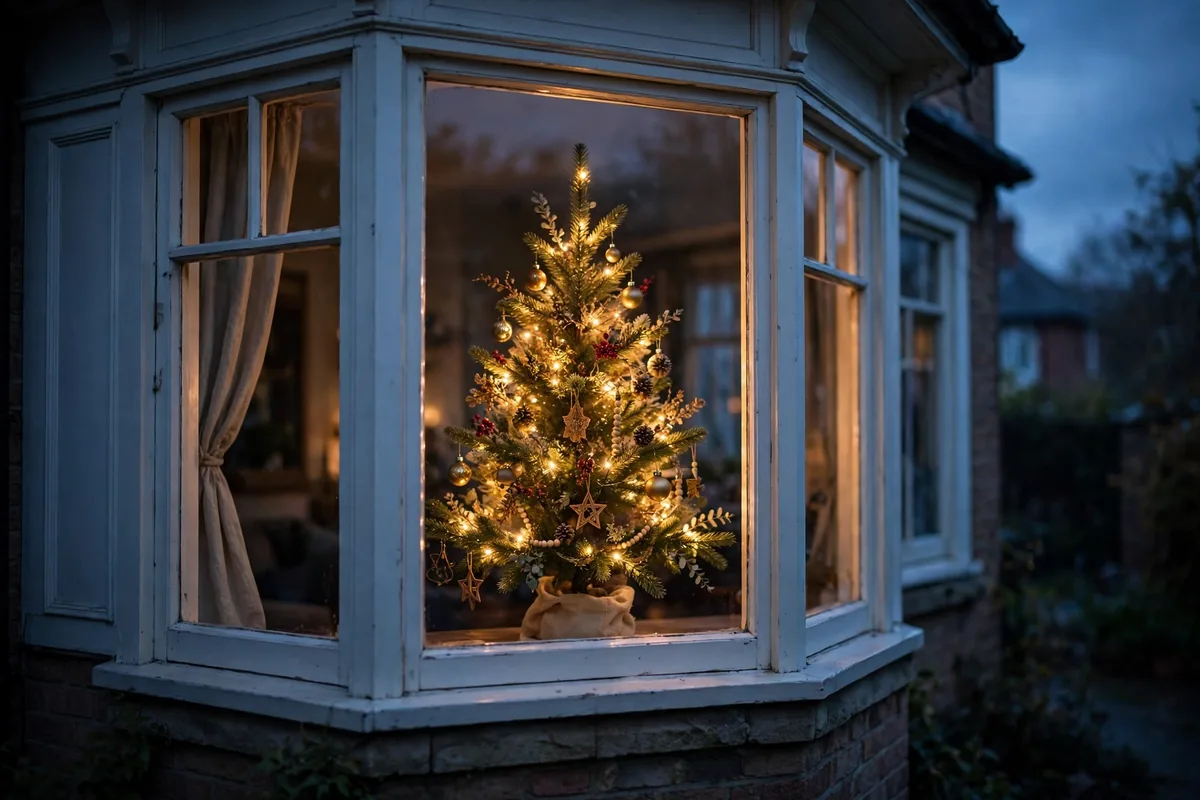
If the main tree lives away from the windows, a small second tree in a bay or front window carries the celebration to the street. The sizing and styling rules are the same as for any small tree — our small Christmas tree styling ideas cover the heights, hidden bases and micro lights that suit it — with one addition: decorate the street side fully, because that is the side on show.
On a timer, a window tree does more for a home’s holiday presence than any other single item in this guide. Mind the gap between tree and glass — a hand’s width — so branches and lights never press against a cold pane or a hot radiator below it.
7. Choose Lights That Read From Outside
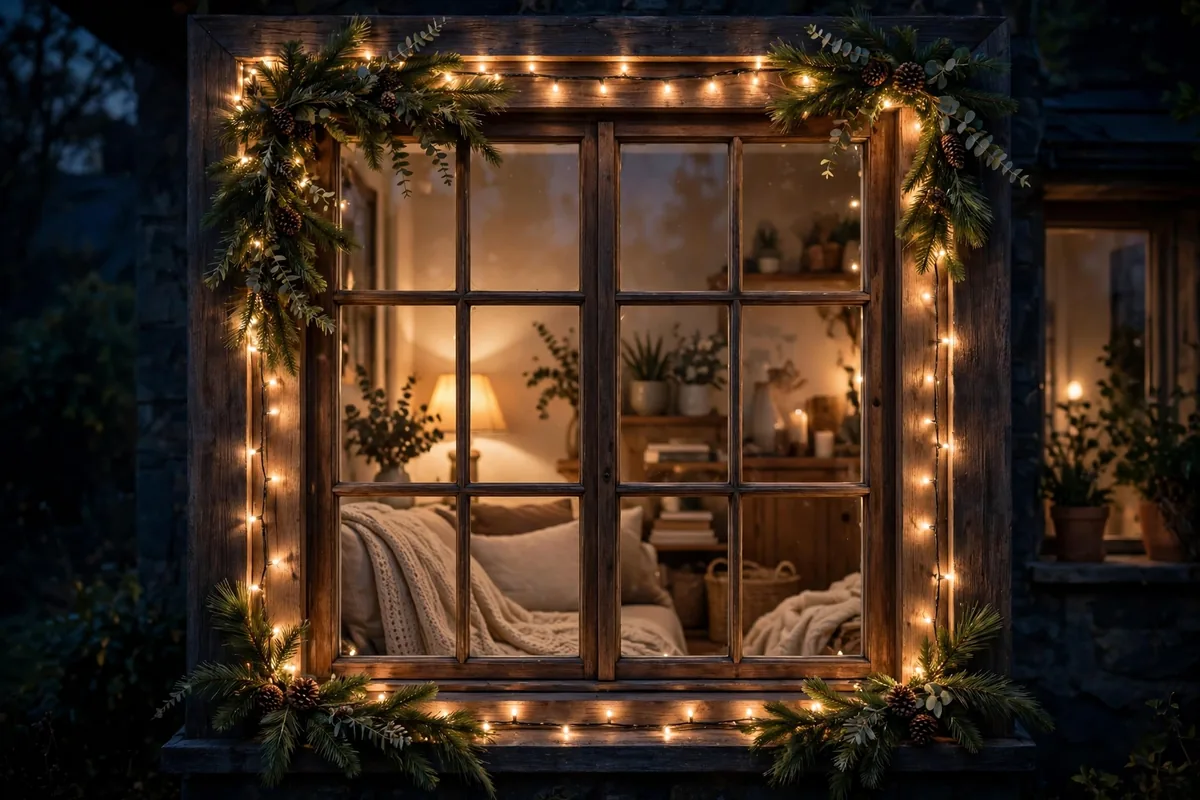
Light colour decides whether a display looks cosy or commercial from the street. Warm white (the candlelight end of the scale) flatters every house colour and every other decoration; mixed colours and flashing modes fight the wreaths and candles for attention. Pick one temperature and use it in every window, including the tree.
Run light strings around the inside of the frame with clips made for the purpose, cords dropped straight down to the socket at one corner — never draped across the sill scene or taped across glass. Put every window on the same timer schedule so the facade switches on as one composition, the way whole-house schemes in our decorating home for Christmas ideas are planned.
8. Switch the Same Windows for Autumn and Halloween
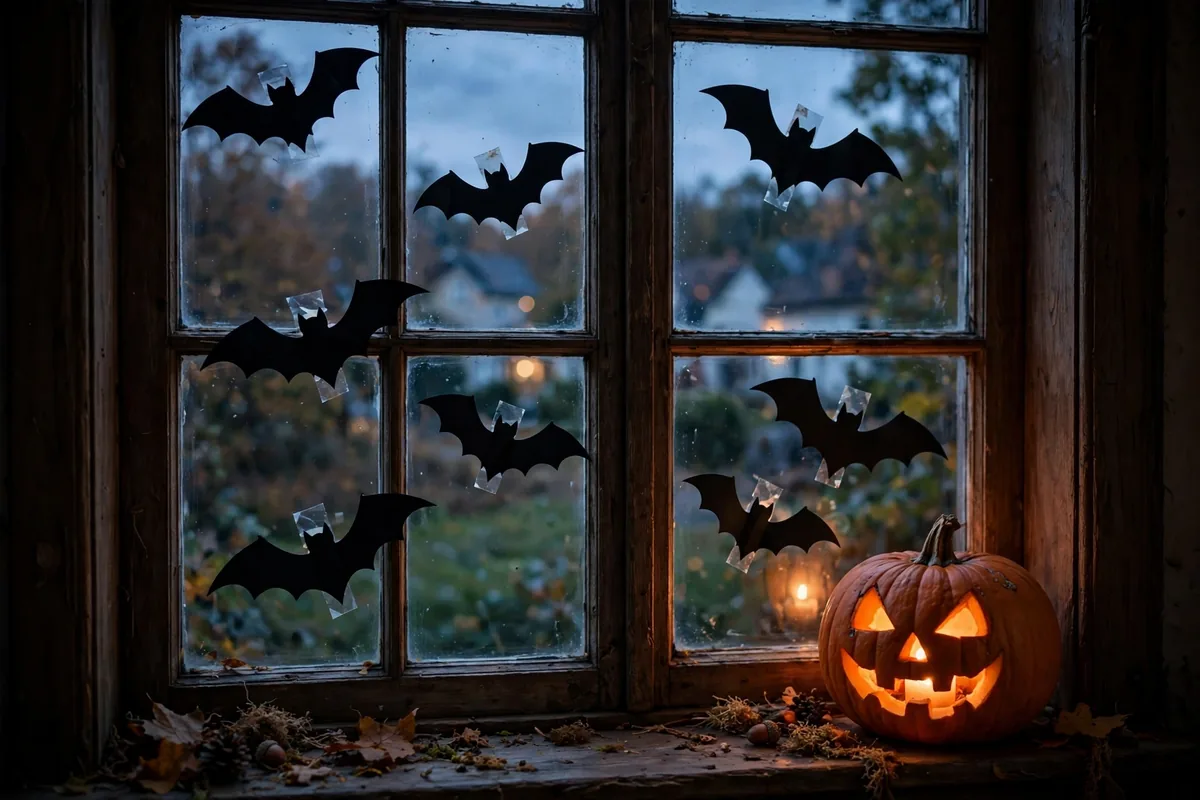
The frame-and-sill system is season-proof; only the dressing changes. For October: black silhouette shapes on the glass (bats, a cat, branches), a pumpkin or two on the sill where the village will sit in December, and the same candles with their warm glow reading slightly spookier against the dark shapes. Houses continuing the theme outdoors can borrow from our front porch Halloween ideas so window and porch tell one story.
Paper silhouettes are the cheapest display in this guide and the one children can make. Cut them from black card, fix with a dab of reusable adhesive at the corners, and they store flat inside a book until next year.
9. Work With Curtains, Blinds and Privacy
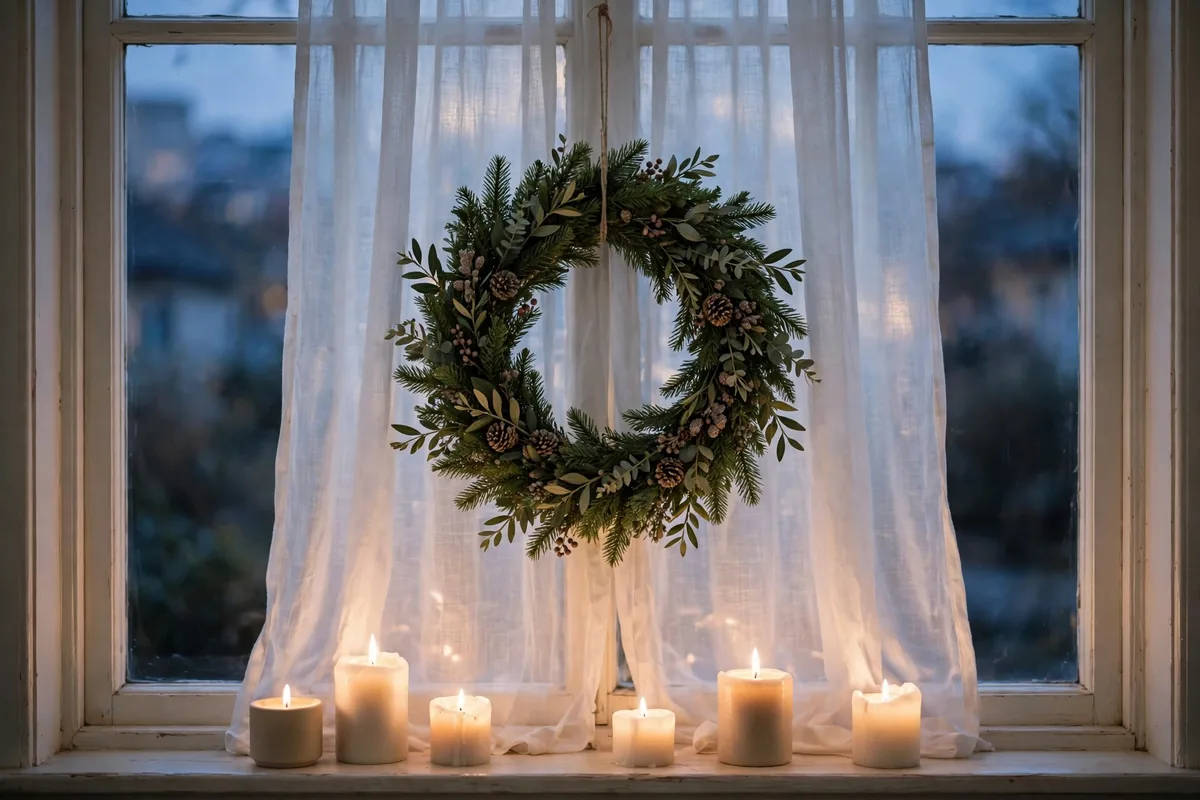
Treatments are the backdrop, not the obstacle. Sheers drawn behind a display soften it and hide cords and the backs of decorations — often the difference between styled and makeshift from the street. With blinds, open them to a consistent angle across all front windows in the evening, or raise them fully above the display line.
Decide the privacy bargain consciously: a dressed front window invites looking, so in rooms you live in after dark, pair the display with sheers or position the scene high in the glass, keeping the lower pane screened. The display gets its audience; you keep your evenings.
10. Keep It Safe: Heat, Moisture and Cords
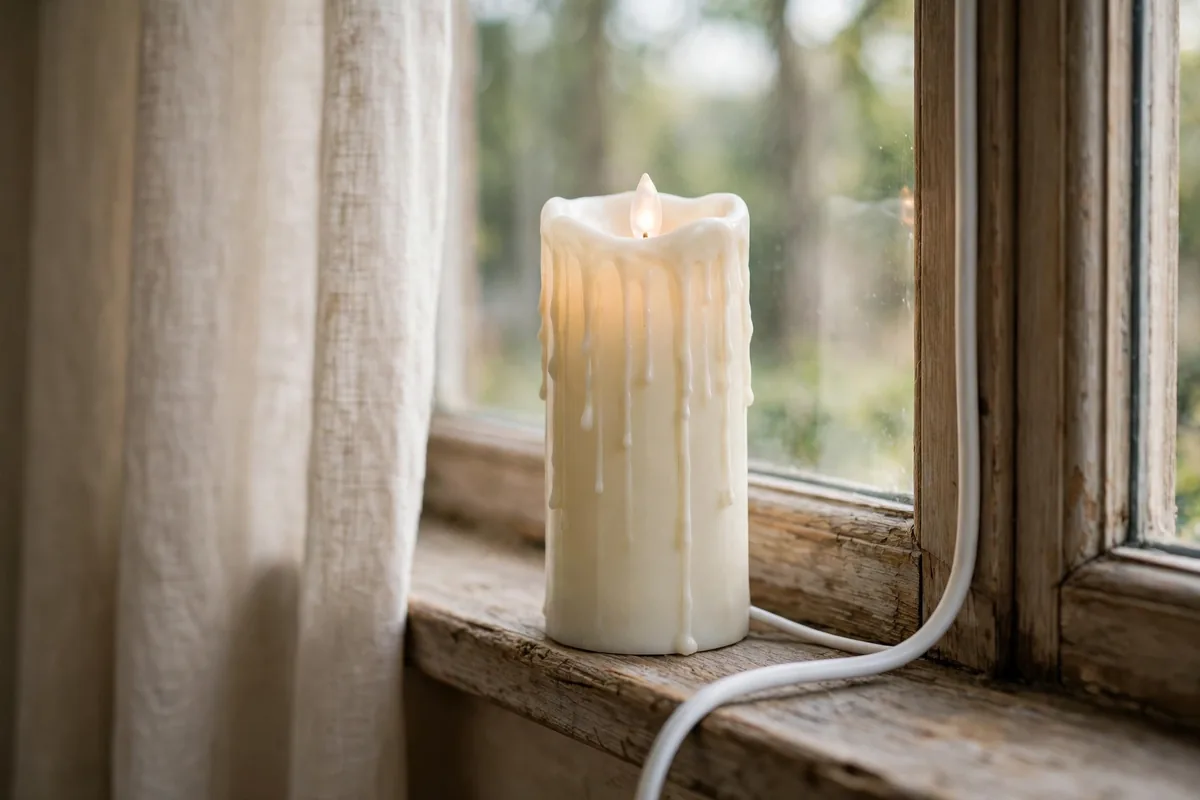
Windows concentrate three hazards: fabric (curtains), water (condensation), and heat (radiators under most sills). The rules that cover all three: flameless candles instead of real flames anywhere on a sill; nothing electrical sitting in the condensation line at the glass edge; cords run down, not across, and never pinched by a closing window.
The candle rule deserves emphasis, because curtains are exactly the material open flames must never reach. The U.S. National Park Service’s holiday safety guide, drawing on NFPA advice, recommends keeping burning candles at least 12 inches from anything that can burn — on a windowsill with curtains moving in the draught, flameless candles are simply the right tool. Pair displays with the fireplace rules in our Christmas mantel arrangement ideas and the whole house follows one safety standard.
Frequently Asked Questions About Holiday Window Displays
How do I hang a wreath on a window without damaging it?
Use a heavy-duty suction hook on clean, dry glass, or loop a ribbon over the top of the sash window so the wreath hangs from the frame without any fixing at all. Never nail or screw into a window frame — it voids warranties and lets in weather.
What looks best in a window from outside?
One strong shape plus warm light: a wreath, a tree, a row of candles, or hanging stars. Fine detail is lost beyond a few metres, so spend effort on silhouette, symmetry and light colour rather than small ornaments.
Should every window have the same display?
Front windows, yes — identical or clearly matching treatments read as one designed facade. Side and back windows can vary freely; they are for the household, not the street.
Are real candles safe in windows?
They are the risky choice there: curtains move, draughts bend flames, and sills collect flammable decorations. Flameless candles on timers give the same street glow with none of the hazard, and they never drip wax on paintwork.
How do I decorate a window with no sill?
Hang the display instead: a wreath or stars in the glass, a garland around the frame, or a hanging planter-style basket at one corner. A narrow console or stool placed under the window can also stand in as a sill.
What colour lights look best in windows?
Warm white, consistently across every window and the tree. It reads as candlelight from the street and flatters both traditional and modern houses. Save coloured lights for a single deliberate feature, if at all.
How do I stop cords looking messy?
Run them straight down one corner of the frame in clips, choose cord colours that match the frame (white on white, green in garlands), and let sheers or the display itself hide the drop to the socket. One cord per window, planned, beats three improvised ones.
Can I decorate windows in a rental?
Yes — everything in this guide is removable: suction hooks, sill scenes, tension rods, flameless candles and paper silhouettes with reusable adhesive. Nothing requires a nail, a screw or permission-worthy change.
When should holiday window displays go up?
Halloween displays through October; winter and Christmas displays from late November to the first week of January. The frame elements — garlands, candles, stars in neutral finishes — can stretch longer as “winter” decor.
How do I display in a bay window?
Use the sill platform as a stage: a small tree at the centre bay or a village scene across all three, candles at the side bays, and hanging pieces kept to the centre glass so the angled panes stay clear.
Taking It Down: Storage That Fits in One Box
The displays in this guide were chosen to leave no trace, and they should store the same way. Peel paper silhouettes and clings off the glass and store them flat between sheets of paper inside a book or folder — rolled, they crease; folded, they crack.
Wrap light strings around a piece of stiff card so they cannot tangle, take the batteries out of candles and timers before storing them (stored batteries leak), and put suction cups and hooks in one labelled bag. Everything for every front window should fit in a single lidded box — if it does not, the display was too complicated to repeat next year anyway.
Conclusion
A good holiday window is designed twice — once from the street, once from the sofa — and built from one shape, warm light and fixings that leave no trace. Dress the front windows identically, put everything on timers, keep flames flameless near curtains, and your house will glow like it means it, every evening, without you touching a switch.





Pingback: 10 Reusable Seasonal Decorations Ideas for Every Season
Pingback: Winter Window Styling Ideas: Warmth, Light & Glow