
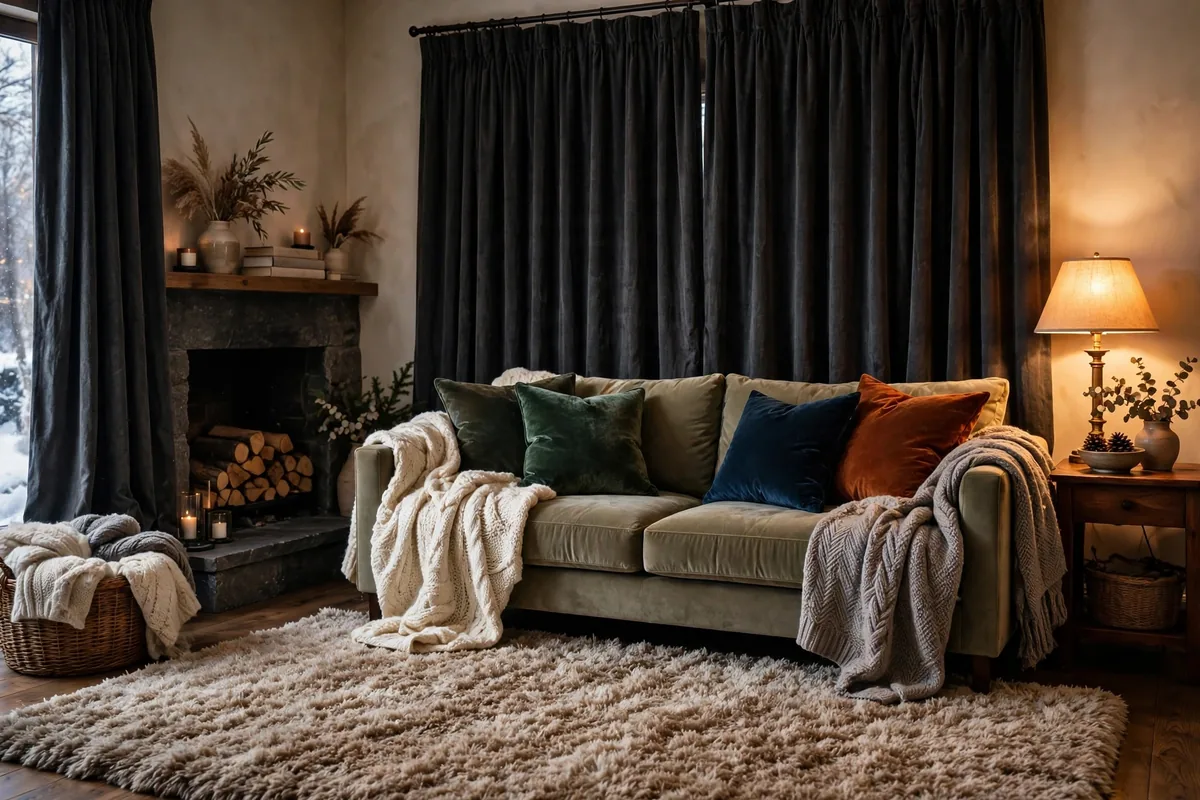
A room can be heated to the same temperature in January as in July and still feel cold — because warmth, as the body reads it, is mostly touch and sight: bare floors, thin curtains, slick cushion covers, a bed made with a single layer. Textiles are how a home feels warm, and winter is when they stop being decoration and become equipment.
The method is layering in the opposite direction to summer: weight back on, texture up, every hard surface softened. Work through the house in the order below and the same rooms, at the same thermostat setting, will genuinely feel degrees warmer.
In this guide: The Three Textile Layers at a Glance · 1. Reverse the Summer Swap: Put the Weight Back On · 2. Layer Cushions in Winter Textures · 3. Hang Heavier Curtains: The Thermal Layer · 4. Layer Rugs: Deep Pile Where Feet Land · 5. Dress the Bed in Tiers · 6. Dress the Table and Chairs Too · 7. Keep a Basket of Warmth in Sight · 8. Add Soft Extras: Poufs, Sheepskins and Window Seats · The Missing Room: The Bathroom · 9. Build the Palette From Texture, Not Pattern · 10. Care for Heavy Textiles So They Last the Decade · Frequently Asked Questions About Winter Textiles · Conclusion
The Three Textile Layers at a Glance
| Layer | Pieces | What It Does |
|---|---|---|
| Base | Rugs, heavy curtains, bedding foundations | Covers cold, hard surfaces; blocks draughts |
| Middle | Throws, cushions, quilts in wool, velvet, bouclé, knit | Traps heat near the body; adds the visible warmth |
| Top | One accent per surface — sheepskin, pouf, runner | The texture contrast the eye reads as “cozy” |
1. Reverse the Summer Swap: Put the Weight Back On
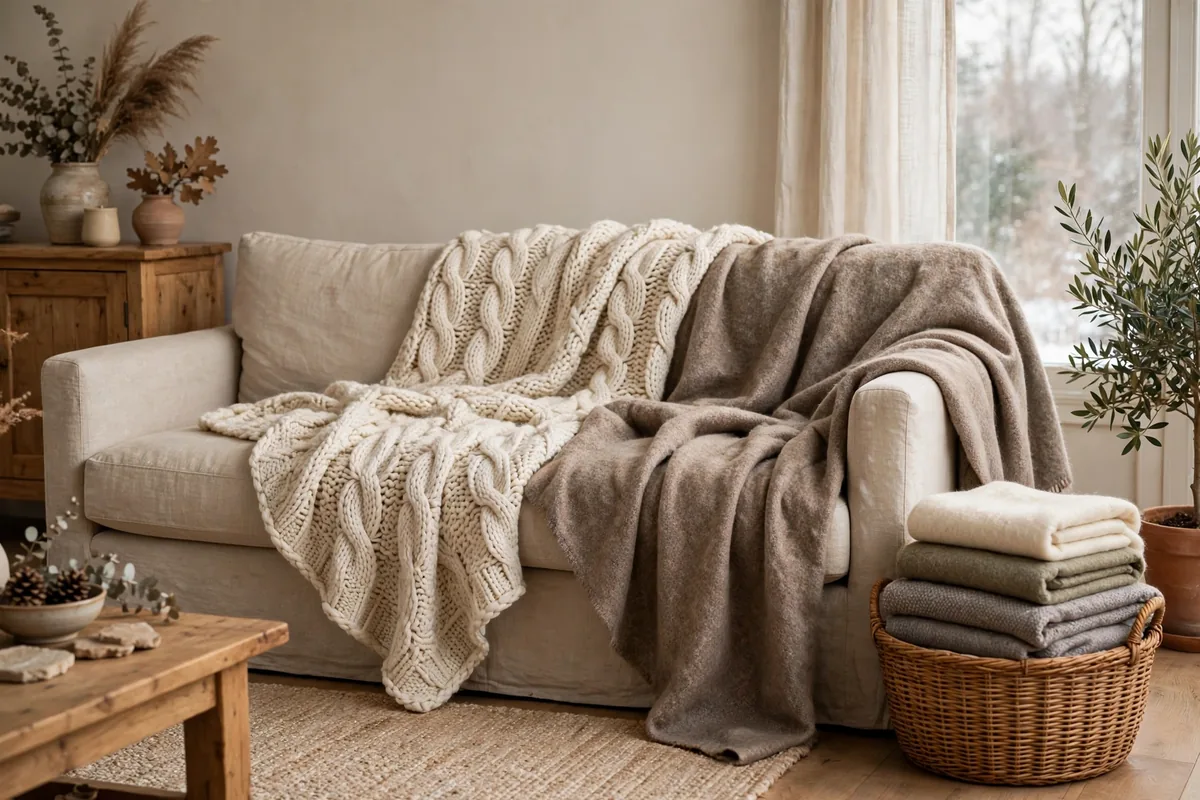
If you ran a summer refresh, this first step is pleasingly mechanical: the labelled bin comes out and the heavy layer goes back on. One throw per seat is the working rule — a wool or chunky-knit throw draped where each person actually sits, not one decorative blanket folded at the sofa’s end for three people to negotiate.
It is the exact reverse of the weight-stripping in our summer living room refresh ideas — which is the point of keeping both sets: the swap takes an hour in each direction, and the room’s temperature feel changes more than any purchase could achieve.
2. Layer Cushions in Winter Textures
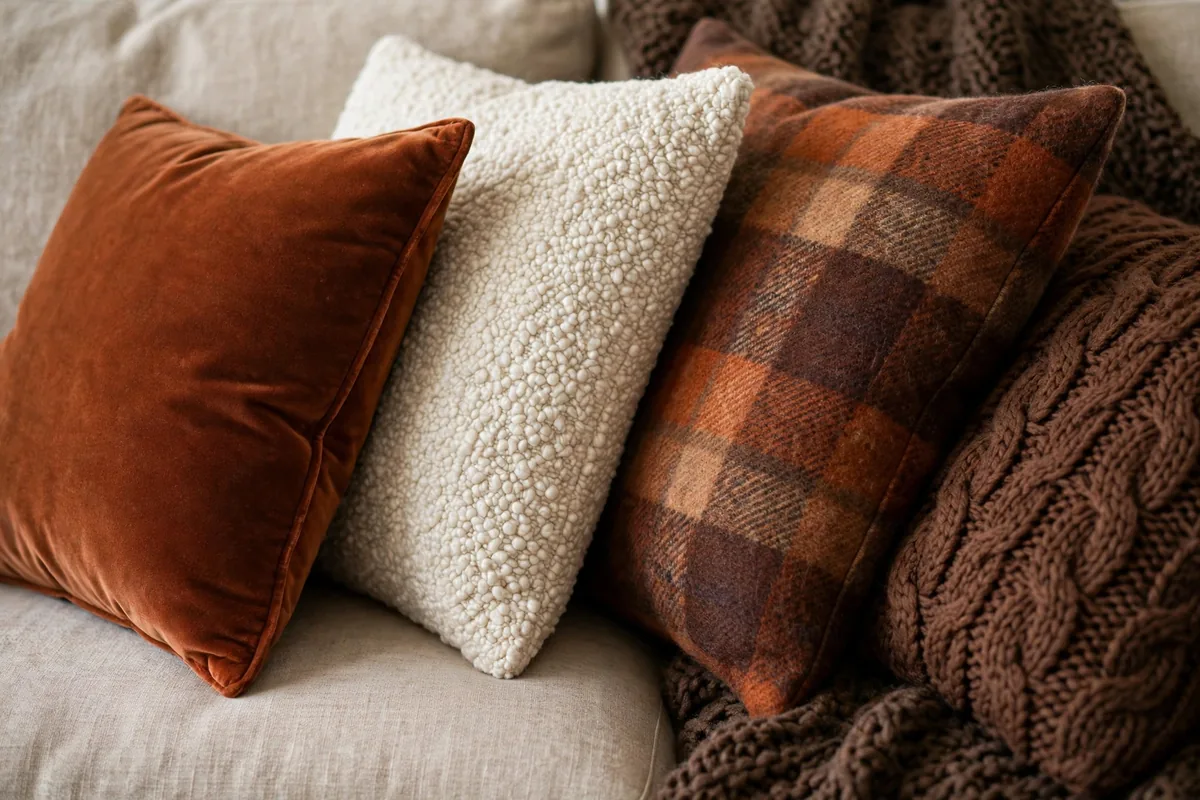
Swap linen covers for the winter weaves: velvet, wool and wool-blend, bouclé, corduroy, chunky knit, a touch of faux fur. Texture contrast matters more than colour matching — a smooth leather chair against a bulky wool cushion feels warmer than two smooth pieces side by side. Fewer, thicker cushions beat a crowd of thin ones, both for comfort and for the look.
On a neutral sofa the winter set can go deep without overwhelming the room — the base stays calm while the cushions carry the season, the same division of labour as in our neutral sofa styling ideas. Keep one cushion per seat genuinely usable: overstuffed styling that has to be moved before anyone can sit down has failed its job.
3. Hang Heavier Curtains: The Thermal Layer
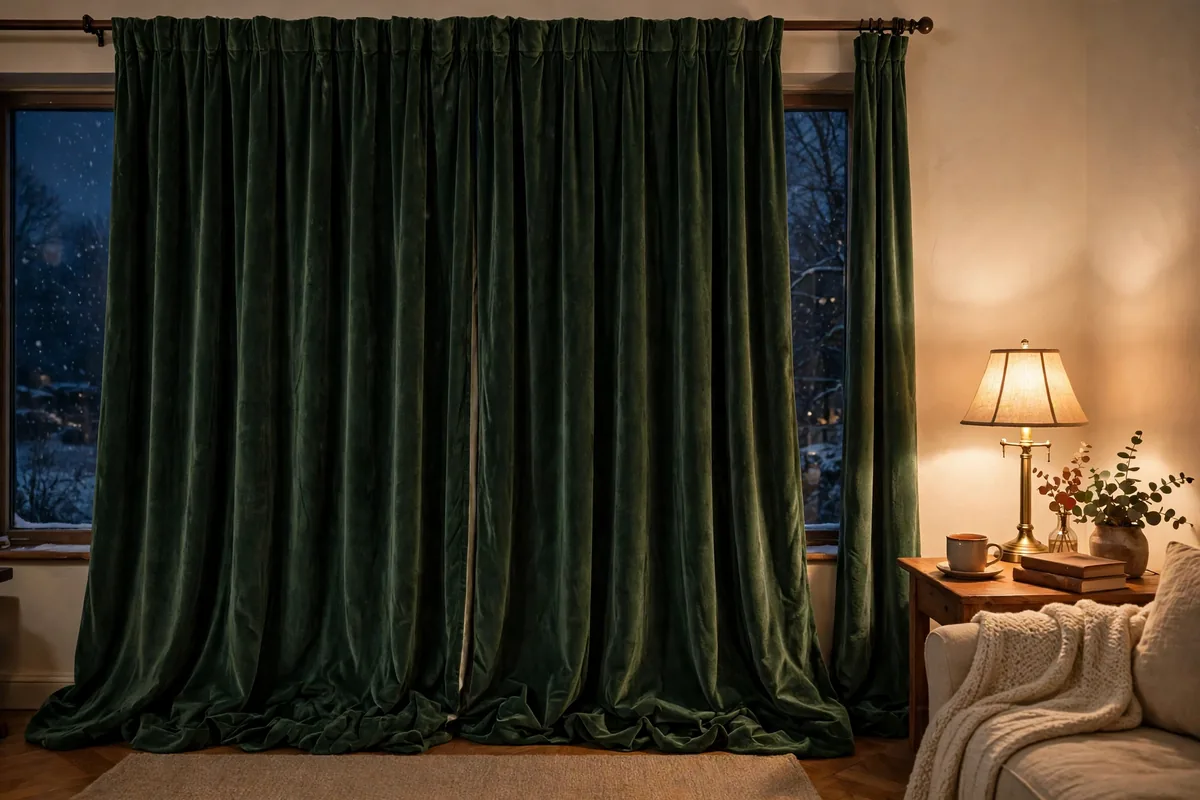
Curtains are insulation you can see. A lined, floor-length drape in velvet, wool blend or heavy cotton creates a pocket of still air against the glass that cuts heat loss and kills the ankle-level draught that makes a room feel cold even when the air is warm. Close them at dusk, the moment the light goes — the day’s warmth stays in the room measurably longer.
The layering guides agree on the mechanism: SeedSheets’ winter warmth guide makes heavy thermal-lined curtains the base layer of the whole system, and a double rod — sheers kept in place, heavy drapes added in front — means spring’s swap is pulling one layer, not rehanging the window.
4. Layer Rugs: Deep Pile Where Feet Land
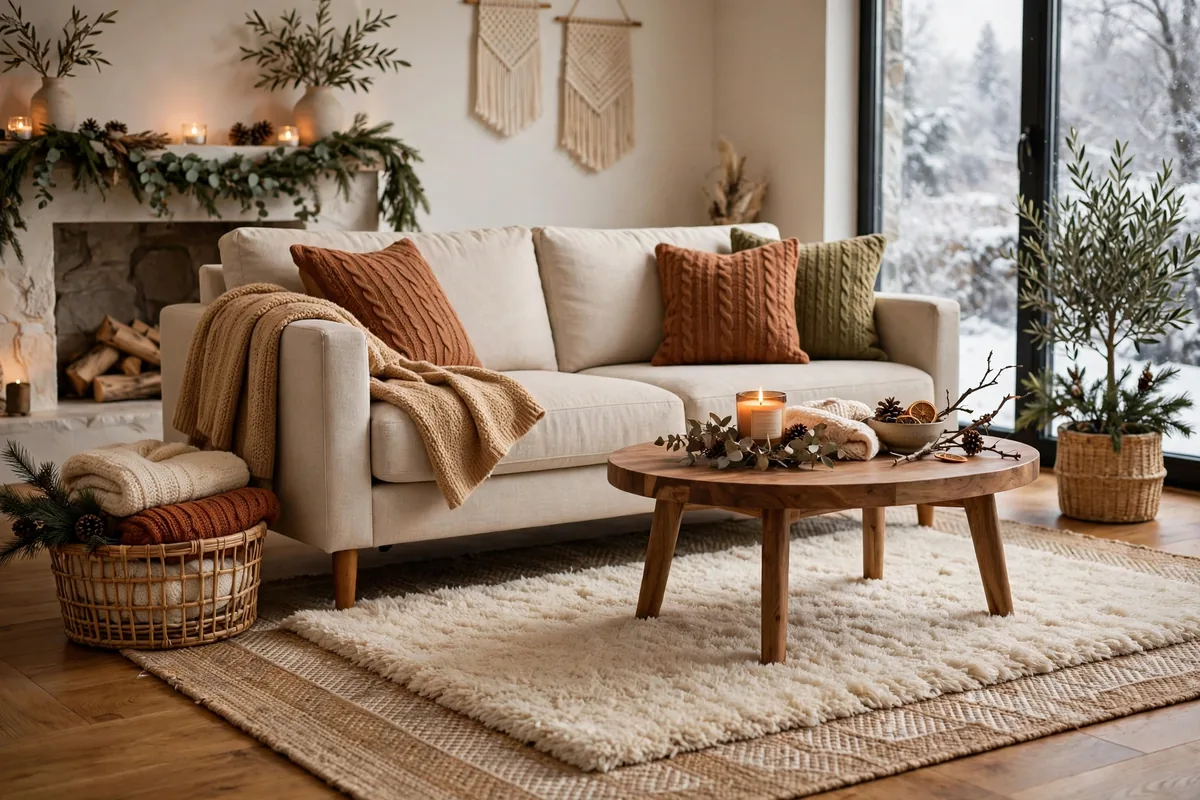
Bare or thinly covered floors are the biggest cold surface in most homes. Winter’s answer is the rug layer: a deep-pile or high-loft rug over the base rug (or over boards), sized so the seating’s front feet sit on it and the landing strip beside beds and sofas is soft. Rug-on-rug also solves the small-rug problem — a treasured smaller rug becomes the top layer over an inexpensive large neutral.
Hallways and the kitchen’s standing spots deserve the same thinking in washable form: a runner where you stand to cook, a mat where boots come off. Cold feet read the whole house as cold.
5. Dress the Bed in Tiers
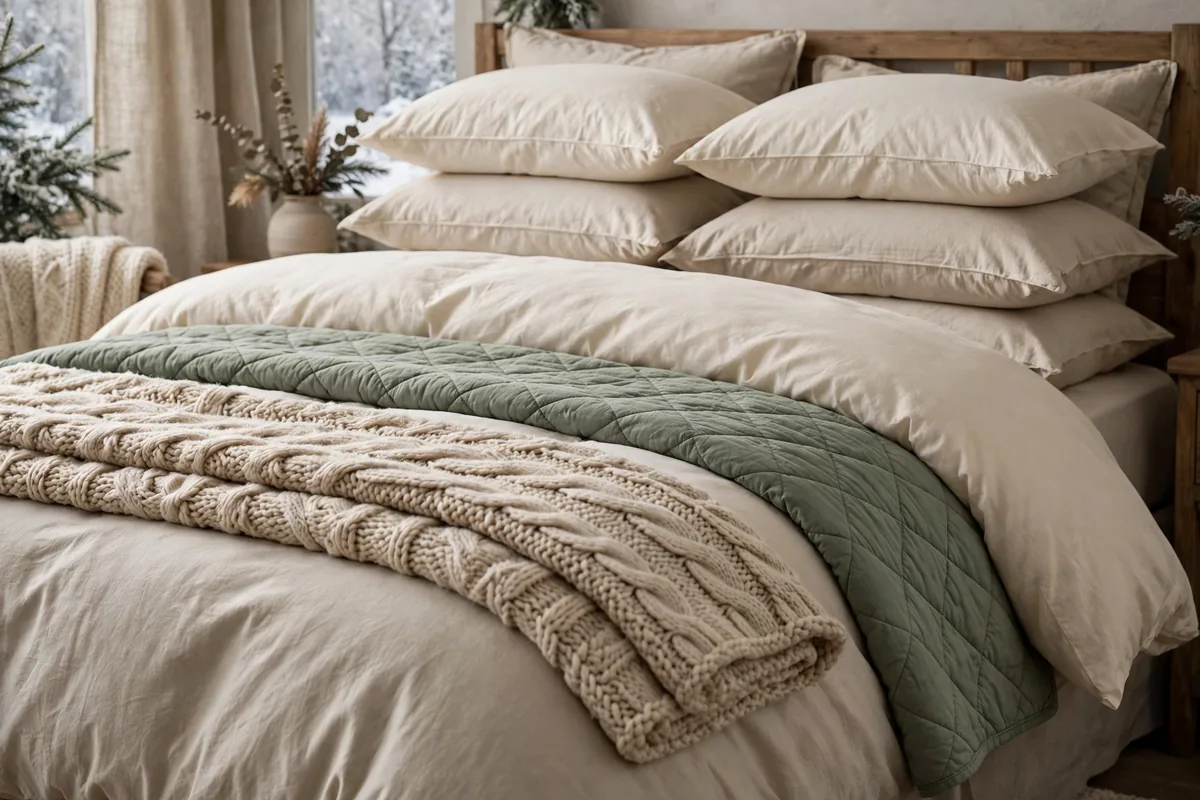
Build the bed like the styling guides build it — in tiers. A brushed-cotton or flannel sheet against the skin, the highest-warmth duvet you own, then a quilt or coverlet across the middle, and a knit or faux-fur throw at the foot for the top layer’s texture. Each tier can be peeled back independently, which is how two people with different thermostats share one bed happily.
The tiered-bedding formula is the core of Fabrica Kraft’s 3-layer winter styling rule: sheet, duvet, then the texture layer on top — with the same mix of velvet, bouclé and wool recommended for the cushions downstairs, so the house’s winter palette reads as one decision.
6. Dress the Table and Chairs Too

Winter meals are long, and cold chairs shorten them. Tie-on seat pads or cushions for dining chairs, a wool or heavy-linen runner under the table’s centre, and cloth napkins in the season’s deep tones turn the dining area into a room people linger in. A folded throw over the back of the host chairs is the extra layer guests always end up using.
Textiles also quiet a dining room — fabric absorbs the clatter that makes hard-surfaced rooms feel stark in winter — one more way soft layers read as warmth before anyone touches anything.
7. Keep a Basket of Warmth in Sight
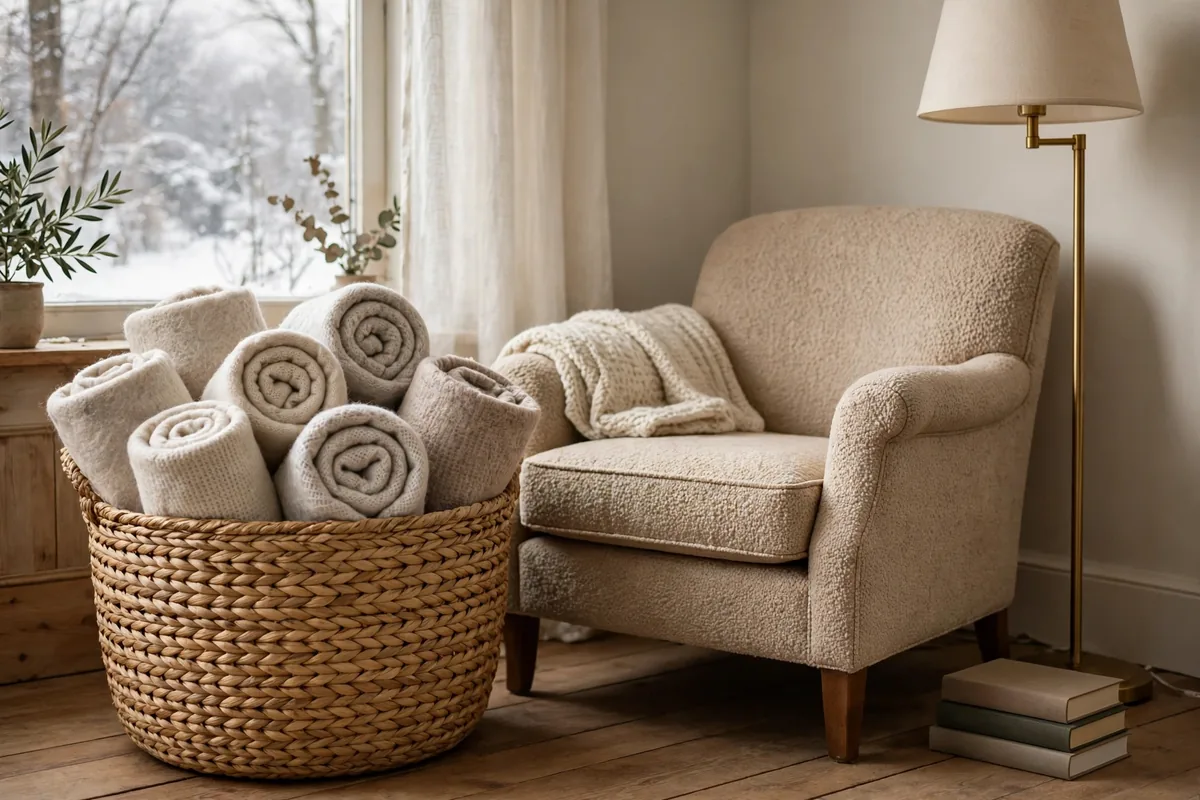
Throws stored in a cupboard get used by nobody. Rolled in a big basket beside the sofa or reading chair, they are part of the room’s texture and within arm’s reach at the exact moment someone feels cold. This is storage as styling — the same basket system that keeps the seasonal swap pieces organised in our reusable seasonal decorations ideas, with the winter set living out and the summer set in the labelled box.
The reading chair especially deserves its own allocation: a dedicated throw and the cushion that lives there permanently make the corner a destination — the finishing layer of the setup in our cozy reading corner ideas.
8. Add Soft Extras: Poufs, Sheepskins and Window Seats
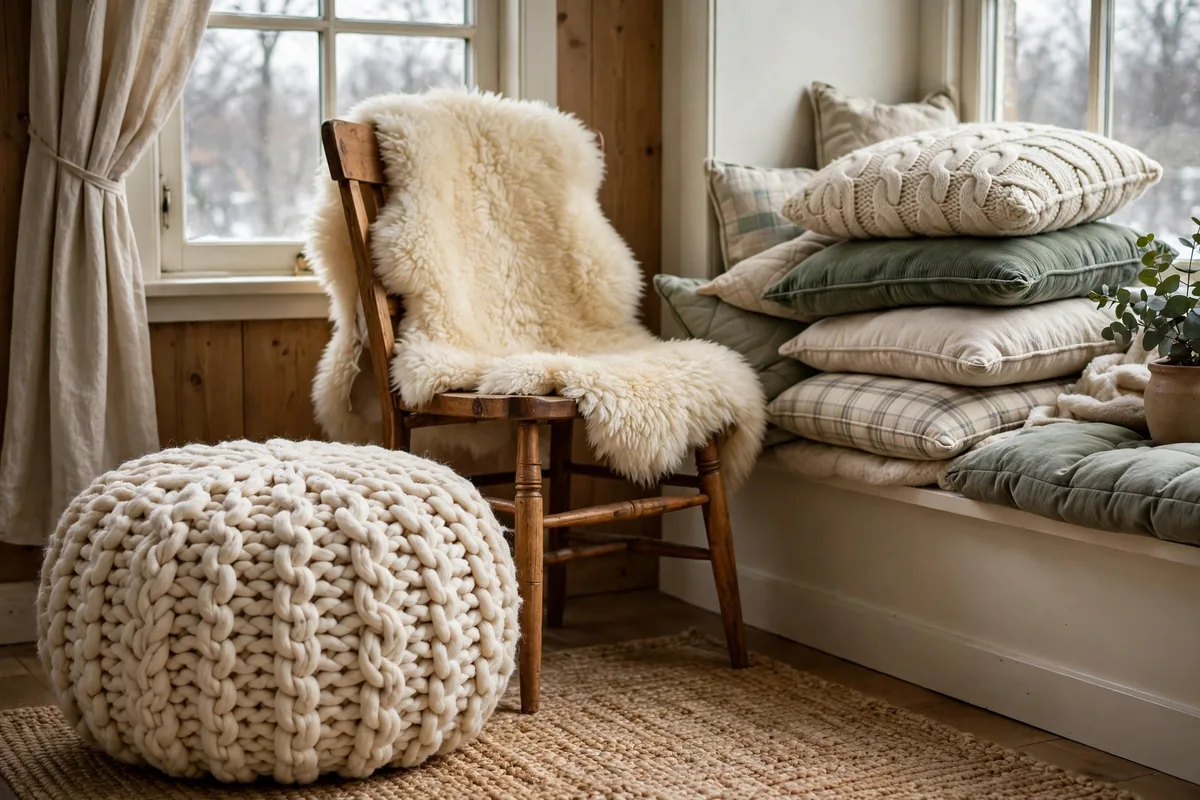
The top layer is one soft accent per surface, and winter’s are tactile: a chunky knitted pouf that doubles as a footstool, a sheepskin (real or good faux) thrown over a chair back or a wooden bench, cushions piled into the window seat so the coldest spot in the house becomes the most inviting. These are the pieces guests touch, which is why they punch above their size.
Restraint still applies: one accent per surface, in the room’s winter palette. A pouf and a sheepskin and a cushion mountain in one corner is a shop display, not a layer.
The Missing Room: The Bathroom
Every room in this system has had its textiles assigned except the one where winter textiles are touched most, skin first. The rules translate without alteration. Towels go to the heaviest weight the household owns — the middle layer’s job, trapping warmth near a bare body instead of a clothed one. The floor gets the landing strip of Section 4 in its bathroom form: a thick, washable mat exactly where feet meet cold tile. The basket of Section 7 echoes in miniature — spare towels rolled where they are reached for, not folded in a distant cupboard. And the curtain discipline of Section 3 has a bathroom form too: the heavier shower curtain, doing draught work at the wet room’s glass-and-tile edge. That room’s colour and senses are another guide’s subject — our bathroom decor guide owns them; here, the bathroom simply receives its textiles like every other room.
9. Build the Palette From Texture, Not Pattern
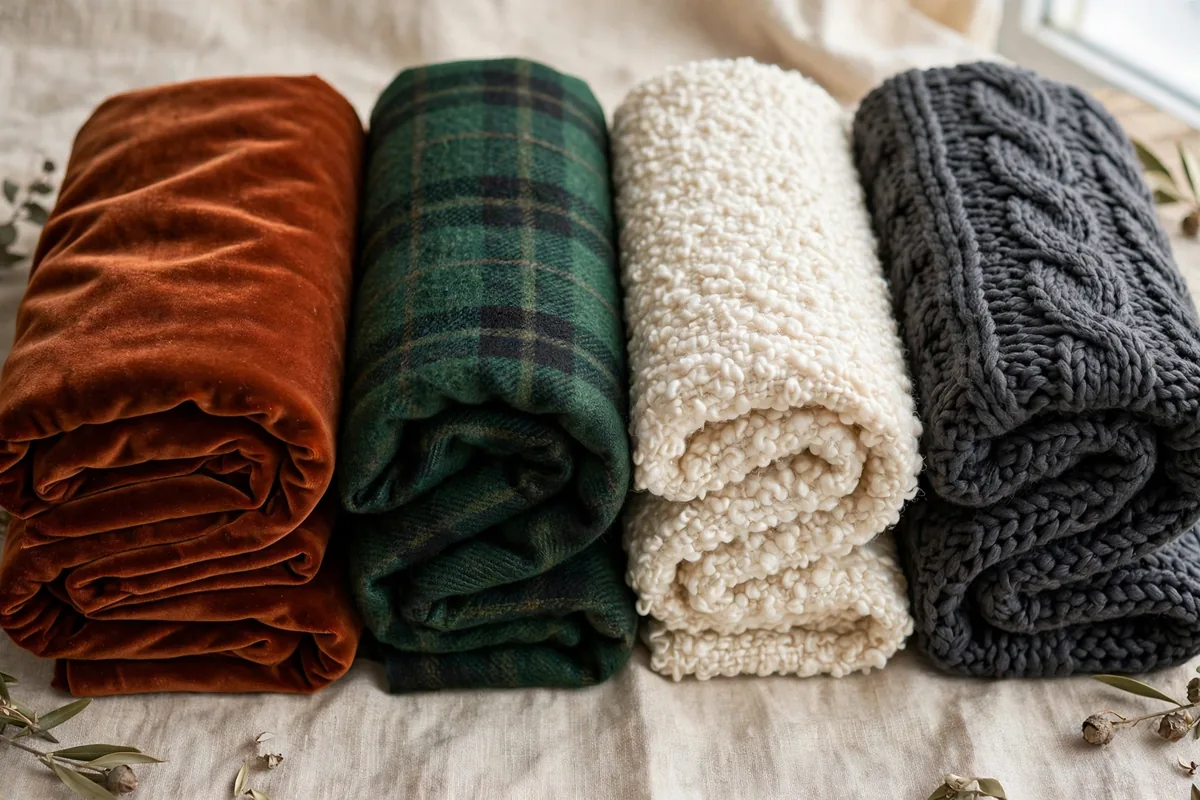
Winter colour is deep and warm — rust, ochre, forest, plum, charcoal, with cream as the breathing space — but the palette succeeds through texture more than hue. Five neutrals in five weaves (velvet, wool, bouclé, knit, linen) will always look richer than five colours in one flat cotton. Choose two deep tones plus neutrals, then vary the weave of everything.
Pattern, if you use it, belongs in one place per room: a plaid throw, a striped cushion. The rest is texture — which is also what makes the set timeless enough to bring out for a decade of winters. One boundary, stated plainly: this page owns the touch half of winter comfort — the warmth of light is a fixed layer of the year-round neutral base, and at the glass it belongs to the winter window guide; textiles do not do that job, and this system does not pretend otherwise.
10. Care for Heavy Textiles So They Last the Decade
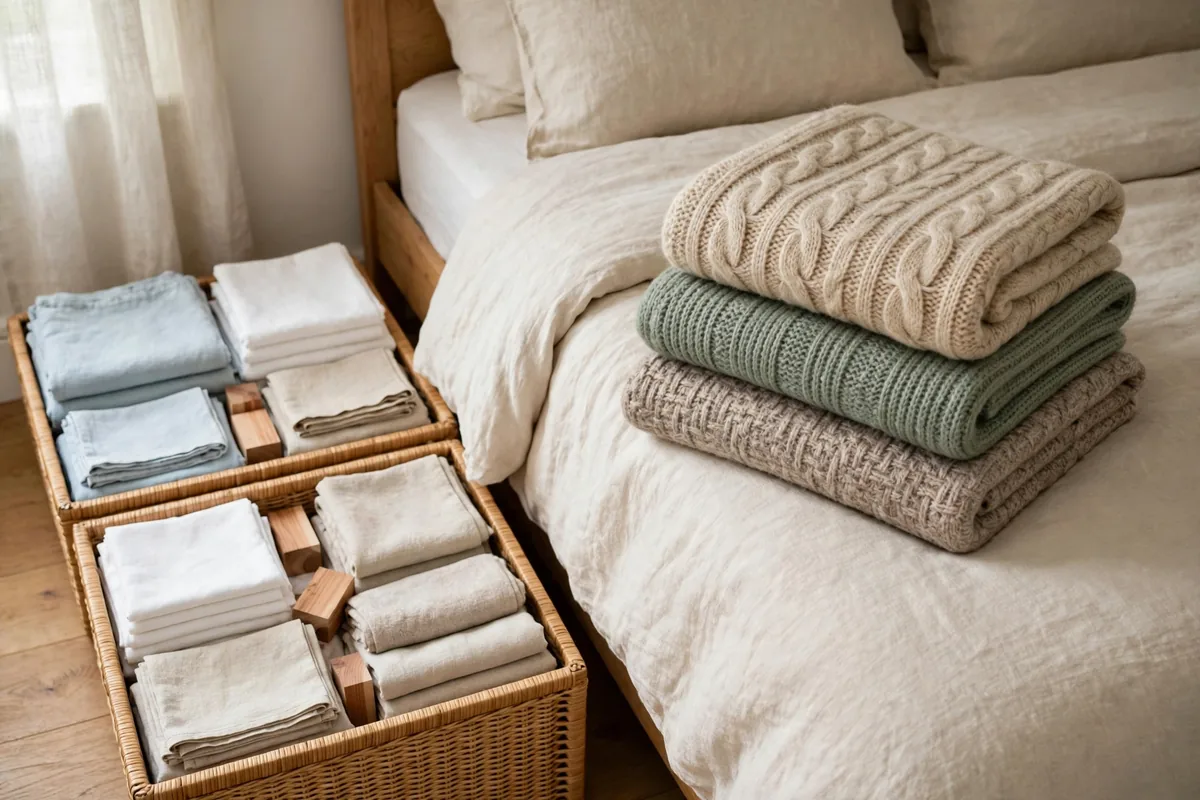
Winter textiles work hard and need a rhythm: shake and air throws weekly (outdoors on a dry day is best), wash covers on the maker’s instructions before they look dirty rather than after, brush velvet and wool with a clothes brush, and treat moths as the real enemy — clean storage, cedar in the box, nothing put away unwashed.
At the spring swap, the winter set goes into the same labelled boxes the summer set just vacated, and the rotation continues. Heavy textiles cared for this way genuinely last ten winters — the cheapest warmth is the set you only buy once.
Frequently Asked Questions About Winter Textiles
Which fabrics feel warmest at home?
Wool first — it insulates, breathes and regulates temperature better than any synthetic — then brushed cotton and flannel against the skin, with velvet, bouclé and chunky knits as the high-texture layers. Faux fur is warm but purely decorative: use it as the top accent, not the working layer.
Do thermal curtains actually make a difference?
Yes, measurably at the glass: a lined, floor-length curtain traps a still-air pocket that reduces heat loss through the window and stops the draught that pools at floor level. The effect is largest on single-glazed and north-facing windows, and biggest when curtains are closed from dusk.
How many throws does a living room need?
One per regular seat, plus one spare in the basket. For most sofas that means two to three working throws. A single folded throw for a whole sofa is styling, not warmth.
Can I mix velvet, wool and bouclé in one room?
That mix is exactly the recommendation: texture contrast is what the eye reads as cozy. Keep the colours inside one palette (two deep tones + neutrals) and let the weaves differ freely.
What is the cheapest winter textile upgrade?
Cushion covers and one good wool throw. Covers transform the sofa for the price of a takeaway, and the throw does daily work all season. Add a washable runner for the coldest floor next.
How do I stop winter textiles making the room feel dark?
Keep the largest surfaces light: cream or pale neutrals for the rug base, bedding foundation and one cushion in three. Deep tones belong in the middle layers. Lamplight at face height in the evening also lifts a deep palette from moody to cosy.
Are electric blankets part of a textile strategy?
They pair well with it — a heated throw on the sofa or an electric blanket under the duvet lets you lower the room’s heating in the evening. Follow the maker’s safety instructions, never fold them away plugged in, and replace them at the recommended age.
How should wool throws be washed?
Cold, gentle cycle with wool detergent (or hand wash), dried flat — heat and agitation are what felt and shrink wool. Many wool throws only need airing and brushing through the season and one wash before storage.
What do I do with summer textiles in winter?
Wash them, fold them into the labelled boxes the winter set came out of, and store them dry with cedar. The two sets rotate through the same storage, which is what keeps the whole system to a couple of boxes.
When should the winter textiles come out and go away?
Out when the evenings turn — typically October — and away at the first reliably mild spring weeks, usually March. Swapping with the season rather than the calendar keeps the house comfortable in the in-between weeks when the weather can’t decide.
What winter textiles does a bathroom need?
The same three layers, translated: the heaviest towels you own (the middle layer, at the body), a thick washable mat where feet land on cold tile (the landing-strip rule), spare towels rolled within reach (the basket, in miniature), and the heavier shower curtain as the room’s draught layer. Warmth in that room is textiles all the way down — the colour and scent of it belong to the decor guides.
Conclusion
Winter warmth at home is a textile system, not a heating setting: heavy curtains against the glass, deep rugs underfoot, wool at every seat, a bed built in tiers, and texture doing the work that colour alone can’t. Layer it once, care for it properly, and the house will feel warmer every winter for years — at the same thermostat setting.





Pingback: 10 Spring Bedroom Refresh Ideas That Need No Renovation
Pingback: 10 Winter Window Styling Ideas for Warmth, Light and Glow
Pingback: Layered Bedding Ideas: The Exact Order & the Morning Audit
Pingback: Summer Living Room Refresh Ideas: Subtract, Swap, Breathe