
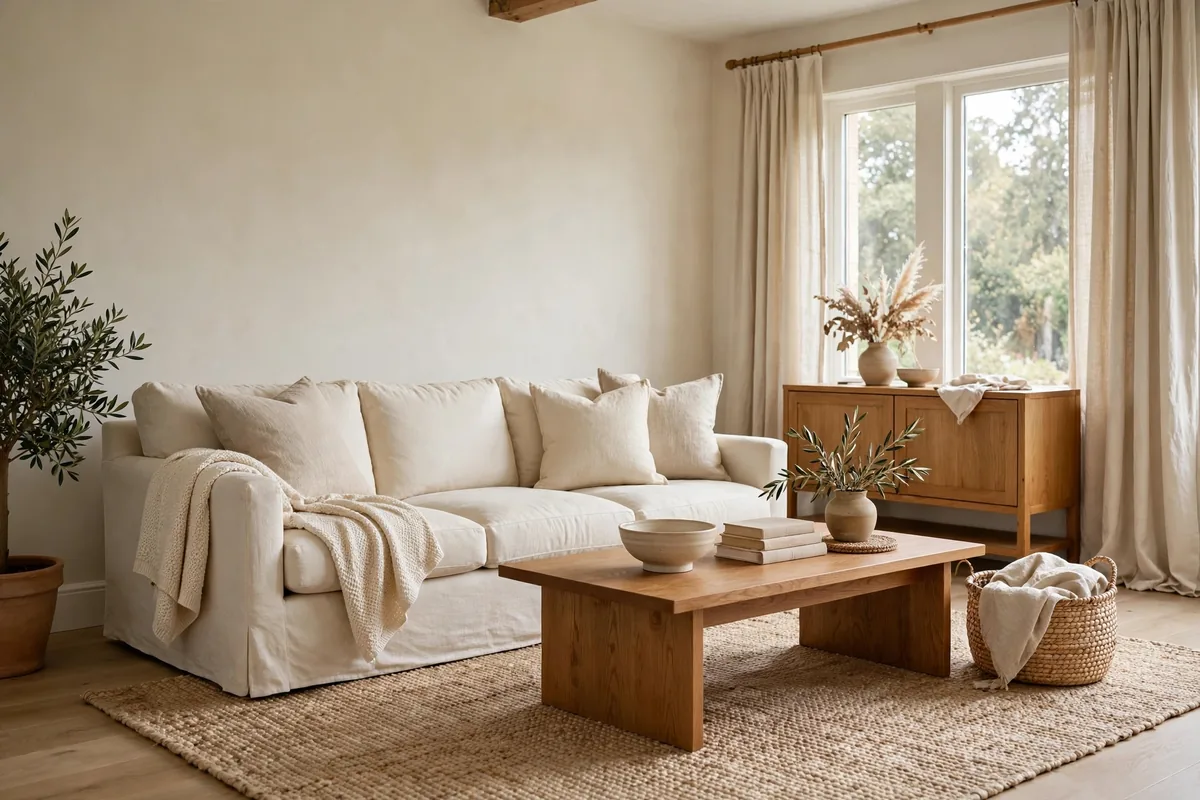
Every seasonal restyle goes one of two ways: an hour of swapping cushions and stems while the room quietly becomes autumn — or a weekend of regret because the sofa, rug and walls are all shouting a different season at once. The difference is the base. Homes that restyle easily are built on a fixed neutral foundation that never changes, so the season only ever has to arrive in the smallest, cheapest layer.
This is the foundation article behind our reusable seasonal decorations system: what to fix, what to rotate, and how to choose each fixed piece so all four seasons fit it.
In this guide: The Base at a Glance · 1. The Idea: Fix 90 Percent, Rotate 10 · 2. Walls: The Warm-Neutral Field · 3. The Sofa: Buy the Base Once · 4. The Rug: Quiet Pattern, Hidden Colours · 5. Curtains: One Good Pair, All Year · 6. Wood and Metal: The Permanent Mid-Tones · 7. Texture Replaces Colour in the Base · 8. Storage That Swallows the Rotation · 9. The Rotating 10 Percent: What Actually Changes · 10. Proofk: One Base, Four Seasons · Frequently Asked Questions About a Year-Round Neutral Base · Conclusion
The Base at a Glance
| Element | The fixed choice | Why it stays |
|---|---|---|
| Walls | Warm neutral (cream, oatmeal, taupe) | The 60% — every season’s backdrop |
| Sofa | Neutral upholstery, best quality you can | Too big to swap; cushions carry the season |
| Rug | Quiet pattern with hidden accent colours | Anchors the room; lends colours to borrow |
| Curtains | One natural pair (linen, cream) | Layers change; the curtain doesn’t |
| Wood + metal | One wood family, one metal family | The permanent 30% mid-tones |
| The rotation | Covers, throws, stems, candles (~10%) | Small, flat-storing, season-carrying |
| Texture | at least five distinct textures, counted | Colour is rationed in the base; texture is what it feels like |
| Storage | one bench, one labelled box per season | A rotation with no home colonises a shelf — and then stops happening |
1. The Idea: Fix 90 Percent, Rotate 10
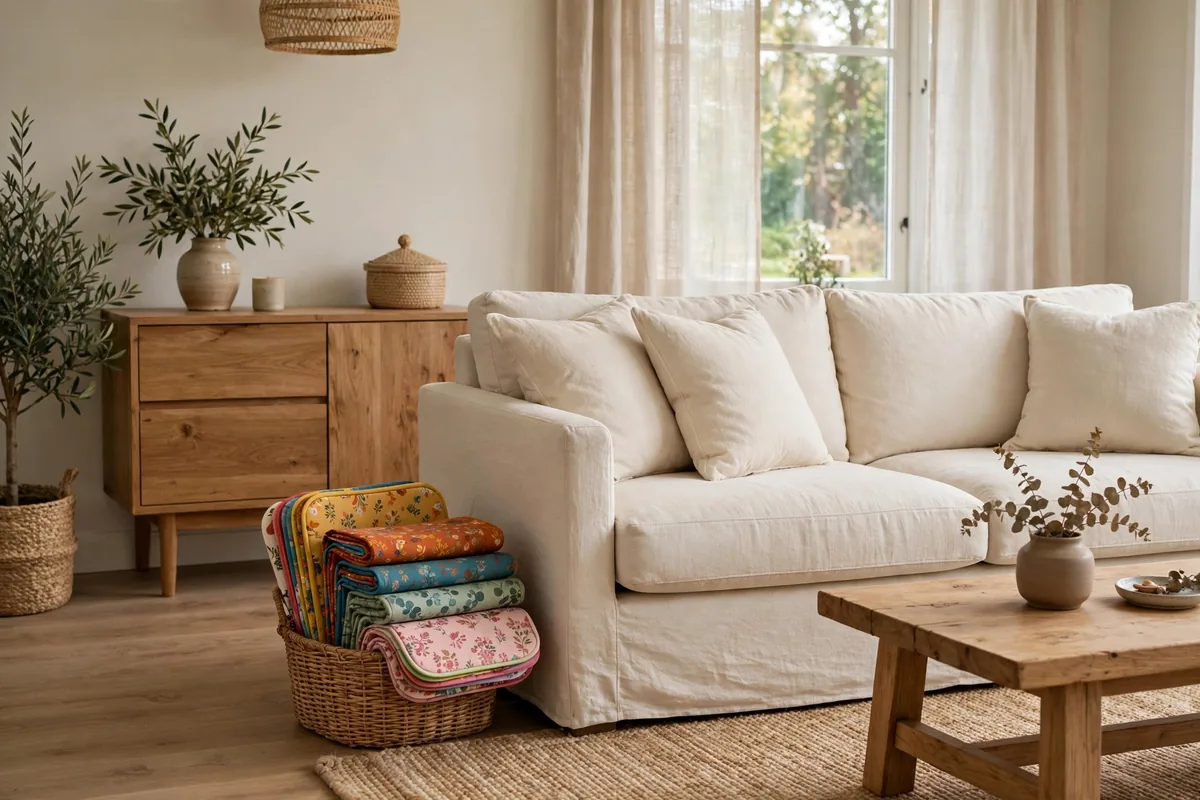
The arithmetic comes from the 60-30-10 rule, applied across the year instead of a single room: as one seasonal decor plan on Nordic Design Blog lays out, roughly 60% of a room is dominant year-round neutrals (walls, rug, upholstery in cream, warm gray, oatmeal or taupe), 30% is secondary permanent tones (wood tables, curtains, baskets), and only 10% — cushion covers, throws, candles, foliage — rotates four times a year. Because only a tenth changes, a season swap is an errand, not a project.
Decide your fixed 90% once, with the seasons in mind, and you will never “redecorate” again — you will only ever re-accent.
2. Walls: The Warm-Neutral Field
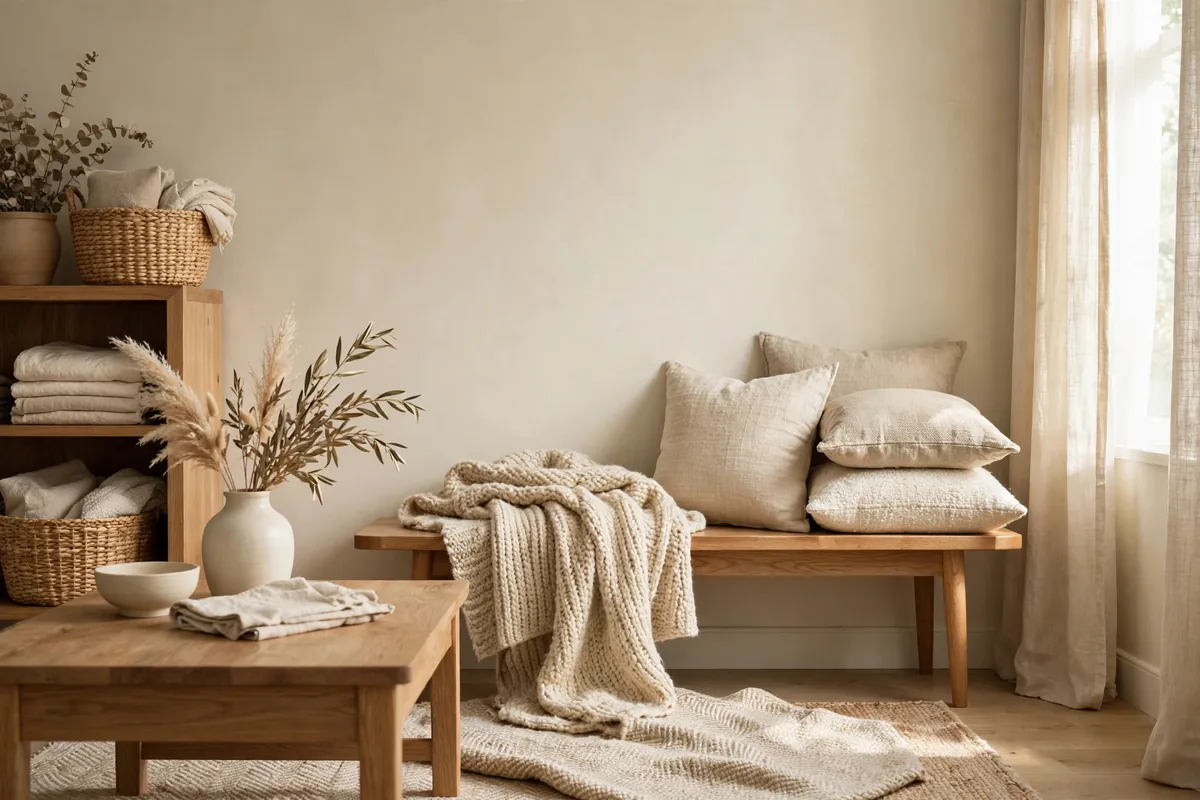
Wall colour is the base’s biggest surface, so it gets the most conservative choice: a warm neutral — cream, oatmeal, warm white, soft taupe — whose undertone agrees with your floors and wood. Warm neutrals flatter every seasonal family (spring pastels, summer blues, autumn rusts, winter evergreens) because none of them have to fight the wall first.
Match undertone to your fixed wood: honey floors want creamy walls, grey-washed floors want a greige that leans their way. Paint is the cheapest square metre in the house — if your walls currently argue with every season, this one change is the base. Sample-first starting points in this register: Benjamin Moore Swiss Coffee OC-45 or Sherwin-Williams Alabaster for the warm whites and creams, and a greige in the class of Sherwin-Williams Accessible Beige for the oatmeal walls — chips against your floors and wood first, because the undertone match this section teaches is the test every sample has to pass.
3. The Sofa: Buy the Base Once
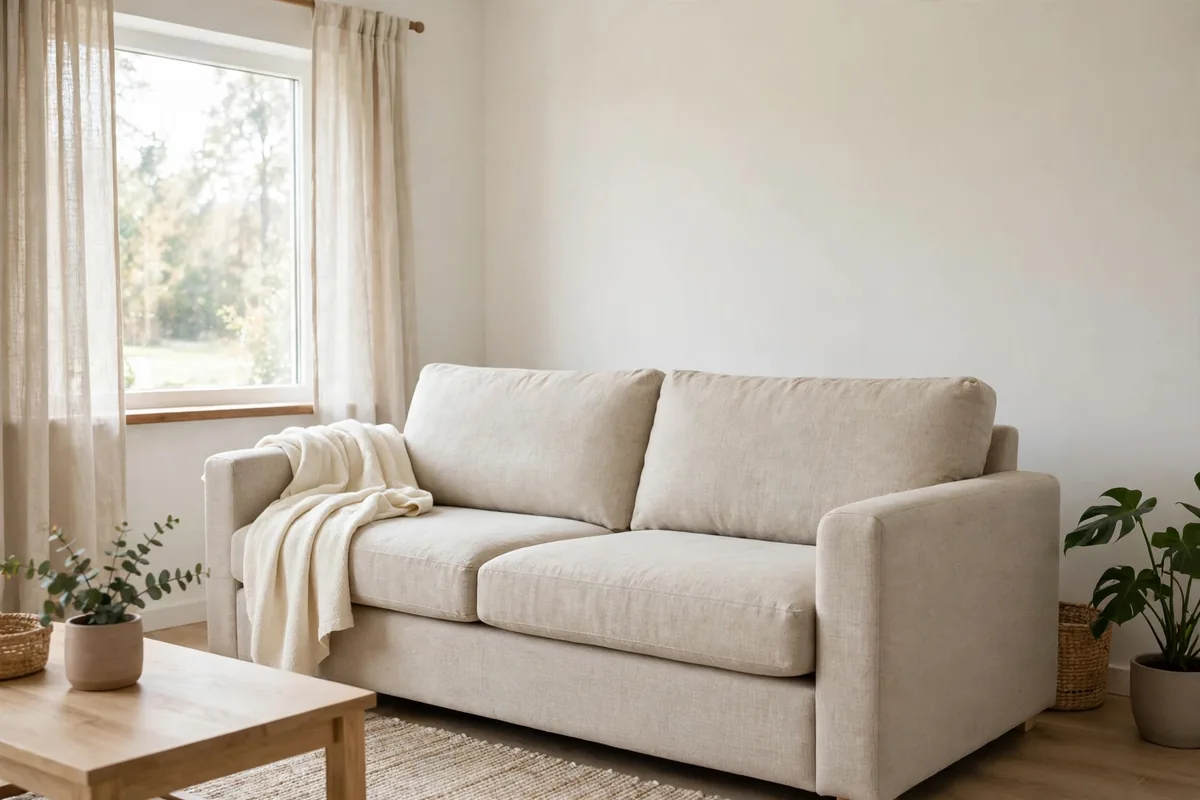
Beginner guides to seasonal colour give the same first instruction: keep the major furniture neutral — sofa above all. It is the largest, priciest textile in the room; in a neutral (oatmeal, stone, warm grey, cream) it becomes the stage every season performs on, and in a colour it becomes a cast member every other piece must negotiate with.
Buy the best neutral sofa you can afford and let covers do the seasonal work — the full styling playbook lives in our neutral sofa styling ideas. A patterned or coloured sofa you already own is not disqualifying: throw a neutral slipcover or a large cream throw over the seat backs and it joins the base.
4. The Rug: Quiet Pattern, Hidden Colours
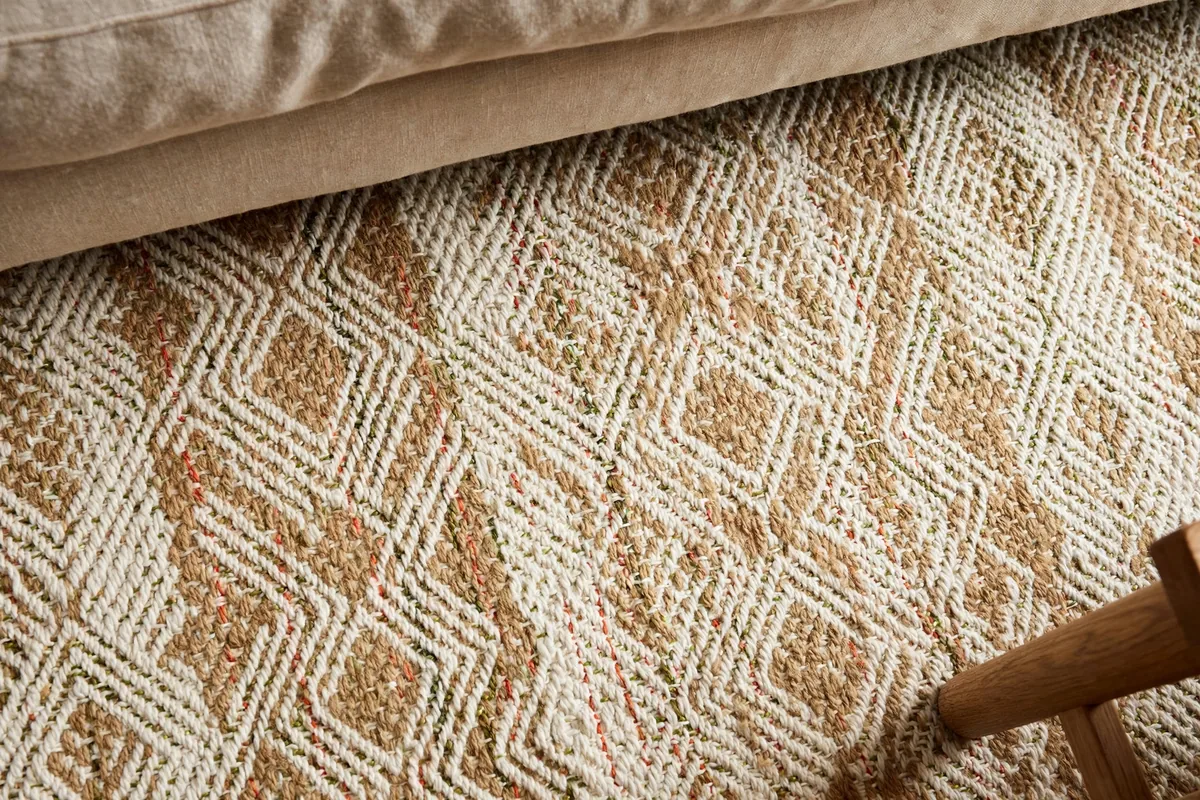
The smartest base rug is not plain — it is quiet: a cream, camel or warm-grey ground with a low-contrast pattern that secretly contains threads of other colours (a rust stripe, an olive motif, a navy line). The pro tip from seasonal planners: pull your seasonal accent shade directly from an existing rug pattern or artwork, and the accent looks custom-designed rather than randomly added.
Natural fibres (wool, jute blends) wear the years and read warm in winter, fresh in summer. Size it generously — a rug that floats small makes even a perfect base look provisional.
5. Curtains: One Good Pair, All Year
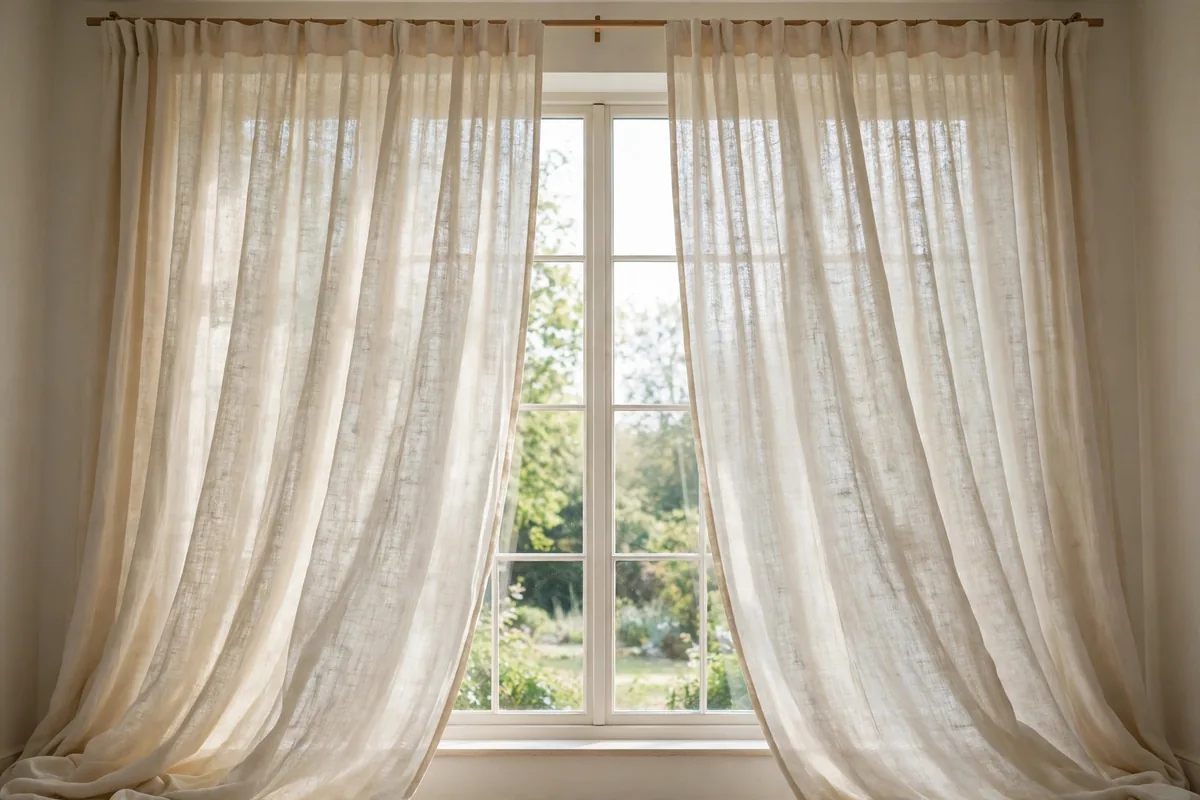
Curtains belong to the fixed foundation in every seasonal system — walls, sofa, rug, curtains and wood tones are the pieces planners name as permanent. Choose one pair with genuine quality: natural linen or a linen-look in cream or oatmeal, hung high and wide, long enough to kiss the floor. It frames spring blossom and winter dusk with equal grace.
Seasonal change happens around the curtain, not to it: a sheer joins in summer, a heavier layer or a pelmet in winter, a wreath in the window for December. The pair itself never goes to storage.
6. Wood and Metal: The Permanent Mid-Tones
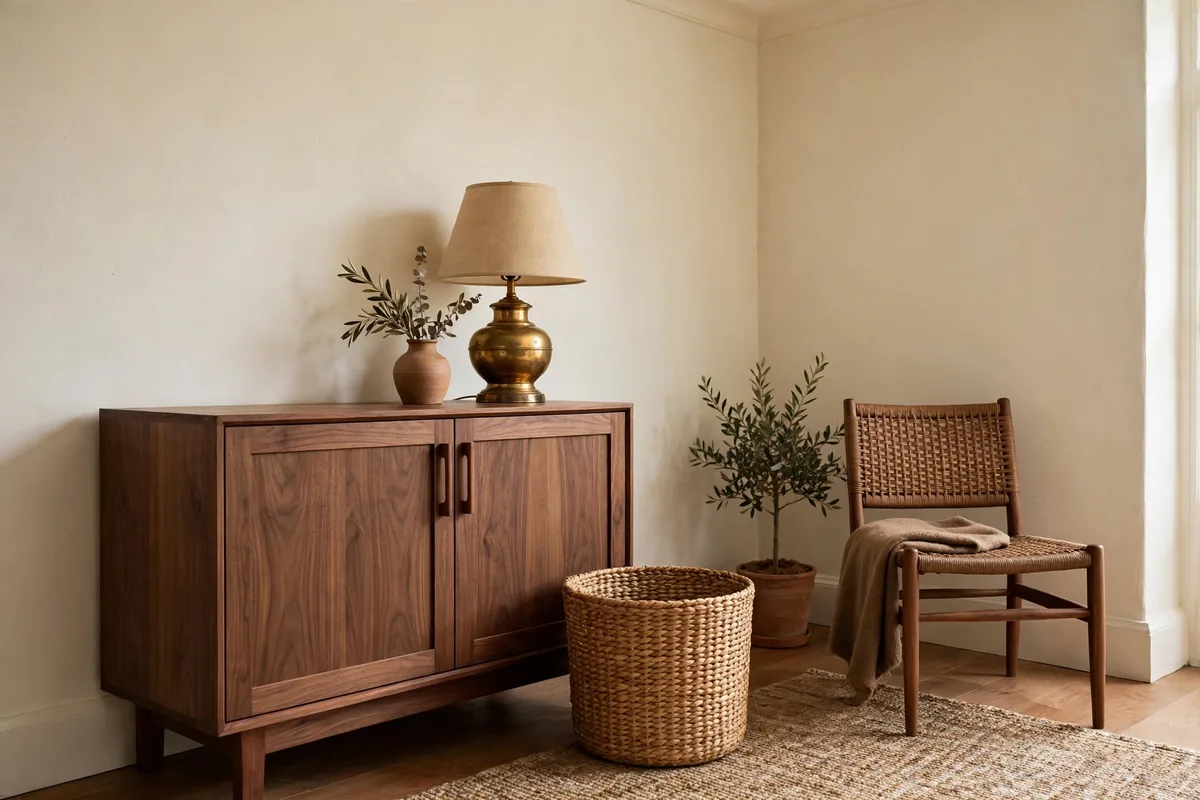
The 30% secondary layer is mostly material, not colour: one wood family (walnut, white oak, or your inherited mix disciplined toward one stain) across tables and shelves, woven baskets as its soft echo, and one metal family (brushed brass, blackened bronze, or pewter) across lamps, frames and hardware. This layer gives the neutral base its depth — it is why a neutral room reads “warm” instead of “empty.”
Consistency is the whole trick: three wood tones fighting reads as accidental; one tone repeated reads as designed, in every season, under every accent colour.
The Light Layer: Fixed, Like the Metal
The base’s light does not rotate. The lamp hardware belongs to this section’s one metal family, and the temperature stays warm all year — that constancy is part of what makes the room feel settled in February and July alike. Only the glow rotates: candles and LED pillars already ride in Section 9’s kit, arriving and leaving with the season. A base whose light changed four times a year would be a fifth rotation nobody budgeted storage for.
7. Texture Replaces Colour in the Base
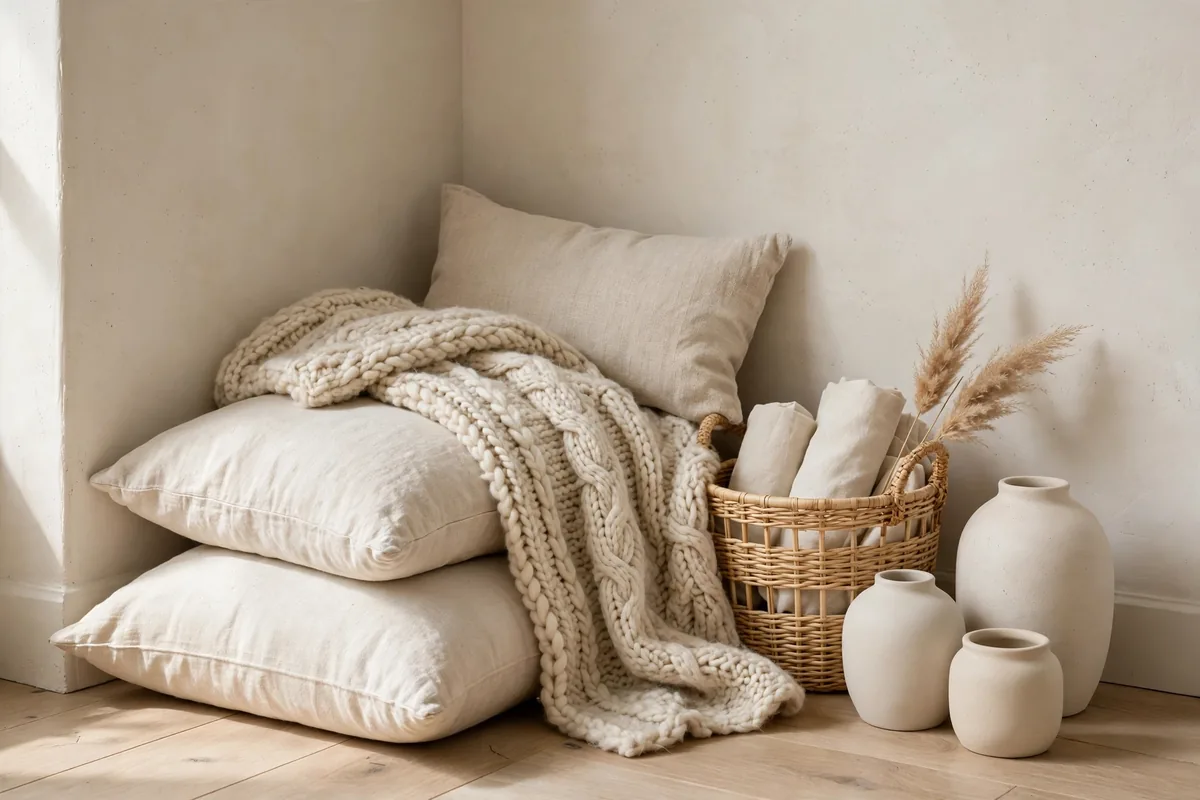
A neutral base fails when it is smooth: one flat cream on every surface reads as a waiting room. The fix is texture variety inside the palette — linen’s slub, wool’s loft, rattan’s weave, ceramic’s matte, leather’s sheen, wood’s grain. Designer advice on warm neutrals is consistent: variety of tones, textures and small patterns is what keeps a neutral scheme layered instead of flat, and it is what lets the base feel complete in the weeks between seasons with no accents at all.
Aim for at least five distinct textures in the main room’s base. Count them — most rooms are two short.
8. Storage That Swallows the Rotation
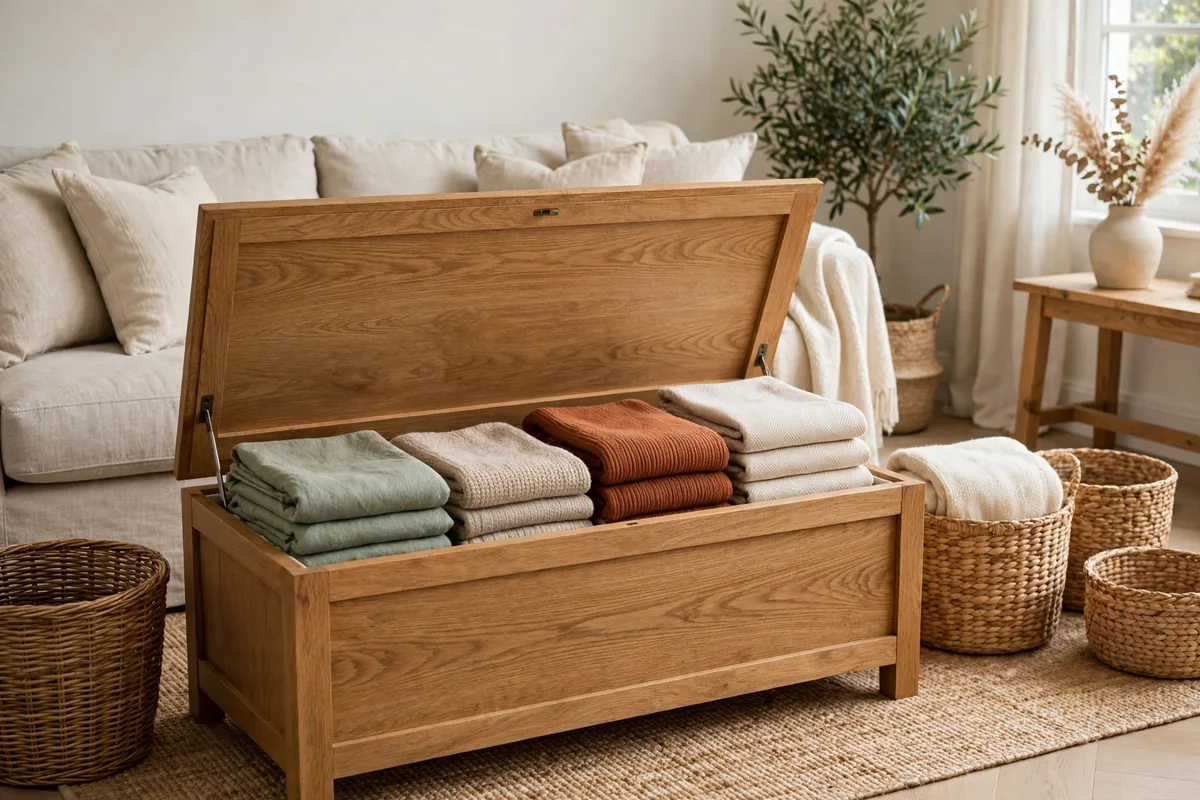
A rotating 10% needs a home that is not a garage shelf: a lidded bench or ottoman in the room itself, two woven baskets (in-use throws; the off-season covers), one labelled box per season in a closet. Everything flat-folds — covers, runners, wreaths in bags — so four seasons of accents occupy roughly one storage bench.
The planners’ clutter rule rides along: leave 40–50% of every flat surface completely clear. The base looks calm partly because it is edited; a crowded neutral room is just beige clutter.
The permanent props: Name the cast that never leaves the stage: the trays that corral the surfaces, the baskets counted in Section 6, the glass and ceramic vessels from Section 7’s textures, the candle holders in Section 9’s kit. They stay out in every season and are simply re-dressed — the props are permanent; only their contents rotate.
9. The Rotating 10 Percent: What Actually Changes

The complete rotation kit is short: cushion covers (two per seat), one throw per room, a table runner or cloth, stems for the house’s one big vase, candles or LED pillars, the door wreath, and a scent. Seasonal planners pair them to the calendar: spring — sage, blush, butter yellow, crisp white; summer — washed linen, sand, coastal blue, citrus, terracotta; autumn — rust, ochre, olive, caramel, espresso; winter — ivory, deep evergreen, navy, pewter, brushed brass.
| Season | Accent colours | The swaps that carry it |
|---|---|---|
| Spring | sage, blush, butter | cushion covers, fresh stems, the light throw |
| Summer | sand, coastal blue, citrus, terracotta | covers, a runner, candles |
| Autumn | rust, ochre, olive, caramel | the throw, covers, the wreath, foliage |
| Winter | ivory, evergreen, navy, pewter, brass | covers, the throw, candles, evergreen stems |
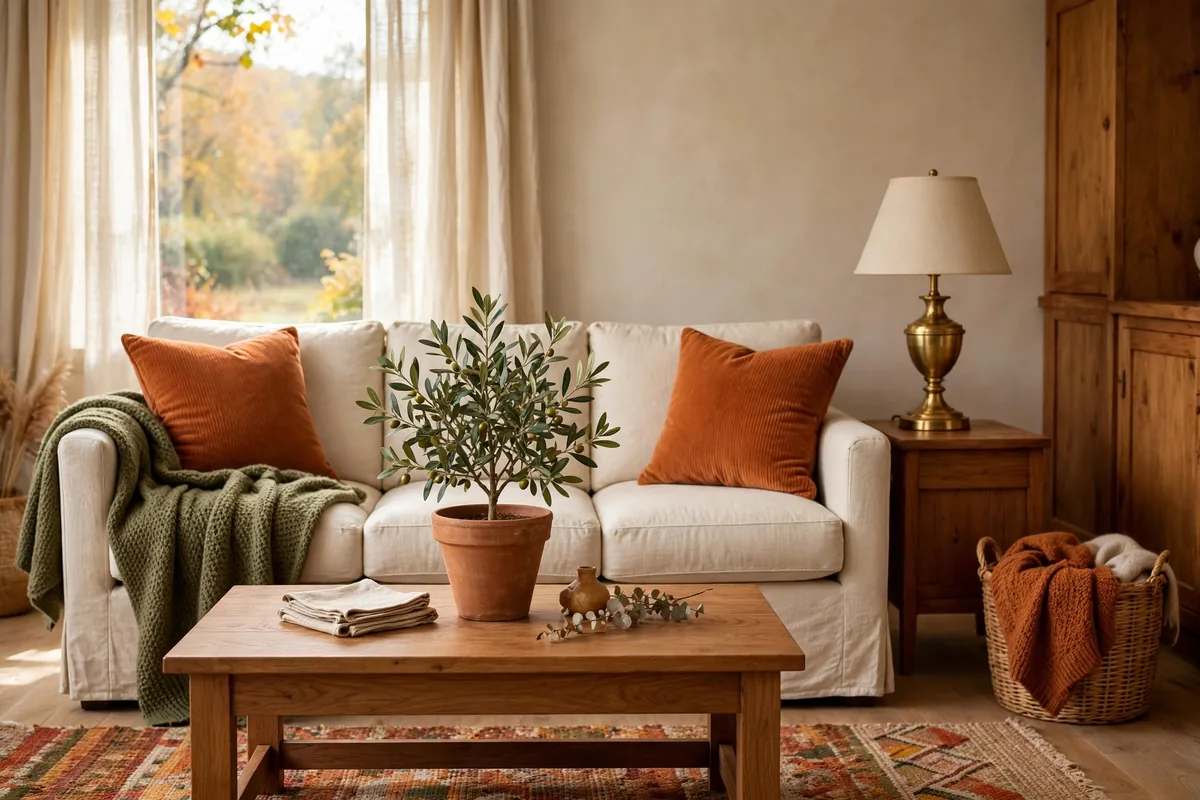
Total cost per season approaches zero after the first year, because the kit is bought once per season and stored (§8). What you see in our autumn color palette ideas is this 10% at work — the base beneath it never moved.
10. Proof: One Base, Four Seasons
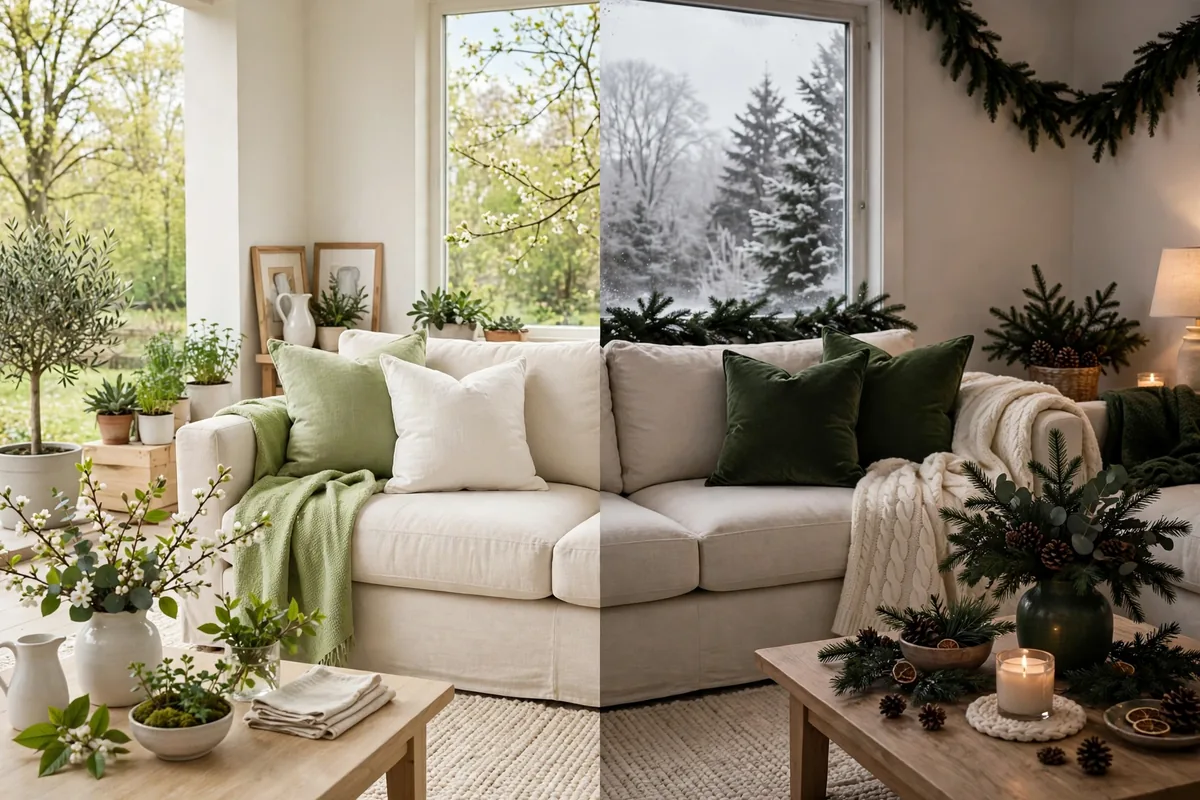
Watch the base perform: in spring, the bedroom version of this system lightens bedding and adds stems — our spring bedroom refresh ideas run entirely on swaps against fixed furniture. In summer, the living room strips to linen and coastal tones per our summer living room refresh ideas — same sofa, same rug, same curtains as January.
As the beginner’s guide to seasonal colours puts it, the goal is a home that evolves rather than transforms — no chaotic one-day change from beach house to cabin, just a calm room wearing the season lightly.
Frequently Asked Questions About a Year-Round Neutral Base
Won’t a neutral base look boring?
Only a texture-less one does. Five or more textures (linen, wool, rattan, ceramic, wood grain, leather) inside a warm neutral palette read as layered and calm, and the rotating 10% supplies the colour story that changes four times a year.
What if my sofa is a strong colour?
Work with it as a fixed accent: build the rest of the base neutral, and choose seasonal accents that include the sofa’s colour family so it always looks intentional. A neutral slipcover or large throw over the seat is the budget alternative.
Which neutrals are warmest and most versatile?
Cream, oatmeal, warm white and taupe on the large surfaces, with warm greys where you need coolness. The key test is undertone agreement with your floors and wood — warm base colours flatter the widest range of seasonal accents.
How many colours should the whole room hold?
Three to five, including the neutrals: for example cream, camel, walnut, plus one or two seasonal accents. Capping the count is what makes the rotating layer read as a scheme instead of a jumble.
Where do I start if my room is currently colourful?
Start with the largest surfaces you can change cheaply: cushion covers and throws to neutral, the rug if it is due, paint when you next decorate. Move one element per month toward the base; the room gets calmer and each season gets easier as you go.
Does the neutral base work in small homes?
It works best there: one calm base stops small rooms from visually fragmenting, and the rotation stores flat in a single bench. Small homes gain the most from the 40–50%-clear-surfaces discipline too.
What about the kitchen and bathroom?
Same system, smaller kit: fixed neutral towels’ base colour is impractical — instead fix the hardware, wood and ceramics as neutrals, and rotate towels, a runner, stems and soap dispensers by season. The principle (fix the expensive, rotate the cheap) is identical.
How do I choose seasonal accents that suit my base?
Borrow them: pull one accent from your rug’s hidden threads or a permanent artwork, and check it against your wood’s undertone. Accents chosen from inside the room always look designed; accents chosen from a shop display always look adopted.
Is a neutral base just the minimalist style?
No — maximalists run neutral bases too; they simply rotate more exuberant 10% layers (patterned covers, bold stems, collected objects) onto the same calm foundation. The base is about what stays, not about owning less.
How long does a seasonal swap take on a good base?
Thirty to sixty minutes for a whole home: covers on, throws swapped, stems changed, wreath hung, previous season’s kit folded into its box. If your swap takes a weekend, the base — not the season — is what needs the work.
What paint colour should the base walls be?
A warm neutral matched to your floors and wood, not to a chart: warm whites and creams (sample-first starting points in Section 2 include Benjamin Moore Swiss Coffee OC-45 and Sherwin-Williams Alabaster) or an oatmeal greige in the Accessible Beige register. The undertone test in Section 2 decides — a sample that fights your floor loses, however beautiful it looked in the shop.
Conclusion
Build the base once — warm-neutral walls, a neutral sofa, a quiet rug with hidden colours, one good pair of curtains, one wood and one metal family, texture everywhere — and the year becomes a light rotation of covers, throws and stems on top of it. Seasons stop being decorating projects and become what they should be: a small, pleasurable ritual, four times a year.




Pingback: 10 Layered Bedding Ideas in the Designer's Exact Order
Pingback: Two Tone Kitchen Cabinets: 12 Combinations & the Rules
Pingback: Upholstered Headboard Ideas: Heights, Styles & Fabrics
Pingback: Seasonal Dining Table Ideas: One Base, Five Seasons
Pingback: Spring Bedroom Refresh Ideas: No Renovation, One Weekend
Pingback: Calming Bedroom Color Palettes: 8 Compared Side by Side