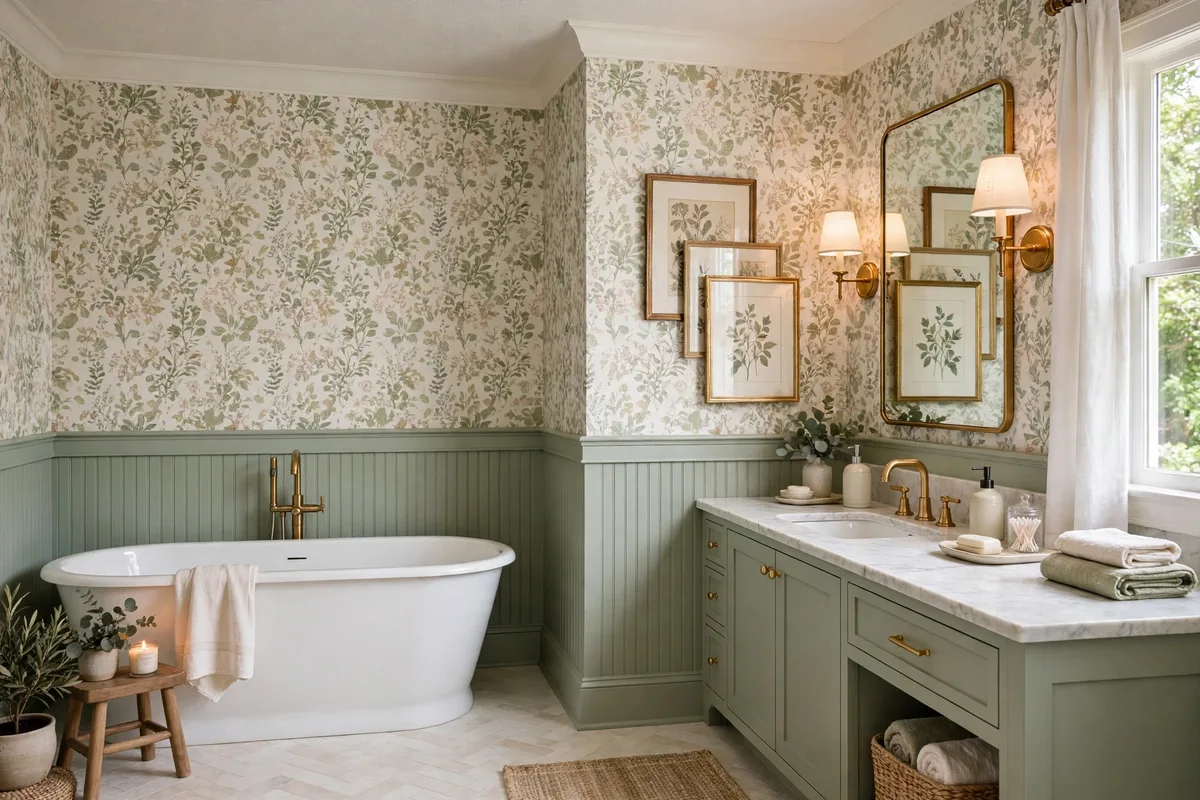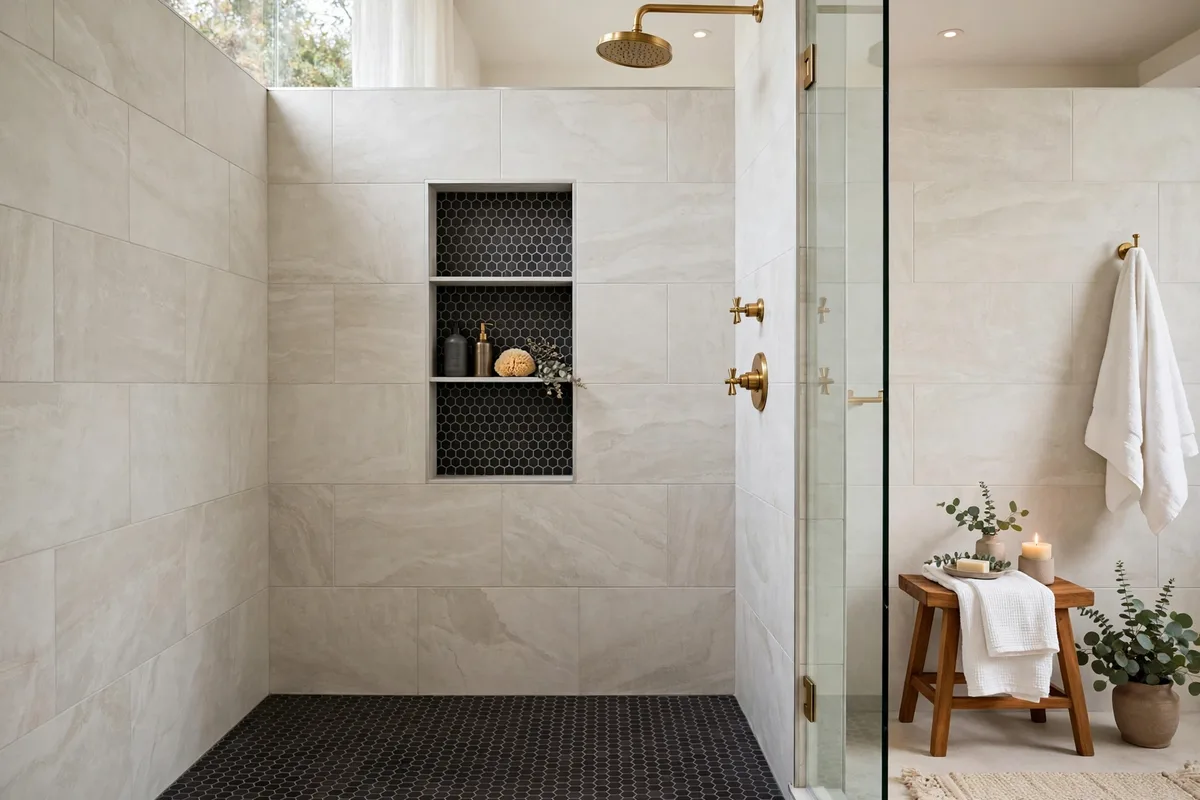
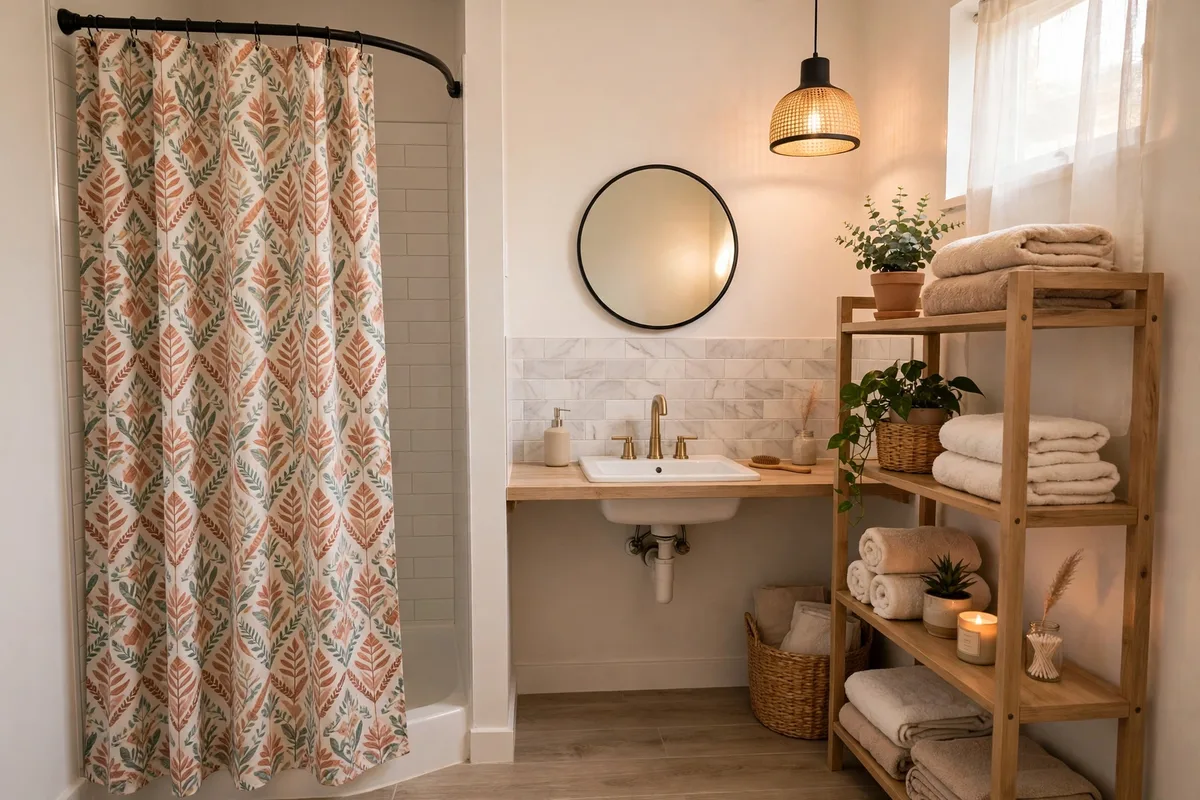
A rental bathroom is the hardest room to love: someone else’s tile, someone else’s showerhead, a landlord’s paint colour — and a deposit riding on every decision. But the bathroom is also the room where removable updates punch hardest, because so much of it is surfaces, fittings and textiles rather than structure. The rule from our renter-friendly bedroom updates ideas applies unchanged — nothing that cannot be reversed in an afternoon — with one bathroom amendment: steam audits every adhesive you use.
Ten updates, ordered from the walls in. Every one reversible, every original part stored, every deposit intact.
In this guide: The Deposit-Safe System at a Glance · 1. The Deposit Rules, Bathroom Edition · 2. Peel-and-Stick Tile and Backsplash · 3. Removable Wallpaper, Dry Wall Only · 4. The Showerhead Swap · 5. The Floor: Tiles That Lift, or a Runner That Washes · 6. Storage That Stands, Hangs or Squeezes · 7. Mirror and Hardware: Swaps With a Storage Bag · 8. Light Without an Electrician · 9. Textiles Do the Decorating · 10. The Exit Kit: Reversal Day, Planned on Day One · Frequently Asked Questions About Renter-Friendly Bathroom Updates · Conclusion
Strict lease? Take the no-adhesive route: tension and standing storage (Section 6), textiles (Section 9) and the showerhead swap (Section 4) — nothing in this route touches a wall. Tiny bathroom? The priority four: showerhead, bulbs (Section 8), one storage piece, and the curtain-and-towel palette. One weekend only? Showerhead, bulbs and textiles — the three highest-impact sections in this guide, all reversible in minutes.
The Deposit-Safe System at a Glance
| Update | Reversal | Watch out for | Install time | Reversal time |
|---|---|---|---|---|
| Peel-and-stick tile / backsplash | Warm, peel, wipe | Steam zones; test a hidden patch first | an afternoon | an afternoon back |
| Removable wallpaper (dry wall only) | Peels off | Humidity curling cheap papers | an afternoon | under an hour back |
| Showerhead swap | Unscrew, refit original | Keep the original + its washer safe | ten minutes | five minutes back |
| Floor tiles / washable runner | Lift out | Trapped moisture underneath | an hour | minutes back |
| Standing + tension storage | Carry out | Measure pipes and ceiling height first | under an hour | minutes back |
| Bulb + plug-in light | Swap back | Colour temperature consistency | half an hour | minutes back |
| Mirror and hardware swaps | Swap back, originals bagged | Bag and label every original | an hour | half an hour back |
| Textiles | Swap out | They move house with you | minutes | minutes back |
| Exit kit | Refit every original | Planned on day one, boring on the day | an hour on move-out day | it IS the reversal |
1. The Deposit Rules, Bathroom Edition
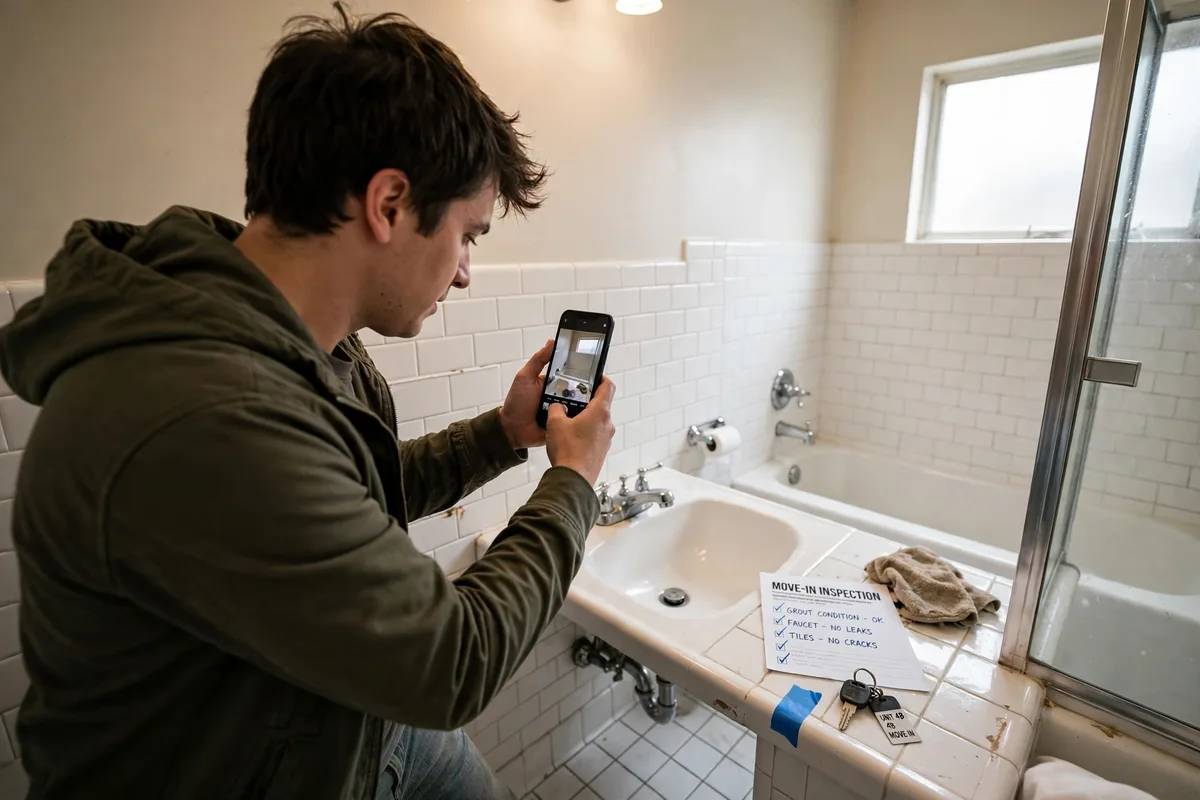
Start where every deposit is actually won: documentation. Photograph every wall, grout line, chip and stain before touching anything, and keep the landlord’s written replies about what is permitted — most leases allow more than tenants assume, especially for swaps where the original is restored. Bay Property Management Group’s renter upgrade guide — written from the landlord’s side of the fence — gives the same advice: approval plus reversible choices is the combination that keeps deposits whole.
Then add the bathroom-specific discipline: test every adhesive product on a hidden patch (behind the toilet, inside a cupboard door) and give it a steamy week before committing a wall. Bathroom steam is the great auditor of “removable” claims; the product that survives the test patch earns the room.
The Permission Tiers: What Needs Asking
| Tier | What belongs here |
|---|---|
| Do freely | Textiles and the shower curtain; freestanding and tension storage; bulb swaps; anything that stands, leans, or hangs over a door |
| Swap, store, restore | The showerhead; knobs and hardware; a mirror over or in place of the original; plug-in sconces — originals go in the labelled box (Section 10) and the room is handed back unchanged |
| Ask in writing first | Adhesive products on walls and floors where the lease restricts them (Sections 2, 3 and 5), and anything touching plumbing beyond the showerhead’s hand-tight thread |
2. Peel-and-Stick Tile and Backsplash
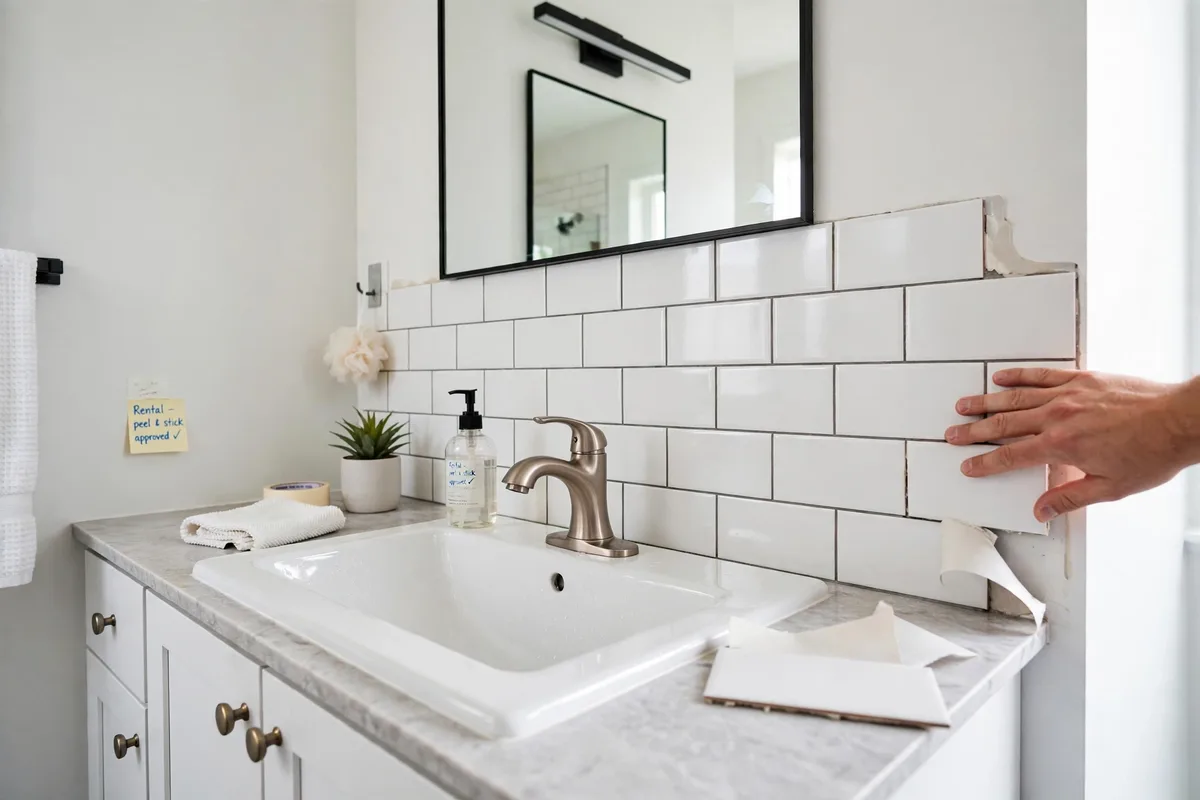
The highest-impact surface swap available to a renter: peel-and-stick tiles over the backsplash, a dated tile band, or a plain splash zone. Modern versions are convincingly three-dimensional, cut with a utility knife, and — on smooth, sound surfaces — peel away cleanly with a hairdryer’s warmth. Bay Management’s list puts them first for a reason: they cover the previous decade’s taste in an afternoon.
Respect the zones from our bathroom wall ideas: peel-and-stick belongs in the splash and dry zones. Inside a daily-steamed shower, adhesives soften and edges lift unless the product is explicitly rated for it — and even then, the test patch (§1) decides. Keep the grout lines underneath clean and dry on install day; adhesive over damp grout fails by Friday.
3. Removable Wallpaper, Dry Wall Only
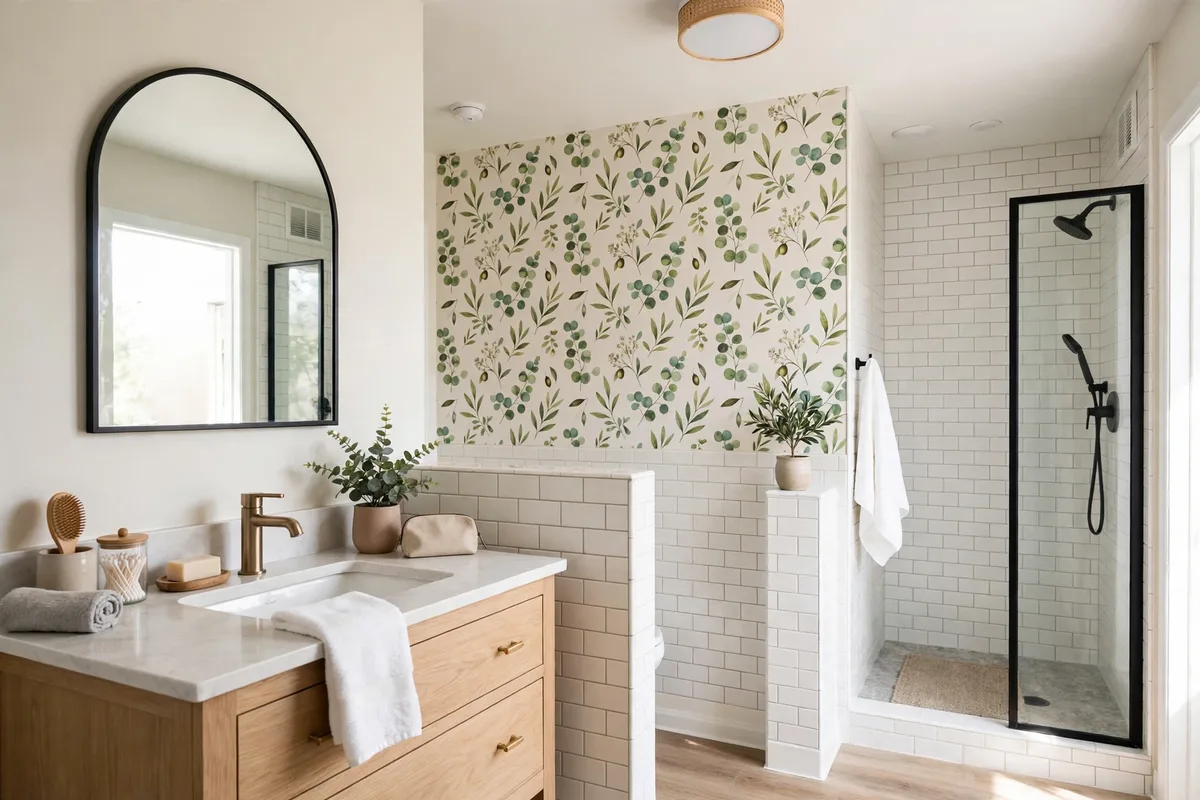
For pattern, removable wallpaper does in the bathroom what it did in the bedroom — one dry wall, total personality change, zero commitment. Choose the wall the zone map blesses: opposite the shower, above a tile or panel cap, never where spray lands. Vinyl-faced removable papers handle ambient humidity best; the prettiest matte paper in a fan-less steamy bathroom will curl at the seams by spring.
Application discipline decides removal day: smooth, clean, fully dry paint underneath; seams butted, not overlapped; and a spare half-roll kept for the inevitable scuff repair. When the tenancy ends, it peels in sheets and the wall underneath is the landlord’s wall again — which is the entire point.
4. The Showerhead Swap
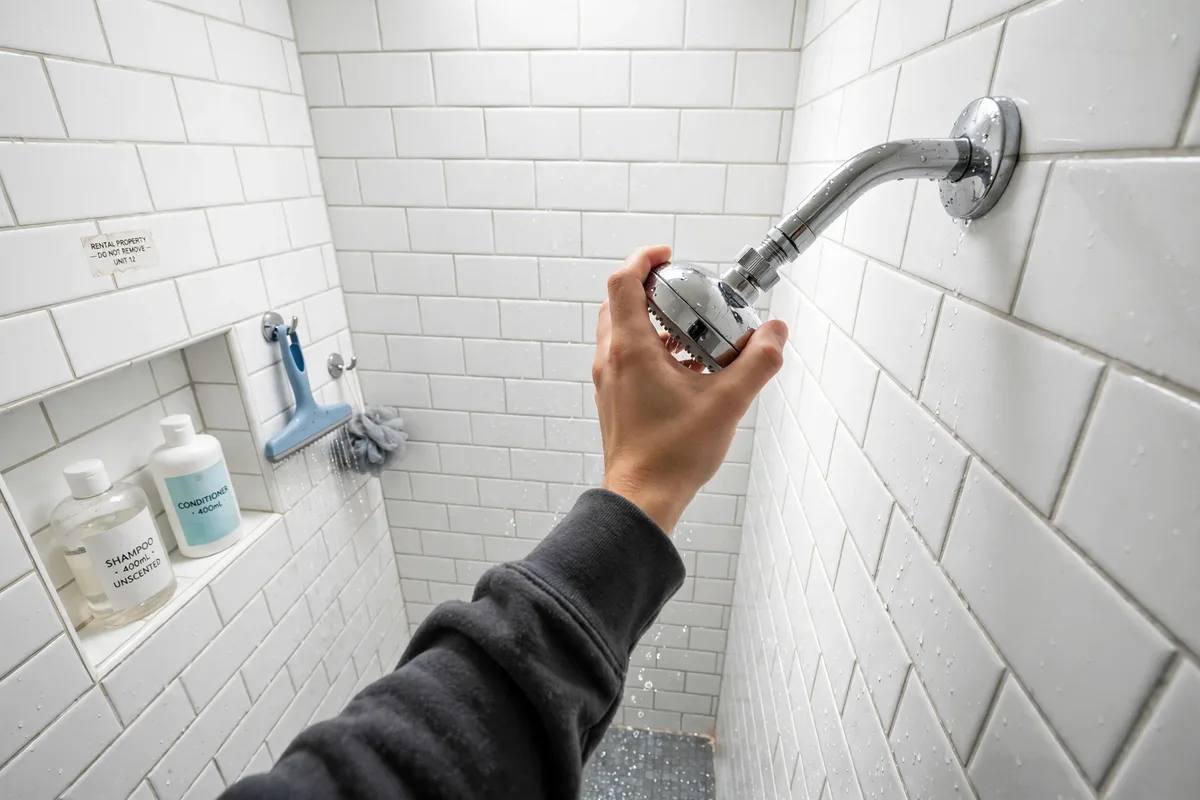
The single best quality-of-life upgrade per dollar in this article, and the one Bay Management’s guide singles out as the easiest: showerheads unscrew by hand. Fit the rainfall or high-pressure head your mornings deserve — a wrap of PTFE tape, hand-tight plus a quarter turn, done in ten minutes. A handheld replacement adds a hose, which quietly doubles as the tub-scrubbing and pet-washing tool the rental never provided.
The deposit lives in the storage: the original head, its washer and any flow restrictor go into a labelled box in the bathroom cupboard, photographed in place before removal. On move-out day the swap reverses in five minutes, and the landlord inherits exactly the shower they let — plus your good reviews of the water pressure.
5. The Floor: Tiles That Lift, or a Runner That Washes
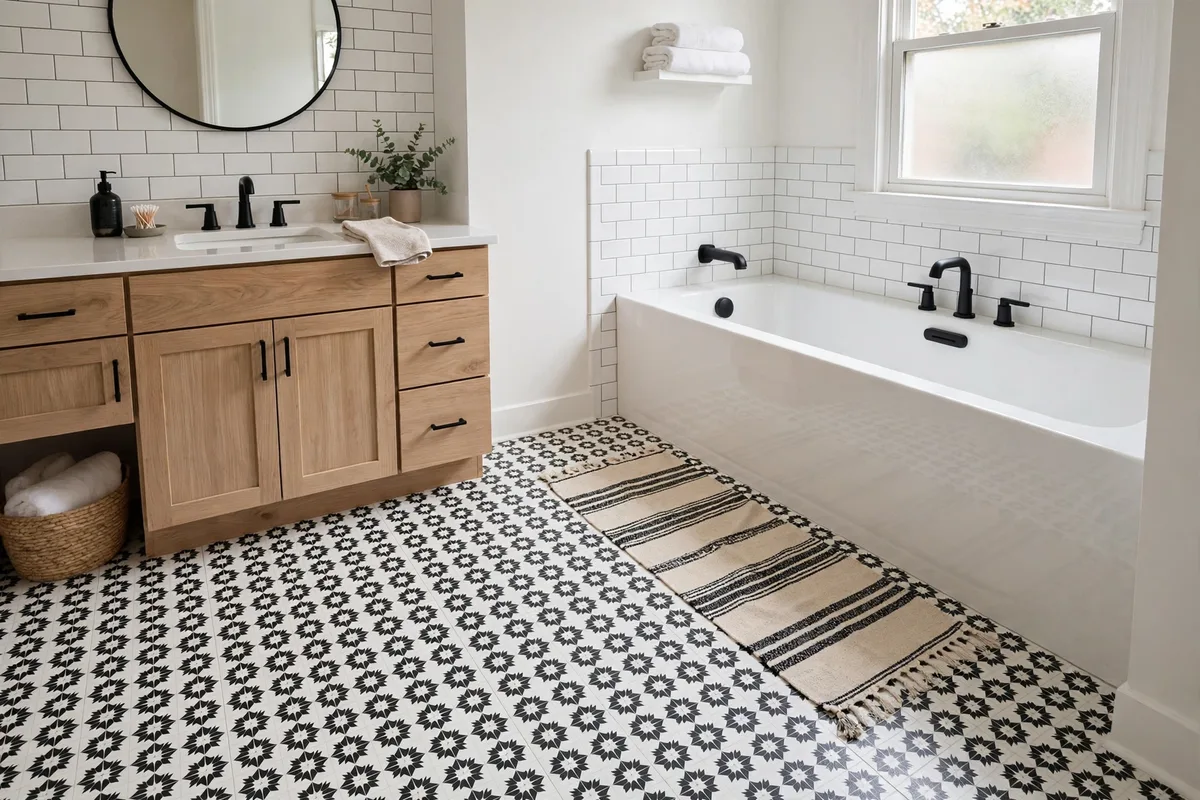
Rental bathroom floors are where dated goes to retire. Two reversible answers: peel-and-stick floor tiles over sound existing flooring (the contact-paper underlay trick — a layer of shelf liner beneath — makes removal guaranteed-clean on delicate originals), or the textile route: a low-pile washable runner or mat set that covers most of the floor and all of its sins, and goes through the washing machine monthly.
Either way, mind the moisture bookkeeping: lift a corner of stick tiles every few months to confirm nothing is trapped and growing underneath, and never seal a floor covering over a known leak. A runner dries on the tub edge after showers; a floor that cannot dry is the one update that can create the damage it was hired to hide.
Mould and Damp: What Is Yours, What Is Theirs
Keep the room dry with habits, not products: fan on and door ajar after showers, the runner dried over the tub edge rather than left on the floor, a squeegee pass over glass and tile. Then know the dividing line. Surface mould on grout and silicone is the tenant’s cleaning duty — wipe it, do not let it establish. Damp coming through the wall itself is the landlord’s repair: report it in writing, photograph it (Section 1’s documentation rule), and never cover it over — covering a known leak can quietly make the damage yours.
6. Storage That Stands, Hangs or Squeezes
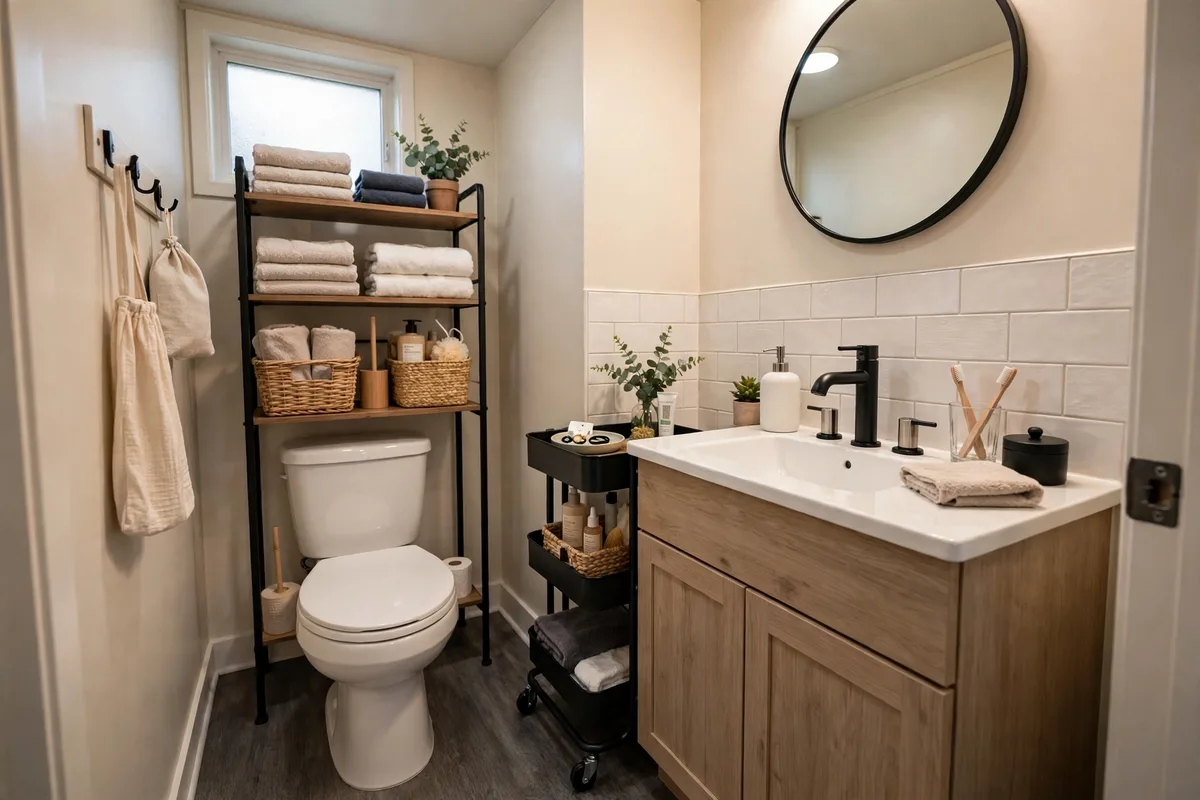
Rental bathrooms ration storage like it is wartime, and drilling is banned — so storage must stand, hang or squeeze. The Small Apartment’s no-drill storage guide catalogues the kit: a freestanding over-toilet étagère, a tension-pole shower caddy, over-door hooks, a slim rolling cart for the gap beside the vanity, and an under-sink organiser measured around the pipes (measure first — bathroom cabinets are narrower than kitchen ones, and the U-bend eats the middle of everything).
Adhesive shelves and caddies join the kit with a rating check: bathroom-rated adhesive, flat smooth surface, load honestly under the stated limit. A caddy that falls at 3 a.m. teaches the whole household to hate removable storage; a correctly rated one becomes invisible infrastructure.
7. Mirror and Hardware: Swaps With a Storage Bag
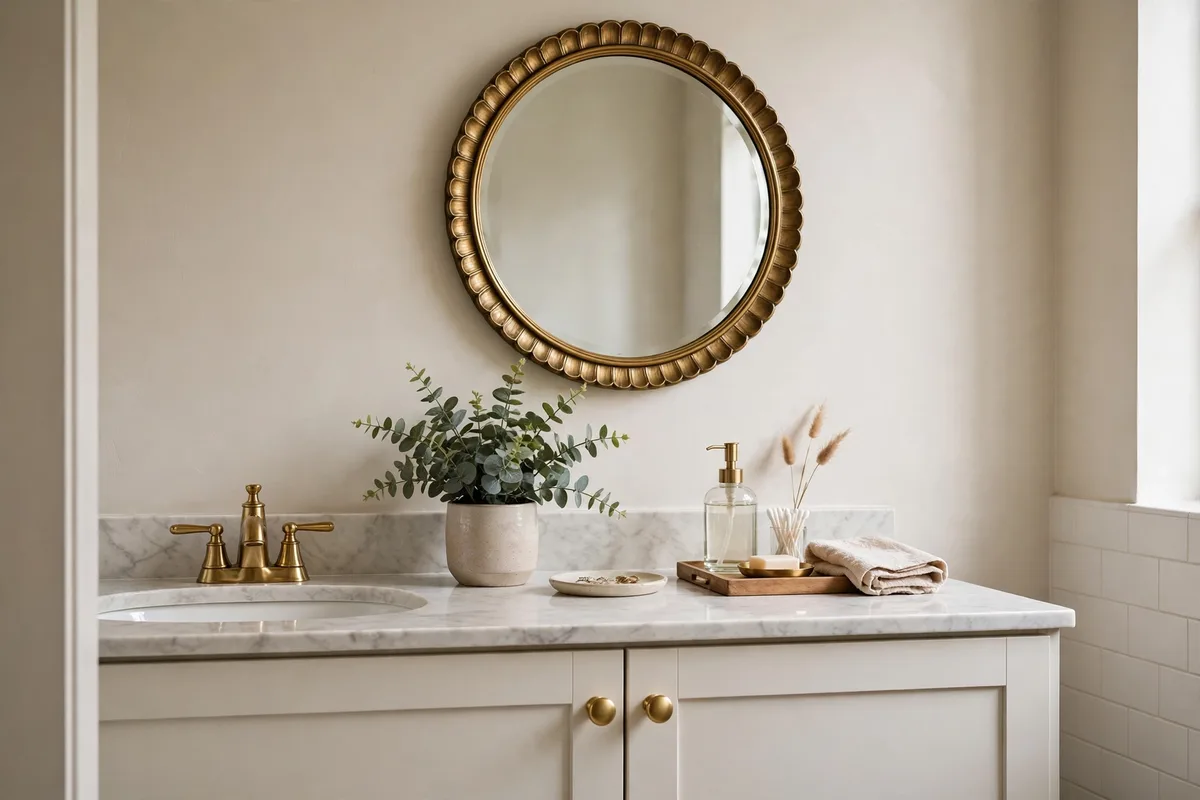
Two ten-minute swaps change the vanity’s whole face. A decorative mirror hung from a picture hook over — or in place of — the builder mirror (the original stays on the wall behind it, or wrapped in the wardrobe), positioned by the placement rules in our bathroom mirror placement ideas: centred on the basin, centre at eye level. And cabinet knobs: unscrew, bag and label the originals, fit ones in your metal — the cheapest custom-vanity illusion in renting.
Extend the same swap logic to the towel rail’s accessories — a freestanding toilet-roll stand replaces the missing holder, a nicer waste bin replaces the landlord’s. Each is a purchase you own and take with you, which is the renter’s version of equity.
8. Light Without an Electrician
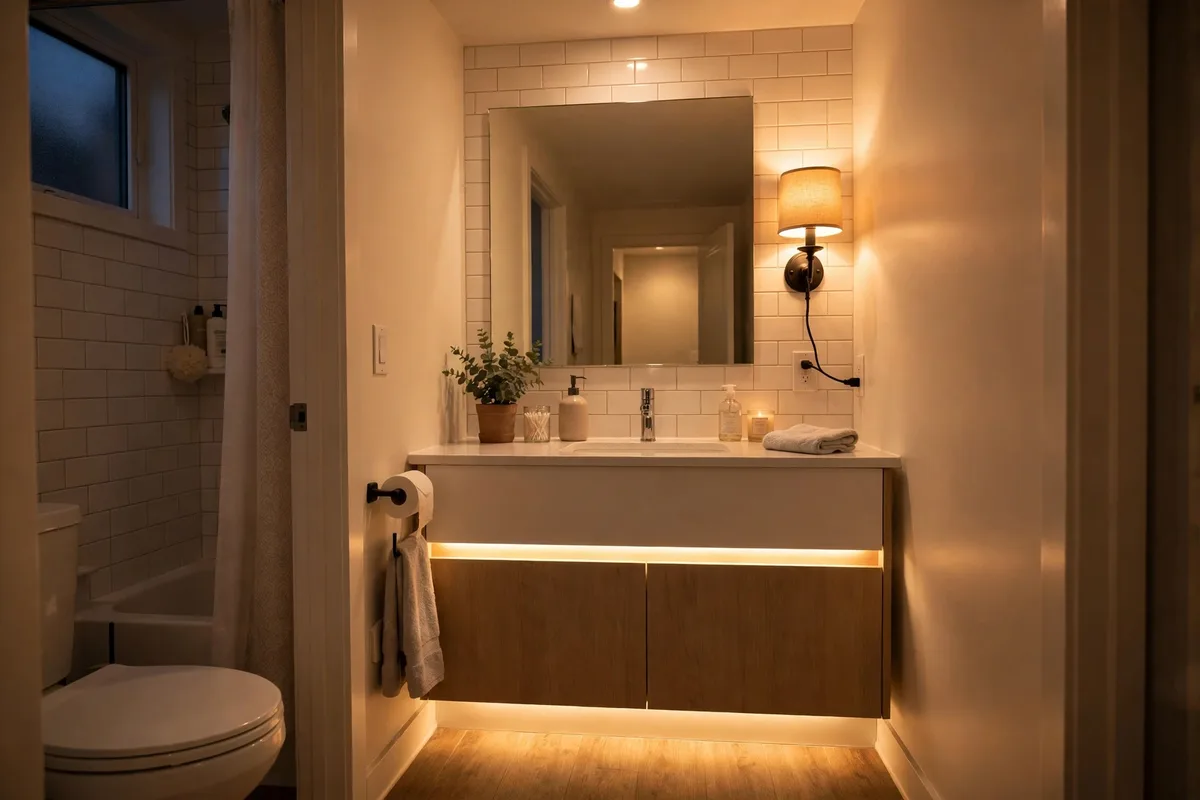
Rental bathroom light is usually one cold bulb doing its worst. The reversible fix is layered and plug-powered: warm (2700–3000K) LED bulbs in the existing fixture — the single highest-value ten dollars in the article — a rechargeable or plug-in sconce mounted beside the mirror with adhesive brackets for face-level light, and an adhesive LED strip under the cabinet or shelf for the evening glow. No wiring, no electrician, no permission slip beyond the bulb drawer.
Consistency is the craft: one colour temperature across every source, or the room looks like three rooms arguing. And keep the original bulbs in the labelled box — move-out you will be too busy to shop for the landlord’s preferred wattage.
9. Textiles Do the Decorating
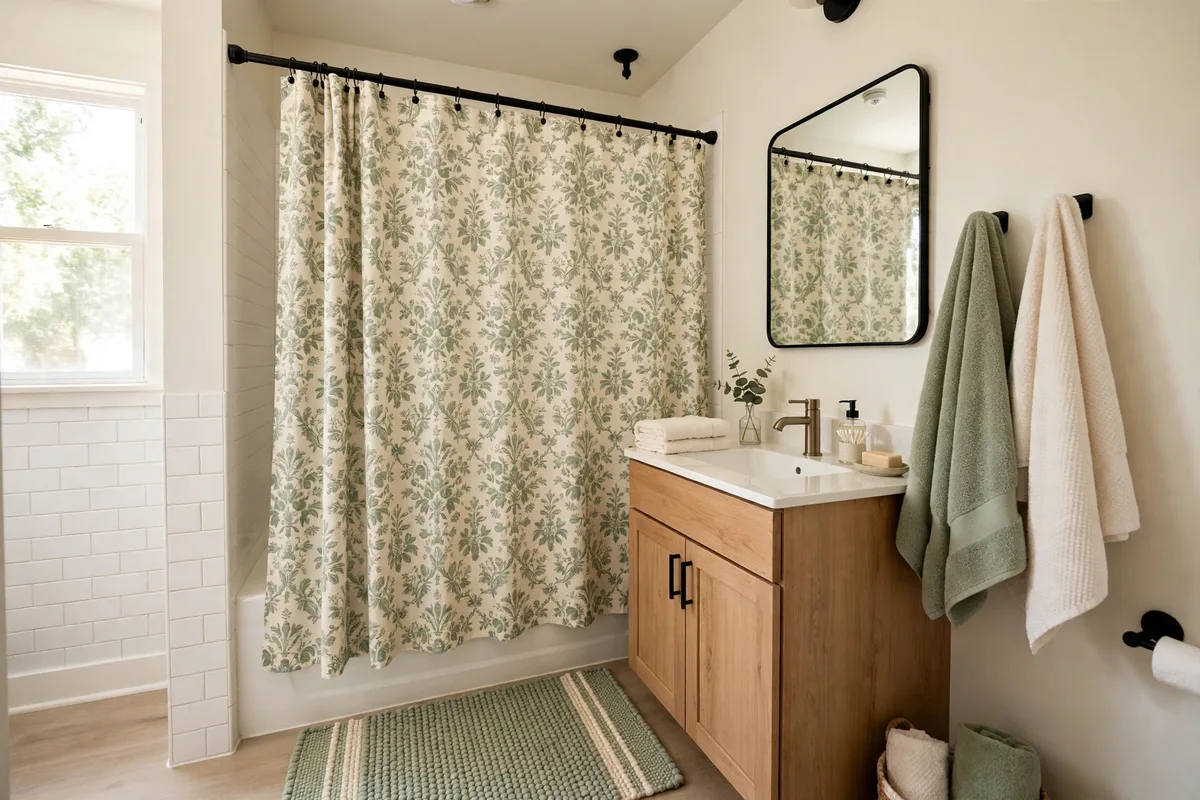
When surfaces are borrowed, textiles are the decor — and the bathroom’s biggest textile is the shower curtain, a full-height artwork the landlord cannot object to. Choose it like a painting: it is the largest pattern in the room and everything else defers to it. Towels and a mat in one coordinated palette — the spa combinations in our spa-style bathroom palette ideas translate directly — turn the remaining colour story calm, and a fabric curtain on decent rings upgrades the shower’s sound and drape as much as its look.
Renters should buy textiles like owners: they are the part of the bathroom that moves house with you. A curtain, towel set and mat bought well serve three tenancies; bought as disposable “rental stuff”, they serve one and look it.
The styled finish: Two cheap moves finish what the updates start. One humidity-tolerant plant — or a convincing faux in the dry zone, out of the spray — softens every hard surface in the room at once. And decant the daily products into coordinated containers on a tray, in this section’s palette: the vanity stops reading as storage and starts reading as styled. Both moves are fully portable on move-out day.
Three micro-moves: Hang two shower curtains high, like window drapes, and the room gains height and ceremony for the price of a second curtain. Group the counter in threes — tray, candle, one green thing — instead of lining bottles along the wall. And choose a rug-like washable mat over a bath mat: it reads as a rug that happens to live in a bathroom, which is the whole trick.
10. The Exit Kit: Reversal Day, Planned on Day One
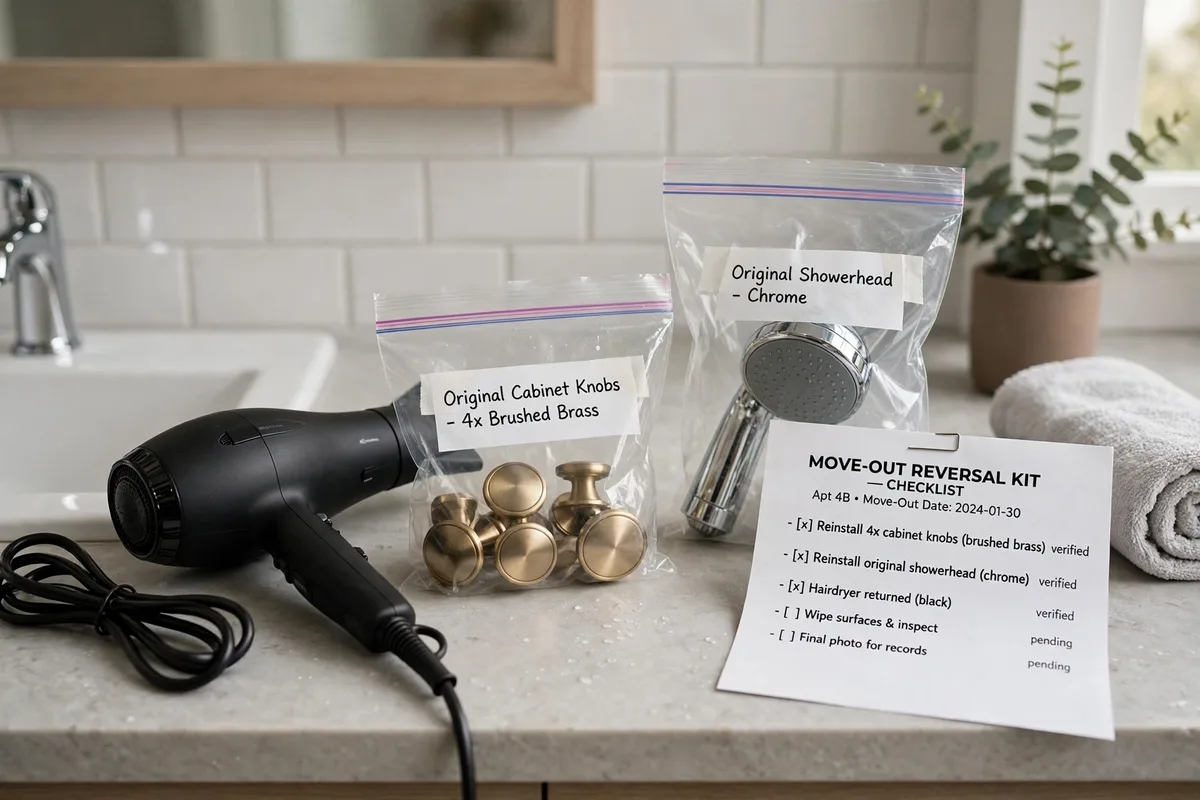
Every update in this article was chosen for its exit; the exit kit makes the exit real. One box, kept in the bathroom cupboard from week one: the original showerhead and washer, original knobs in their labelled bag, original bulbs, a hairdryer or heat gun for adhesive softening, adhesive remover, and the move-in photographs on your phone. Reversal becomes a checklist, not an archaeological dig.
On the day: warm and peel the stick products slowly, refit every original, clean the grout you covered (it will need it), and walk the room against your day-one photos. The bathroom you hand back should be photographically indistinguishable from the one you received — except cleaner. That is what a full deposit looks like, and it was designed on the day you moved in.
Frequently Asked Questions About Renter-Friendly Bathroom Updates
What bathroom updates are allowed in most rentals?
Anything reversible without trace: peel-and-stick products on sound surfaces, swapped showerheads and knobs (originals stored and refitted), freestanding and tension storage, textile changes, bulb swaps and plug-in lighting. When in doubt, ask the landlord in writing — management guides themselves recommend approval plus reversibility as the deposit-safe combination.
Will peel-and-stick tile damage the wall or floor underneath?
On smooth, sound, fully painted or tiled surfaces, quality products remove cleanly — especially warmed with a hairdryer and peeled slowly. Risk rises on flaky paint, raw plaster and delicate old vinyl. That is why the hidden test patch, steamed for a week, is non-negotiable: it tells you your surfaces’ answer before the wall does.
Can I change a rental bathroom’s showerhead?
Yes — it is the classic renter swap. Showerheads unscrew by hand (PTFE tape on the thread, hand-tight plus a quarter turn). Photograph the original setup, keep the original head and washer in a labelled box, and refit it before you leave. Keep any flow restrictor with it; some leases and local rules require it remain at handover.
How do I add storage without drilling?
Stand it (over-toilet étagère, rolling cart), tension it (pole caddies), hang it (over-door hooks and racks) or rate it (bathroom adhesive products on flat, smooth surfaces, loaded under their stated limit). Measure under-sink space around the pipes first — the U-bend dictates what fits.
Is removable wallpaper OK in a bathroom?
On dry walls, yes — ideally vinyl-faced, away from direct spray, in a room with a working fan. In the splash zone or a fan-less steamy bath, seams curl and adhesive tires; keep paper in the dry zone and let tile or stick-tile handle the wet work.
What if my lease bans adhesive products?
Then the tension, standing and textile routes carry the whole makeover: tension caddies and rods, freestanding shelves, a leaned mirror, swapped showerhead (a fitting, not an adhesive), bulbs and textiles. A strict lease narrows the kit; it does not cancel the refresh.
How can I improve rental bathroom lighting without rewiring?
Bulbs first — warm LEDs in the existing fixture transform the room for a few dollars. Then add plug-in or rechargeable sconces beside the mirror (adhesive brackets) and adhesive LED strips under cabinets. Keep every source at one colour temperature so the layers read as one scheme.
Are peel-and-stick floor tiles a good idea over old vinyl?
Generally yes, with two disciplines: lay a contact-paper/shelf-liner underlay on delicate originals for guaranteed-clean removal, and lift a corner every few months to check no moisture is trapped underneath. Never cover a known leak or lifting floor — report it instead; covering damage can make it yours.
What should I keep for move-out day?
Every original you removed — showerhead, washer, knobs, bulbs — in labelled bags in one box, plus your move-in photos. Add a hairdryer and adhesive remover for peel products. Reversal planned on day one takes an hour; reversal improvised on the last day costs deposits.
My rental bathroom is tiny. Which updates matter most?
The showerhead (daily quality of life), the bulbs (the room’s whole mood), one standing storage piece (the clutter) and the curtain-and-towel palette (the look). Small bathrooms amplify each of these because there is nothing else in the room to dilute them.
How long does it take to reverse everything before moving out?
Planned properly, an afternoon. The exit kit in Section 10 exists so that day is boring: originals labelled and stored, adhesives tested on a hidden patch long before, reversal times known per update (the glance table lists them). The tenants who lose deposit money are rarely the ones who changed the most — they are the ones who never planned the way back.
Conclusion
A rental bathroom is a borrowed room with your mornings in it — and borrowed does not have to mean endured. Zone-aware stick products, hand-swapped fittings, standing storage, plug-in light and owner-quality textiles transform it completely, while the labelled box in the cupboard guarantees the landlord gets their bathroom back untouched. Your deposit stays whole, your showers get better, and the best pieces move house with you. That is the renter’s renovation: all of the change, none of the trace.