
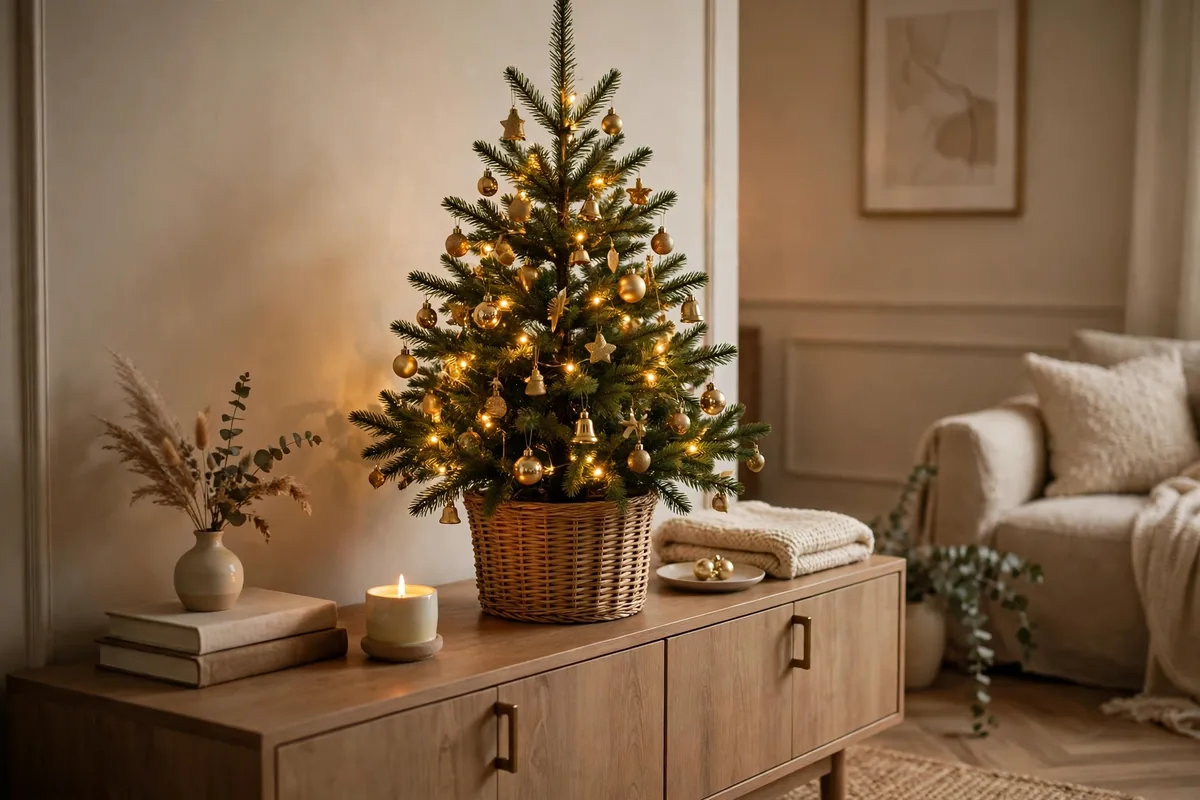
A small Christmas tree is not a compromise — in an apartment, a small living room, or on a table, it is often the better design decision. It fails only when it is styled like a shrunken version of a big tree: standard ornaments bending its branches, a full-size light string swamping it, a plastic stand left showing. Styled at its own scale, a small tree reads as deliberate and jewel-like — the piece guests photograph.
The rules below cover choosing, placing, dressing and grouping small trees, whether yours is a 60 cm tabletop fir or a slim 120 cm corner tree. Treat the tree and the fireplace as one composition using our Christmas mantel arrangement ideas, and the whole room comes together around them.
In this guide: Small Tree Sizing at a Glance · 1. Pick the Height From the Spot, Not the Shop · 2. Give a Small Tree Height With Crates, Crocks and Stands · 3. Hide the Base — Baskets, Collars and Fabric · 4. Scale the Ornaments Down to the Tree · 5. Use Micro Lights, Not Standard Strings · 6. Commit to One Theme, Head to Toe · 7. Style It as a Table Centrepiece · 8. Group Two or Three Small Trees Together · 9. Put a Second Tree Where Life Actually Happens · 10. Real Mini Trees: Keep Them Fresh and Safe · Frequently Asked Questions About Small Christmas Trees · Conclusion
Small Tree Sizing at a Glance
| Spot | Ideal Tree Height | Base That Works |
|---|---|---|
| Dining or coffee table | 30–60 cm | Crock, basket or tree collar on the table |
| Sideboard / console | 60–90 cm | Weighted stand inside a basket |
| Floor, small room corner | 90–150 cm slim profile | Crate or stand to add 20–30 cm of lift |
| Entryway / stair landing | 60–120 cm | Heavy crock that cannot tip |
| Desk or bedside | 30–45 cm | Small pot or mug-style holder |
1. Pick the Height From the Spot, Not the Shop
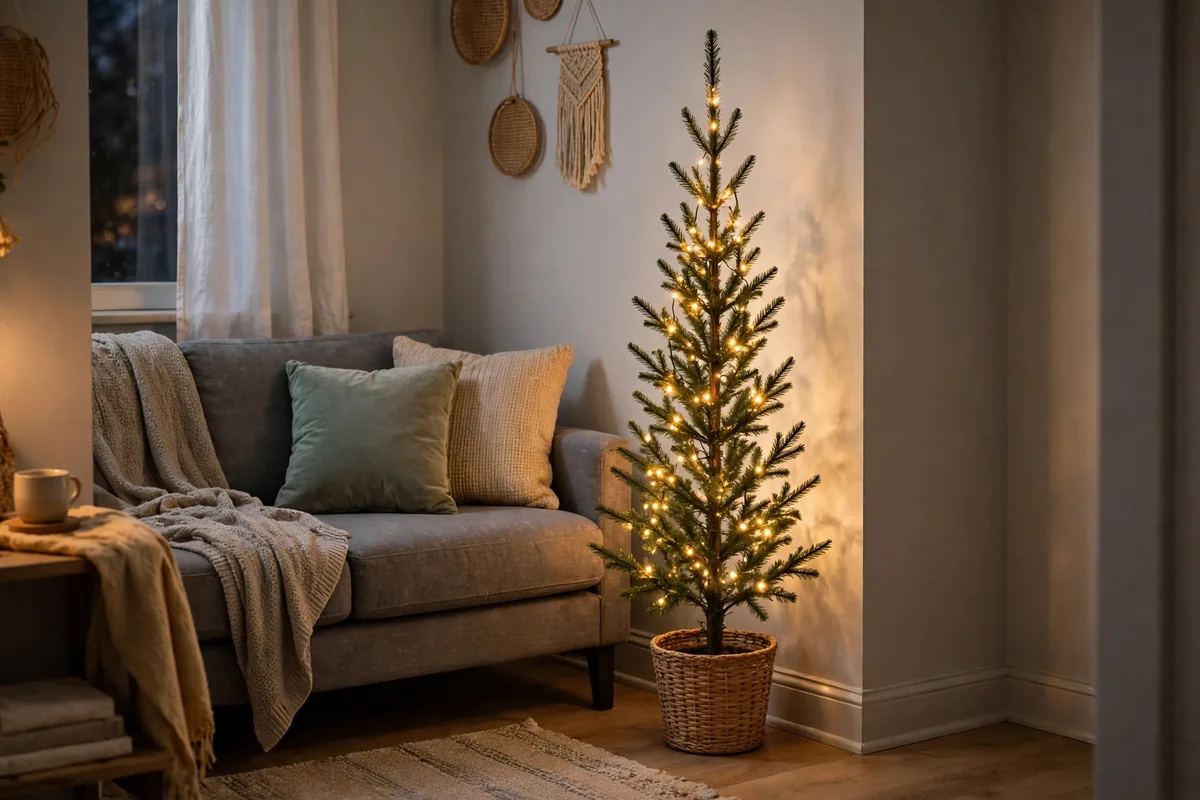
Measure the spot first: the surface or floor area, the ceiling or shelf above it, and the viewing distance. A tabletop tree should finish — topper included — below the eye line of someone seated at the table, or it becomes a wall between diners. A floor tree in a small room earns more presence from a slim profile at 120–150 cm than from a wide 90 cm tree that eats the corner.
Proportion to the room is the same judgement behind whole-home planning in our decorating home for Christmas ideas: one well-scaled focal point beats three undersized ones competing. When in doubt, go one size up in height and one size down in width.
2. Give a Small Tree Height With Crates, Crocks and Stands
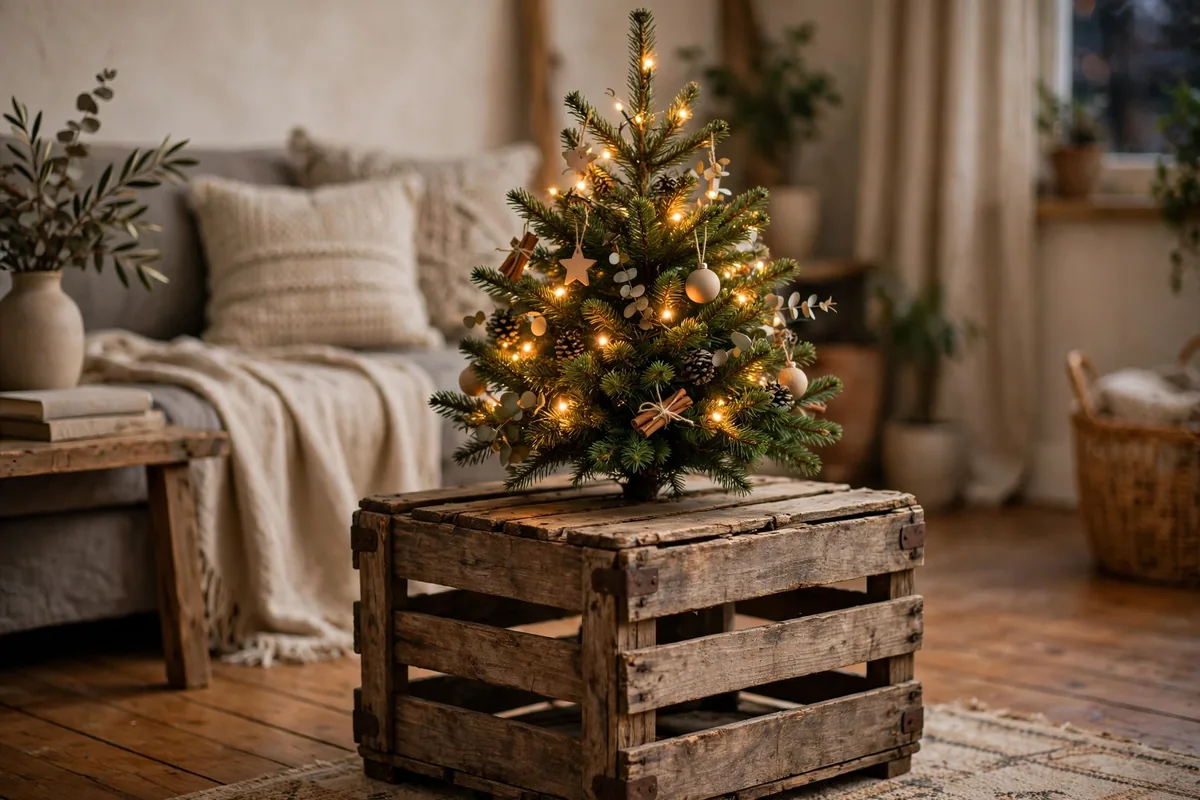
A small tree placed straight on the floor reads as an afterthought; the same tree raised 20–40 cm becomes the room’s focal point — floor-corner trees sit at the lower end of that range (20–30 cm), which is where the sizing table puts them. Set it on a wooden crate, a low stool, a stack of vintage suitcases or inside a tall crock — the lift costs nothing and changes how every ornament sits in the sightline.
Stability is the non-negotiable: the base must be wider than the tree’s widest branch spread at its lowest point, and heavy enough that a cat, a child or a vacuum cleaner cord cannot topple it. Test with a gentle push before decorating, not after.
3. Hide the Base — Baskets, Collars and Fabric
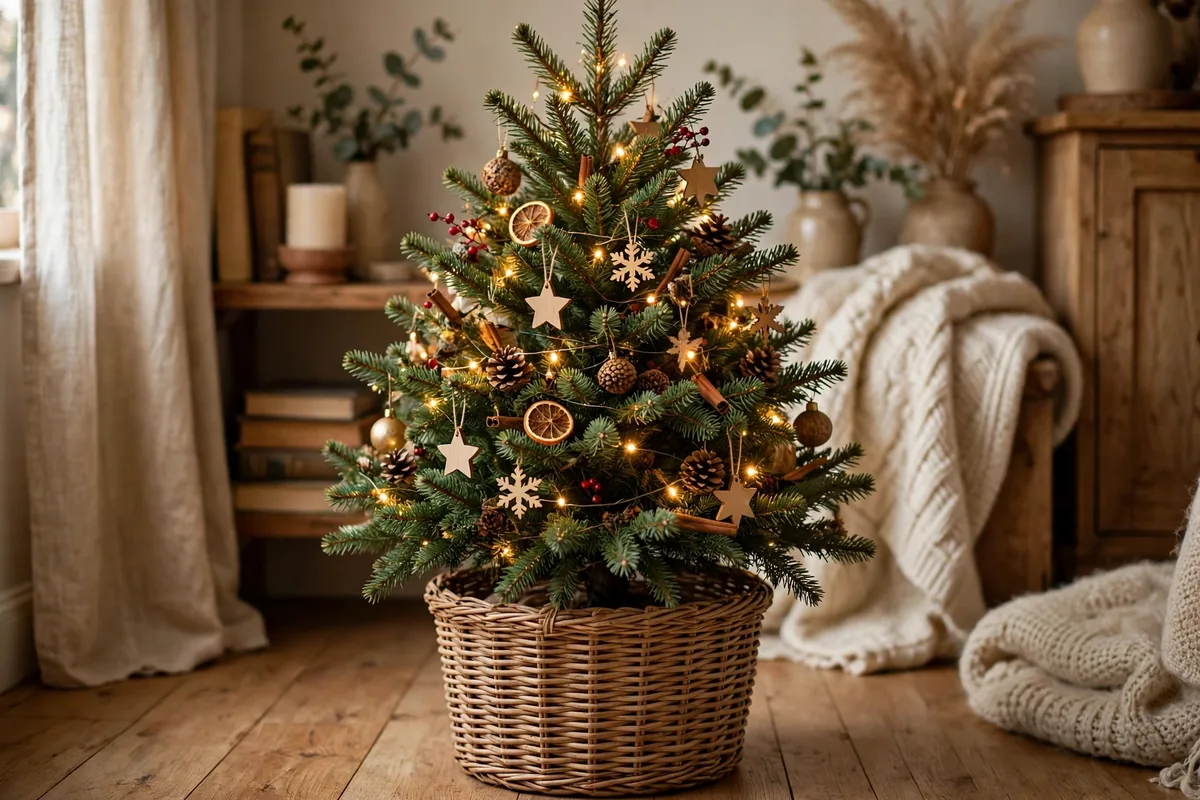
The exposed plastic stand is what makes most small trees look cheap, and it is the easiest flaw to fix. Slide the stand into a woven basket, a galvanised bucket, a ceramic crock or a purpose-made tree collar; for a tabletop tree, wrap the pot in linen, burlap or a folded throw and tie it with ribbon or twine.
Match the base to the room, not the season alone: a rattan basket in a neutral room, a black metal collar in a modern one, a red enamel bucket where the scheme is classic. The base is part of the styling — choose it with the same care as the topper.
4. Scale the Ornaments Down to the Tree
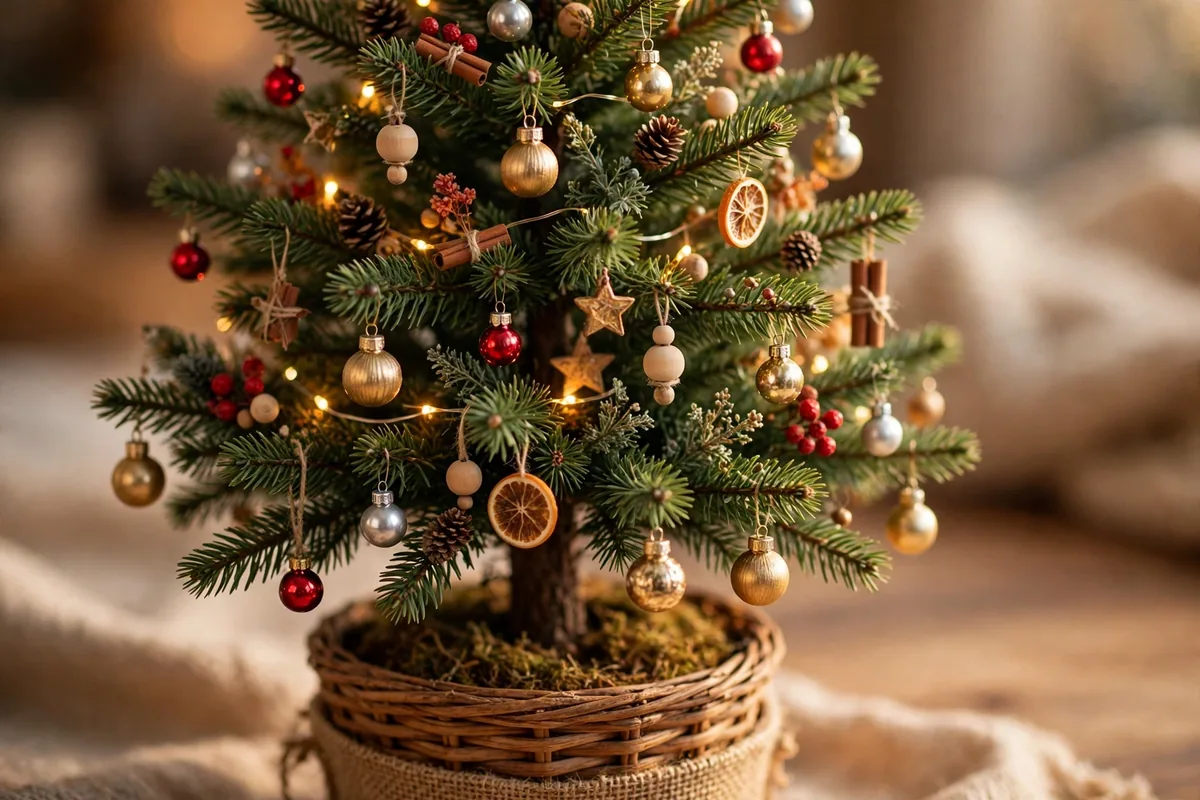
Standard 8 cm baubles overwhelm a small tree’s branches and drag the tips down. Work at roughly half scale: ornaments of 3–5 cm, thin ribbon instead of wide, and picks and sprays cut short. Keep the count generous but the pieces light — a small tree looks fullest with many small touches rather than a few heavy ones.
Hang the largest of your small ornaments low and inside, the smallest at the tips, and step back every ten minutes. HGTV’s tabletop Christmas tree ideas show the proportion principle beautifully — even novelty themes work when every piece respects the tree’s scale. And the counts: roughly 15–20 small ornaments for a 60 cm tree, 30–40 for a 120 cm tree — half-scale pieces need company, not sparseness. Work the fullness before the dressing: fluff every branch outward and upward, and set ornaments inside the branches as well as on the tips — a small tree dressed only on its surface reads as sparse.
5. Use Micro Lights, Not Standard Strings
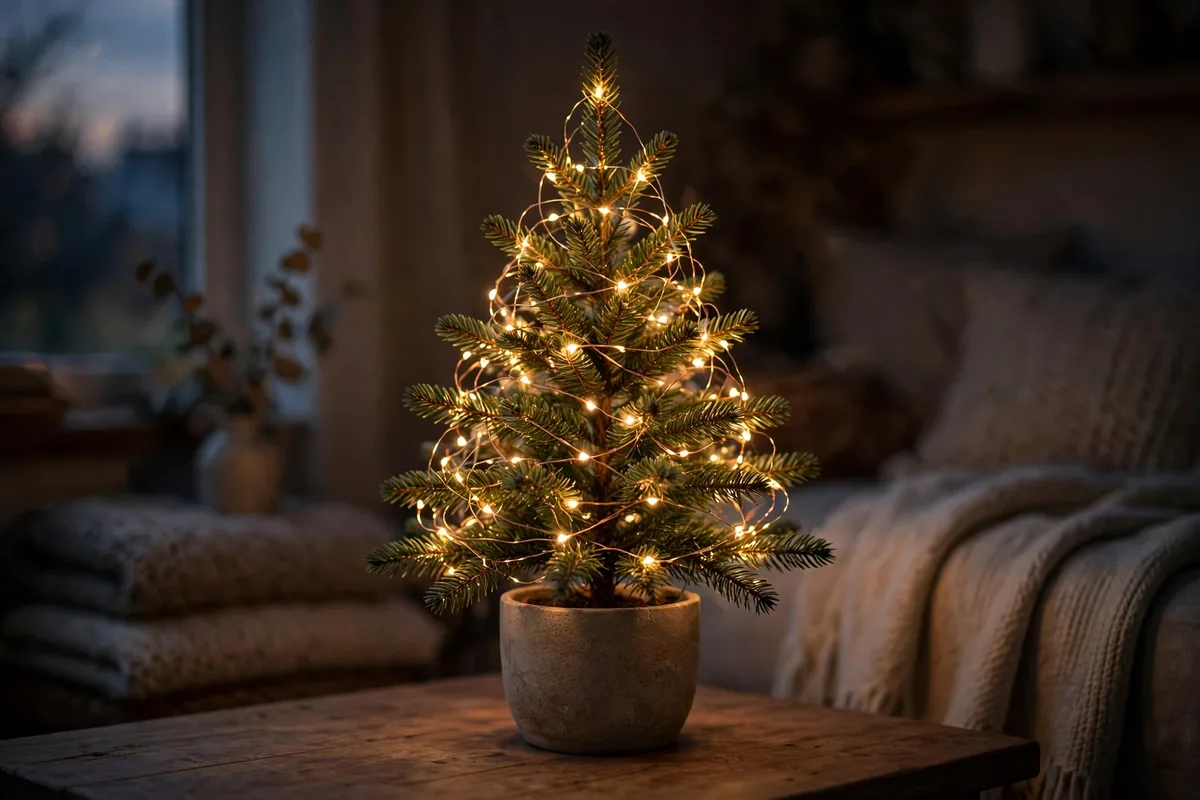
Light strings are where small trees most often go wrong: standard bulbs are too big, too far apart and too heavy for fine branches. Use micro LED fairy lights on thin copper or green wire instead — the wire disappears into the branches, the points of light sit close together, and battery packs hide inside the base so no cord crosses the table.
Wind the string from the trunk outward along each main branch rather than circling the tree in a spiral. It takes five minutes longer and produces the deep, even glow that makes a small tree look expensive. A timer setting means it lights itself every evening.
6. Commit to One Theme, Head to Toe
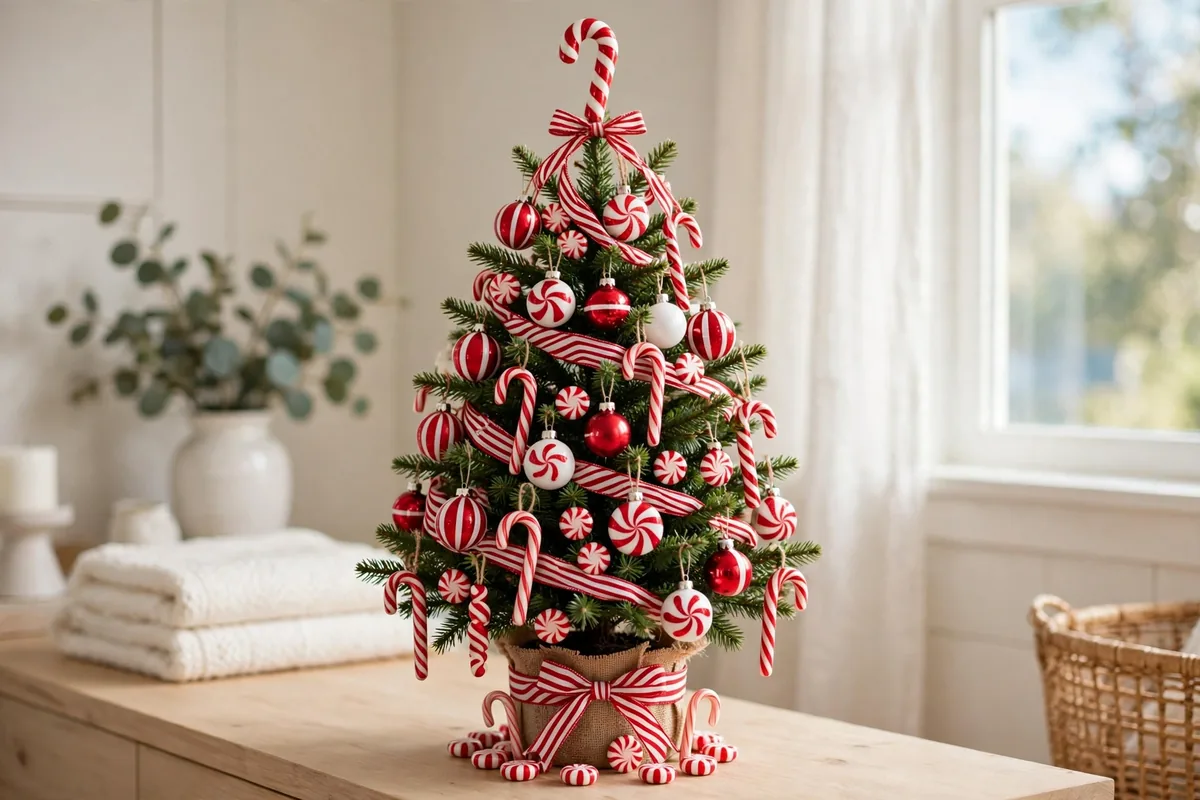
A small tree has room for one idea, executed completely: red-and-white candy, woodland naturals, all-gold glamour, paper and straw Scandinavian, or a single colour in mixed finishes. Theme discipline matters more at small scale because there is nowhere for a stray style to hide — three off-theme ornaments are a tenth of the whole display.
This is the same one-motif discipline as our subtle Halloween living room ideas: choose the story, repeat it gently, and let everything that does not belong go back in the box for the big tree or next year.
7. Style It as a Table Centrepiece
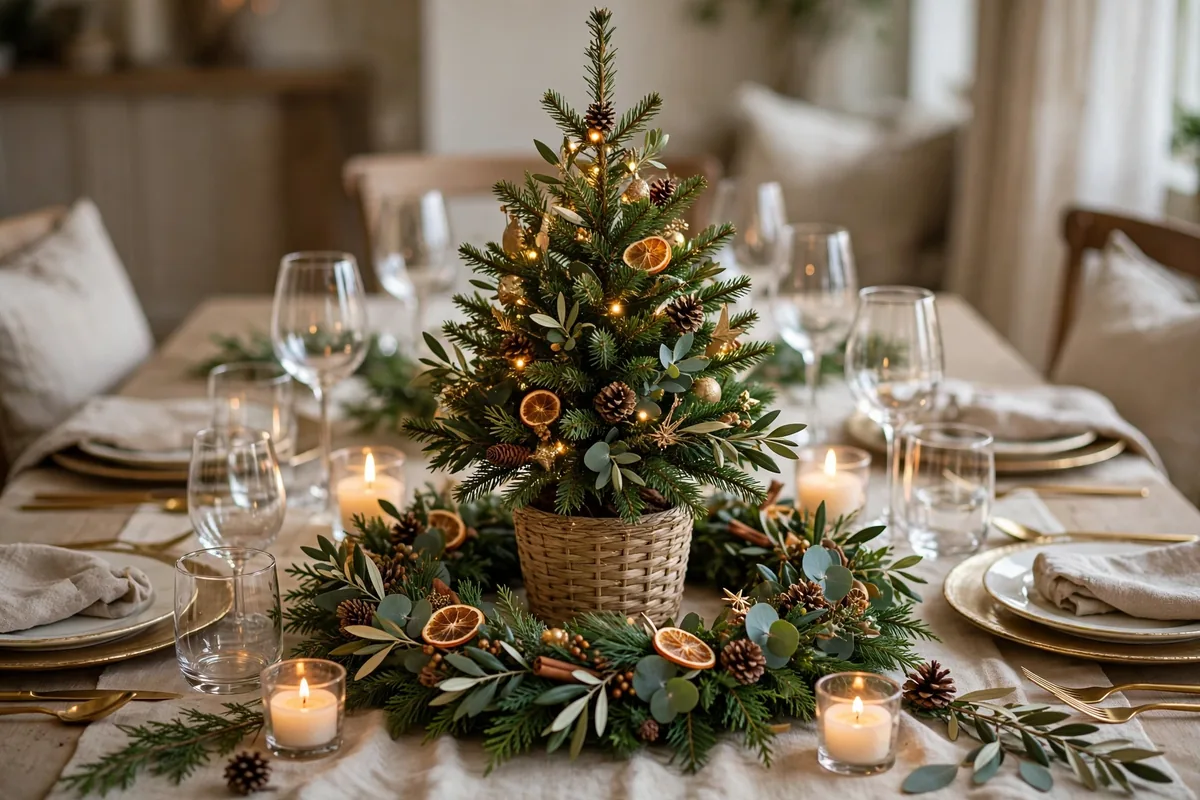
On a dining table, build outward from the tree: a runner underneath, a low ring of greenery or ornaments around the base to anchor it, and candlelight at two heights flanking — never crowding — it. Keep the total arrangement below seated eye level and narrower than the table’s middle third, so plates, glasses and conversation still work.
A centrepiece tree earns a slightly dressier treatment than a corner tree: your best mini ornaments, the metal that matches the tableware, and the ribbon colour from the napkins. It is the tree guests sit beside for hours; detail rewards the attention.
8. Group Two or Three Small Trees Together

One small tree can look lonely; a group of two or three at staggered heights looks like a forest — and a design decision. Group them on a sideboard, a mantel end, a stair landing or a wide windowsill: tallest at the back, odd numbers, bases in the same material family so the group reads as one set.
Decorate grouped trees more simply than a solo tree — lights on all three, ornaments on one, the others left green or flocked. The grouping itself is the decoration. Leave the arrangement where your cozy reading corner chair can see it, and it becomes the view you enjoy all season.
9. Put a Second Tree Where Life Actually Happens

If the main tree lives in the living room, a small second tree spreads the season through the house: on the entryway console where it greets every arrival, at the top of the stairs, in the kitchen corner where mornings start, or on a bedside table in a guest room. Small trees make second trees affordable and storable.
Keep second trees low-maintenance: battery lights on a timer, shatterproof ornaments, and a theme that nods to the main tree — the same ribbon or one shared colour — so the house feels designed rather than decorated twice.
10. Real Mini Trees: Keep Them Fresh and Safe
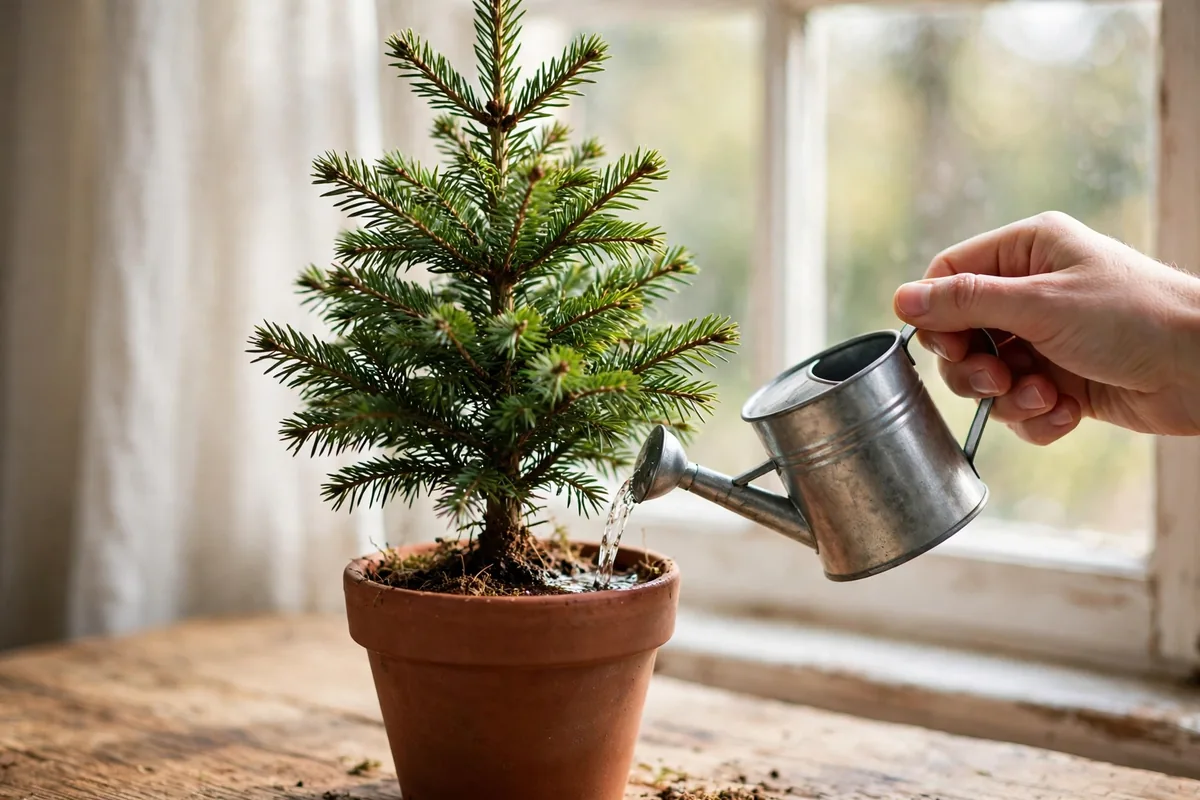
A real small tree — cut or pot-grown — needs the same care as a full-size one, in miniature: a fresh cut across the trunk base before it goes into water, a stand or pot that never dries out, and a position away from radiators, fires and heat vents, which dry needles and raise fire risk. Pot-grown trees additionally want light and a cool room, and can be planted out or kept in the garden after the season.
The safety basics are well established: the U.S. National Park Service’s holiday safety guide, drawing on NFPA advice, recommends keeping a live tree watered at all times, placing it at least three feet from heat sources, and never leaving it up once it has dried out and begun dropping needles freely. A small tree dries faster than a large one, so check its water daily — it takes ten seconds.
Frequently Asked Questions About Small Christmas Trees
What size is considered a small Christmas tree?
Generally anything under about 150 cm (5 feet). Tabletop trees run 30–90 cm, and slim floor trees for small rooms are usually 90–150 cm with a narrower profile than standard trees of the same height.
How many ornaments does a small tree need?
As a working guide, about 15–20 small ornaments for a 60 cm tree and 30–40 for a 120 cm tree, spaced evenly and scaled to the branches — mini ornaments of 3–5 cm rather than standard 8 cm baubles.
How do I make a small tree look fuller?
Fluff every branch outward and upward, add a second micro-light string deep near the trunk, tuck a few greenery picks or ribbon loops into gaps, and hang ornaments inside the branches as well as on the tips. Grouping it with a second small tree also reads as fullness.
Can a small tree be the only tree in the house?
Absolutely — in studios, flats and small homes it is often the smarter choice. Raise it on a crate or stand, style it completely (base hidden, one theme, micro lights), and give it the room’s focal position rather than apologising for its size.
What do I put under a small tree instead of a skirt?
A basket, crock, bucket or tree collar hides the stand and replaces the skirt at small scale. On a table, a folded linen cloth, a small rug or a tray under the pot does the same job and protects the surface.
Are battery lights bright enough for a small tree?
Yes — micro LED battery strings are designed for exactly this scale, and their close spacing often looks better than mains strings on small branches. Choose a set with a timer so it runs itself each evening.
How long will a real small tree last indoors?
A cut small tree kept watered lasts three to four weeks; a pot-grown tree can last the whole season and beyond if kept cool, watered and away from heat. Both dry out faster than large trees, so check water daily.
Where is the best place for a small tree in an apartment?
A corner of the main living area on a raised stand, a sideboard or console against the wall, or the centre of the dining table. Avoid doorways and walkways — a small tree at ankle or elbow height gets knocked.
How do I store a small artificial tree?
Keep its original box if you can — small trees store best upright in the box, or wrapped in a storage bag on a shelf. Decorations for it store in one small labelled box, which is part of the appeal: the whole tree’s kit fits in a single container.
Can I put a small tree in a child’s bedroom?
Yes, with shatterproof ornaments, battery lights (no mains cords), and the tree positioned where it cannot be pulled over. A themed mini tree — woodland animals, paper stars — makes a lovely night-light-adjacent decoration on a timer.
Conclusion
A small Christmas tree succeeds on scale and finish: the right height for its spot, a hidden base, ornaments and lights sized to its branches, and one theme carried through. Style it as the room’s partner to the mantel — the layering in our fireplace mantel styling ideas is the same thinking at shelf height — and a small tree stops looking like a compromise and starts looking like the plan.


Pingback: 10 Holiday Window Display Ideas That Glow From the Street