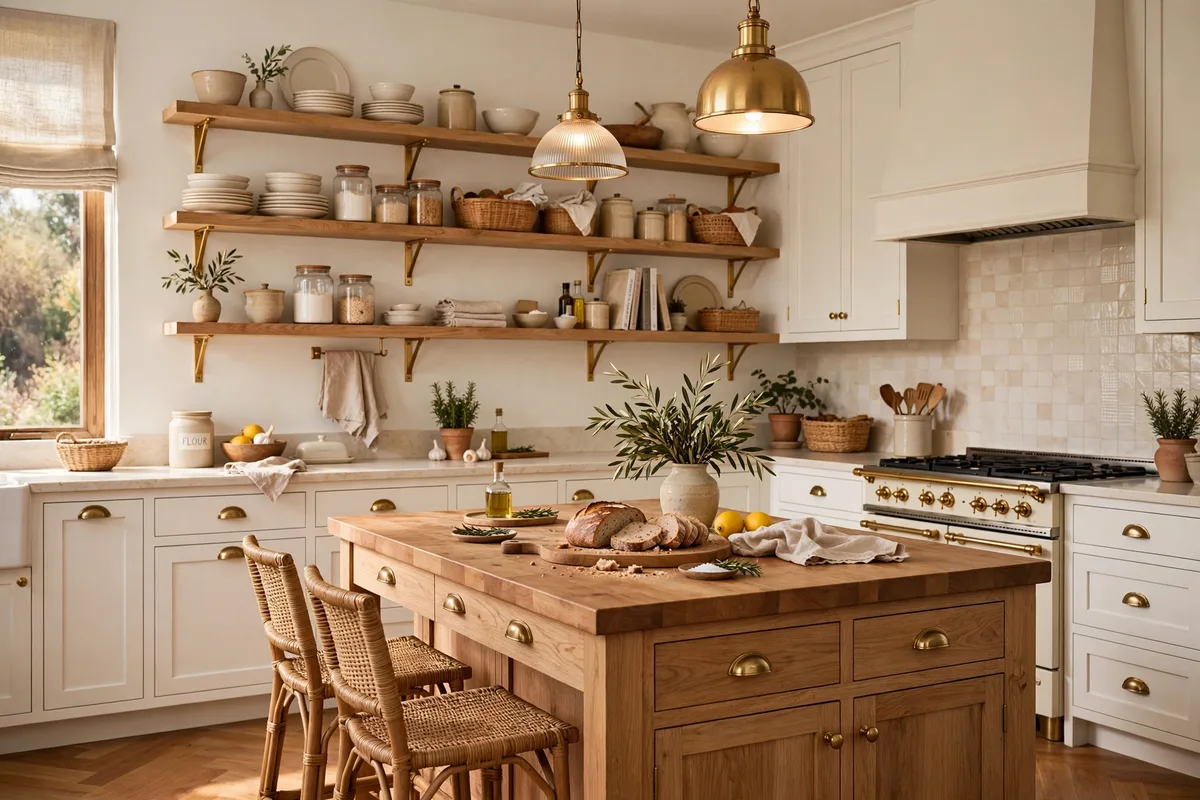
An all-white kitchen fails in one way: flat. Same white, same sheen, same smoothness everywhere, and the room reads as a showroom — or a clinic. It succeeds the opposite way: white stays the base (60% or more of what the eye sees) and a small, deliberate set of accents does all the warming — one wood, one warm metal, black in planned doses, stone with a voice, texture you can feel, and light at the right temperature. Accents in a white kitchen are not decoration sprinkled on top; they are a dosing system, and the dose is the design.
Ten ideas: undertone first, then each accent family with its dose, then the floor and light that hold it all.
The White Kitchen Accent Doses at a Glance
| Accent | Dose | What it fixes |
|---|---|---|
| Layered whites | 2–3 whites, varied sheen | Flatness |
| Wood | One species, repeated 3+ times | Coldness |
| Warm metal | One finish, everywhere metal | Sterility |
| Black | Planned points only | Wishy-washiness |
| Colour | Only in things that move | Lifelessness |
1. Start With the Undertone: Your White Has a Temperature
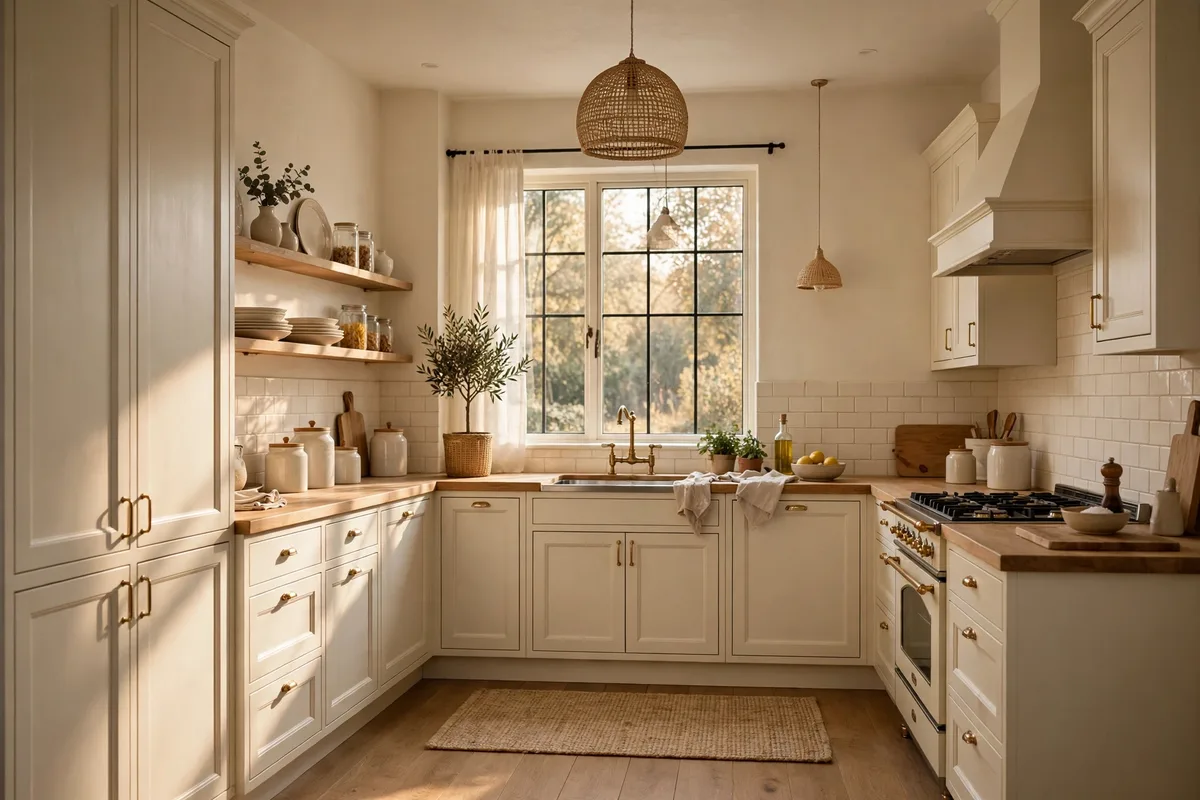
Before any accent is chosen, name your white’s temperature. Warm whites (cream, ivory, alabaster — a whisper of yellow or brown beneath) ask for warm accents: wood, brass, travertine. Cool whites (blue-grey beneath) take chrome, black and marble’s grey veining. Most “sterile white kitchen” complaints are actually undertone fights — warm marble against cool cabinets, brass against a blue-white — where every element is fine and the mixture is cold. Test whites the way the painters do: big boards, your light, morning and evening.
When in doubt, go warm. The current correction in white kitchens is entirely in that direction — creamy alabasters and soft putties replacing brilliant ceiling-white — because warm white forgives both northern light and evening bulbs, and cool white forgives neither.
2. Layer the Whites Themselves: Sheen Is an Accent
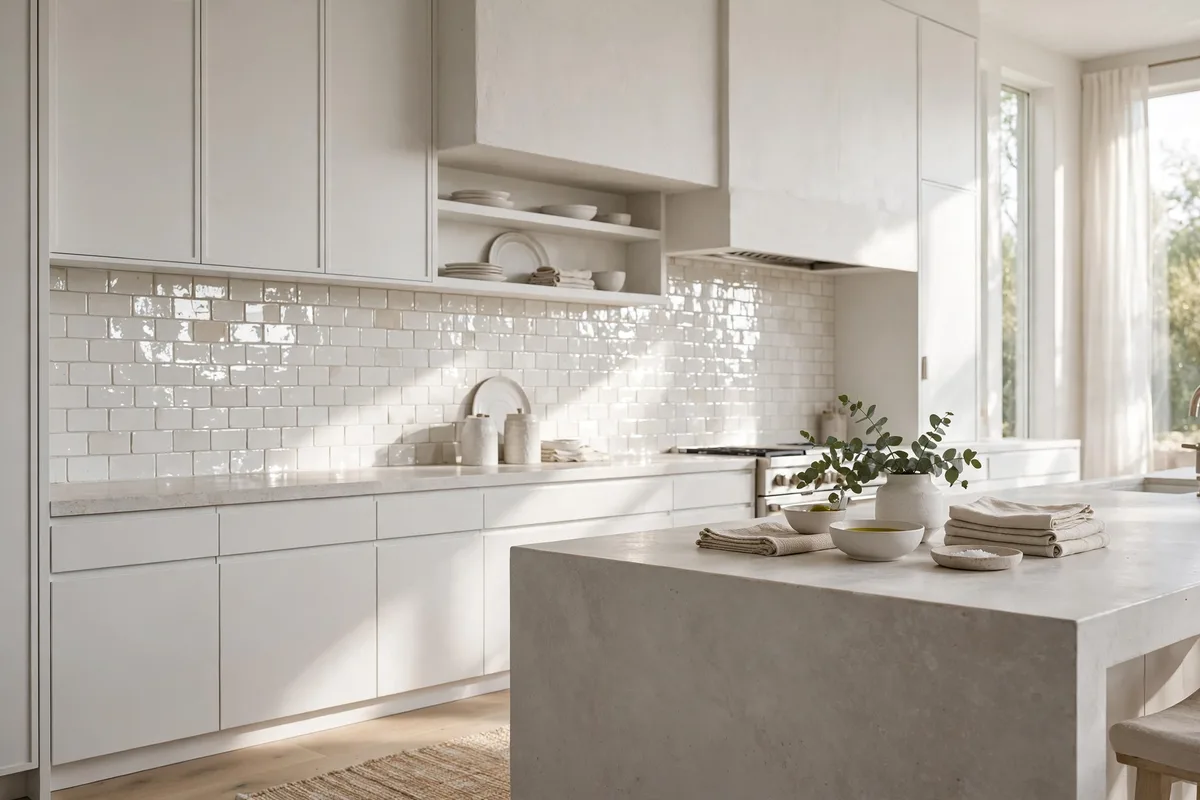
The first accent is more white — handled as layers instead of a single coat. Courtney’s World’s white-on-white breakdown gives the working formula: vary sheen intentionally — walls satin, cabinets matte or eggshell, the backsplash glossy — so identical colour reads as three materials as light moves across the day. Add texture inside the palette: handmade-look tile with uneven edges, honed (not polished) stone, plaster or limewash on one surface. The room stays monochrome and stops being monotonous.
The failure this prevents is the matched-sample kitchen, where cabinet, tile, counter and wall were all chosen to be “the same white” and ended up five competing whites in one flat light. Layered whites are chosen to differ — slightly in tone, clearly in finish — which is why they harmonise instead of arguing.
3. One Wood, Repeated: The Warmth Anchor
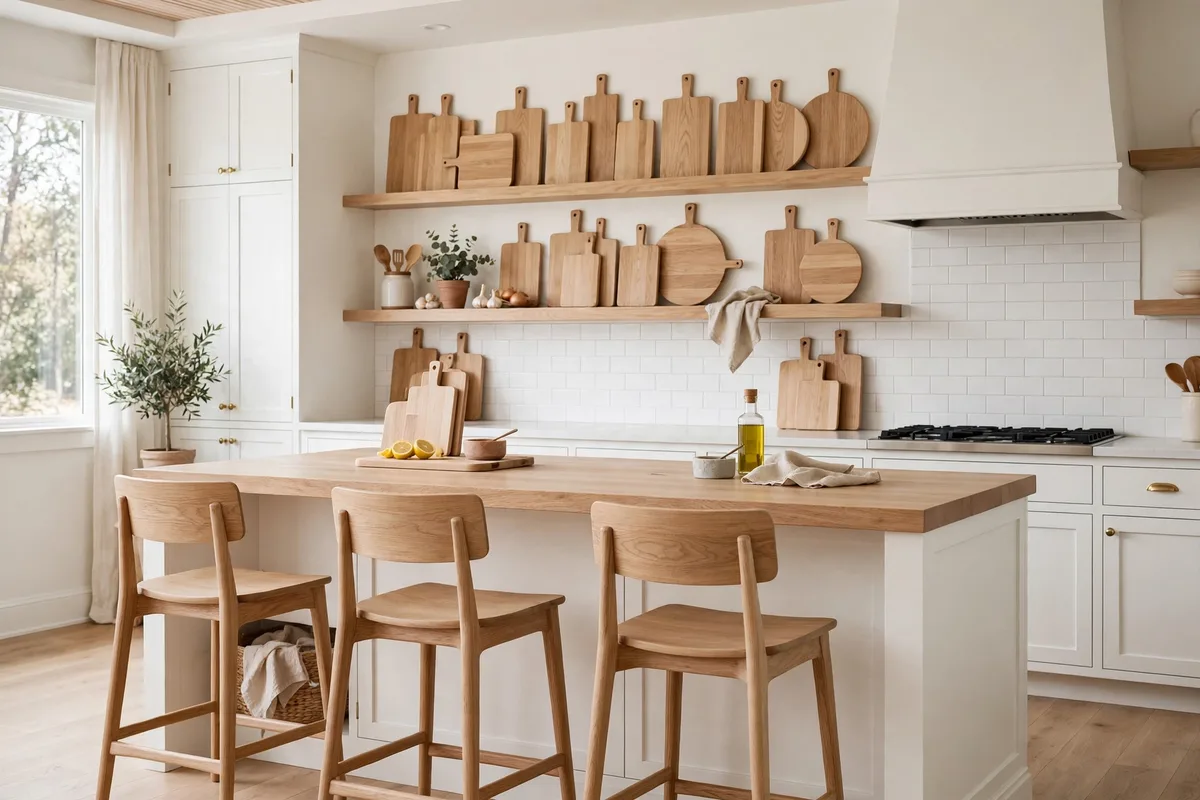
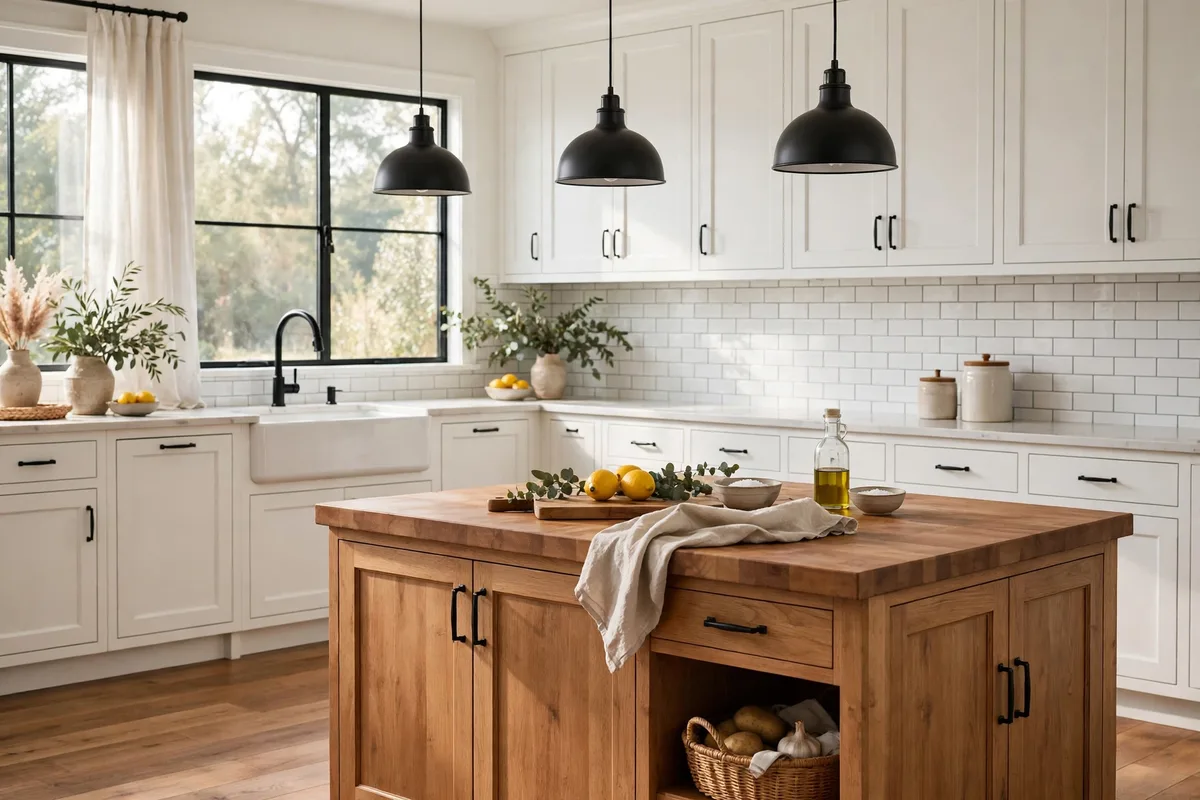
Wood is the non-negotiable accent — the one that does the most warming per object. The discipline is singularity: ONE species and tone (white oak is the era’s default), repeated at least three times so it reads as a system — floor or shelves, stools, boards and a tray — rather than a souvenir. The species-and-finish logic lives in our warm wood kitchen finishes ideas; in a white kitchen the dose matters more than the species: enough wood that every sightline includes some, never so much that the room stops being white.
Placement follows the eye: wood low and at touch points (stools, boards, the island’s work side) warms where hands land; a wood ceiling beam or shelf line warms the view. Start with one large surface — floor, island, or a full shelf wall — then echo it small twice.
4. One Warm Metal: Brass Is Jewellery, Chrome Is Equipment
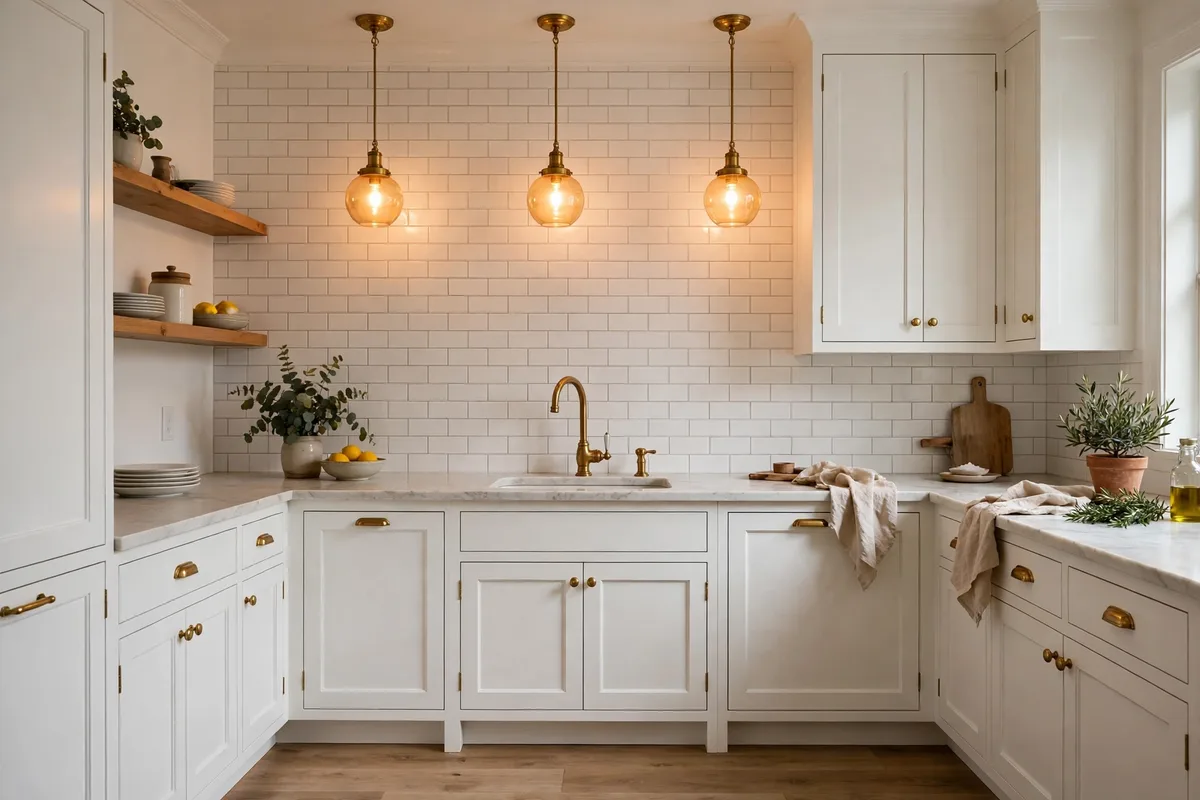
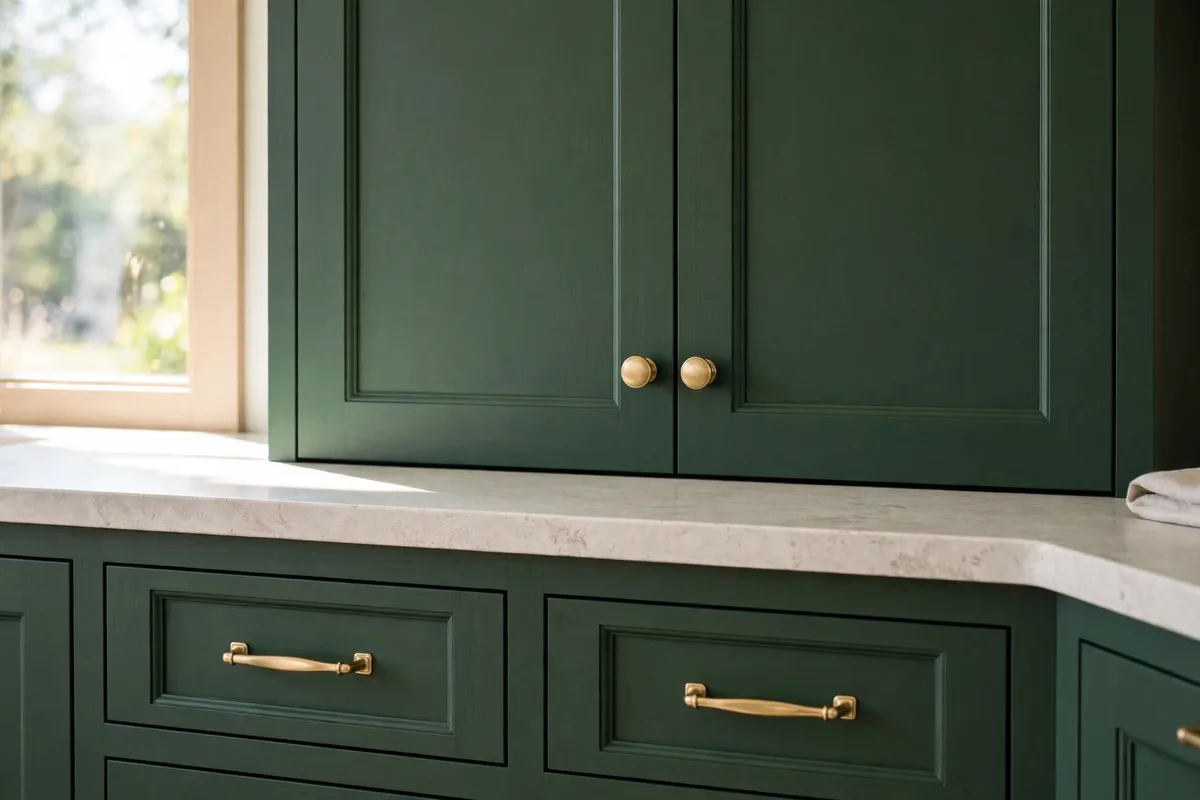
Metal is the white kitchen’s jewellery, and the warm metals do the warming: brass (unlacquered if you want the living finish that patinas where hands touch), aged bronze, copper. One finish, carried through hardware, faucet and lighting without exception — in a monochrome room, a second metal reads as a mistake at a glance. Chrome and polished nickel are not wrong, but they cool the room; in a warm-white kitchen they are the undertone fight of §1 wearing a faucet.
Size matters too: in an all-white scheme, hardware is one of the few repeated small shapes in the room, so it carries design weight out of proportion to its cost. Generous pulls, a real faucet silhouette, pendants with presence — the accents budget in a white kitchen belongs disproportionately to metal.
5. Black, Dosed: Planned Points, Never a Theme
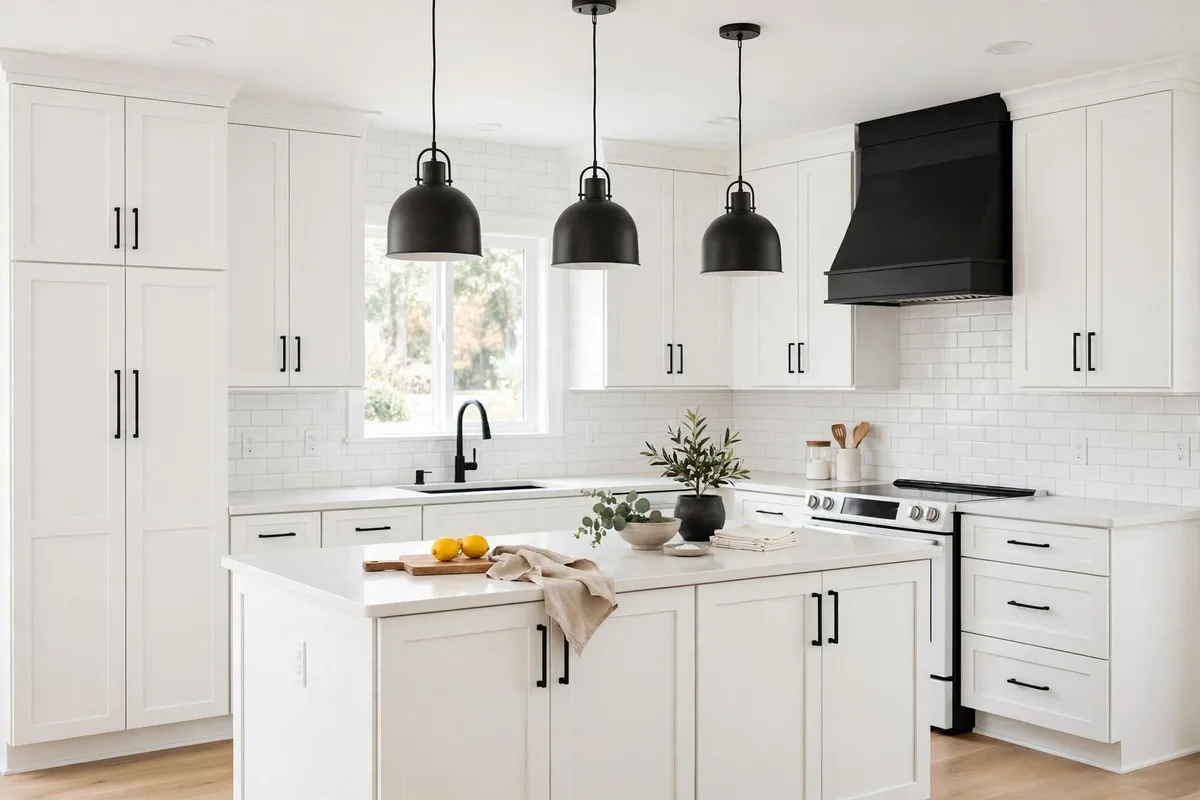
Black is white’s definition — the accent that stops a pale kitchen from dissolving into fog. The dose is the discipline. Lily Ann Cabinets’ black-and-white formula puts black in a few planned places — hardware, light fixtures, faucet, window frames, or one big gesture like the island split in our two-tone kitchen cabinets ideas or a range hood — and sizes the dose to the room: the smaller or darker the kitchen, the more of it stays white. Black everywhere it can go is a different (also valid) kitchen; black at five chosen points is an accent system.
Choose matte black for the modern register, and let the black repeat the room’s lines — pendant silhouettes echoing the faucet’s curve, pulls sized to their drawers. And follow their balancing rule: a black-accented white kitchen still needs its one wood surface and one warm metal, or the contrast turns cold.
6. Stone With a Voice: Veining Is the Pattern
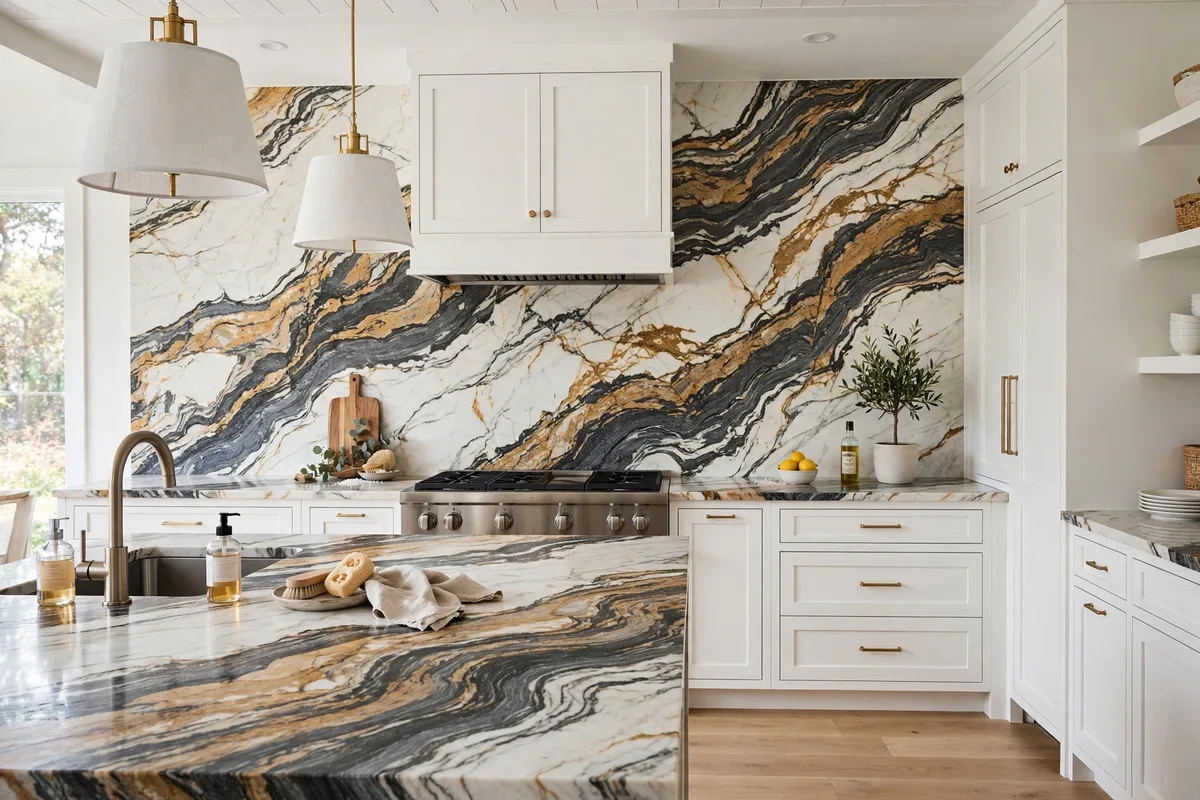
An all-white kitchen has renounced patterned tile, busy counters and coloured walls — which leaves exactly one place for pattern: the stone’s own veining. A Calacatta-style marble or quartzite, with grey and gold movement across a white field, is simultaneously the counter, the backsplash and the room’s artwork. Choose the slab like art (see the full piece, not a corner sample), and run it up the wall so the pattern gets the area it needs — this is the statement-slab option from our kitchen backsplash colors ideas, in its natural home.
Match the veining’s temperature to §1: gold-veined stone in warm kitchens, grey-veined in cool ones. And keep everything else quiet around it — a loud slab beside loud tile is two stars in one sightline, and the white kitchen’s whole calm depends on having only one.
7. Texture You Can Feel: Zellige, Linen, Rattan, Grain
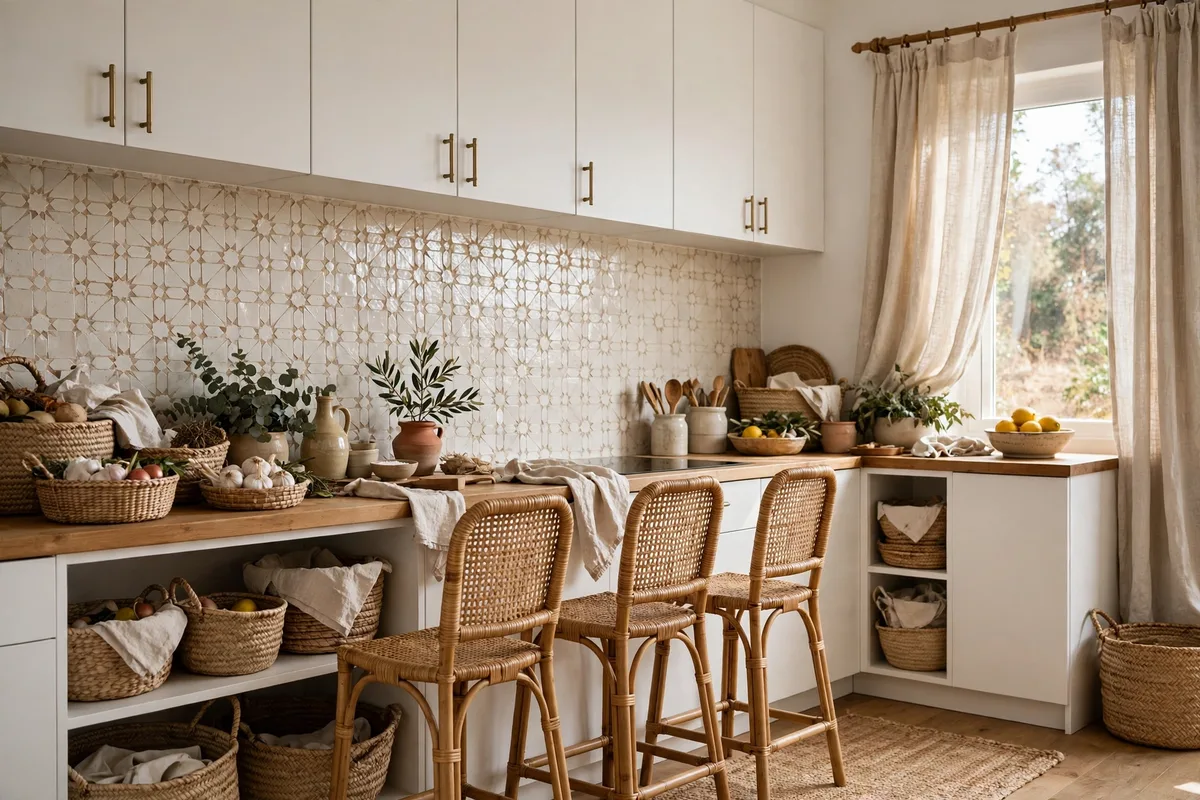
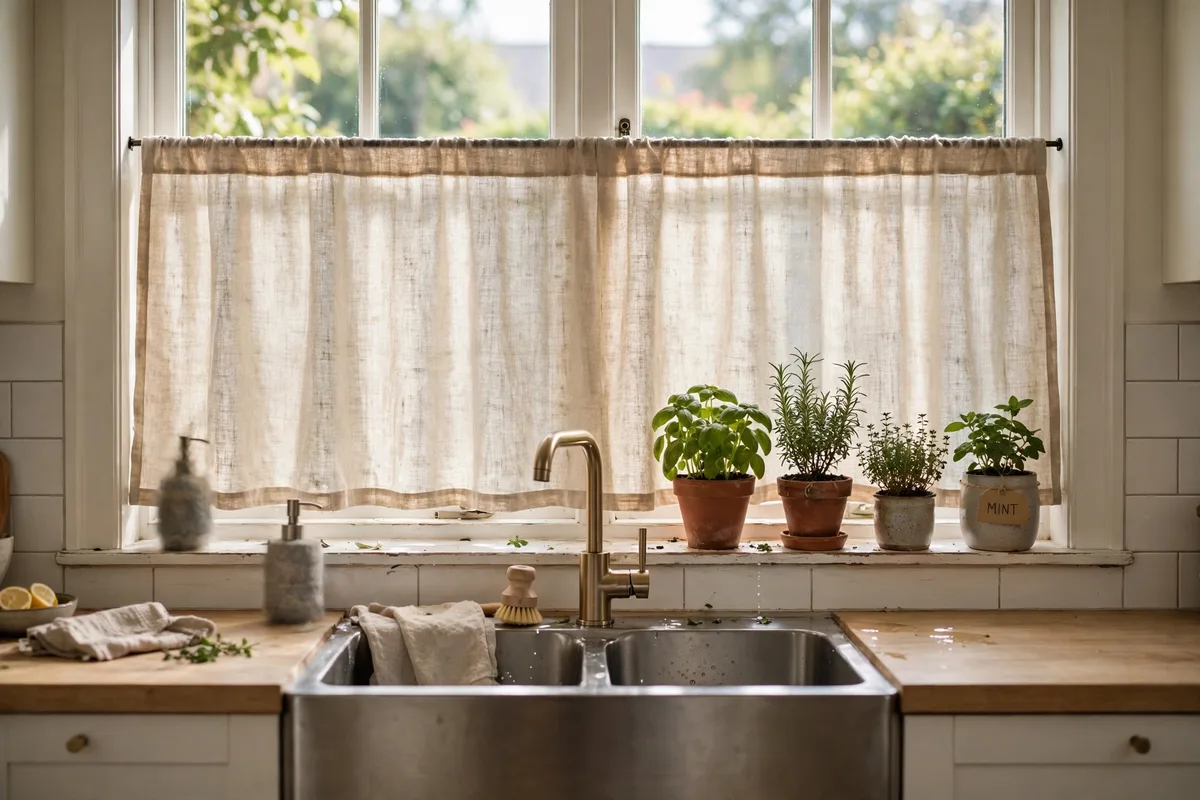
When colour is refused, texture becomes the variety. The white kitchen’s texture stack, one per surface type: a handmade-look tile (uneven glaze, soft edges) on the wall; linen or woven cotton at the window and on towels; rattan, cane or woven seats at the island; baskets for the storage that shows; a vintage or honed, imperfect object or two to break the manufactured smoothness. Each is still white or natural — the interest is in the hand-feel and the shadow play, not in new hues.
The test is touch at arm’s length: standing at the counter, you should be able to feel four textures without moving — stone, wood, textile, weave. A white kitchen that passes the touch test never reads sterile, whatever the photographs suggest.
8. Colour, But Only in Things That Move
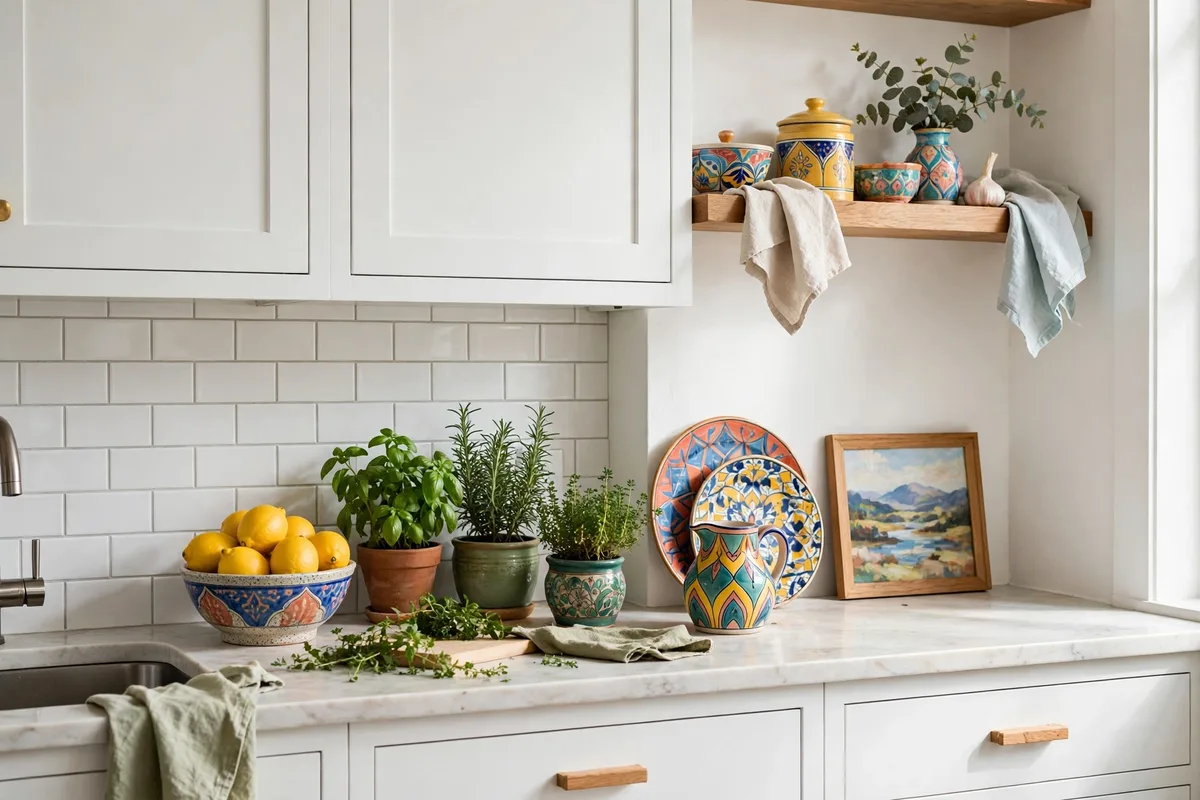
The white kitchen’s colour strategy is tenancy, not ownership: colour arrives in objects that can leave — a bowl of lemons or oranges, herbs growing at the window, the ceramic collection on the shelf, a runner, one piece of art, flowers. This gives the room a living colour note that changes with seasons and shopping, and it keeps the permanent bones calm. Choose ONE colour family at a time (citrus + green is the classic; terracotta is the warm alternative) and let it appear three times — fruit, textile, object — before it counts as present.
This is also the cheapest refresh in all of kitchen design: a white kitchen re-accents for the price of a market trip. When the room feels tired, the answer is almost never renovation — it is a new tenant colour.
9. Light at the Right Temperature: 2700–3000K or Nothing Works
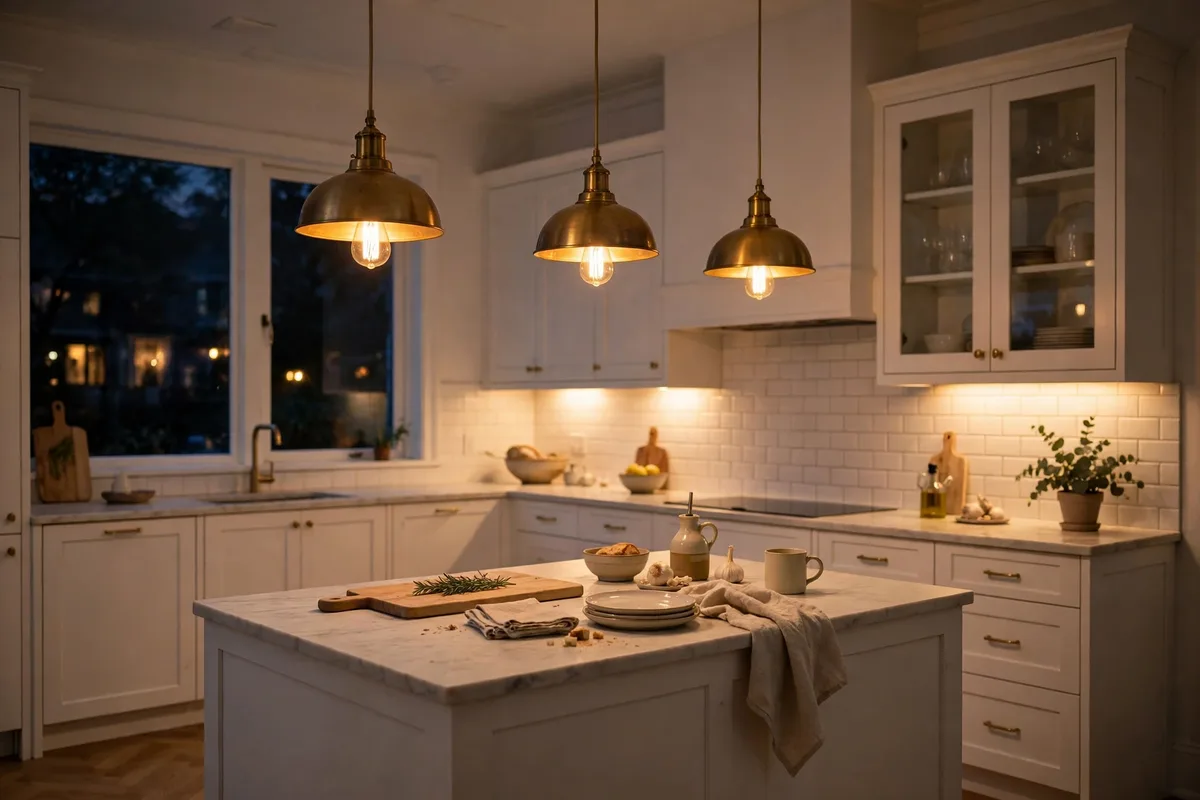
Every accent above is judged under light, and the wrong light undoes them all: bulbs above ~3500K push white toward blue-grey — the literal hospital effect — while 2700–3000K keeps whites creamy and wood and brass glowing. Layer it as always (ambient, task, accent) with dimmers, per the system in our kitchen island lighting ideas, and let the pendants be part of the metal story from §4 — same finish, real presence.
Daylight deserves the same audit: a north-facing white kitchen needs its warm accents (wood, brass, warm stone) at double dose, while a sun-flooded one can afford the cooler register. The room’s light is an accent whether you choose it or not — choose it.
10. The Floor Anchors It: Warm Wood or Graphic Stone
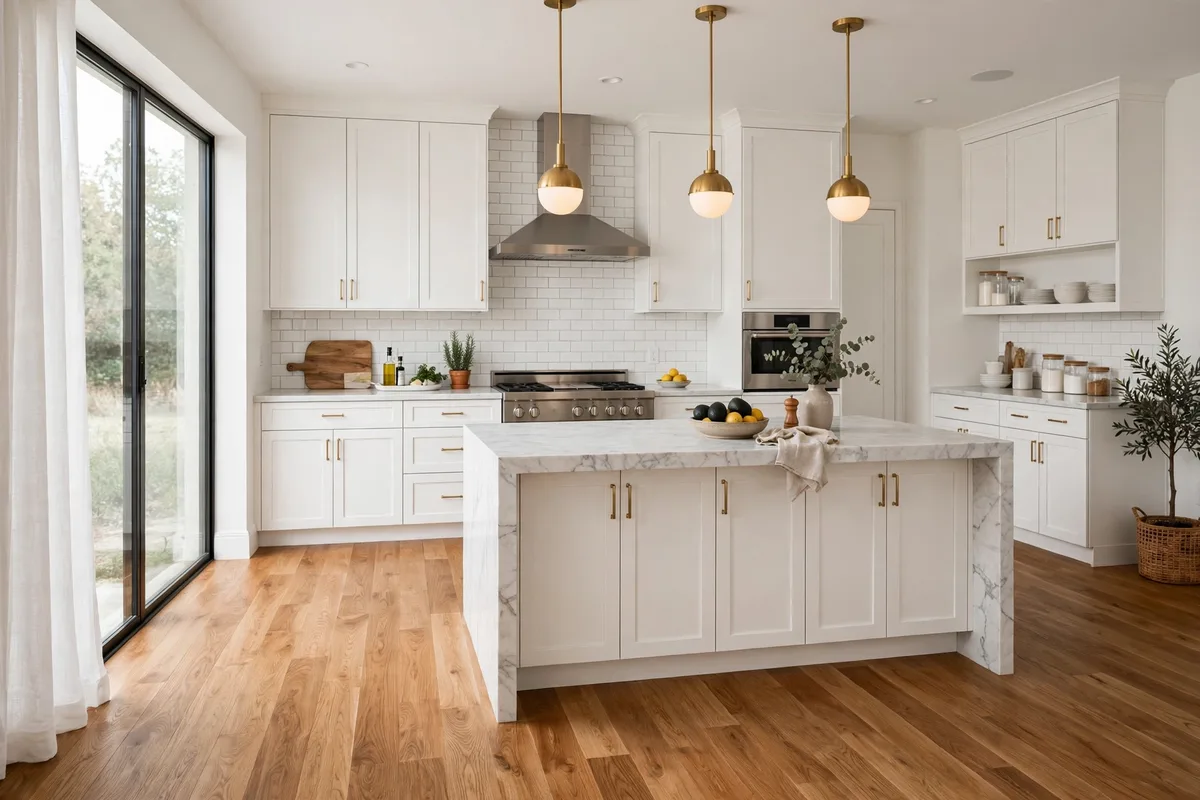
The floor is the white kitchen’s largest accent surface, and the default answer is warm wood — the §3 wood story at full scale, grounding the pale room the way a frame grounds a print. If the floor cannot be wood, the classic alternative is graphic stone: oversized checkerboard (24-inch tiles read Parisian; small 12-inch reads dated) in black and white, which supplies the §5 black dose at the room’s base. Pale cool tile is the one floor that works against everything in this article — it doubles the room’s chill and gives the eye nothing to land on.
Whichever floor: it is chosen as an accent, with the same undertone discipline as the cabinets. In a white kitchen the floor is not the background. It is half the design.
Frequently Asked Questions About White Kitchen Accents
How do I stop a white kitchen from looking sterile?
Attack flatness, not whiteness: layer whites with different sheens, add one wood repeated at least three times, one warm metal throughout, black at a few planned points, texture at every surface, and bulbs at 2700–3000K. Sterile is a texture-and-temperature problem, not a colour problem.
What colours go with a white kitchen?
As accents: warm wood tones, brass and bronze, matte black, veined stone, and one movable colour family at a time (citrus-green, terracotta, soft blue). Keep permanent surfaces inside the white-and-natural family and let objects carry colour.
How much black should a white kitchen have?
A few planned points — hardware, lighting, faucet, frames — or one big gesture (island, hood). The smaller or darker the room, the more stays white. Black should read as punctuation: deliberate, repeated, and finished.
What metal looks best in a white kitchen?
Brass for warmth (unlacquered for a living patina), aged bronze for depth, copper for a traditional register. One finish only, everywhere. Chrome and polished nickel cool the room — use them only in deliberately cool, grey-veined schemes.
Which wood pairs best with white cabinets?
White oak is the default — warm-neutral, quiet grain, works at floor, shelf or island scale. Walnut for contrast and luxury, maple to stay pale. Pick one species and repeat it; mixed woods are the fastest route to a white kitchen that feels accidental.
Should my white cabinets and walls be the same white?
No — layer them. Slightly different tones and clearly different sheens (satin walls, matte or eggshell cabinets, gloss tile) create depth in one colour. Perfectly matched samples under showroom light become competing whites at home.
What backsplash works in an all-white kitchen?
Either quiet handmade texture (zellige-style white tile, where the accent is variation) or one loud voice: a veined stone slab run full-height. Match the stone’s veining temperature to your white’s undertone.
Are white kitchens hard to keep clean?
They show marks sooner but clean the same; the design answers are in this article — honed over polished stone, satin over gloss cabinets, texture that forgives, and a wood floor that hides a day’s evidence better than pale tile ever will.
What colour floor suits a white kitchen?
Warm wood first — it anchors the room and carries the wood accent at full scale. The graphic alternative is oversized black-and-white checkerboard. Avoid pale cool tile, which doubles the chill.
Can I add colour without repainting anything?
Yes — that is the white kitchen’s superpower. Fruit, herbs, ceramics, a runner, art and flowers carry a whole colour family for the price of a market trip, and the room re-accents every season without a single permanent change.
Conclusion
A white kitchen is not the absence of accents; it is accents under strict management — one wood, one metal, black by appointment, colour by tenancy, texture everywhere, light kept warm. Dose them deliberately and white stops being the safe choice and becomes what it was always supposed to be: the calmest, brightest room in the house, with a personality that arrives in the details.