
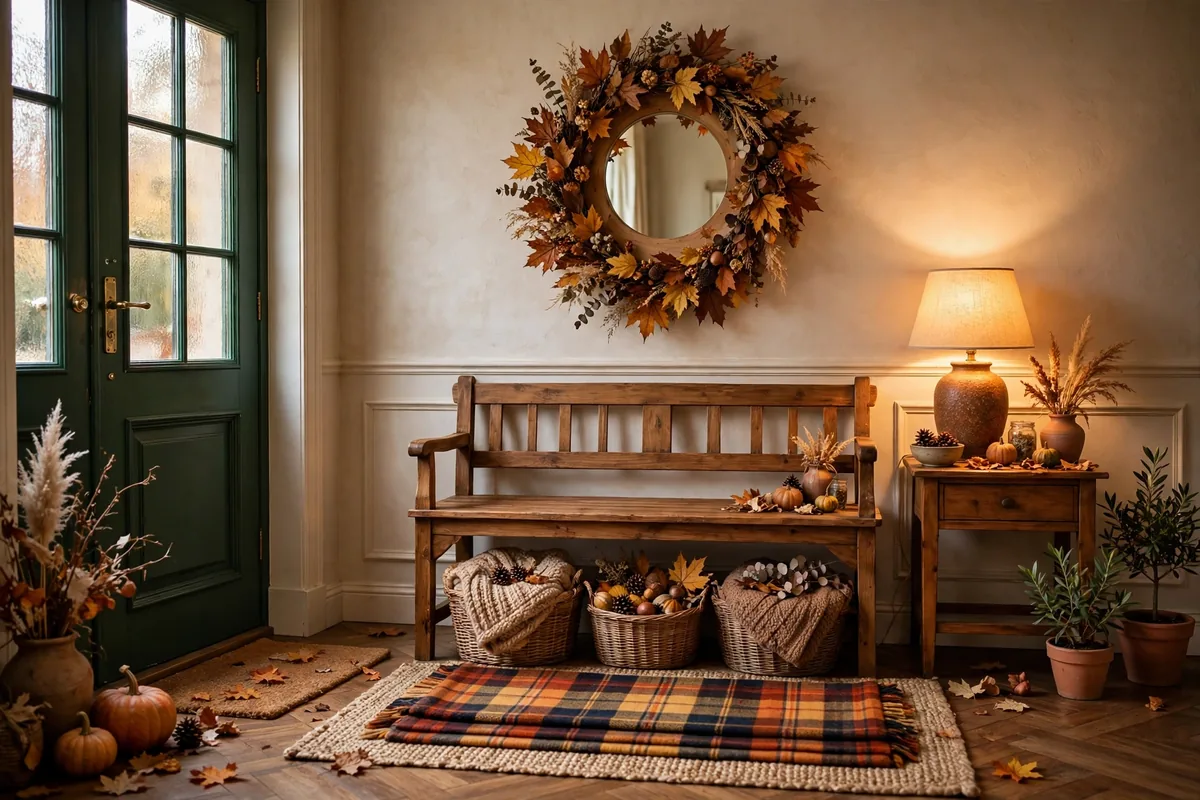
The entryway is the hardest-working two square metres in the house and, in autumn, the most punished: wet boots, dripping umbrellas, school bags, dog leads, and a daily harvest of leaves tracked in on everyone’s soles. A fall entryway that only looks good is useless here. It has to look warm at 7 a.m. in the rain and still look intentional at 7 p.m. when guests arrive — which means styling built on systems, not ornaments.
Build it in layers — floor, wall, surface, storage — and let the season live in the small, swappable pieces. Done in this order, the whole refresh takes an afternoon and survives the entire season.
In this guide: 1. Layer the Floor: Durable Runner, Seasonal Mat, Boot Tray · 2. Give the Wall a Mirror-and-Wreath Duo · 3. Style the Console or Bench in Three Groups · 4. Add Baskets That Swallow the Season’s Clutter · 5. Use Pumpkins and Natural Texture — Kept Grown-Up · 6. Put Warm Light at Face Height · 7. Give Guests Hooks They Can Actually Use · 8. Bring Height With Branches and Greenery · 9. Let Scent Do the Greeting · 10. Keep It Styled With a Five-Minute Reset · Frequently Asked Questions About Fall Entryways · Conclusion
The Fall Entryway Layers at a Glance
| Layer | Fall Choice | Job It Does |
|---|---|---|
| Floor | Durable runner + seasonal doormat + boot tray | Traps water, mud and leaves at the door |
| Wall | Round mirror + autumn wreath | Last-check mirror; the season’s one big gesture |
| Surface | Console or bench styled in three groups | Keys, post and one styled moment |
| Storage | Baskets for boots, hats, gloves, leads | Swallows the season’s clutter invisibly |
| Light | Lamp or sconce at face height, warm bulb | Nobody looks good under a hallway ceiling light |
The operating rules: One hook per household member plus two guest hooks kept deliberately empty (Section 7), and a five-minute reset that returns the whole system to ready (Section 10). The layers above decorate; these two rules are what make it work on a wet Tuesday.
1. Layer the Floor: Durable Runner, Seasonal Mat, Boot Tray
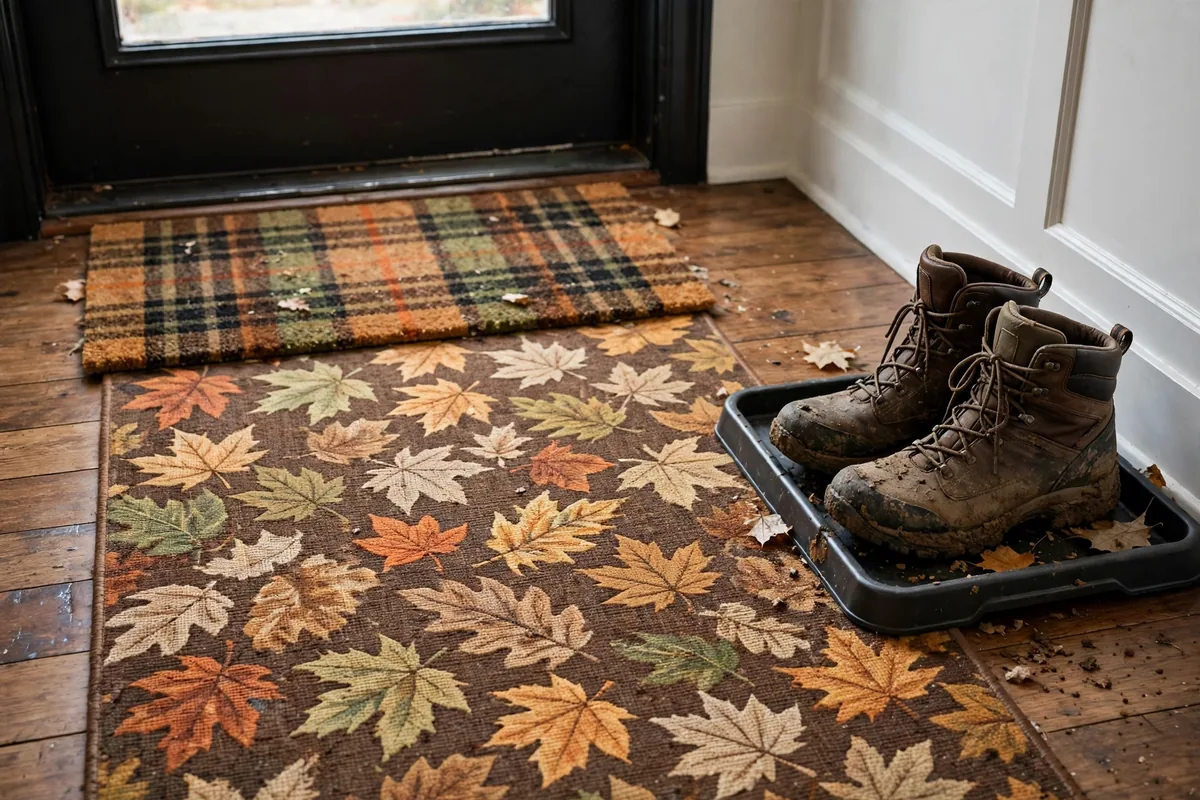
Start where the weather lands. A washable runner in a deep autumn pattern (patterns hide the season’s dirt between washes) covers the traffic path; at the door itself, layer a seasonal coir or plaid doormat over a larger neutral base mat — the layered-rug formula fall entry guides such as City Home’s fall entry refresh use at the doorstep works just as well inside it.
Beside the door, a boot tray with a lip is non-negotiable from October on: wet footwear goes there and only there, which protects the floor and quietly trains the whole household. Choose a tray long enough for the family’s real boot count, not the aspirational one.
2. Give the Wall a Mirror-and-Wreath Duo
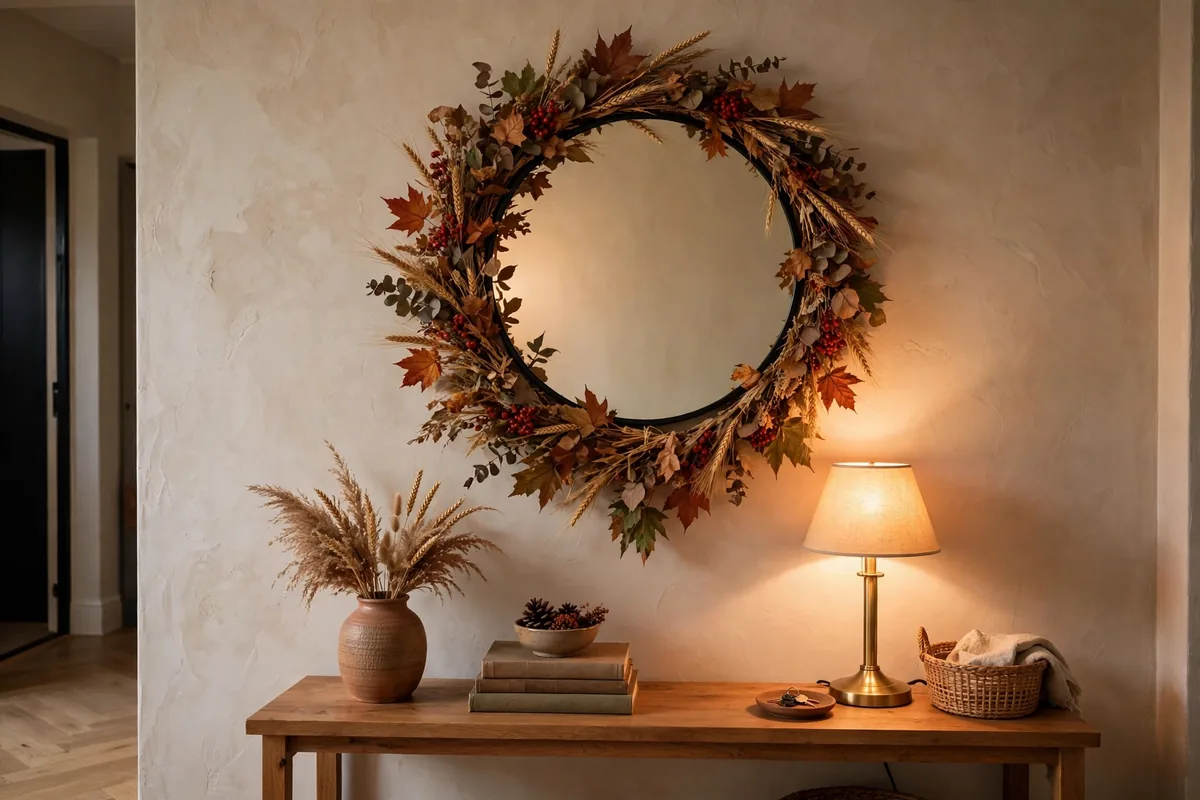
Above a console or bench, hang a round mirror — the entryway’s last-check essential — and layer the season over it: an autumn wreath of dried leaves, wheat and berries hung on the mirror itself or on the wall beside it. The mirror does double duty in a dark season, throwing lamplight and what little daylight the hall gets back into the space.
If the wreath is a plain year-round one restyled with autumn picks, even better — the base-and-swap method in our reusable seasonal decorations ideas turns this wall four times a year with nothing but a change of picks and bow.
3. Style the Console or Bench in Three Groups
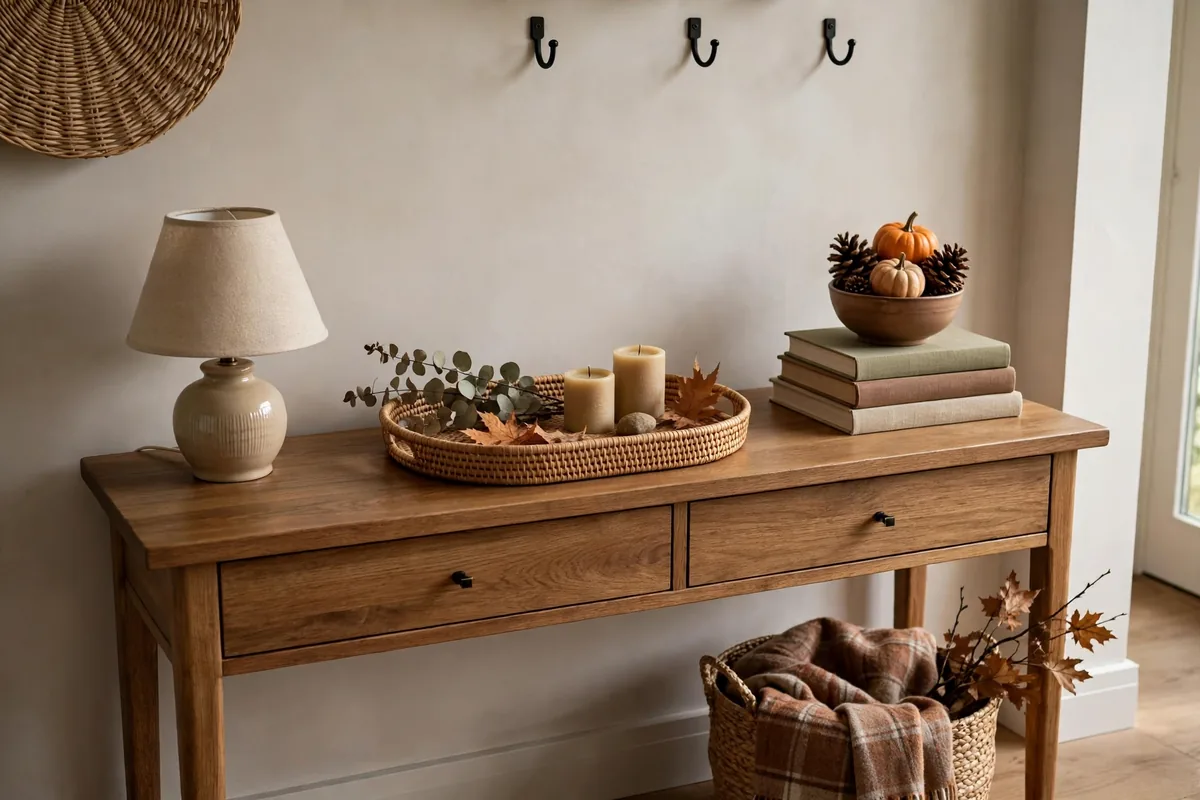
An entryway surface fails when it becomes a long, even row of stuff. Group it in threes instead: the lamp at one end (tall), a working bowl or tray in the middle (low, catches keys and post), and one styled group at the other end — a small stack of books with a vase of branches, or a bowl of pinecones and mini pumpkins. The gaps between groups are what make it read as styled rather than stored.
Keep the middle group honestly functional. The prettiest key bowl in the world fails if keys land beside it; a shallow tray wide enough for the household’s real handfuls wins.
4. Add Baskets That Swallow the Season’s Clutter
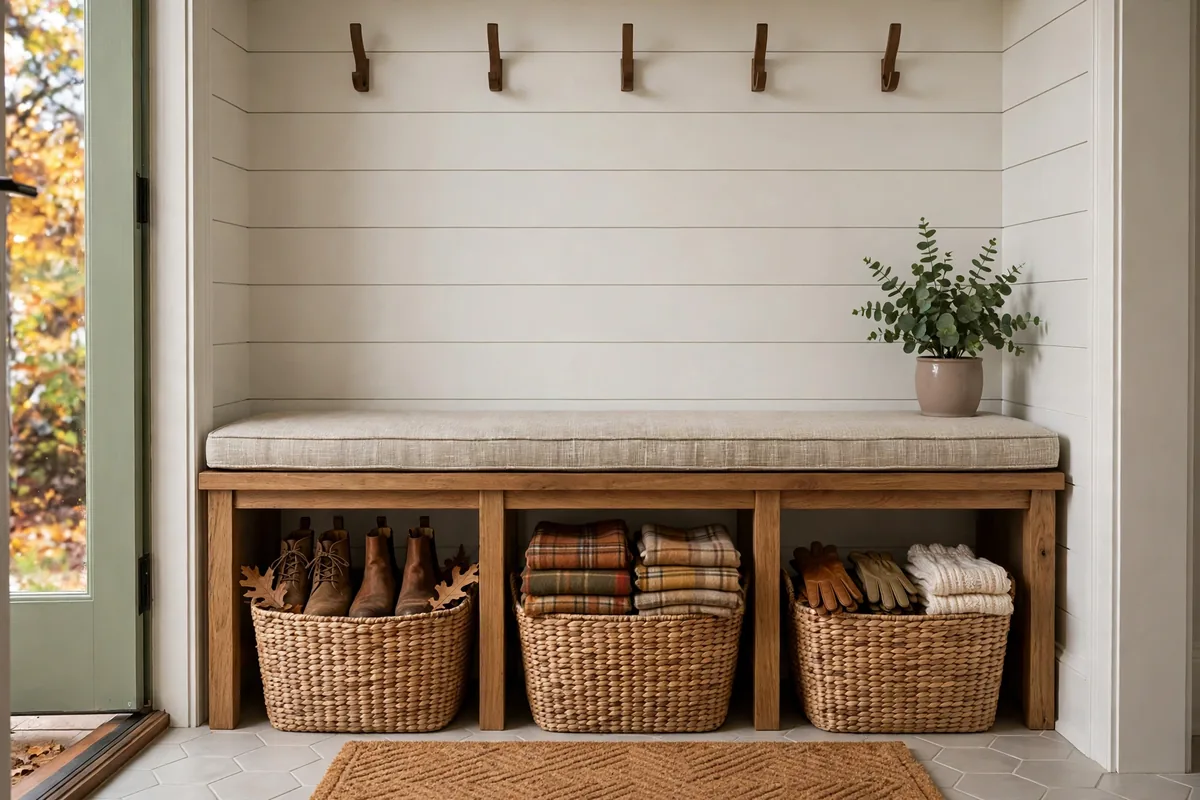
Autumn multiplies small belongings — hats, gloves, scarves, the dog’s towel, everyone’s second pair of shoes. Open baskets under the bench or beside the console give each category a landing zone that reads as texture, not mess. One basket per job: footwear, wearables, dog kit, and a small one by the door for the leaf-and-conker collections children import.
Choose sturdy, structured baskets with handles — they will be pulled out daily for three months. A lidded basket where the bench meets the wall hides the genuinely ugly items (the umbrella bag, the torch, the spare leads).
5. Use Pumpkins and Natural Texture — Kept Grown-Up
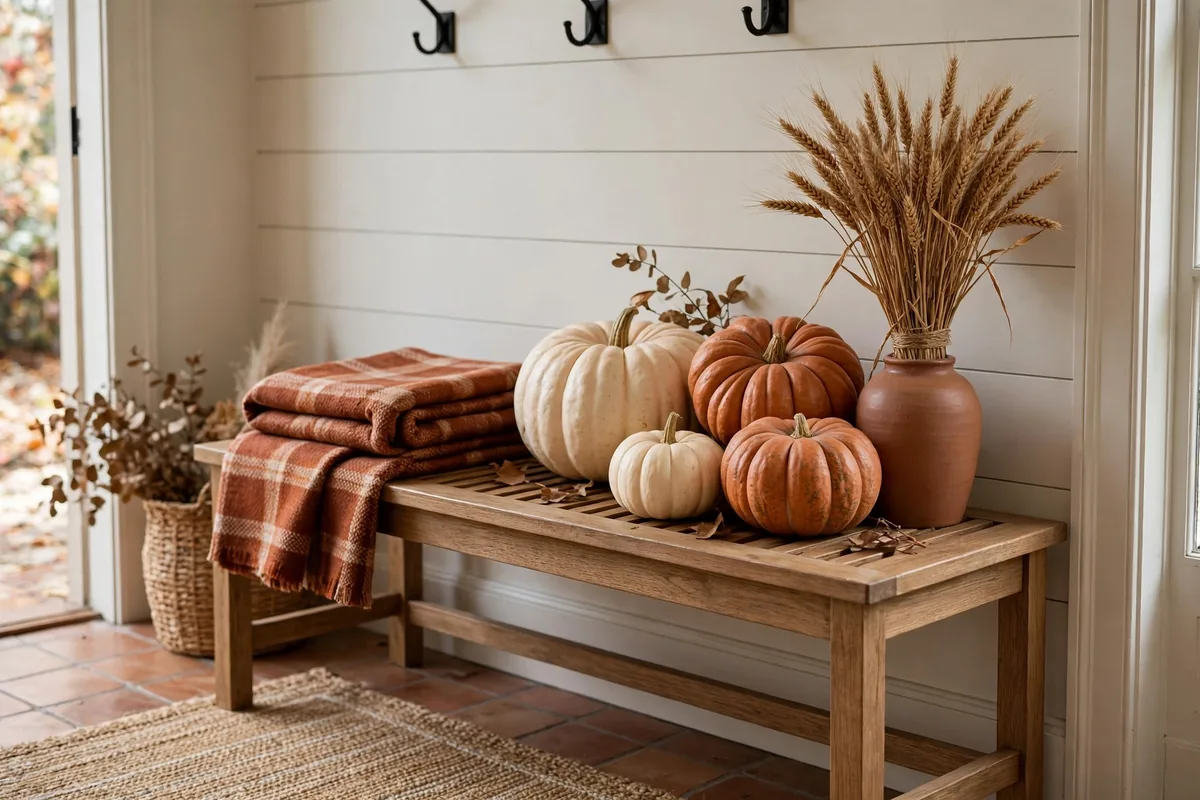
Pumpkins belong in the entryway — in a restrained palette. Cream, sage and terracotta heirlooms (real or good faux) grouped in odd numbers on the bench, the console’s styled end, or the floor beside the boot tray read as harvest, not Halloween. Add wheat bundles, pinecones and a plaid throw and the texture does the rest.
Keep the carved and spooky versions for the porch and the Halloween fortnight — our no-carve pumpkin styling ideas cover the indoor pumpkin family in full, including the ones that last the whole season without a knife ever touching them.
The same layers, darker: If the harvest palette is not your dialect, the system takes a moodier one without changing a single layer: swap the orange pumpkins for the cream and sage ones, let the plaid throw carry the pattern, take the branches deep green (Section 8), and let aged metal and amber light (Section 6) do the warmth. Same floor, same hooks, same reset — the entry reads deep-green and amber instead of harvest-bright.
6. Put Warm Light at Face Height
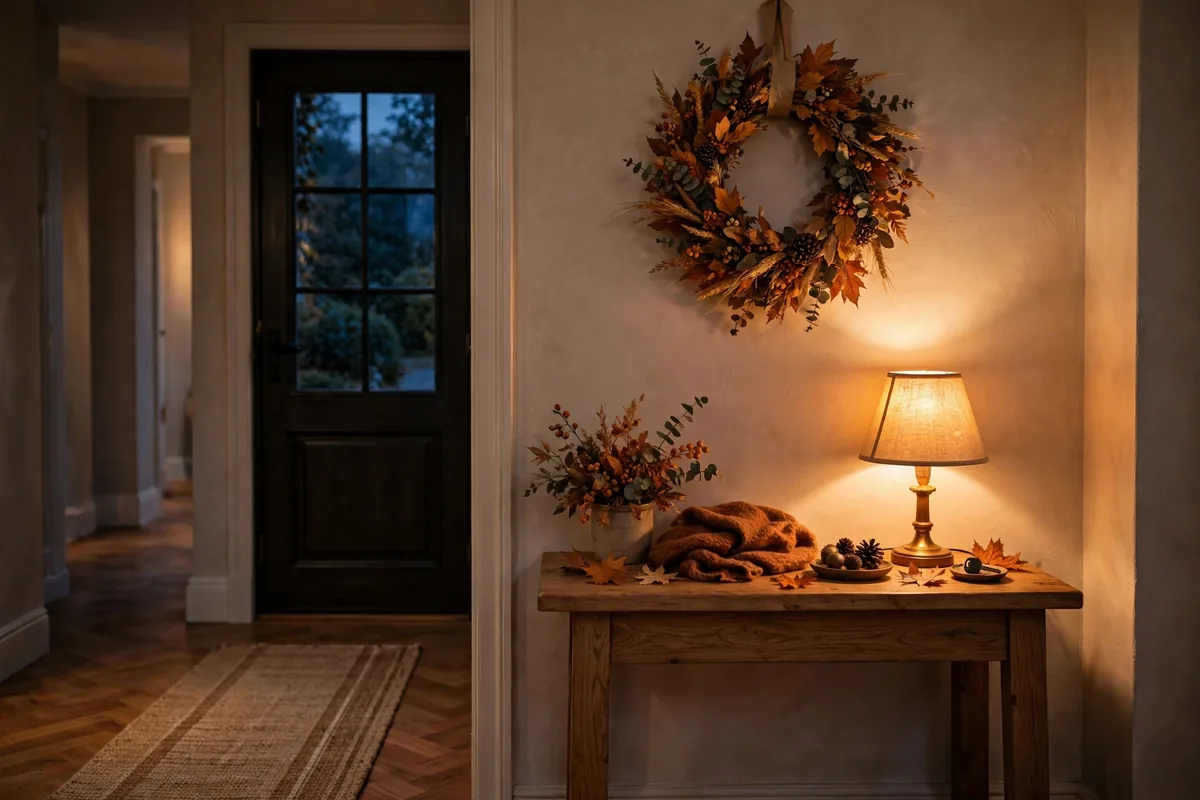
Hallway ceiling lights are interrogation lighting: cold, overhead, unforgiving. A small lamp on the console (or a plug-in sconce where there’s no surface) at face height turns arriving home into an exhale — warm bulb, 2700K or lower, on a timer so the house is lit before you reach it on dark evenings.
The layering method for fall foyers from DesignLike’s fall foyer guide makes the same point: in a hall with little natural light, warm artificial light IS the ambient layer, and leaning into amber tones and aged metals makes a dark entry feel intentional rather than gloomy.
7. Give Guests Hooks They Can Actually Use
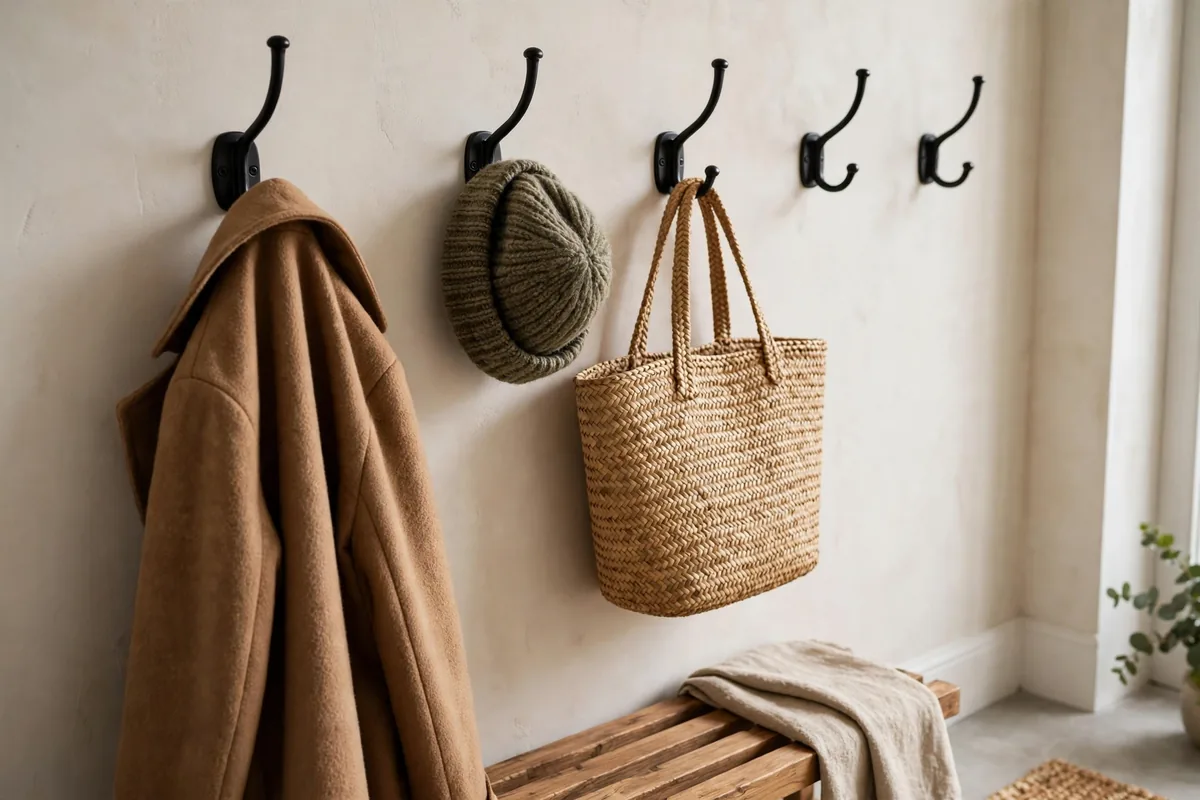
Nothing exposes a styled-but-useless entryway faster than a guest holding a wet coat with nowhere to put it. Keep at least two hooks permanently empty for guests, at reachable height, near the door — the household’s own coats live on the other hooks or in the closet. A small rail or a sculptural coat stand does the same job in a hall without wall space.
Style the hooks lightly between guests: one hat, one woven tote, one scarf in the palette. The row should look ready, not full.
8. Bring Height With Branches and Greenery
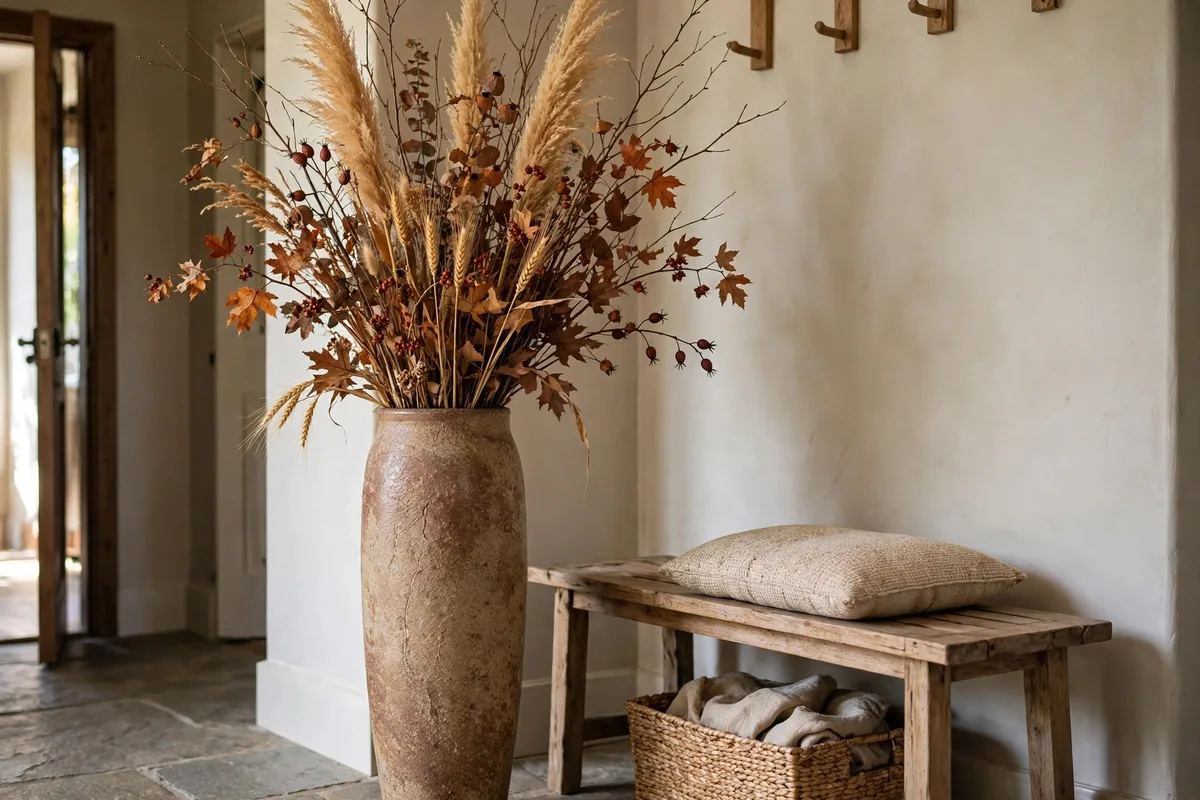
Cut flowers are a poor fit for a hallway; branches are its natural decor. A tall floor vase or crock of autumn branches, dried grasses or berry stems gives the entryway vertical drama that survives weeks without water changes. For greenery that lives, a hardy plant on the console or a hanging pot by the door adds the green note — the tough, low-light survivors in our guide to the best indoor plants are the ones that cope with a draughty hall.
Forage first: garden branches, hedgerow berries (out of reach of small children and pets) and dried seed heads cost nothing and look more “fall” than anything wrapped in plastic.
9. Let Scent Do the Greeting
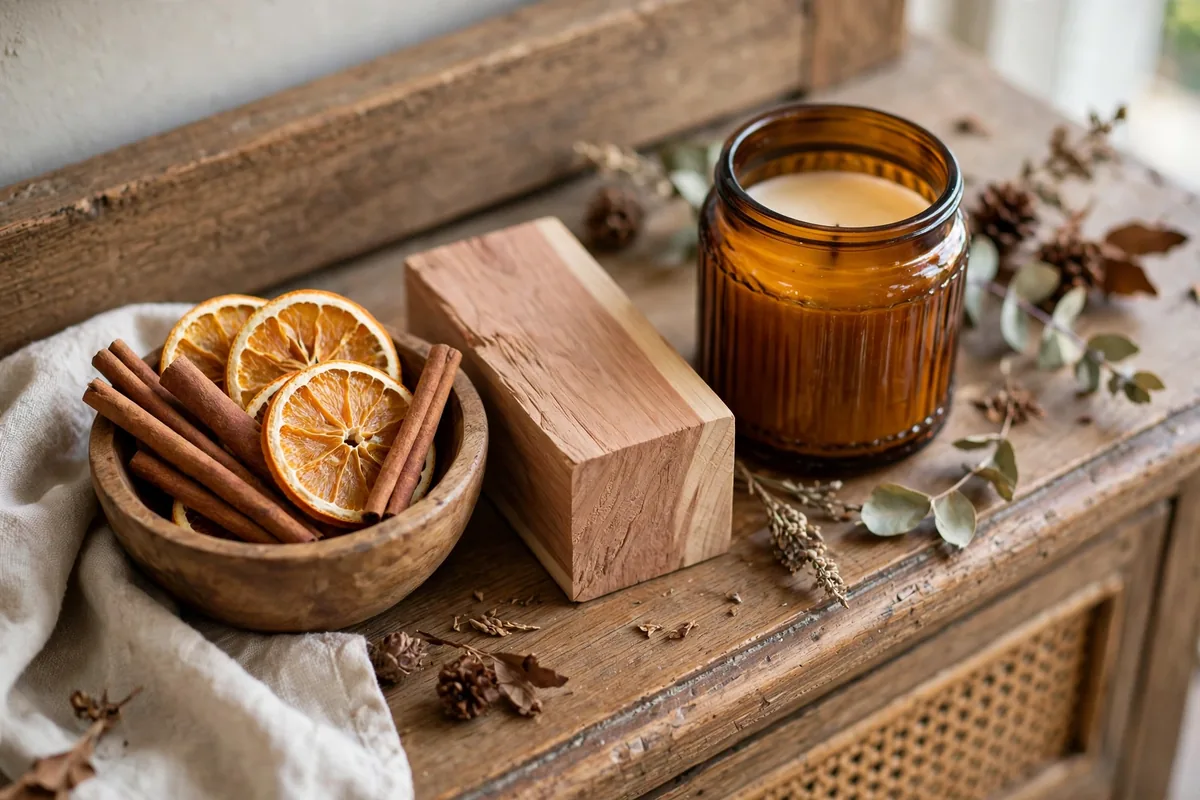
The entryway is the one room where scent belongs, because it’s a threshold, not a living space: cedar, cinnamon, clove, a little orange. A bowl of cinnamon sticks and dried orange on the console, a cedar block in the coat area, or one candle lit for the first hour of the evening — kept well away from coats, paper and the traffic path, and never left burning unattended.
Keep it subtle and seasonal rather than perfumed. The goal is “this house smells like autumn” as a background note guests register without being able to name.
10. Keep It Styled With a Five-Minute Reset
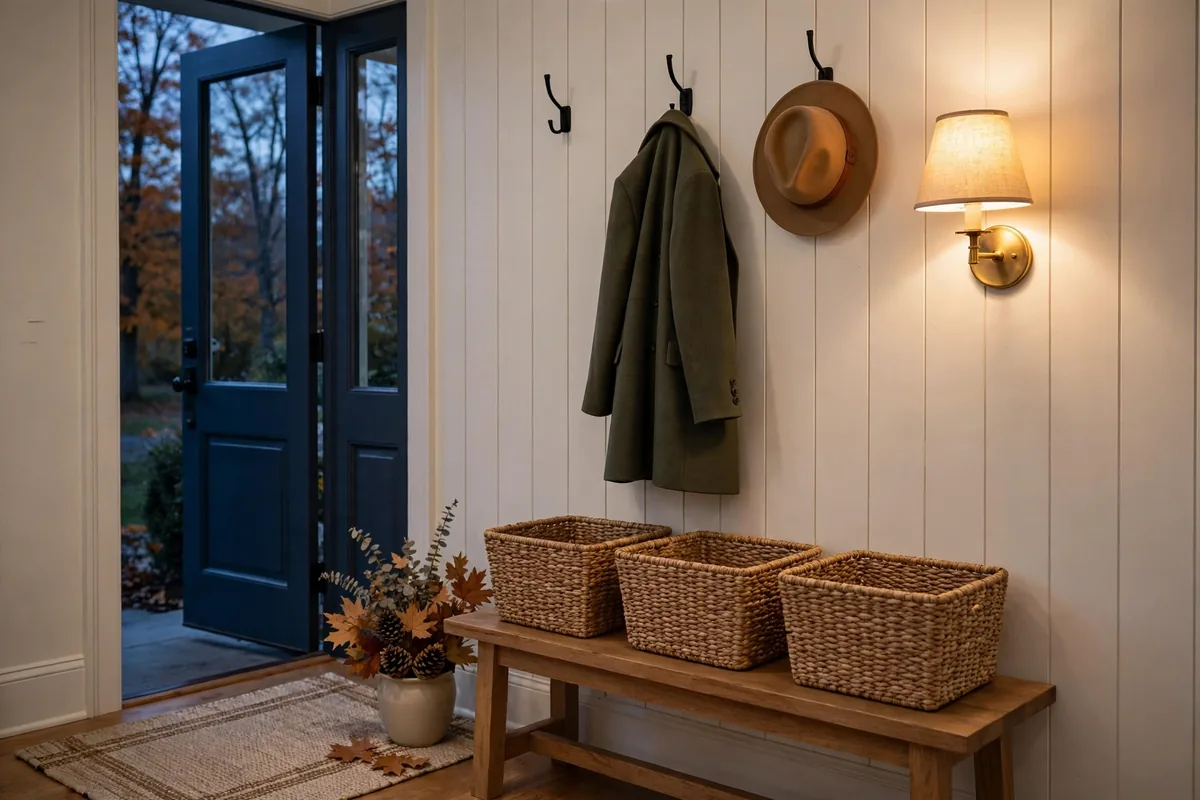
Entryways decay daily; the styling survives only if the reset is tiny. Five minutes each evening: shoes to the tray or basket, post sorted into the tray, hooks back to their styled minimum, a sweep of the leaf drift by the door, lamp on. Because every category has a named home (§4), the reset is putting things back, not deciding where they go.
And when October’s second half arrives, this fall base takes the Halloween overlay without a fight — swap the console bowl for a pumpkin display, add silhouettes to the door glass — in the spirit of our front porch Halloween ideas, then lift the overlay off on November 1st and the fall entryway is still standing underneath.
Frequently Asked Questions About Fall Entryways
How do I style a very small entryway for fall?
Use two layers only: the floor plane (a runner and seasonal mat) and one eye-level element (a wreath or the mirror duo). Skip the console styling entirely — in a tiny hall, negative space is what stops it feeling like a storage closet.
What colours define a fall entryway?
The harvest family: rust, terracotta, ochre, cream, sage and warm wood tones, with plaid as the season’s signature pattern. Build them into textiles and natural pieces so they can all leave in one box in December.
How do I keep mud and leaves under control?
The three-part floor system: an aggressive doormat outside or at the threshold, a washable patterned runner inside, and a boot tray that wet shoes never leave. A small brush-and-pan set living in the entryway basket handles the daily leaf drift in seconds.
Real or faux pumpkins for the entryway?
Both earn their place: real heirlooms on the floor and bench look and smell the part for six to eight weeks; good faux ones in the styled groups repeat every year. Avoid carved pumpkins indoors — they belong on the porch and last only days.
What lighting is best in a dark hallway?
A warm lamp at face height on a timer, 2700K or lower. If there is no console, use a plug-in wall sconce. Keep the ceiling light for cleaning only — its job is visibility, not atmosphere.
How many hooks does an entryway need?
One per household member plus two permanently free for guests. Overflow belongs in a closet, not on more hooks — an over-full hook row is the visual definition of entryway chaos.
Can I style an entryway with no console or bench?
Yes: a wall-led solution — mirror and wreath above, hooks and a slim shelf for keys below, baskets on the floor. The layers stay the same; the furniture just gets thinner.
When should the fall entryway go up, and when does it end?
Mid-to-late September for most homes (earlier if your autumn comes early), with the Halloween overlay added for the last two weeks of October only. The fall layer itself runs through Thanksgiving before the winter swap.
How do I stop the entryway smelling of wet boots?
Ventilation first — boots dry on the tray, never in a closed basket — plus cedar blocks in the shoe zone, which deodorise as well as scent. A tray that can be rinsed weekly stops the smell at its source.
What is the cheapest fall entryway refresh?
A seasonal doormat, a plaid throw over the bench, foraged branches in a floor vase, and a bowl of pinecones — the four together cost less than one statement ornament and deliver most of the effect.
Can I style a fall entryway without orange?
Yes — the palette is a layer, not the system. Keep the layers and swap the dialect: cream and sage pumpkins instead of orange, a plaid throw for pattern, deep-green branches for height, aged metal and amber light for warmth. The no-orange version of this entryway is written out at the end of Section 5.
Conclusion
A fall entryway works when it is styled like the hard-working space it is: layered floors that catch the weather, a mirror-and-wreath wall, surfaces grouped in threes, baskets that swallow the clutter, and warm light waiting at face height. Build the systems once and the warmest welcome in the house takes five minutes a day to keep. When the season turns, the fall layer lifts and the system stays — floor, mirror, baskets and light are this entry’s permanent base, and what rotates onto it next is the winter weight of the same layers, dressed in our winter cozy textiles guide.


Pingback: 10 Summer Porch Accents Ideas for Shade, Colour and Glow
Pingback: 10 Autumn Color Palette Ideas (With the 60-30-10 Rule)