
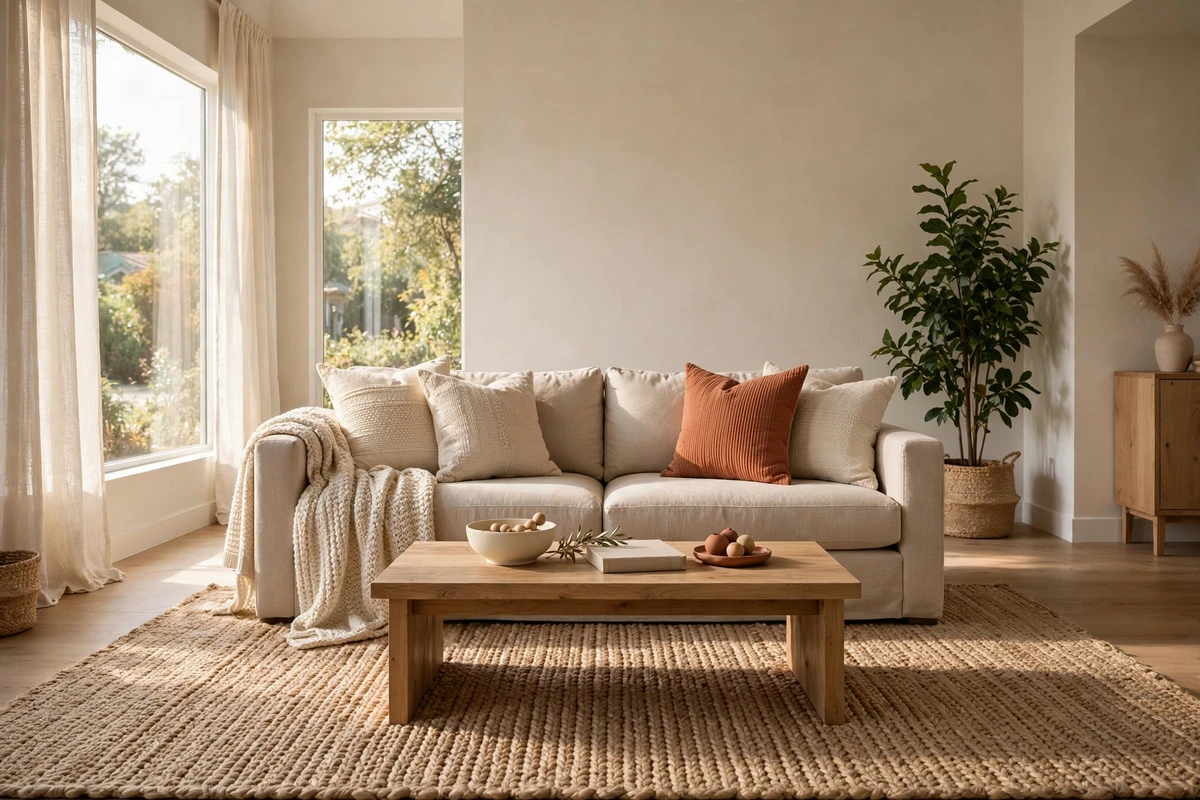
A neutral sofa — beige, cream, gray, ivory, or taupe — is one of the most versatile pieces you can own. It adapts to nearly any style, calms a busy room, and gives you a foundation you can refresh season after season without buying new furniture. But that same versatility is also the trap: without the right layers, a neutral sofa can look unfinished, and the whole living room can feel flat and forgettable. Those styles, compared side by side on four levers with a decision guide, are our guide to neutral sofa styling styles.
The fix is not more color — it is more intention. Professional stylists build calm, cohesive rooms around neutral sofas with a repeatable set of moves: mixing pillow textures instead of matching them, draping throws so they look deliberate, grounding the seating area with a correctly sized rug, adding one contrasting accent chair, and finishing the space around the sofa with art, wood tones, greenery, and layered light. The ideas below walk through each move — ten core ideas plus two bonus variations, twelve in all.
The catalogue’s working instruments: a fabric-pairing table keyed to your sofa’s undertone, the 2-2-1 pillow formula, three named throw drapes, the front-legs rug rule, art at two-thirds the sofa’s width, the 60-30-10 colour split, and a four-season refresh that swaps only covers and a throw.
In this guide: Layer Textured Throw Pillows · Drape a Throw With Intention · Ground It With the Right Rug · Add an Accent Chair for Contrast · Style the Wall Behind the Sofa · Introduce Warm Wood Tones · Bring in Greenery · Layer Lighting Around the Sofa · Use the 60-30-10 Color Rule · Refresh Seasonally Without Redeccorating · Frequently Asked Questions About Neutral Sofa Styling · Conclusion
1. Layer Textured Throw Pillows
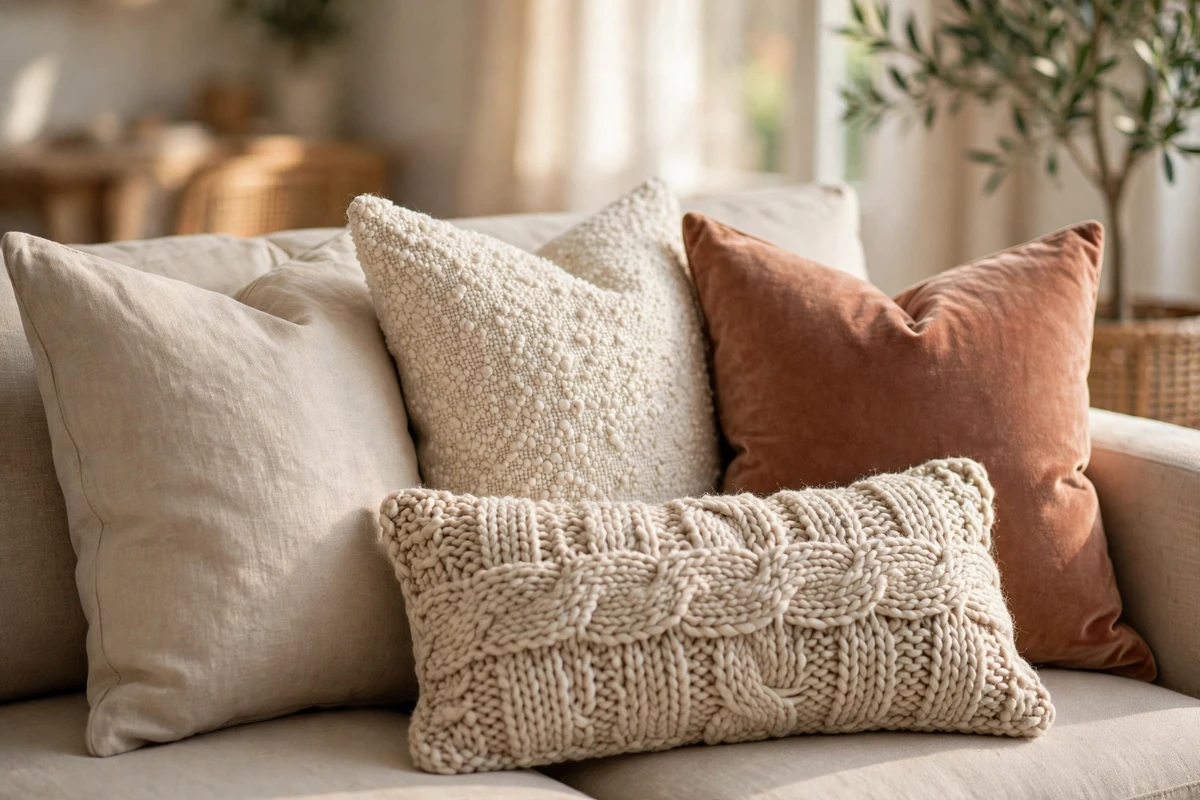
Throw pillows do more visual work than anything else on a neutral sofa, and texture matters more than color. When every cushion shares the same flat weave, the arrangement looks unfinished no matter how well the tones match. Mix fabrics that catch the light differently — nubby boucle beside smooth linen, soft velvet against crisp cotton — and the sofa gains instant depth without a single bold color.
Match colors to your sofa’s undertone
Cream and warm-white sofas have warm undertones that pair beautifully with sage, dusty terracotta, warm mustard, and blush. Beige and oatmeal bases are the most flexible — they welcome tone-on-tone layering in sand and camel as well as deeper accents like forest green or navy. Gray sofas lean cool, so balance them with warm counterpoints such as terracotta, rust, or deep mustard.
| Pillow fabric | Pair it with | Why it works |
|---|---|---|
| Linen | Boucle or velvet sofas | Relaxed, breathable contrast |
| Velvet | Linen or cotton sofas | Richness and a soft sheen |
| Boucle | Smooth or flat-weave sofas | Cozy, tactile dimension |
| Chunky knit | Any neutral base | Handcrafted warmth |
Arrange pillows in a 2-2-1 formula: two larger matching squares at the ends, two slightly smaller cushions in a complementary tone in front, and one lumbar or statement pillow centered. Odd numbers read as effortless, and varying sizes keeps the eye moving.
2. Drape a Throw With Intention
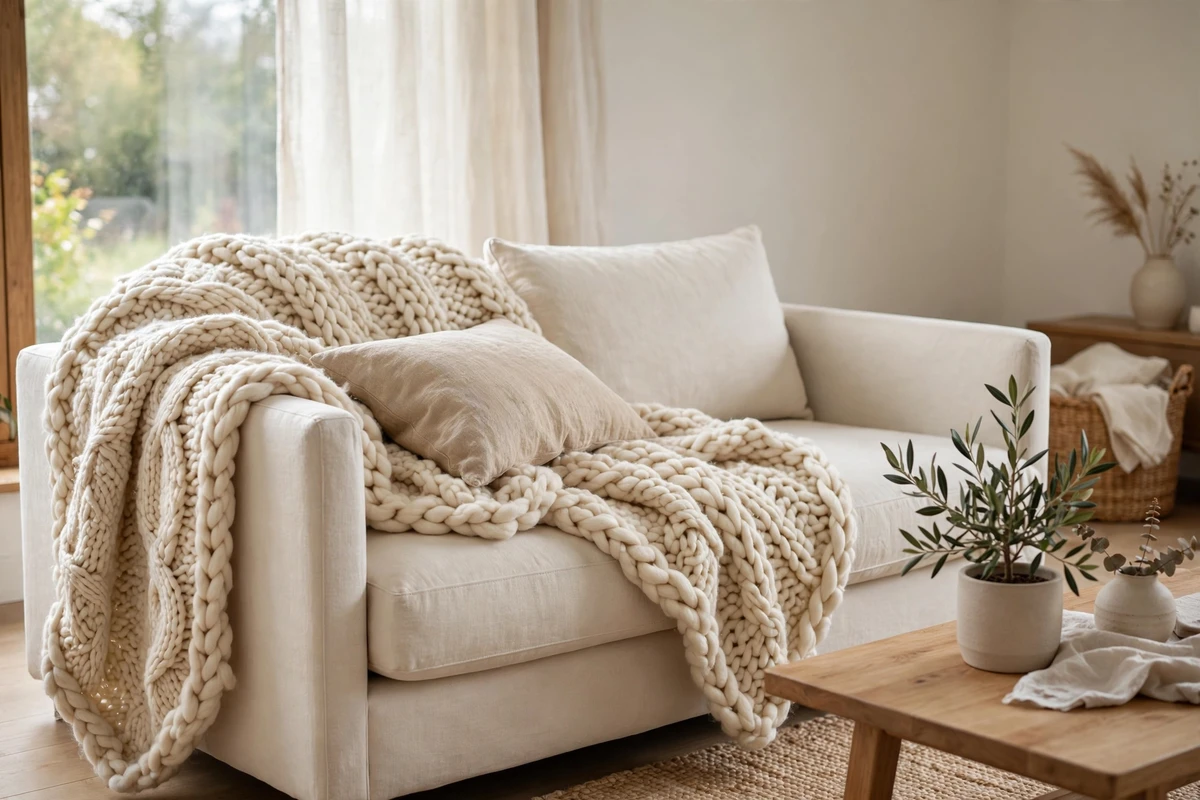
A throw should look casually placed, never abandoned. The difference between the two is about ten seconds of intention — and it is one of the fastest ways to make a neutral sofa feel styled.
Choose a throw in a texture your sofa does not already have. A chunky knit on smooth linen, a lightweight woven throw on velvet, a soft wool on boucle. The contrast is what makes both fabrics look better. Then pick a drape method:
- The arm cascade: Fold the throw into a loose rectangle, drape it over one arm, and let one end fall onto the seat. Tuck a cushion partially over it to anchor it.
- The back fold: Fold the throw lengthwise into thirds and lay it along the sofa back for a clean horizontal line — especially effective on three-seaters.
- The corner toss: Drape the throw diagonally across one corner, letting it fall naturally. Best with lighter fabrics that fold softly.
The throw should look deliberate, not accidental — that is what draws the eye when you enter the room.
3. Ground It With the Right Rug
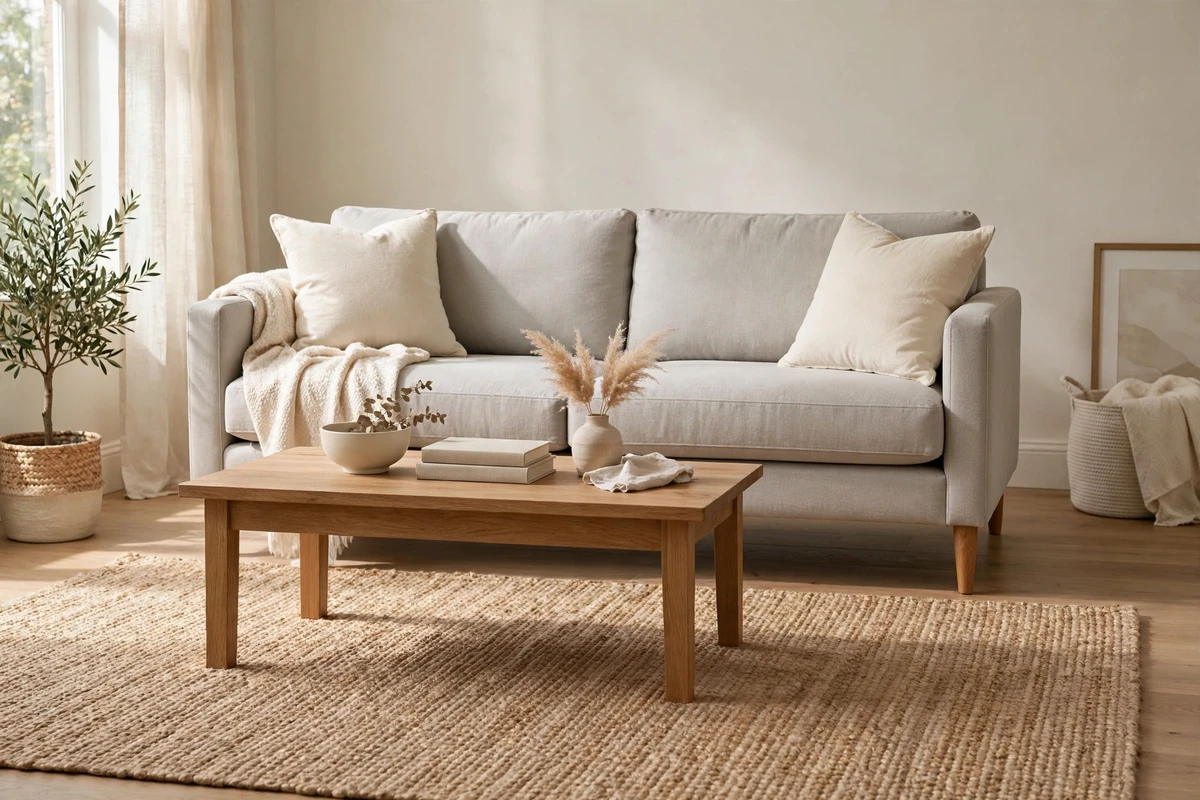
Without a rug, even a beautifully styled neutral sofa can look like it is floating. A rug defines the seating zone and gives the whole arrangement a finished, anchored feel.
Size matters more than pattern. The golden rule: the rug should be large enough for at least the front legs of the sofa to rest on it. In larger rooms, placing all four legs on the rug looks even more considered. A rug that is too small has the opposite effect — it makes the seating area feel cramped and disconnected, and the room actually looks smaller.
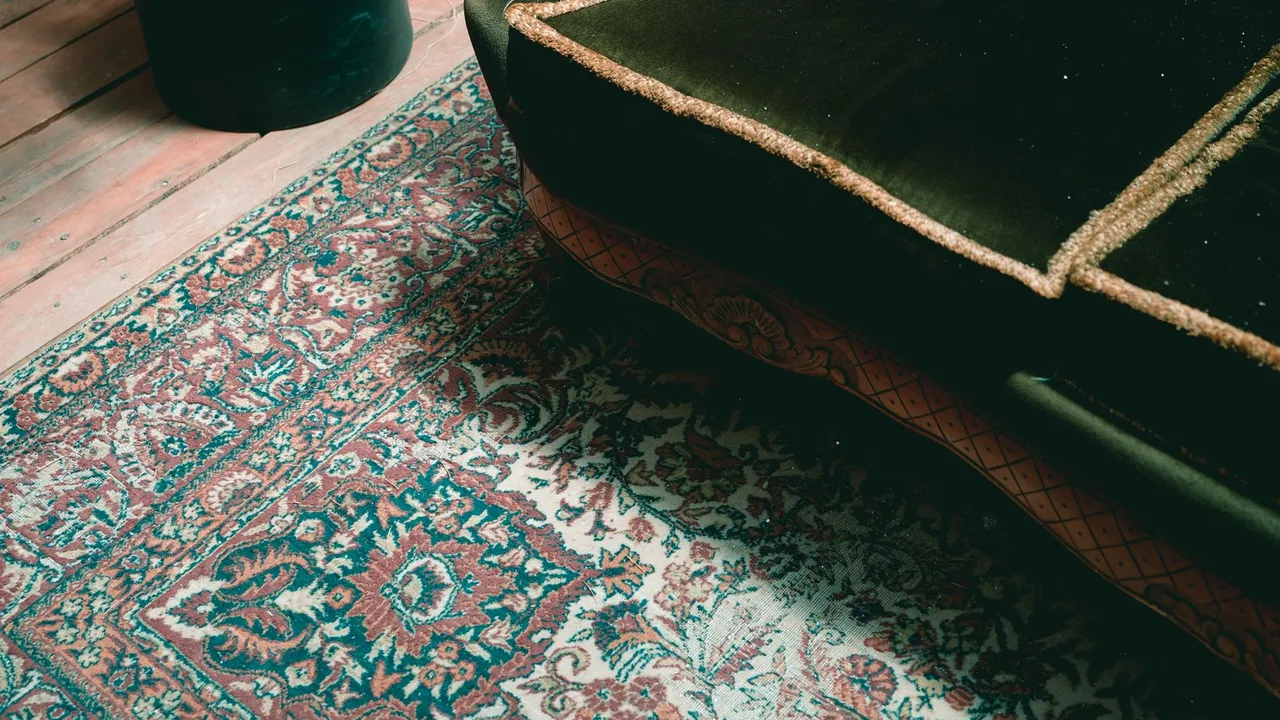
For a neutral sofa, the rug is your best chance to introduce pattern or a deeper tone without committing to a statement piece of furniture. A deep-toned jute, a geometric wool flat-weave, or a soft abstract print all work. As a practical guide, match the rug’s texture to the sofa fabric for a unified feel: woven jute or flat-weave rugs suit cotton and linen sofas, while thick wool or deeper-pile rugs flatter velvet and boucle. The graded numbers behind every rule on this page — rug, pillow, art and lamp sizes measured against the sofa — are tabled in our size guide to neutral sofa styling inspiration.
Leave roughly 18 inches of bare floor around the rug so the room breathes, and make sure the rug extends under the coffee table to tie the pieces together.
Bonus: Try a round rug for softer geometry
If your seating area is built from rectangles — sofa, coffee table, media console — a round rug breaks the grid beautifully. The curve softens all those straight edges and makes the arrangement feel collected rather than showroom-staged. Size it so the front legs of the sofa still rest on it; a 6- to 8-foot round works for most three-seater setups.
4. Add an Accent Chair for Contrast
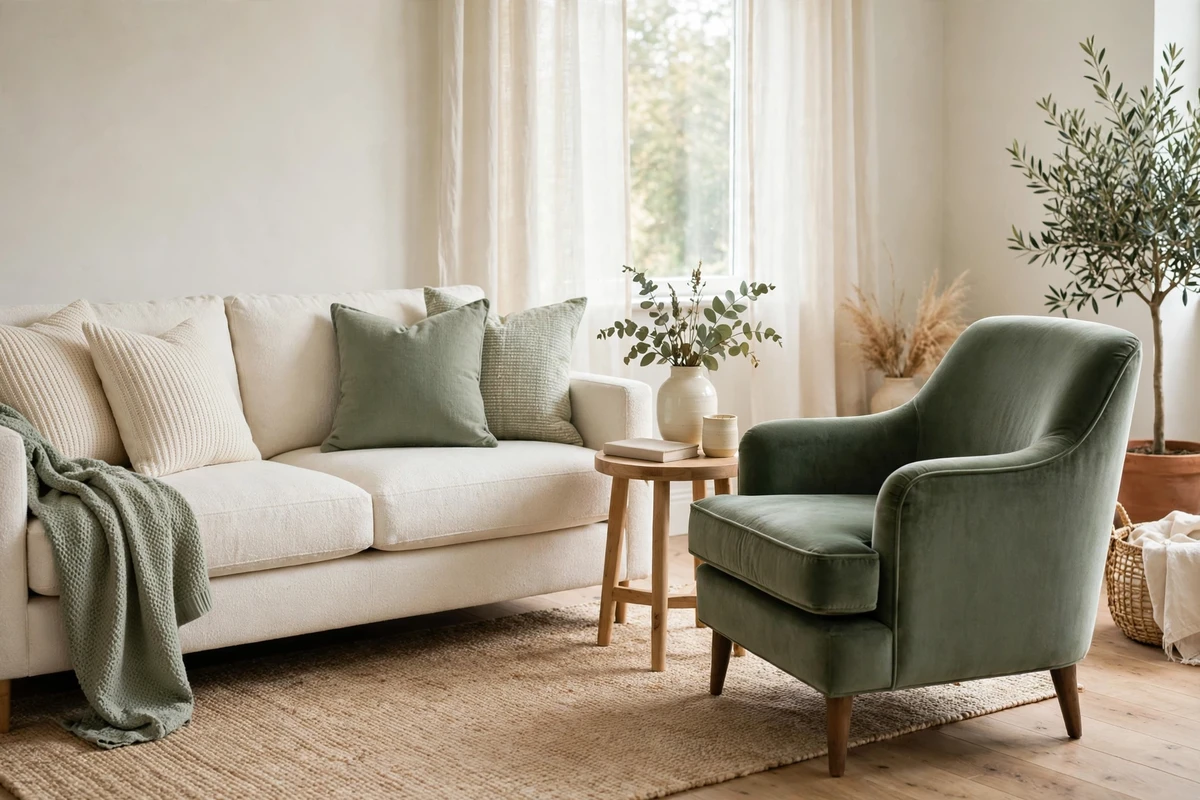
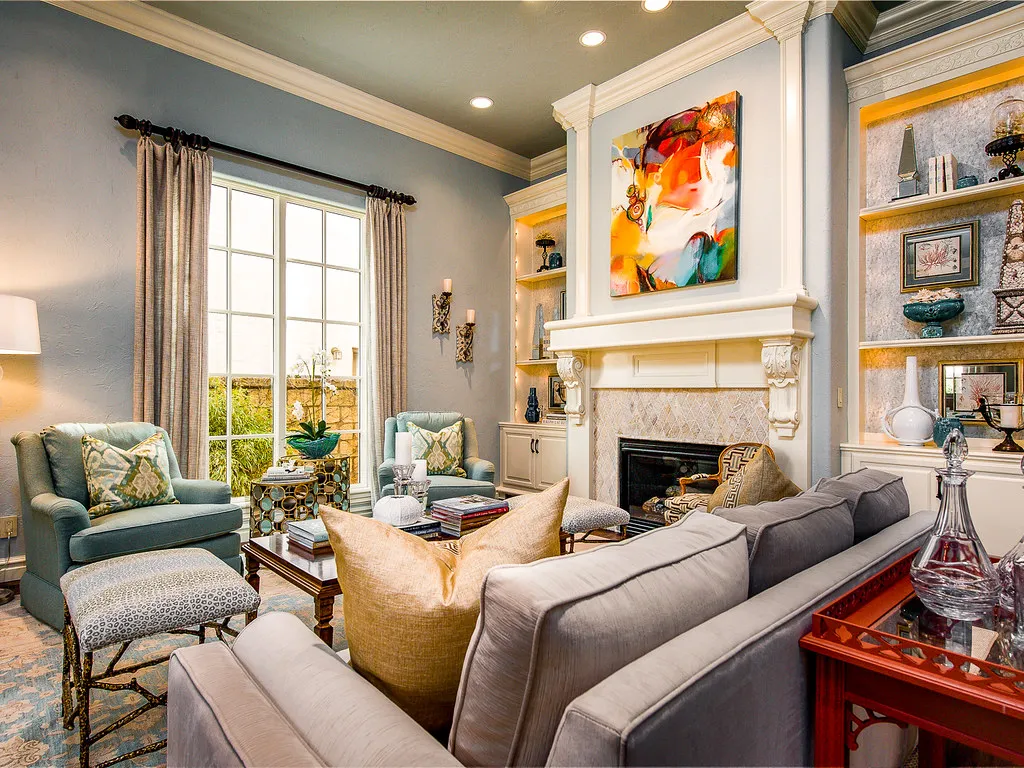
A neutral sofa paired with a more expressive armchair is one of the most effective living room moves available. The sofa supplies the calm, grounded base; the chair supplies the color or pattern the sofa deliberately avoids. Together they read as a deliberate pair instead of furniture that arrived separately.
The chair does not need to shout. A sage velvet armchair beside an oatmeal sofa, a warm terracotta linen chair next to a cream three-seater, or a deep teal accent chair against warm beige — each pairing works because the tones relate. For maximum flexibility, pick a chair in a color that already appears in your cushions. That single echo creates a visual connection across the room and makes the scheme feel considered rather than assembled.
Angle the chair toward the sofa to form a conversation area, leaving room for a side table between them. In tighter rooms, a slim-profile chair with raised legs keeps the footprint light — there are plenty of seating ideas for small living rooms that prove a compact space can still carry contrast.
5. Style the Wall Behind the Sofa
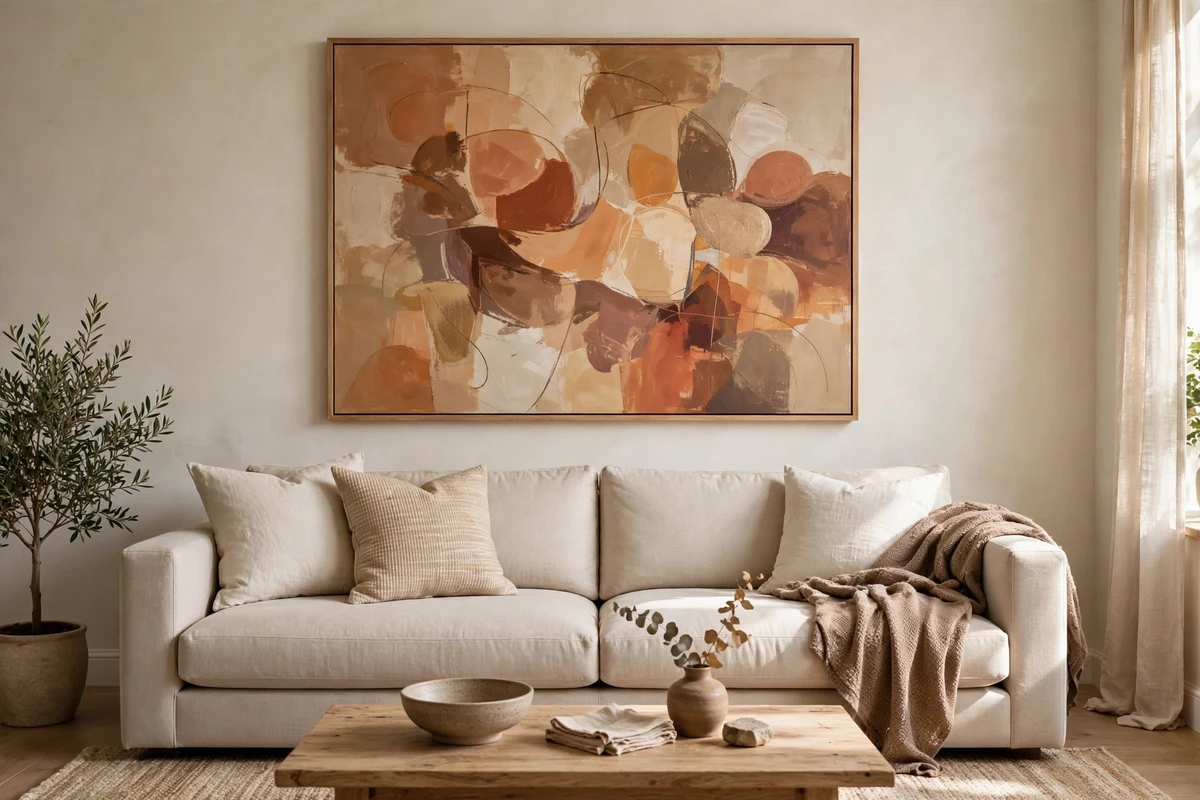
The wall behind a neutral sofa is prime decorating real estate, and leaving it blank is the fastest way to make the sofa look stranded. One well-scaled piece of art instantly turns the sofa into a focal point.
Scale is the rule that matters most: aim for artwork roughly two-thirds the width of the sofa. A single oversized abstract print works beautifully in minimal rooms, while a gallery wall of complementary prints adds personality and lets you rotate pieces over time. Hang the center of the arrangement at eye level — about 57 inches from the floor — rather than floating it near the ceiling.
Mirrors are a strong alternative, especially in smaller or darker rooms, because they bounce light back into the space and make the seating area feel larger. Whatever you choose, keep a visual relationship between the wall and the sofa: echo one accent color from your cushions in the artwork, and the whole wall will feel like it was styled with the sofa in mind rather than as an afterthought.
6. Introduce Warm Wood Tones
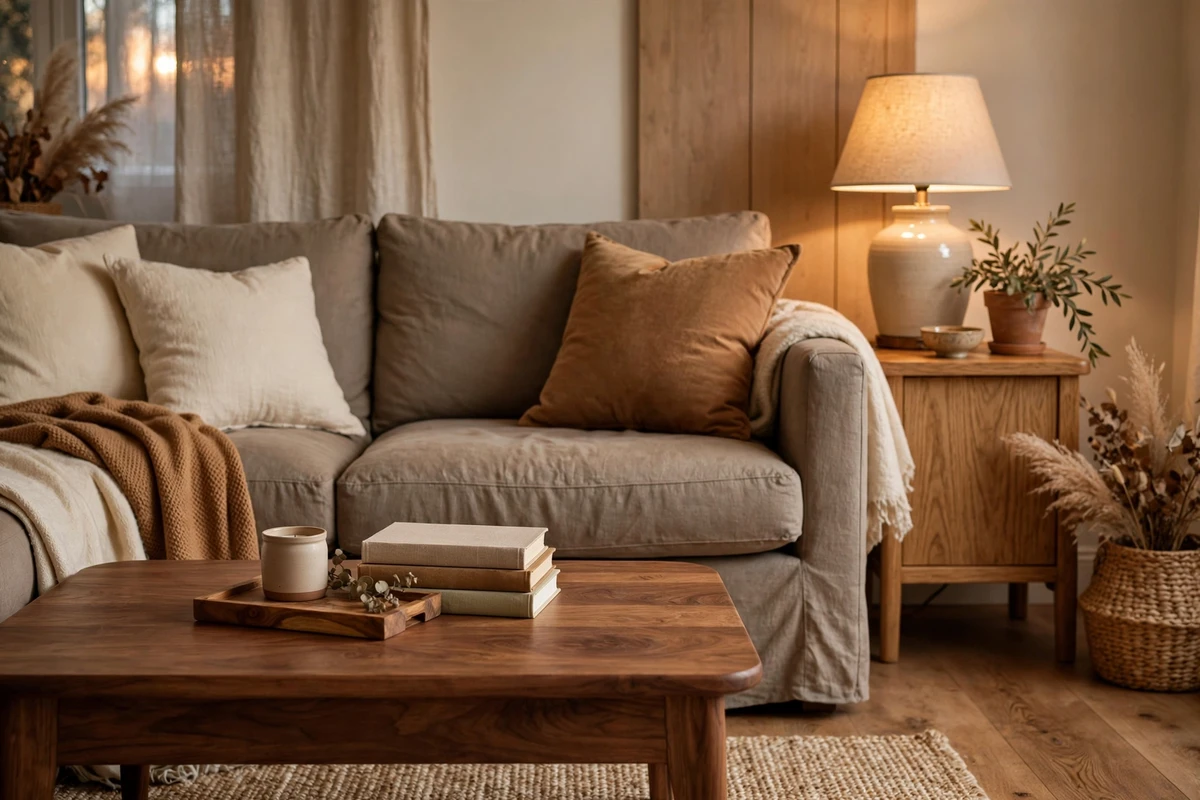
Neutral upholstery can read as cold if everything around it shares the same soft finish. Warm wood is the antidote — it extends the sofa’s warmth into the room and adds the organic texture that flat fabrics cannot.
A wooden coffee table or pair of side tables in oak, walnut, or acacia does most of the work. The wood’s natural grain introduces variation that plain upholstery lacks, and its warm undertones echo the warmth of beige, cream, and taupe sofas. You do not need a full matching set; in fact, mixing wood tones — a walnut side table beside an oak coffee table — looks more collected and personal than a matched suite.
Keep finishes in the same temperature family: honey or amber woods for warm sofas, medium walnut for gray or cool ones. Small wooden accents — a tray on the coffee table, a turned-wood lamp base — carry the material through the room so it feels intentional rather than isolated.
7. Bring in Greenery
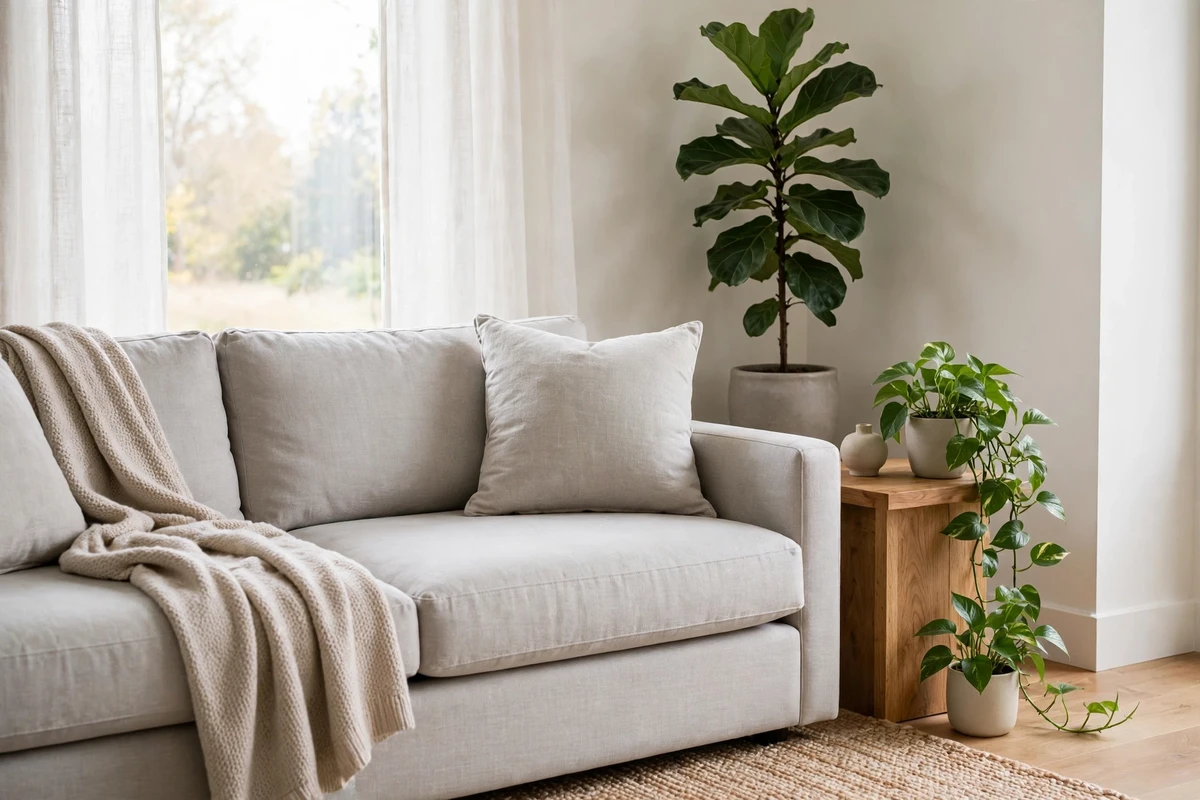
Plants are the quickest way to stop a neutral living room from feeling sterile. Green is nature’s neutral — it works with every sofa tone and adds life, shape, and a sense of movement that no textile can.
You do not need a jungle. One or two thoughtfully placed plants beat a dozen scattered ones. A tall plant — a fiddle-leaf fig, olive tree, or bird of paradise — in the corner beside the sofa adds height and draws the eye upward, balancing the sofa’s horizontal mass. A smaller plant, like a pothos or snake plant, on the side table or a nearby shelf brings greenery down to seating level.
Choose planters that support the palette: matte ceramic, woven seagrass baskets, or simple terracotta. If natural light is limited or maintenance is not realistic, high-quality faux greenery delivers a similar visual effect — just dust it occasionally so it keeps looking convincing.
Bonus: Style with dried botanicals for zero upkeep
Dried pampas grass, preserved eucalyptus, or bleached ruscus give you the organic shape of greenery with no light or watering needs at all. Their muted, wheat-toned palette is made for neutral sofas — they add height and texture without introducing a color you have to coordinate. One tall arrangement in a floor vase beside the sofa does the whole job.
8. Layer Lighting Around the Sofa
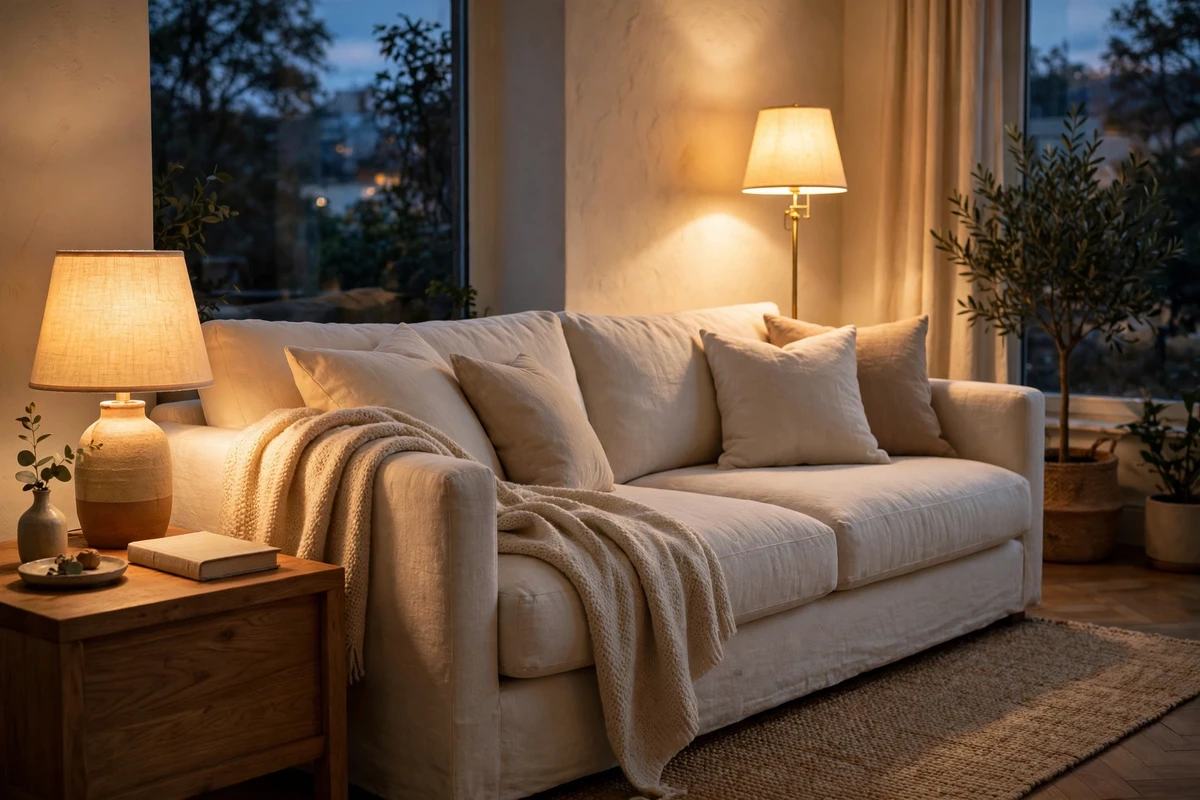
A neutral sofa styled in flat overhead light will always look a little lifeless. Layered lighting — ambient, task, and accent working together — is what makes the textures you have built actually visible in the evening.
Build three layers
- Ambient: The room’s base layer, from a ceiling fixture or recessed lights on a dimmer. Keep it warm (2700K) so neutral fabrics read as cozy rather than clinical.
- Task: A slim floor lamp behind one end of the sofa creates a reading corner and adds vertical height. Alternatively, a table lamp on the side table gives a softer, more intimate pool of light.
- Accent: A small picture light over the artwork behind the sofa, or a candle cluster on the coffee table, adds the final glow that makes the arrangement feel finished after dark.
Place lighting asymmetrically — a floor lamp on one side, a plant on the other — for a relaxed, lived-in balance. In open-plan spaces, a pendant or arc lamp over the sofa zone also helps define the seating area as its own room — useful when decorating a studio apartment where zones must be created, not just furnished.
9. Use the 60-30-10 Color Rule
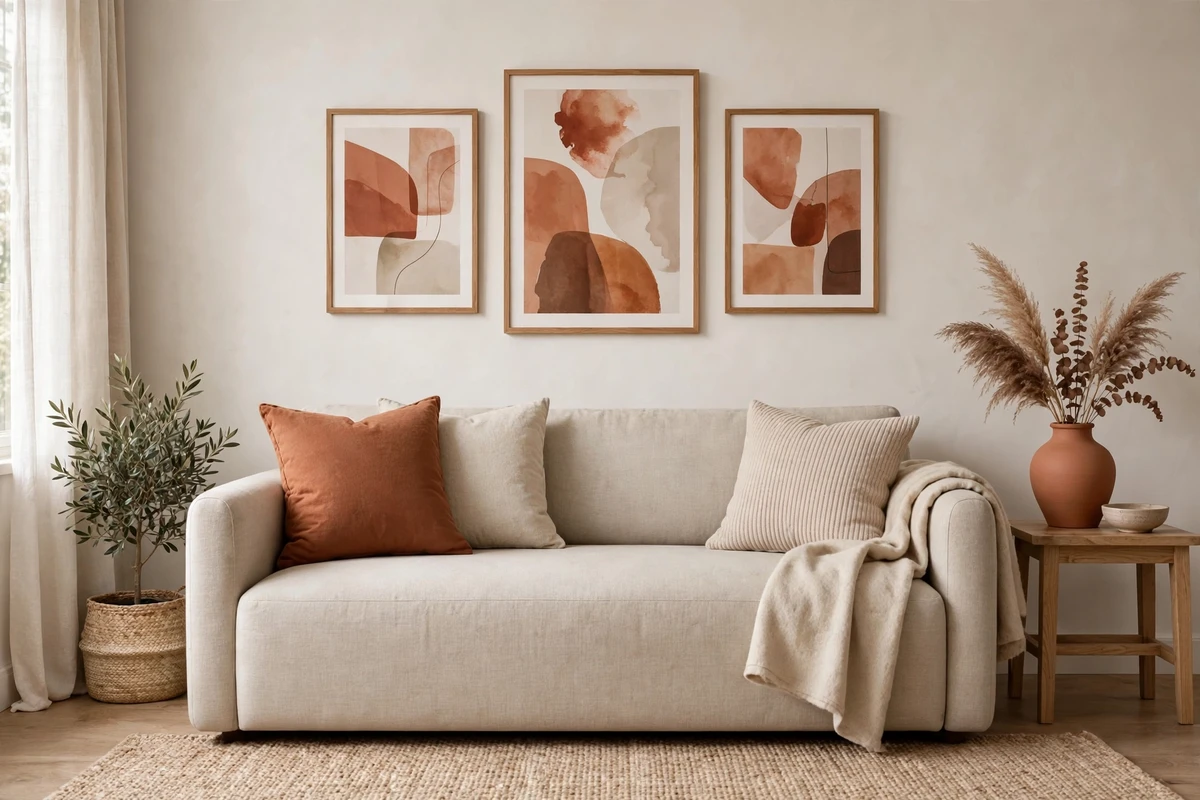
When a neutral room feels “off” but you cannot say why, the color balance is usually the culprit. The 60-30-10 rule — a principle taught by professional designers and design organizations like the American Society of Interior Designers — gives you a simple framework.
Sixty percent of the room’s color comes from large surfaces: walls, flooring, and the sofa itself. Thirty percent comes from mid-size pieces: the rug, curtains, and accent furniture. The final ten percent is your accent color — cushions, throws, vases, artwork.
On a neutral sofa, that ten percent does almost all the emotional work. A single terracotta cushion on a cream sofa shifts the entire mood of the room; a mustard throw over an oatmeal sofa introduces a season’s worth of warmth. The key is consistency: repeat your accent color at least twice more in the room — in the art, a vase, or the rug — so it reads as intentional rather than accidental. One bold pop is a statement; two is a conversation; three is a considered scheme.
10. Refresh Seasonally Without Redeccorating
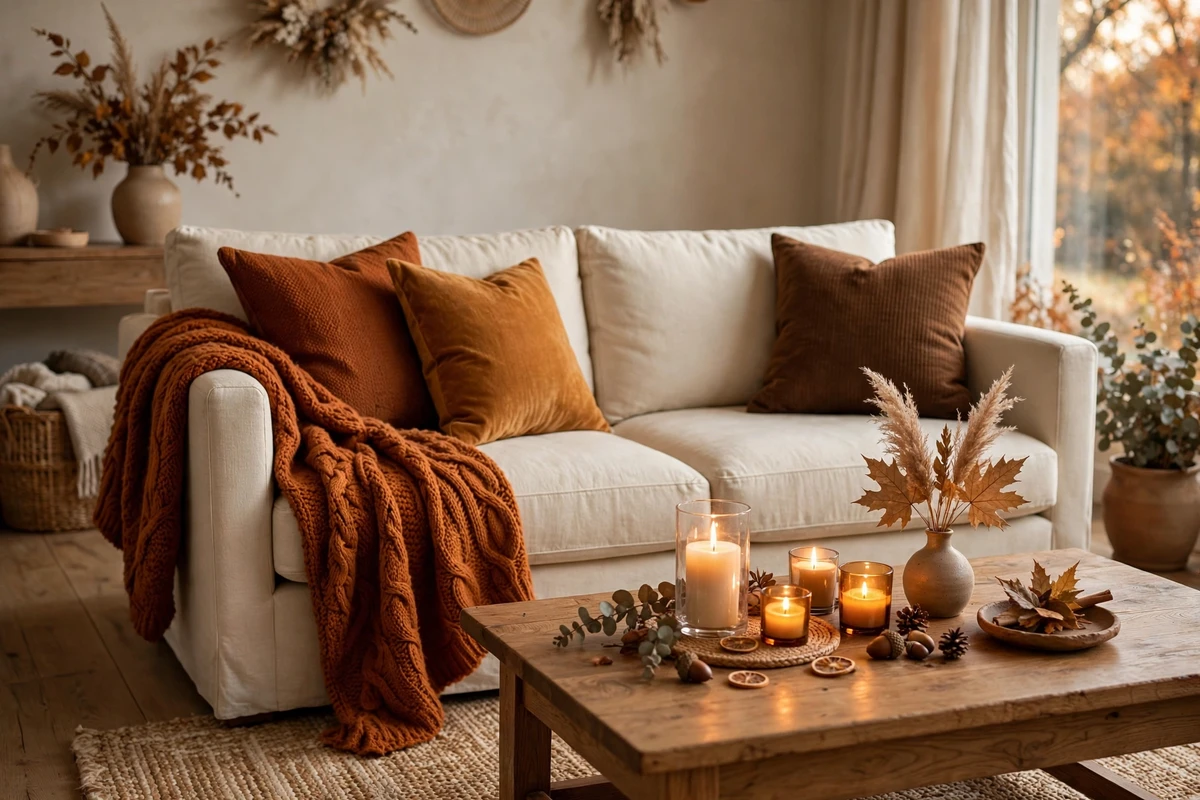
One of the strongest arguments for a neutral sofa is that it costs almost nothing to update across the year. The sofa stays; only the accessories change.
- Spring: Sage, dusty terracotta, and pale blue cushions with botanical prints; swap in a lighter cotton throw.
- Summer: Brighter accents, breathable linen, and fresh-cut flowers in a simple vase on the coffee table.
- Autumn: Rust, amber, and deep brown; bring out the chunky knit throw and a heavier wool rug layer.
- Winter: Deep teal or indigo cushions, a heavyweight wool throw, and warm candlelight for long evenings.
A pair of cushion covers and a seasonal throw is genuinely all it takes — no new furniture required. While you are swapping, take the opportunity to vacuum the upholstery and rotate the cushions so wear distributes evenly; a neutral sofa shows its age in flattened cushions long before the fabric gives out.
Frequently Asked Questions About Neutral Sofa Styling
What colors go best with a beige sofa?
Beige is the most forgiving neutral base. It pairs beautifully with warm whites, camel, and taupe for a tone-on-tone look, and with deeper accents like forest green, navy, terracotta, and rust when you want contrast. Metallics like brushed brass also warm it up nicely without adding color.
How many throw pillows should I put on a neutral sofa?
For a standard three-seater, three to five pillows is the sweet spot; two to three works for a loveseat. Use odd numbers and vary the sizes — larger squares at the back, smaller ones in front, and one lumbar pillow centered. Fewer, well-chosen pillows always look better than a crowded row.
How do I stop a neutral sofa from looking boring?
Layer contrasting textures — velvet against linen, boucle beside cotton — because texture creates depth without color. Add one accent color repeated in at least three places, ground the sofa with a rug, and style the wall behind it. A flat neutral sofa usually just needs layers, not louder colors.
What size rug should go under a neutral sofa?
Choose a rug large enough for at least the sofa’s front legs to rest on it; in bigger rooms, all four legs on the rug looks most considered. As a starting point, an 8×10-foot rug suits most three-seater arrangements, while a 5×8 works for loveseats and compact seating areas.
Can I mix patterns with a neutral sofa?
Yes — a neutral sofa is the ideal base for pattern mixing. Keep patterns in the same color family and vary the scale: one large-scale print, one medium geometric, and one small texture or stripe. Limit the mix to two or three patterns so the calm, cohesive feeling stays intact.
What throw colors work with a gray sofa?
Gray’s cool undertone responds best to warm accents. Terracotta, rust, burnt orange, deep mustard, and warm blush all add life without clashing. Rich tones like navy, burgundy, and forest green add depth. Finish with a neutral throw in beige or warm cream to keep the palette grounded.
How do I style a neutral sofa in a small living room?
Keep the palette light to reflect natural light, choose a slim-profile sofa with raised legs, and avoid oversized cushions that eat seating space. Use a mirror to double the sense of space, size the rug so the front legs sit on it, and pick one accent chair rather than two. Every piece should earn its footprint.
How often should I rotate and fluff sofa cushions?
Fluff and rotate seat and back cushions weekly, and flip reversible cushions monthly so wear distributes evenly. Feather-filled cushions need the most attention; foam holds shape longer. This simple habit keeps a neutral sofa looking structured for years, since flattened cushions age a sofa faster than fabric wear.
How do I clean and maintain a neutral sofa?
Vacuum weekly with an upholstery attachment, blot spills immediately instead of rubbing, and always check the manufacturer’s cleaning code before using any product. For fabric-specific guidance, follow a maker’s upholstery care guide — the right method depends on whether your sofa’s fabric is linen, velvet, or a performance blend.
Should my curtains match my neutral sofa?
They should coordinate, not match. Curtains in a tone a shade lighter or darker than the sofa keep the room cohesive, while an exact match can look flat. If your curtains carry a subtle pattern or texture, keep the sofa pillows simpler to maintain balance across the room.
Conclusion
A neutral sofa is not a compromise — it is the most flexible decision you can make for your living room. Once the layers are in place — textured pillows, a deliberate throw, a grounding rug, one contrasting chair, styled walls, warm wood, greenery, and layered light — the sofa stops being background and becomes the calm anchor the whole room is built around.
The real advantage is longevity. Trends will cycle, but a well-styled neutral sofa absorbs each one with nothing more than a cushion swap. For more ideas on building rooms that age gracefully, explore these designer-approved features of a timeless living room, and revisit this guide each season when you refresh your accessories.


Pingback: 10 Summer Living Room Refresh Ideas for a Lighter, Brighter Space
Pingback: 10 Year-Round Neutral Base Ideas for Effortless Seasonal Decor
Pingback: Winter Cozy Textiles Ideas: The Three-Layer System
Pingback: Autumn Color Palette Ideas: Five Palettes & Named Paints
Pingback: Subtle Halloween Living Room Ideas: 10 Elegant, Never Cheesy
Pingback: Neutral Sofa Measurements: Pillow, Rug and Art Dimensions